There is a very uncomfortable sentence many SaaS founders need to hear in 2026: your product may not be a company. It may be a step in someone else’s prompt.
That is the brutal little monster hiding inside AI Compression SaaS. AI is not just making software faster. It is collapsing workflows. The old stack looked like this: open one tool, copy data, paste it somewhere else, check another dashboard, ask a teammate, export a CSV, write a summary, schedule a task, send a report, then pretend this was “productivity.” Very sophisticated. Also, slightly ridiculous.
For years, mid-market SaaS thrived on best-of-breed fragmentation. Every workflow had a specialist tool. Every specialist tool had seats, onboarding, permissions, integrations, renewal calls, and a pricing page that somehow required a demo. But AI is now asking a nastier question: why should an 8-person agency operate 14 tools when three AI-connected systems can produce the same output with less admin pain?
The SaaS Stack Autopsy: How 14 Tools Shrink Into 3
Let’s take a fictional 8-person agency called BrightFork. It is not a massive enterprise. It is not a chaotic startup in a garage. It is exactly the kind of mid-market customer that has kept modern SaaS companies alive: small enough to move quickly, large enough to pay for tools, busy enough to tolerate waste.
Before AI compression, BrightFork runs a normal modern agency stack:
| Workflow Area | Old Stack Example | Monthly Cost Estimate |
|---|---|---|
| Project Management | 1 tool | $120 |
| CRM | 1 tool | $200 |
| Team Chat | 1 tool | $80 |
| Meeting Notes | 1 tool | $120 |
| Writing And Content | 2 tools | $300 |
| Design | 1 tool | $120 |
| SEO Research | 1 tool | $150 |
| Analytics Reporting | 1 tool | $150 |
| Email Marketing | 1 tool | $100 |
| Automation | 1 tool | $100 |
| Customer Support | 1 tool | $160 |
| Proposal And Docs | 1 tool | $80 |
| Social Scheduling | 1 tool | $100 |
| Dashboarding | 1 tool | $120 |
| Total | 14 Tools | About $1,900/Month |
Now the founder looks at that stack and sees a familiar SaaS horror show: 14 logins, 14 billing lines, 14 permission systems, 14 renewal risks, and at least three tools everyone forgot they were paying for. The agency is not buying outcomes. It is renting software furniture.
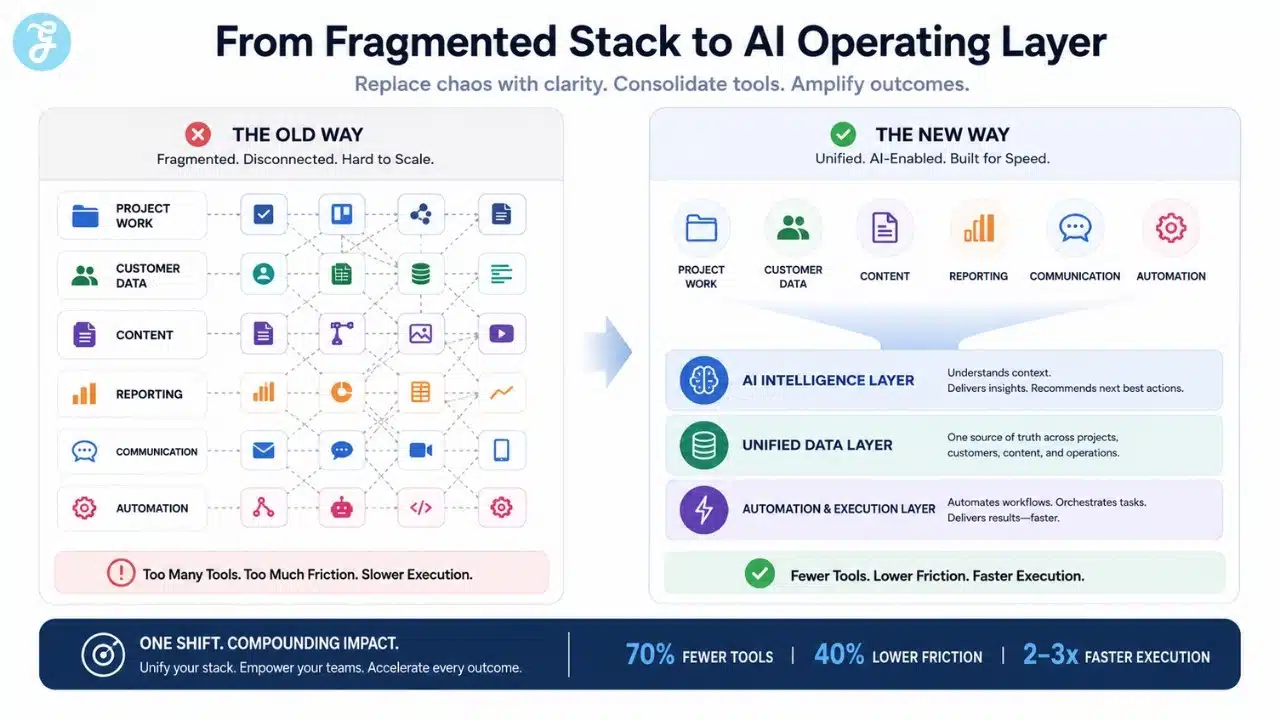
Old SaaS Stack Vs AI-Compressed Workflow Stack
Then AI compression arrives.
BrightFork does not remove software completely. That would be fantasy. Instead, it compresses the stack into three main layers:
| Compressed Layer | What It Replaces | Monthly Cost Estimate |
|---|---|---|
| AI Workspace And Agent Layer | Writing, notes, research, summaries, task creation, reporting drafts | $240 |
| Core System Of Record | CRM, projects, client records, tasks, documents | $350 |
| Creative And Publishing Layer | Design, content assets, social, email, lightweight automation | $300 |
| Total | 3 Core Systems | About $890/Month |
The subscription savings alone are about $1,010 per month, or $12,120 per year. Nice, but that is not the scary part.
The scarier part is operational compression. The agency also saves time on switching between tools, training employees on separate interfaces, rebuilding the same client context repeatedly, manually transferring data, cleaning reports, chasing updates, and running meetings just to understand what happened in other tools.
If each of the 8 employees saves only 3 hours per week through AI-driven workflow compression, that is 24 hours per week. At a blended internal cost of $50 per hour, BrightFork saves about $1,200 per week, or more than $60,000 per year in labor-equivalent time.
That is the real math. Not “AI replaced a $20 subscription.” More like: “AI made five tabs, two coordinators, and half a reporting workflow look embarrassingly optional.”
A company like ViewCord, for example, would need to think beyond being “one more platform in the stack.” In an AI-compressed market, the real question is whether the product owns a meaningful workflow, or whether an AI layer can quietly absorb its role.
Why Best-Of-Breed SaaS Is Weakening In The AI Era
Best-of-breed SaaS made sense when humans were the integration layer. Humans opened the CRM. Humans checked the analytics dashboard. Humans turned meeting notes into tasks. Humans copied campaign performance into slides. Humans translated chaos into a client update.
So the logic was simple: buy the best tool for each job, then force the team to stitch everything together with meetings, Slack messages, exports, and mild resentment.
AI weakens that logic.
If an AI layer can read across systems, write across systems, summarize across systems, and trigger actions across systems, the value shifts away from the individual tool interface. The user no longer wants to “use software.” The user wants the workflow finished.
That is why AI replacing tools is not always dramatic. It does not need to delete a SaaS category overnight. It only needs to make one tool less necessary, then another, then another. Death by compression. Very elegant. Very rude.
Why Mid-Market SaaS Companies Are Most Exposed To AI Replacing Tools
Enterprise SaaS has bureaucracy as a moat. Procurement cycles, compliance reviews, legacy integrations, security audits, and custom workflows slow everything down. Annoying? Yes. Protective? Also yes.
Tiny businesses, on the other hand, were never buying 30 SaaS tools anyway. They already used duct tape, spreadsheets, and vibes.
The mid-market is where the compression pain gets interesting. These companies bought best-of-breed stacks because they were too complex for spreadsheets but not large enough to justify custom enterprise systems. They are exactly the customers most likely to ask, “Why are we paying for seven separate workflow tools when an AI layer can produce the same operational result?”
This is where SaaS consolidation becomes dangerous. Consolidation is not just one platform acquiring another. It is the customer deciding that several tools no longer deserve separate budget lines.
And investors should pay attention. Some ARR may be more fragile than it looks. If a customer pays because a tool owns a workflow, that revenue is stronger. If a customer pays because the tool owns a tiny step between two other tools, that revenue is standing on a trapdoor.
Why Adding A Chatbot Is Not A Real AI SaaS Strategy
Let’s be honest. A lot of SaaS companies are responding to AI compression by adding a chatbot and calling it innovation.
Wonderful. Now the dashboard has a floating assistant that can explain why the dashboard still exists.
That is not enough.
Founders do not need a decorative AI widget. They need an AI agentic piece that can actually complete work, reduce tool-switching, and protect the product from being bypassed by broader AI platforms.
If the product remains the same old interface with a polite AI sticker on top, it does not solve the compression problem. Founders need to ask harder questions:
- Does the product complete work, or merely display work?
- Does it own unique data, or just repackage data from elsewhere?
- Does it sit inside a critical workflow, or beside it?
- Can AI agents bypass the interface?
- Can a broader platform absorb the feature?
- Would customers notice if the product disappeared, or would they simply ask another tool to do the job?
The next competitor may not be another SaaS dashboard. It may be a prompt that makes your dashboard unnecessary.
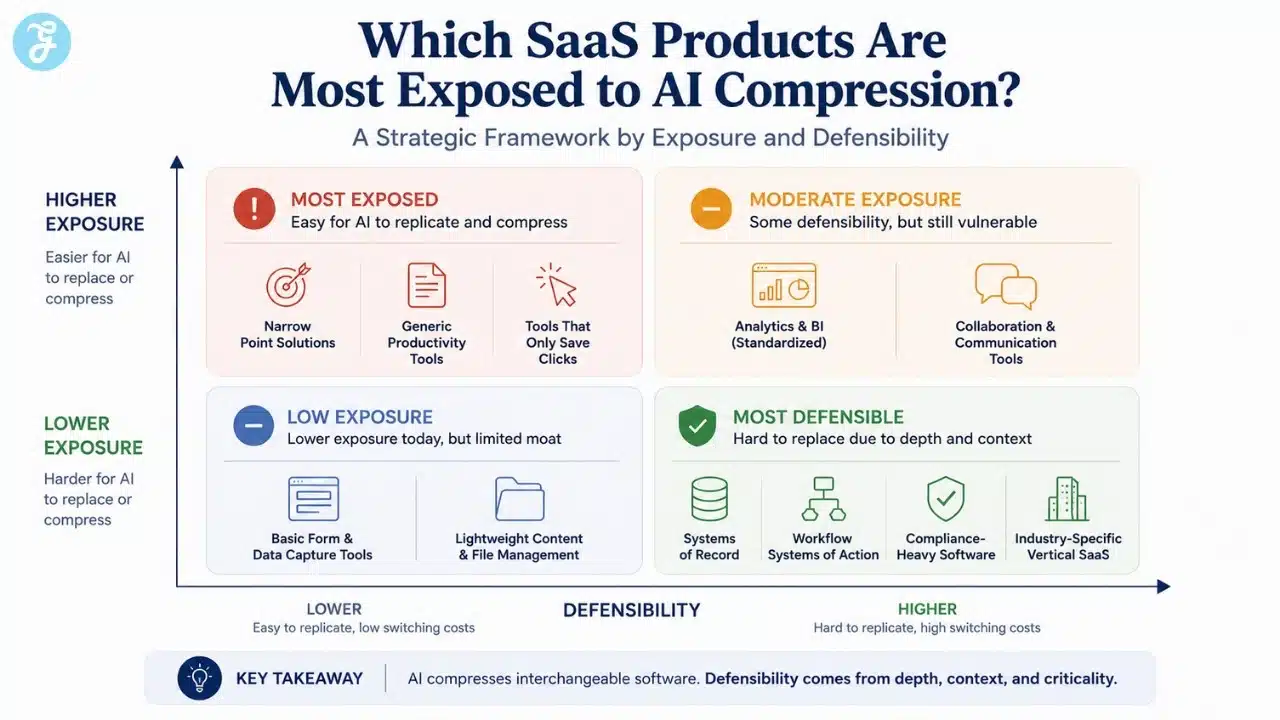
Why Vertical SaaS Is Safer But Not Untouchable
This is where vertical SaaS gets interesting. A vertical SaaS company that owns industry data, compliance requirements, workflows, distribution, and customer trust is much harder to compress. A dental clinic platform, legal practice system, construction management product, school administration tool, healthcare workflow system, or insurance operations platform can have deeper roots than a generic productivity app.
But vertical SaaS is not safe just because it has an industry label.
It is safer when it owns:
- the system of record;
- workflow-specific data;
- compliance logic;
- payment or transaction rails;
- customer communication history;
- domain-specific reporting;
- operational permissions;
- embedded distribution.
If it only offers a nicer interface for a generic workflow, AI can still compress it.
Old SaaS Logic Vs AI Compression SaaS Logic
Here is the simplest way to think about it.
| Old SaaS Logic | AI-Compressed Logic |
|---|---|
| Users open tools | Users ask for outcomes |
| Dashboards display information | Agents summarize and act |
| Each tool owns one workflow slice | AI crosses workflow boundaries |
| Integrations connect apps | Context connects decisions |
| Seats drive revenue | Usage, outcomes, and data depth drive value |
| Training teaches interfaces | AI reduces interface dependency |
| Best-of-breed wins through specialization | Platforms win by compressing workflows |
That does not mean every SaaS company dies. Calm down. But it does mean the weak middle gets squeezed.
Tools that only save clicks are in danger. Tools that own decisions are stronger.
How SaaS Founders Can Survive AI Compression
The survival plan is not “add AI.” That phrase has been abused enough and deserves a nap.
Founders should do five things.
First, move from tool to workflow.
If your product handles one isolated task, expand toward the full job-to-be-done. Customers do not want a better button. They want the work finished.
Second, own proprietary context.
The more your product understands the customer’s data, history, rules, constraints, and operating model, the harder it becomes to replace.
Third, become a system of action.
Systems of record store truth. Systems of action change reality. The safest SaaS companies will combine both.
Fourth, price around value, not seats.
Seat-based pricing becomes fragile when AI reduces human operators. If fewer people can do more work, pricing must evolve toward usage, outcomes, workflow volume, or business value.
Fifth, build AI into the workflow, not beside it.
An assistant who explains the product is cute. An agent that completes the workflow is defensible.
What SaaS Investors Should Watch Before The Next Renewal Cycle
Investors should stop asking only, “How sticky is the product?” and start asking, “What happens when AI compresses this workflow?”
Look closely at:
- gross retention by customer size;
- seat expansion assumptions;
- multi-tool overlap;
- feature depth versus workflow depth;
- data ownership;
- customer switching pain;
- AI roadmap credibility;
- pricing pressure from platforms;
- churn risk after tool consolidation;
- whether the product is a system of record or a workflow accessory.
A SaaS company can look healthy while sitting in the blast radius. ARR does not always reveal fragility until renewal season starts asking rude questions.
The Real Threat To SaaS Is Optional Software
Here is the uncomfortable truth: AI compression does not destroy valuable SaaS. It destroys optional SaaS.
If your product is deeply embedded, trusted, regulated, data-rich, and action-oriented, AI may strengthen it. If your product is a thin workflow layer with a nice UI and three integrations, AI may turn it into a memory.
That is why AI Compression SaaS should worry founders and investors. It changes the buying question from “Which tool should we use?” to “Do we need this category at all?”
The old SaaS world rewarded fragmentation because every team needed specialized interfaces. The new AI world rewards compression because every team wants fewer tools, fewer handoffs, fewer dashboards, and fewer excuses.
The winners will not be the companies shouting “AI-powered” the loudest. They will be the companies that own data, decisions, workflows, and outcomes. The losers will be the companies whose products only existed because humans had to click through the mess manually.
Founders do not need to panic. Panic is not a strategy, although it does pair nicely with bad board meetings. But they do need to ask the painful question now:
If your customer could replace five tools with one prompt, would yours survive the cut?