In a significant development that underscores growing espionage threats in the Middle East, Israeli authorities have arrested two citizens—a soldier and a civilian school teacher—on charges of spying for Iranian intelligence agencies. The arrests come amid heightened tensions following the brief but intense 12-day war between Israel and Iran in June 2025. Both individuals are accused of knowingly sharing sensitive visual information with agents linked to Iran.
Soldier Charged With Providing Missile Impact Visuals to Iran
On Thursday, the Israel Defense Forces (IDF) announced that a serving Israeli soldier had been formally indicted on charges of espionage after being caught transmitting videos and images related to Israeli missile defense operations.
According to the military indictment filed in a military court, the soldier handed over footage showing missile interceptions as well as photographs capturing missile impacts and blast zones on Israeli territory. The incidents in question occurred during the June conflict, when Iran launched waves of missile attacks at various Israeli targets, prompting an aggressive Israeli air defense response using Iron Dome and other missile interception systems.
Authorities stated that while the information the soldier shared did not fall under the category of top-secret military intelligence, it still held strategic value and was deliberately passed to foreign agents. Importantly, investigators from the IDF Military Intelligence Directorate, the Shin Bet (Israel Security Agency), and the Israel Police emphasized that the soldier did not access this information as part of his official army duties. Instead, he is believed to have obtained the footage through personal means, potentially from civilian sources or mobile recordings.
What makes this case particularly serious is that the soldier was fully aware that he was communicating with Iranian operatives. Despite this, he agreed to share the materials in exchange for financial compensation. The investigation has not disclosed the total amount of money exchanged but described it as part of a pattern where Iranian intelligence uses small monetary incentives to lure Israeli citizens into committing acts of espionage.
Bedouin School Teacher Arrested for Air Force Base Surveillance
In a parallel and equally alarming case, authorities earlier in the day disclosed the arrest of a 33-year-old Bedouin school teacher named Tahani Abu Samhan, who resides in the unrecognized Bedouin village of Abu Quwader in Israel’s southern Negev region.
Samhan is accused of spying on behalf of Iranian intelligence during the same June conflict. According to the Shin Bet, she covertly took photographs of Israeli Air Force jets stationed at the Nevatim Air Force Base, one of the most strategically important military facilities in Israel, located in the Negev Desert. The base has long served as a critical operational hub for Israeli air power and houses advanced aircraft, including F-35 fighter jets.
Authorities reported that Samhan did not act on a whim or out of ignorance. Instead, she had been in direct contact with Iranian intelligence officers for over a year and had completed a series of intelligence-gathering missions for them. Her involvement went far beyond casual contact—she was knowingly cooperating with operatives of a hostile foreign power and willingly executed tasks that jeopardized national security.
During the year-long engagement with Iranian handlers, Samhan allegedly sent images and reports related to military assets and infrastructure. The Shin Bet indicated that she demonstrated full awareness of the espionage nature of her activities and carried them out despite understanding the risks involved.
Escalating Trend: Dozens of Israelis Accused of Spying for Iran
With the arrest of these two individuals, the total number of Israeli citizens arrested or charged with espionage for Iran has now reached 35 within the past seven months. This figure, confirmed by Israeli intelligence and law enforcement agencies, represents a sharp spike in espionage activity linked to Iran and illustrates a pattern of covert recruitment efforts aimed at Israeli civilians and military personnel alike.
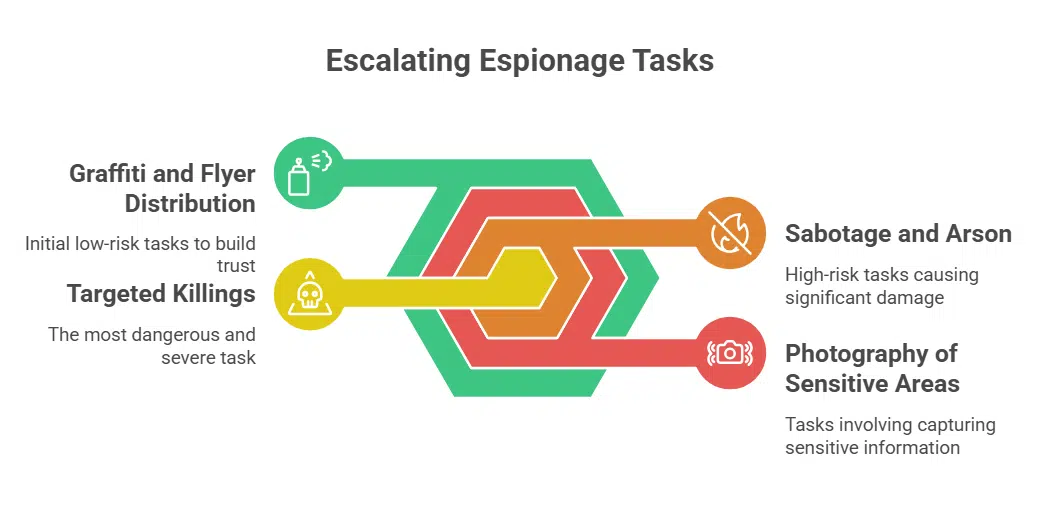
Over the past year, Iran has intensified its hybrid warfare strategy, which includes a significant emphasis on cyber operations, psychological operations, and espionage. One tactic involves targeting individuals through social media and encrypted messaging platforms, initially requesting benign or low-risk tasks to build trust before escalating to more serious espionage-related missions.
Israeli Police spokesperson Dean Elsdunne recently described how the recruitment process often begins subtly. Individuals might first be asked to spray graffiti containing coded messages or distribute flyers in certain neighborhoods. Over time, the demands become more dangerous, with operatives requesting that recruits take photographs of high-security zones, infrastructure hubs, shopping malls, or even private residences of prominent Israeli officials and military personnel.
The tasks can escalate further, according to security sources. In rare but severe cases, individuals recruited by Iranian agents have been instructed to start fires, carry out acts of sabotage, or even consider targeted killings.
Iran’s Expanding Intelligence Network Targets Israeli Society
Iran’s recruitment of Israeli citizens—both Arab and Jewish—has grown increasingly sophisticated. Analysts believe Tehran aims not just to gather intelligence but also to destabilize Israel from within by exploiting social, political, and economic fault lines.
By leveraging economic vulnerabilities and targeting communities on the periphery—like the unrecognized Bedouin villages in the Negev—Iranian operatives have found willing participants who may feel disconnected from mainstream Israeli society.
Security officials have pointed out that while some individuals cooperate for ideological reasons, many are enticed primarily by financial rewards. Iran has been particularly adept at offering relatively small payments in exchange for information that, while not always classified, still holds high value when pieced together with other intelligence.
National Response: Heightened Surveillance and Awareness
Following the latest arrests, the Israeli government and its security branches are stepping up both digital and physical surveillance to detect early signs of espionage activity. The Shin Bet has launched educational campaigns aimed at helping citizens recognize suspicious communications or recruitment attempts, especially those initiated via WhatsApp, Telegram, and other encrypted apps.
Military personnel are also being re-briefed on the importance of operational security and the dangers of sharing any kind of visual or textual information, even with family or friends, while on active duty.
As part of broader counterintelligence efforts, Israel is also working closely with international allies to track the movement and communications of Iranian operatives abroad. Collaborative efforts with Western intelligence agencies are helping to identify sleeper cells and foreign influence campaigns that extend beyond the Middle East.
The arrest of a soldier and a school teacher in Israel for allegedly spying for Iran paints a troubling picture of how foreign intelligence operations are increasingly infiltrating societies from within. These arrests not only highlight Iran’s aggressive intelligence-gathering strategies but also expose vulnerabilities within Israel’s civilian and military sectors.
With 35 espionage cases now linked to Iranian operatives within seven months, Israel faces a growing internal security threat that demands continued vigilance, tighter surveillance, and stronger public awareness. National security agencies continue to urge citizens to report any suspicious approaches—especially those involving requests for photos, videos, or seemingly harmless tasks offered with monetary incentives. The line between civilian life and national security is becoming increasingly blurred in today’s era of hybrid warfare.