The unfolding Iranian civilian crisis represents one of the most misunderstood geopolitical catastrophes of the modern era. While the world focuses on the spectacular military dimensions of Operation Epic Fury, a far more insidious devastation is taking root on the ground. The joint military campaign launched on February 28, 2026, successfully decapitated the upper echelons of the Islamic Republic. This culminated in the death of Supreme Leader Ali Khamenei and over fifty top officials in the first wave of strikes. The assumption that this military success will automatically translate into a democratic dawn for the Iranian people is a dangerous fallacy. Instead, the immediate aftermath has triggered a suffocating reality for ordinary citizens.
The nation is trapped between the crushing weight of massive external bombardment and the brutal internal consolidation of a wounded but surviving security apparatus. The continuous strikes from B-52 bombers and F-35 stealth fighters have decimated infrastructure. This leaves populations vulnerable and exposed. To understand the true cost of this conflict, we must look past the smoking craters of command centers and examine the systemic collapse of everyday life.
This deep dive will explore the multifaceted layers of this ongoing emergency. The intricate details of this unfolding disaster require a careful examination of both state mechanics and street-level realities to understand the broader implications.
Analyzing the 2026 Iranian civilian crisis
The international narrative requires immediate deconstruction to understand what is truly happening to the population.
The Front Stage of the Iranian Civilian Crisis
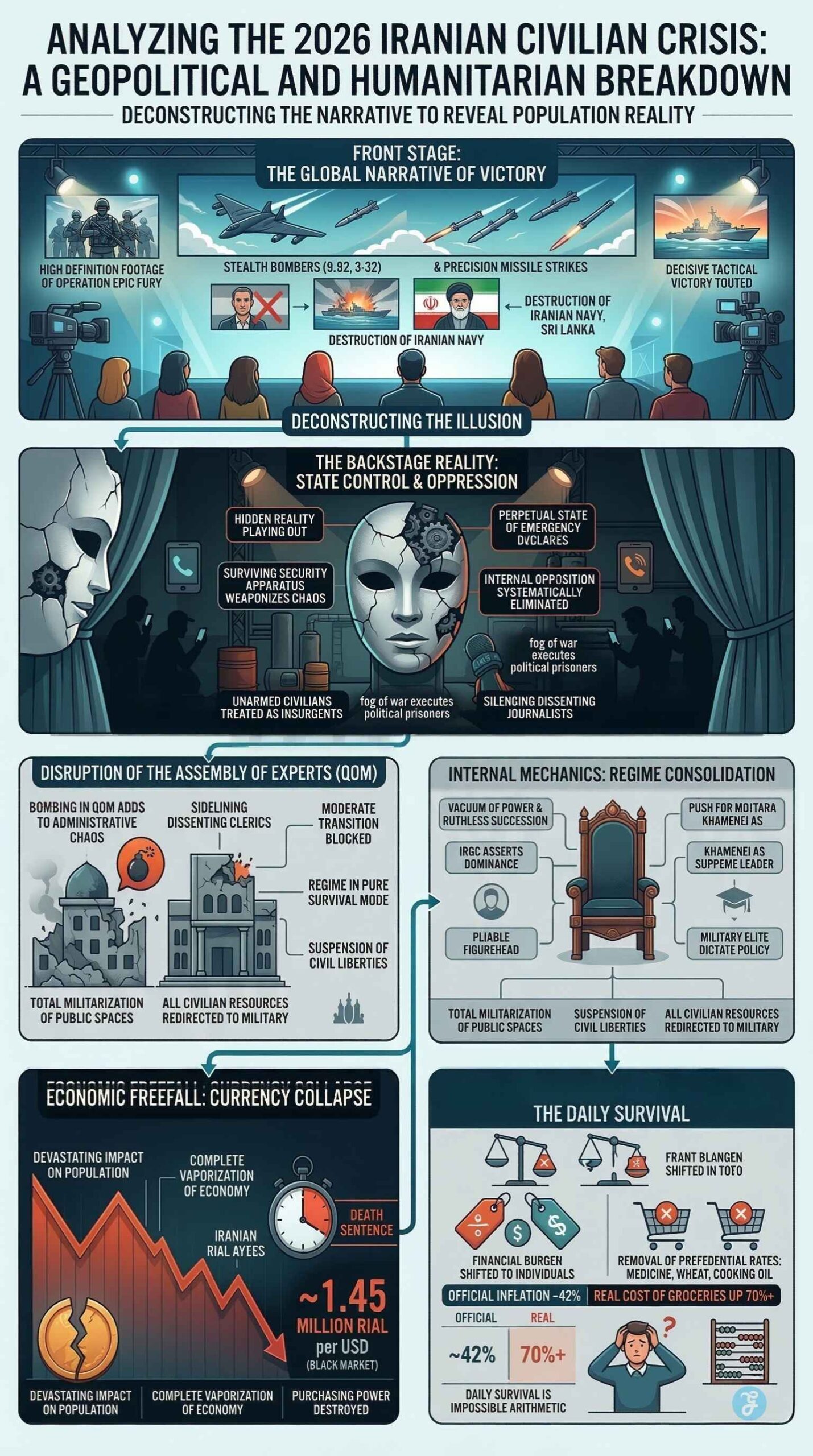
The global media landscape has been saturated with high-definition footage of stealth bombers and precision missile strikes since the onset of Operation Epic Fury. The narrative presented to the global public is one of decisive tactical victory. This is bolstered by the destruction of the Iranian Navy in the Gulf of Oman and off the coast of Sri Lanka. The obliteration of the Islamic Revolutionary Guard Corps command facilities and the assassination of Ali Khamenei are touted as the ultimate crippling blows to the regime.
However, this front-stage illusion obscures a terrifying reality playing out away from the cameras. This hidden reality involves the surviving state security apparatus weaponizing the chaos.
The Backstage Reality of State Control
The state security apparatus has not evaporated. In fact, it is consolidating its power. By declaring a perpetual state of emergency, the surviving elite are systematically eliminating internal opposition under the guise of national security and wartime necessity. The true victims of this power play are not the military commanders. They are the unarmed civilians who are now treated as potential insurgents.
The war has effectively handed the most radical elements of the regime a blank check to enforce total compliance. They utilize the fog of war to execute political prisoners and silence dissenting journalists. This terrifying dynamic sets the stage for a brutal internal power struggle at the highest levels of government.
The Internal Mechanics of Regime Consolidation
The vacuum created by the sudden death of the Supreme Leader has accelerated a ruthless game of succession. Behind the closed doors of Tehran, the Islamic Revolutionary Guard Corps is asserting unprecedented dominance over the civilian government and the newly formed Interim Leadership Council.
The push to install Mojtaba Khamenei as the new Supreme Leader is not merely a dynastic transition. It is a calculated move by the military elite to ensure a pliable figurehead remains at the top while they dictate absolute policy. This power grab is further complicated by physical attacks on key administrative institutions.
The Disruption of the Assembly of Experts
The recent bombing of the Assembly of Experts building in Qom only added to the internal paranoia and administrative chaos. This disruption allowed the security forces to sideline dissenting clerics who favored a more moderate transition or a leadership council format. The regime is currently operating in pure survival mode. They are utilizing the wartime environment to justify mass arrests, the suspension of civil liberties, and the total militarization of public spaces across all major cities.
The government is no longer pretending to serve the public interest. This is evidenced by the redirection of all civilian resources to the military effort. It is entirely focused on self-preservation at any cost. This relentless consolidation of political power is happening precisely as the nation’s financial foundations crumble.
The Economic Freefall and Hyperinflation
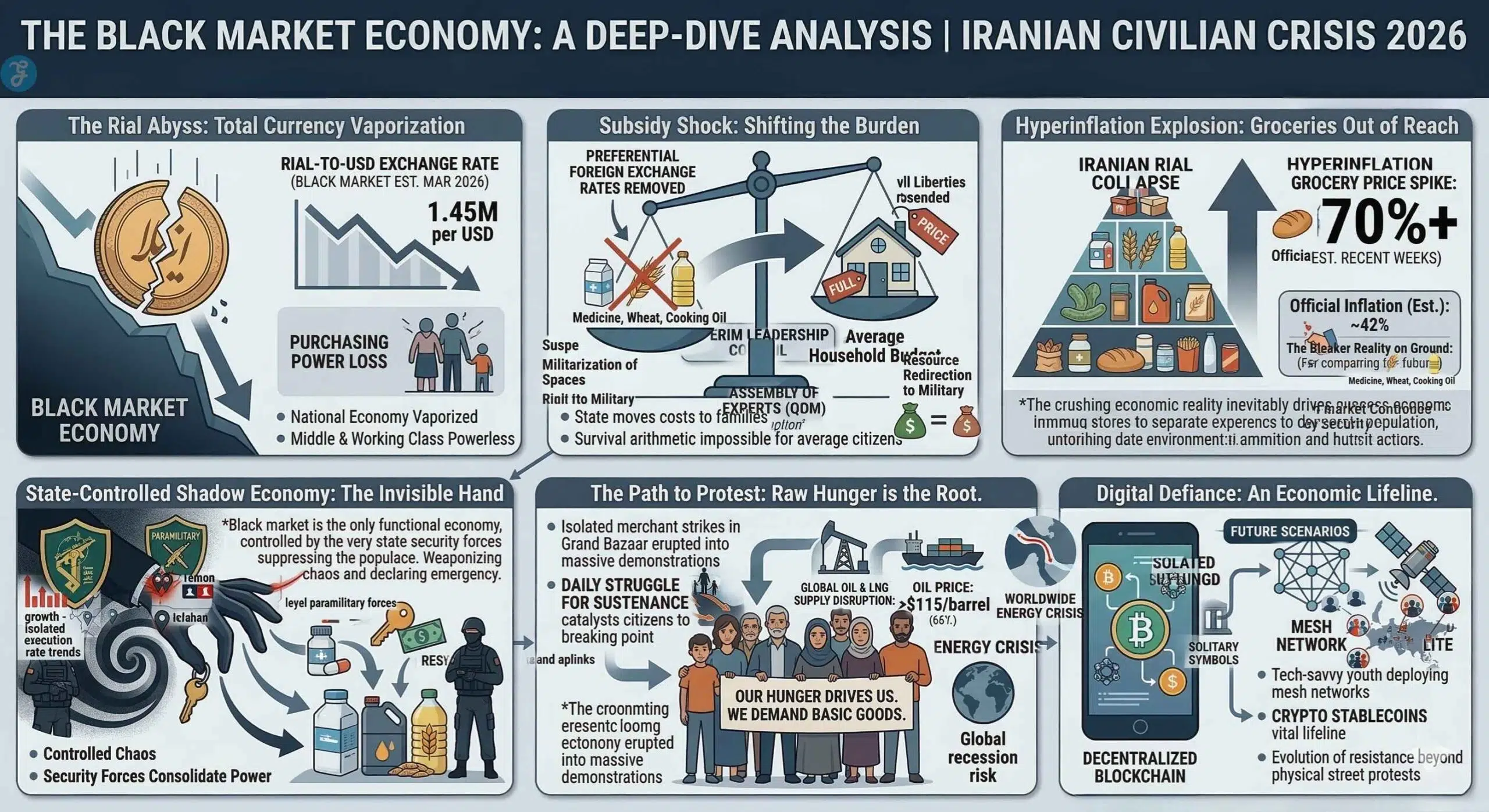
The most immediate and devastating impact on the population is the complete vaporization of the national economy. The Iranian rial has plummeted into an abyss, recently hitting a catastrophic low of 1.45 million per US dollar on the black market. This is not just a statistical anomaly.
It is a death sentence for the purchasing power of the working class and the shrinking middle class. The government’s response to this currency collapse has only worsened the situation for ordinary families.
The Removal of Essential Subsidies
The state’s decision to remove preferential foreign exchange rates for essential goods like medicine, wheat, and cooking oil has shifted the entire financial burden onto individual households. Official inflation figures hover around 42 percent, but the reality on the ground is far bleaker and much more volatile.
The cost of basic groceries has surged by over 70 percent in a matter of weeks. This makes daily survival an impossible arithmetic for the average family. The sheer scale of this economic destruction means that mere survival has become a full-time occupation for millions.
The Black Market Economy
The black market is now the only functional economy. It is controlled by the very same security forces suppressing the populace. This desperate financial environment is the primary catalyst driving citizens to the breaking point.
The resulting Iranian civilian crisis is fundamentally rooted in this daily struggle for basic goods. The crushing economic reality inevitably drove the desperate population into the streets to demand basic survival rights.
The Roots of the Nationwide Protests
The current wave of nationwide protests is not born of abstract ideological aspirations. It comes from raw, undeniable hunger and grief. What began as isolated merchant strikes in Tehran’s Grand Bazaar over currency devaluation has erupted into massive, decentralized demonstrations across all 31 provinces.
The people are demanding basic sustenance and the immediate cessation of hostilities that have brought war directly to their doorsteps. The tragedy of foreign strikes is compounding the anger directed at the state.
The Public Fury and Tragedy
The tragic strike on a primary school in Minab has only poured gasoline on the public’s fury toward both foreign intervention and domestic incompetence. The regime’s response to this anger has been predictably merciless.
With international eyes focused on the military theater, the domestic security forces have unleashed a campaign of terror against their own citizens. The tactics used to quell this unrest are unprecedented in their brutality.
The Brutal Suppression of Domestic Unrest
State execution rates have skyrocketed, serving as a gruesome deterrent to further political mobilization. Loyal paramilitary units are utilizing live ammunition against unarmed crowds, turning city squares in Isfahan and Shiraz into literal combat zones.
The civilian population possesses nothing but their numbers, while the state wields the full, unbridled power of a mechanized military force. Despite the physical violence and communication blocks, the populace is finding new ways to fight back against this oppression.
The Digital Underground and Decentralized Survival
The state has enforced total internet blackouts to mask its brutal crackdowns. However, the civilian population is not completely isolated. Tech-savvy youths and underground syndicates are actively deploying mesh networks and smuggled satellite uplinks to maintain communication with the outside world.
This technological resistance extends directly into the financial sector.
The Rise of Alternative Financial Tools
The collapse of the traditional banking system and the devaluation of the rial have forced citizens to adopt alternative financial tools. Decentralized ledgers and cryptocurrency stablecoins are now functioning as a vital lifeline for moving essential funds across heavily monitored borders. This digital defiance proves that the spirit of the resistance is evolving beyond physical street protests.
The government is struggling to police this invisible infrastructure. This reveals a critical vulnerability in its absolute control. This localized tragedy and internal friction are severely fracturing the nation’s borders and creating regional instability.
The Impending Border Crisis and Regional Spillover
The internal pressure of hyperinflation and violence is pushing millions toward the edges of the country. Neighboring nations like Turkey, Iraq, and Pakistan are bracing for an unprecedented influx of desperate refugees.
The existing humanitarian corridors are completely unequipped to handle millions of starving citizens fleeing the conflict zones. This massive population shift carries severe geopolitical risks for the entire area.
The Threat to Middle Eastern Stability
This mass exodus threatens to destabilize already fragile regional economies. It could ignite new sectarian conflicts along the borderlands. The international community is currently failing to pre-position adequate emergency relief or establish safe zones. This regional spillover will inevitably transform a localized state collapse into a generational demographic catastrophe across the Middle East.
The expanding Iranian civilian crisis now threatens to engulf neighboring nations entirely. The consequences of this massive population shift are directly tied to the broader macroeconomic impacts felt around the world.
The Global Shockwaves and The Cost of Inaction
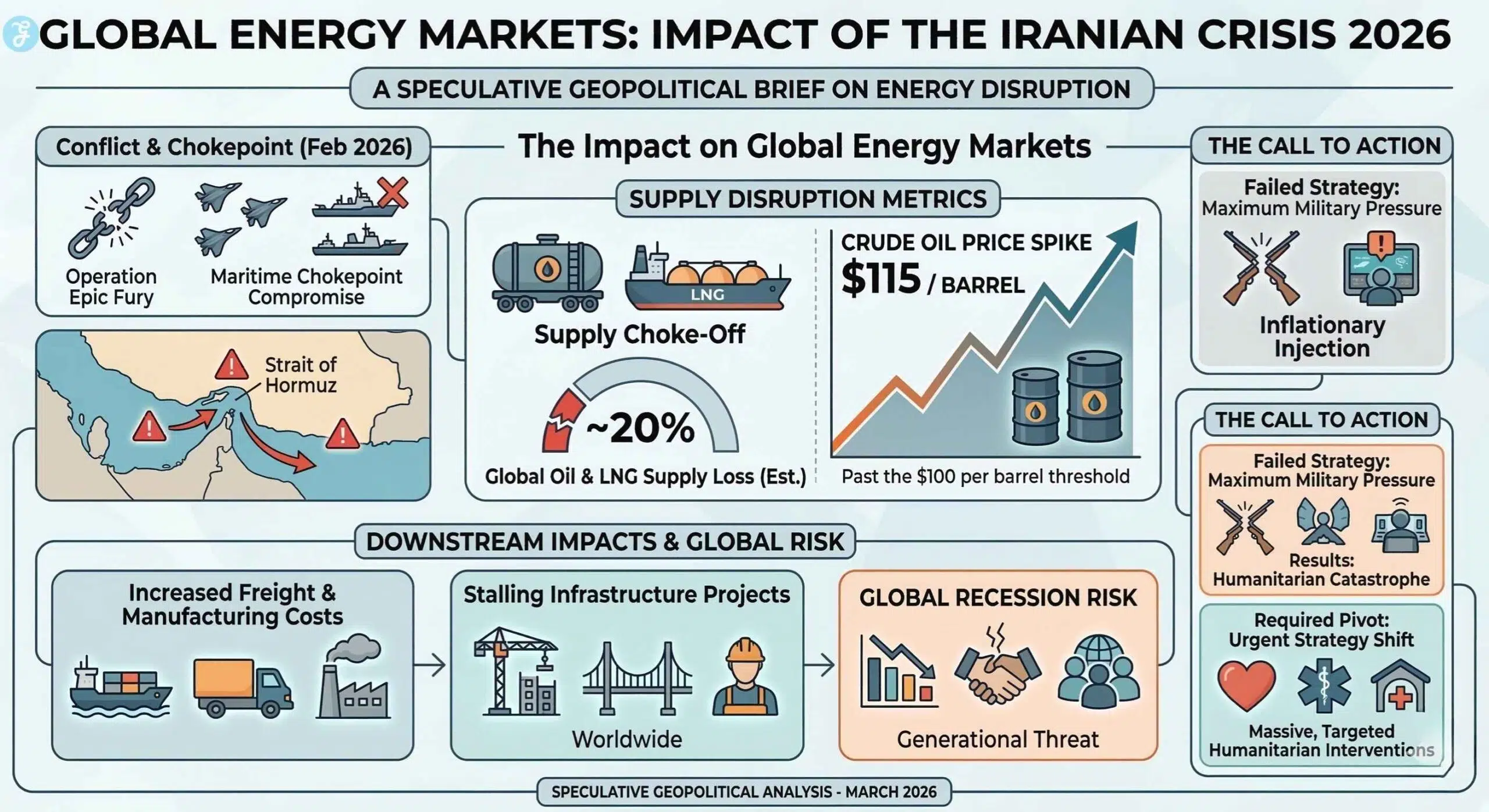
The implosion of the Iranian state is creating a vortex that threatens the stability of the global economy. The conflict has severely compromised the Strait of Hormuz, the world’s most critical energy transit chokepoint. The disruption of this maritime artery has choked off approximately twenty percent of the global oil and liquefied natural gas supply. This bottleneck at sea translates directly to financial pain across international markets.
The Impact on Global Energy Markets
This bottleneck has sent immediate shockwaves through international markets. It drove oil prices well past the $100 per barrel threshold. This energy crisis is a direct injection of inflation into the global economic bloodstream. The resulting spike in freight and manufacturing costs is stalling infrastructure projects from Europe to East Asia. The international community must recognize the true cost of allowing this disruption to continue.
Sector Breakdown: The Global Supply Chain Fracture
Energy Metrics: The sustained disruption has pushed crude oil prices firmly past the $115/barrel mark, injecting raw inflation directly into the global economy.
Transit Chokepoint: With the Strait of Hormuz compromised, the 20% cut to global oil and liquefied natural gas (LNG) supplies is compounding existing logistical backlogs.
Manufacturing Slowdown: Industrial output in heavily energy-reliant regions (specifically East Asia and Western Europe) has contracted by an estimated 14% in recent weeks.
Consumer Ripple Effect: The staggering increase in maritime insurance premiums and freight rerouting costs is trickling down to the retail level, spiking grocery and consumer goods prices worldwide.
The Worldwide Economic Consequences
The international community must recognize that allowing this situation to continue unchecked is a recipe for global recession. The cost of diplomatic inaction is being paid at gas pumps and grocery stores worldwide. Understanding these global stakes is crucial for anticipating the next phase of this protracted disaster. Looking ahead twelve to eighteen months, the prognosis for the region is deeply troubling.
The Over-The-Horizon Foresight
The continued pressure cooker of the domestic situation will likely lead to one of two outcomes. Either the state security apparatus will successfully crush all resistance and emerge as an isolated, hyper-militarized hermit kingdom, or the internal friction will ignite a chaotic, multi-factional civil war.
Neither scenario offers a pathway to stability or prosperity for the Iranian people. This grim reality exposes the critical flaw in the current international strategy.
The Failure of Maximum Military Pressure
The international strategy of maximum military pressure without a coherent political off-ramp has created a humanitarian catastrophe of historic proportions. The core lesson of Operation Epic Fury must be that dismantling a regime’s military hardware does not automatically dismantle its mechanisms of domestic terror.
The global powers must urgently pivot their focus from tactical military achievements to the implementation of massive, targeted humanitarian interventions. Failing to adjust this strategy guarantees a catastrophe that will haunt the globe for decades.
The Generational Impact of Inaction
If the world continues to ignore the plight of the populace, the resulting explosion of refugees and regional instability will reshape the Middle East for generations to come. This grim forecast demands immediate reflection and a fundamental shift in how the world responds to the ongoing emergency. The time for passive observation has ended, requiring a firm commitment to humanitarian support.
Finally: The Ultimate Cost of Conflict
The true measure of global leadership in 2026 will not be defined by the precision of our missiles, but by the depth of our compassion. The Iranian civilian crisis exposes a fatal flaw in modern geopolitical strategy. We have perfected the art of dismantling regimes while entirely neglecting the societies left in the rubble. If the international community continues to treat the Iranian people as acceptable collateral damage, we are merely trading one form of tyranny for another.
The time has come to look beyond the battlefield and the boardroom. We must extend a direct lifeline to the millions trapped in the crossfire. The future of the Middle East depends entirely on whether we choose to empower its people or abandon them to the ashes.