

The Iran-Israel Brinkmanship has entered a critical new phase in 2026, threatening to shatter the fragile stability of Global Energy Security. With Tehran cornered by economic collapse and military setbacks, the risk of asymmetric escalation in the Strait of Hormuz is at an all-time high. This analysis explores how a cornered regime could trigger the next global energy crisis.
Tehran has entered a critical phase of “regime survival mode,” driven by the unstable convergence of humiliating military defeats in June 2025 and a catastrophic currency collapse in January 2026, with the Rial plummeting to approximately 1.4 million against the dollar. This existential pressure has forced a strategic pivot away from degraded conventional defenses toward asymmetric leverage, specifically naval mining in the Strait of Hormuz and increased nuclear opacity. This shift is further necessitated by a widening technological disparity; the operational deployment of Israel’s Iron Beam laser defense system in late 2025 has effectively neutralized Iran’s traditional “saturation” missile strategy by fundamentally altering the cost-benefit analysis of aerial warfare. Consequently, the crisis has metastasized into a broader geopolitical standoff, triggering a US-China trade rift as Washington threatens secondary tariffs on Beijing for its continued purchase of over 80% of Iranian oil exports.
The fragile status quo in the Middle East has fractured. Following the “12-Day War” of June 2025, Tehran is now battling a dual crisis: a humiliating military setback abroad and a paralyzing economic collapse at home. For global markets, the risk has shifted from a direct missile exchange to a desperate, cornered regime leveraging global energy chokepoints for survival.
The Road to 2026: From Shadow War to Open Conflict
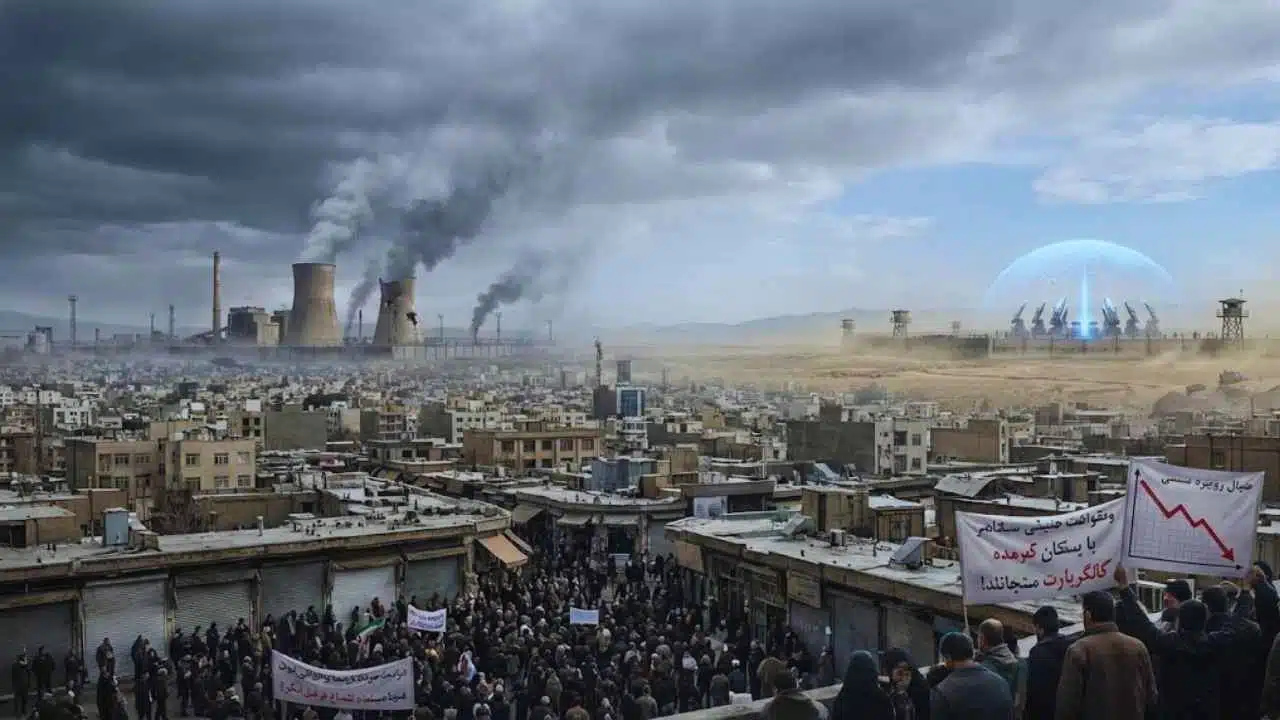
To understand the volatility of January 2026, one must contextualize the watershed events of the previous year. The long-standing “shadow war” erupted into open conflict in June 2025. Israel, utilizing targeted airstrikes, significantly degraded Iran’s integrated air defense network (IADS) and damaged key centrifuge assembly halls at Natanz.
While a ceasefire was brokered, it left Tehran’s deterrence doctrine in tatters. Now, six months later, the economic aftershocks are hitting. The Iranian Rial has plummeted to record lows, triggering nationwide strikes in the vital “Bazaari” merchant class. This internal weakness makes the external Iran-Israel brinkmanship even more dangerous, as the regime may calculate that foreign escalation is the only vehicle to unify a fracturing populace.
Asymmetric Warfare: The Weaponization of Global Trade
The dynamics of the conflict have fundamentally changed. Previously, Iran relied on its “Forward Defense” strategy—proxies in Lebanon and Syria—to project power. However, with Hezbollah’s missile inventory depleted and Hamas neutralized, Iran is pivoting to its last remaining advantage: geography.
The most immediate global threat is the Strait of Hormuz. In previous years, threats to close the strait were viewed as rhetorical bluffs. In 2026, the calculation is different. With its oil revenue strangulated by renewed US “Maximum Pressure” enforcement and its conventional military humiliated, Iran’s asymmetric naval capabilities are its primary leverage.
Recent intelligence reports of naval mine deployments near the Strait have reintroduced a “war risk premium” to shipping insurance. Unlike a missile strike, which invites immediate retaliation, naval mining offers a deniable, slow-strangulation of global energy supply chains.
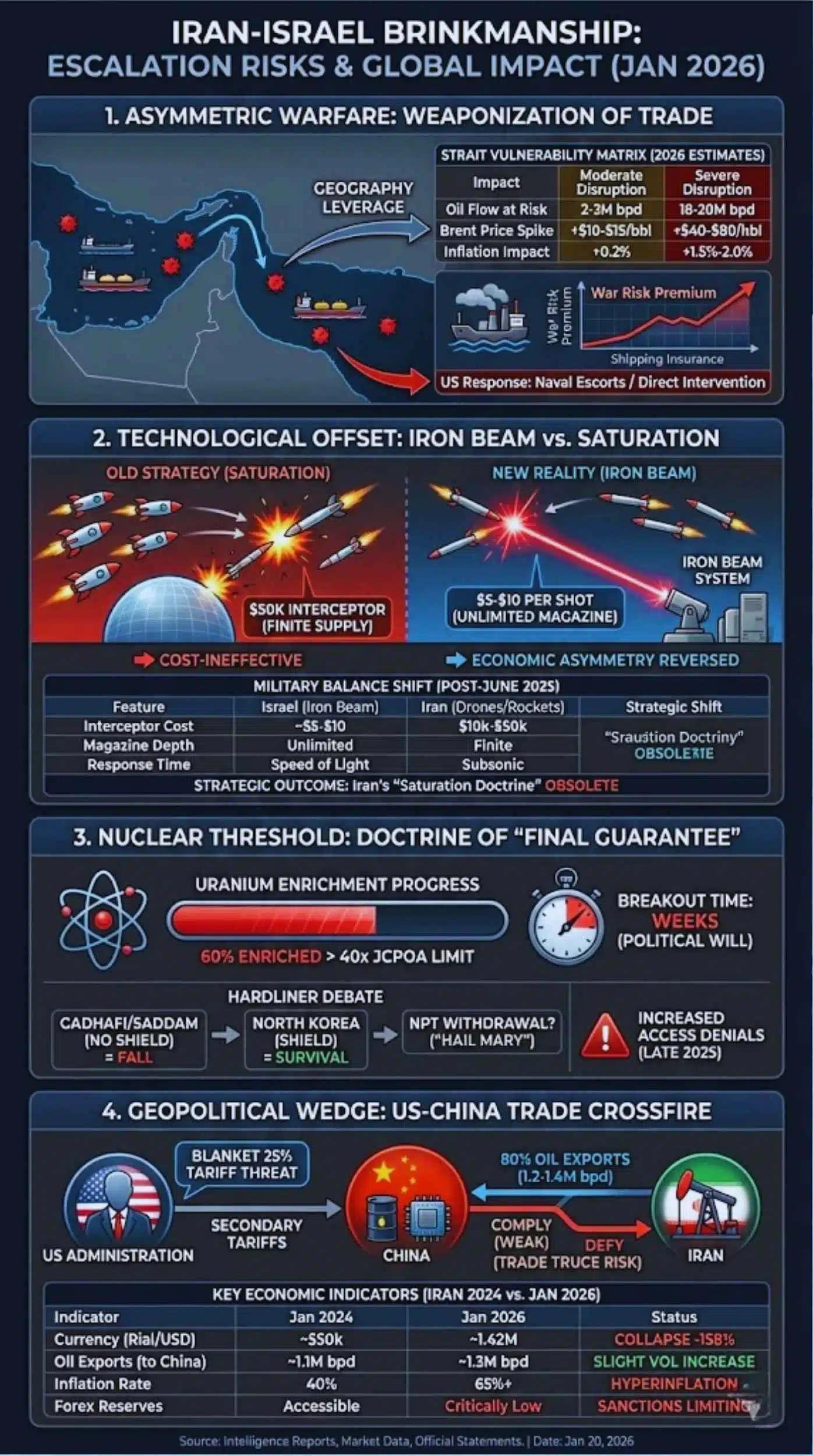
The Strait of Hormuz Vulnerability Matrix (2026 Estimates)
| Impact Category | Moderate Disruption (Harassment) | Severe Disruption (Mining/Blockade) |
| Daily Oil Flow at Risk | ~2-3 Million bpd | ~18-20 Million bpd |
| Brent Crude Price Spike | +$10 – $15 / barrel | +$40 – $80 / barrel |
| Global Inflation Impact | +0.2% | +1.5% – 2.0% |
| Primary Victim | Regional Shipping Insurers | China, India, Japan (Importers) |
| US Response | Naval Escorts (Operation Sentinel) | Direct Military Intervention |
The Technological Offset: Iron Beam vs. Saturation Strikes
A critical, often underreported factor in the current standoff is the technological leap taken by the IDF in late 2025. The operational deployment of the Iron Beam laser defense system has drastically reduced the efficacy of Iran’s saturation tactics.
For over a decade, Iran’s strategy relied on overwhelming Israel’s Iron Dome with cheap rockets, forcing a cost-ineffective exchange ratio (a $50,000 Tamir interceptor vs. a $800 rocket). Iron Beam changes this equation entirely. With a “cost per shot” of roughly $5-$10 and a “bottomless magazine,” Israel can now neutralize drone swarms and rocket barrages at negligible cost. This forces Tehran to rethink its offensive options, potentially pushing it toward more extreme measures—such as hypersonic missiles or nuclear blackmail—to restore deterrence.
Military Balance & Cost Analysis (Post-June 2025)
| Feature | Israel (Iron Dome + Iron Beam) | Iran (Drone Swarms/Rockets) | Strategic Shift |
| Interceptor Cost | ~$5 – $10 (Laser) | $10k – $50k (Production) | Israel Advantage: Economic asymmetry reversed. |
| Magazine Depth | Unlimited (Power dependent) | Finite (Supply chain limits) | Iran can no longer “exhaust” Israeli defenses. |
| Response Time | Speed of Light | Subsonic / Supersonic | Reduced warning time for interception. |
| Strategic Outcome | High-Volume Defense | Low-Yield Offense | Iran’s “Saturation Doctrine” is now obsolete. |
The Nuclear Threshold: Doctrine of the “Final Guarantee”
Perhaps the most alarming trend is the internal debate within Tehran regarding its nuclear doctrine. The June 2025 strikes set the program back technically but accelerated it politically. Hardliners argue that Gadhafi and Saddam Hussein fell because they lacked a nuclear shield, whereas North Korea survives because it has one.
The “breakout time” discussion is no longer just about technical capacity; it is about political will. International inspectors have faced increasing access denials since late 2025. With uranium stockpiles enriched to 60% now exceeding 40 times the JCPOA limits, a “dash” to 90% weapon-grade material could ostensibly happen in weeks, not months. If Tehran concludes that the US administration is actively pursuing regime collapse via economic warfare, the decision to withdraw from the NPT (Non-Proliferation Treaty) becomes a plausible “Hail Mary.”
The Geopolitical Wedge: US-China Trade Crossfire
The conflict has metastasized beyond the Middle East, becoming a wedge issue in Great Power competition. China remains the primary purchaser of Iranian oil, taking over 80% of exports (approx. 1.2M – 1.4M bpd) in defiance of sanctions. This trade effectively bankrolls the regime’s survival.
In January 2026, the US administration threatened a blanket 25% tariff on nations continuing to facilitate Iranian oil trade. This puts Beijing in a bind: comply and look weak, or defy Washington and risk upending the fragile trade truce. For global markets, this introduces a layer of volatility that extends far beyond oil prices, threatening supply chains in technology and semiconductor manufacturing.
Key Economic Indicators (Iran 2024 vs. Jan 2026)
| Indicator | Jan 2024 | Jan 2026 (Current) | % Change / Status |
| Currency (Rial/USD) | ~550,000 | ~1,420,000 | -158% (Collapse) |
| Oil Exports (to China) | ~1.1M bpd | ~1.3M bpd | Slight Increase (Volume) / Decr. (Value) |
| Inflation Rate | 40% | 65%+ | Hyperinflation territory |
| Forex Reserves | Accessible | Critically Low | Sanctions limiting access |
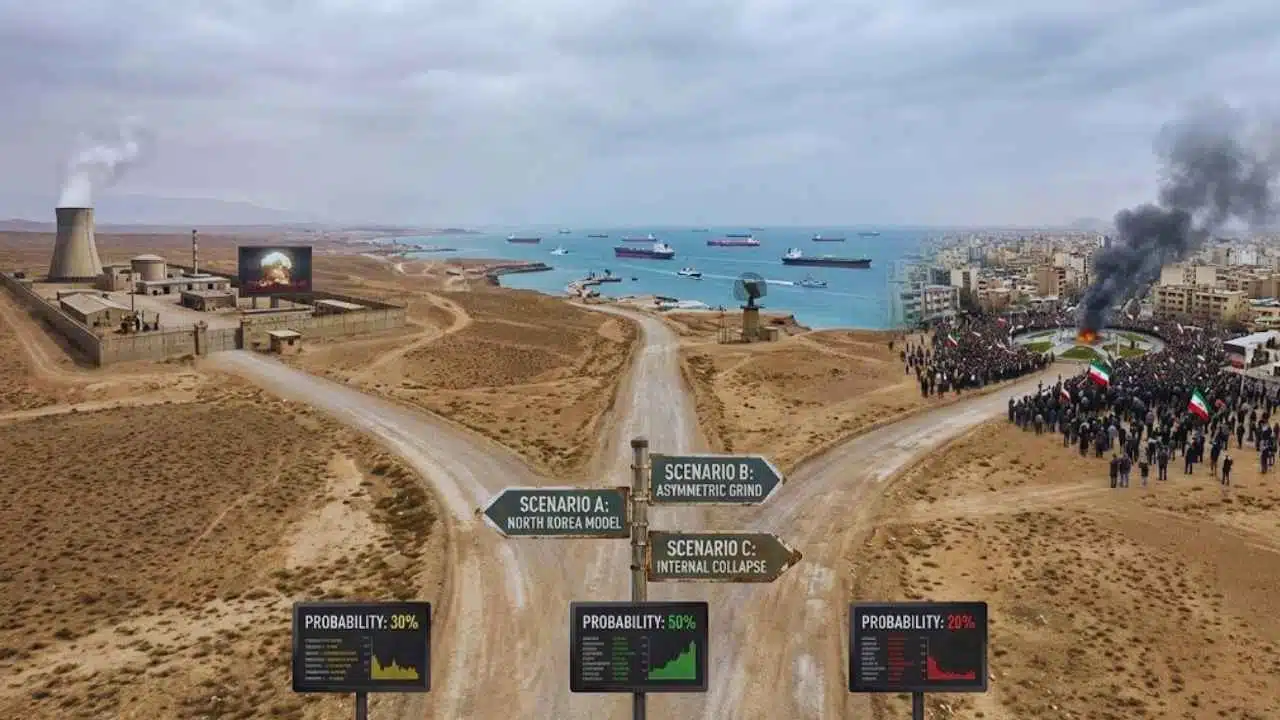
Horizon 2026: Three Scenarios for the Next Six Months
History suggests that authoritarian regimes are most dangerous when they fear internal collapse. The protests rocking Isfahan and Mashhad are not just about the price of poultry; they are about the legitimacy of the system.
- Scenario A: The North Korea Model (Probability: 30%)
Tehran expels all IAEA inspectors and conducts a nuclear test to cement regime survival.- Result: Total isolation, potential US/Israel preventive war, oil spikes to $150+.
- Scenario B: The Asymmetric Grind (Probability: 50%)
Continued harassment of shipping in Hormuz and cyberattacks on Gulf states to force a negotiation.- Result: Oil hovers at $85-$95, insurance premiums soar, global trade slows.
- Scenario C: Internal Collapse (Probability: 20%)
The security forces fracture under the pressure of protests; a military junta or chaotic power vacuum emerges.- Result: Unpredictable volatility, potential civil war, temporary cessation of oil exports.
Expert Perspectives
The Strategic Hawk
“The regime is terminally ill. The operational success of Iron Beam has removed their primary conventional threat against Israel. The West must not throw them a lifeline. Maximum pressure now will either force a collapse or a complete capitulation.”
— Dr. Michael Orenstein, Senior Fellow, Institute for National Security Studies (INSS)
The Diplomatic Realist
“We are sleepwalking into a catastrophe. A cornered Iran has no incentive to show restraint. If the US pushes too hard on the secondary tariffs against China, we risk merging the Middle East crisis with a Pacific trade war. We need a diplomatic off-ramp, not more economic strangulation.”
— Sarah Vakil, Director of Middle East Programs, Chatham House
The Market Analyst
“Traders are complacent. The market has priced in the ‘status quo’ of tension, but it hasn’t priced in a naval mining event. The disconnect between the geopolitical risk and the current Brent price ($74) is the widest we’ve seen since 2019.”
— Commodities Desk Forecast, Goldman Sachs (Jan 2026)
Future Outlook: What Comes Next?
As we move deeper into 2026, the Iran-Israel brinkmanship will pivot from the skies to the seas and the spreadsheets.
- Watch the Water: The months of February and March will be critical. If the Rial does not stabilize, expect the IRGC to conduct provocative “naval exercises” in the Strait of Hormuz.
- The IAEA Deadline: The Board of Governors meeting in March 2026 will be the deciding moment. If Iran follows through on threats to withdraw from the NPT, the window for a diplomatic solution closes permanently.
- The China Factor: Will Beijing absorb the US tariff hit to keep Iranian oil flowing? Or will they cut Tehran loose? The answer will likely decide the fate of the Iranian economy.
Final Thoughts
The “simmering pot” of the Middle East has been welded shut by sanctions and military containment. The heat underneath—fueled by domestic fury—is rising. The explosion, when it comes, may not look like a conventional war, but its shockwaves will be felt in every gas station and stock exchange from Tokyo to New York.





















