In recent weeks, thousands of Indian students with dreams of studying in the United States have found themselves in a state of anxiety and confusion. The situation stems from a series of policy decisions by the Trump administration that have upended what is typically the busiest season for student visa processing.
New U.S. Visa Policy Sparks Concern Across India
The trouble began on May 22, 2025, when the U.S. government, under the Trump administration, announced a ban on Harvard University from enrolling new international students, citing alleged violations of compliance standards. Just five days later, the U.S. State Department issued another controversial order: a temporary pause on scheduling interviews for foreign nationals applying for student visas (F-1), exchange visitor visas (J-1), and vocational training visas (M-1).
Though the department clarified that interviews already scheduled would go ahead, the move left thousands in limbo — especially students from India, which currently sends the highest number of international students to U.S. universities. According to the Institute of International Education (IIE), over 330,000 Indian students were studying in the U.S. in the 2023–24 academic year, surpassing China for the first time.
Widespread Panic and Rapid Response in India
The sudden announcement has caused widespread uncertainty. For many Indian students who have received admission letters from U.S. universities for the Fall 2025 semester, the primary concern now is whether they’ll be able to secure visa appointments in time.
As a result, career counselors, who typically advise students on academic pathways, have been forced into the role of emotional support counselors. “I’ve been receiving non-stop calls from students and parents. Many are confused and fearful that their plans will collapse,” said Karan Gupta, a Mumbai-based education consultant. “There are students who have been accepted to Ivy League universities, and they don’t even know if their interviews will be honored.”
Meanwhile, Indian families with relatives in the U.S. have created online support ‘war rooms’, using platforms like WhatsApp and Signal to share real-time updates, seek legal advice, and exchange strategies. Encrypted group chats have become hubs for circulating insider information and coping mechanisms.
Scrubbing Social Media and Praying for Visas
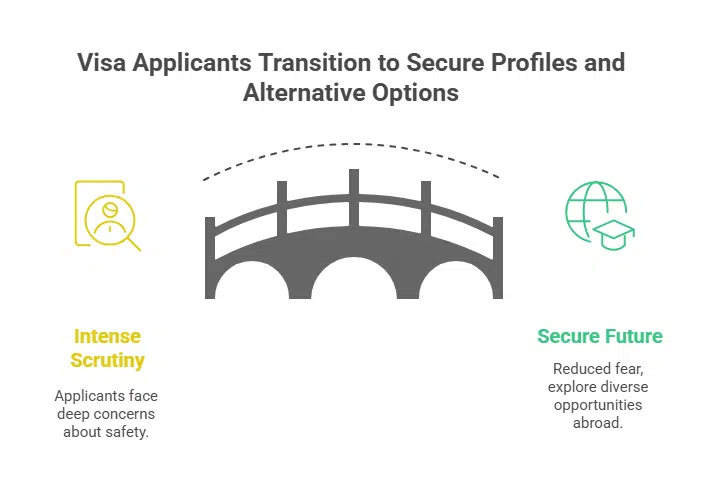
A particularly unsettling aspect of the policy shift is the intensified scrutiny of social media profiles. The State Department now mandates a more thorough review of applicants’ online activities, including posts, comments, associations, and even deleted content.
In response, many prospective students are scrubbing their feeds, deleting political or religious posts, removing follows from controversial accounts, and switching to private profiles.
Some, like 28-year-old Kaushik Sharma, are considering abandoning their U.S. plans altogether. Sharma, who aspired to attend a top public policy program, expressed deep concern. “I’ve spent years crafting my profile and credentials to qualify for U.S. schools. But now, I’m not just worried about the visa process — I’m worried about my safety and mental health once I’m there,” he said. “I don’t want to live in fear.” He is now exploring programs in Singapore and the U.K., which he feels offer similar academic quality without the current instability.
In rural and semi-urban India, many families are turning to spirituality. So-called “visa temples”, where prayers are offered specifically for the approval of U.S. tourist, study, or work visas, are experiencing a surge in visitors. One such temple in Chilkur, Telangana, has seen footfall double in recent weeks. Hindu devotees believe that special rituals performed here help overcome bureaucratic hurdles abroad.
Fallout from the Harvard Decision: Legal and Symbolic Shockwaves
The move to ban Harvard University from enrolling international students sent shockwaves through academic communities worldwide. The U.S. administration cited compliance issues and alleged “foreign influence” concerns on campus, particularly regarding research funding and surveillance risks. The university quickly challenged the order, and within a week, a federal judge issued an injunction, temporarily lifting the ban and allowing Harvard to continue processing international student enrollments.
Despite the legal reprieve, the symbolic damage is done. Institutions across the U.S. are now questioning whether their ability to attract international talent might be jeopardized by abrupt federal interventions.
“This decision undermines the trust that the global academic community has in American institutions,” said Dr. Nisha Roy, a professor of international education policy. “International students bring both economic value and intellectual diversity. To see their futures become bargaining chips in political battles is deeply troubling.”
Global Icons Once in Their Shoes
It’s worth noting that many of today’s global leaders once trod the same path that Indian students are now struggling to follow. Satya Nadella (CEO of Microsoft) and Sundar Pichai (CEO of Alphabet/Google) were born and raised in India before completing graduate studies in the U.S.
Others, like Gita Gopinath (Deputy Managing Director of the International Monetary Fund) and Abhijit Banerjee (Nobel laureate in Economics), also received early education in India before advancing their academic careers in the U.S.
These individuals are frequently cited as evidence of how the U.S. higher education system has historically welcomed and benefited from Indian talent. Today, however, that legacy appears to be under strain.
Alternative Destinations: U.K., Canada, Singapore on the Rise
With uncertainty clouding the U.S. application process, many Indian students are seriously reconsidering their academic plans. The United Kingdom, Canada, and Singapore are emerging as preferred alternatives.
These countries have been investing in attracting international students through flexible visa regimes, post-study work permits, and inclusive immigration policies. For example, the U.K. Graduate Route Visa allows students to work in the country for two years after completing their degrees — a major incentive for international applicants.
Conclusion: What Lies Ahead
Although the Trump administration’s policy changes are intended to bolster national security, they have also created a chilling effect on international education. For Indian students, the journey to the U.S. — long seen as a rite of passage for ambitious scholars — is now fraught with uncertainty, fear, and tough decisions.
As legal challenges continue and diplomatic pressure builds, students and families hope for more clarity. In the meantime, the global education map is shifting — and the U.S. may risk losing its long-held status as the world’s premier academic destination if such policies persist.