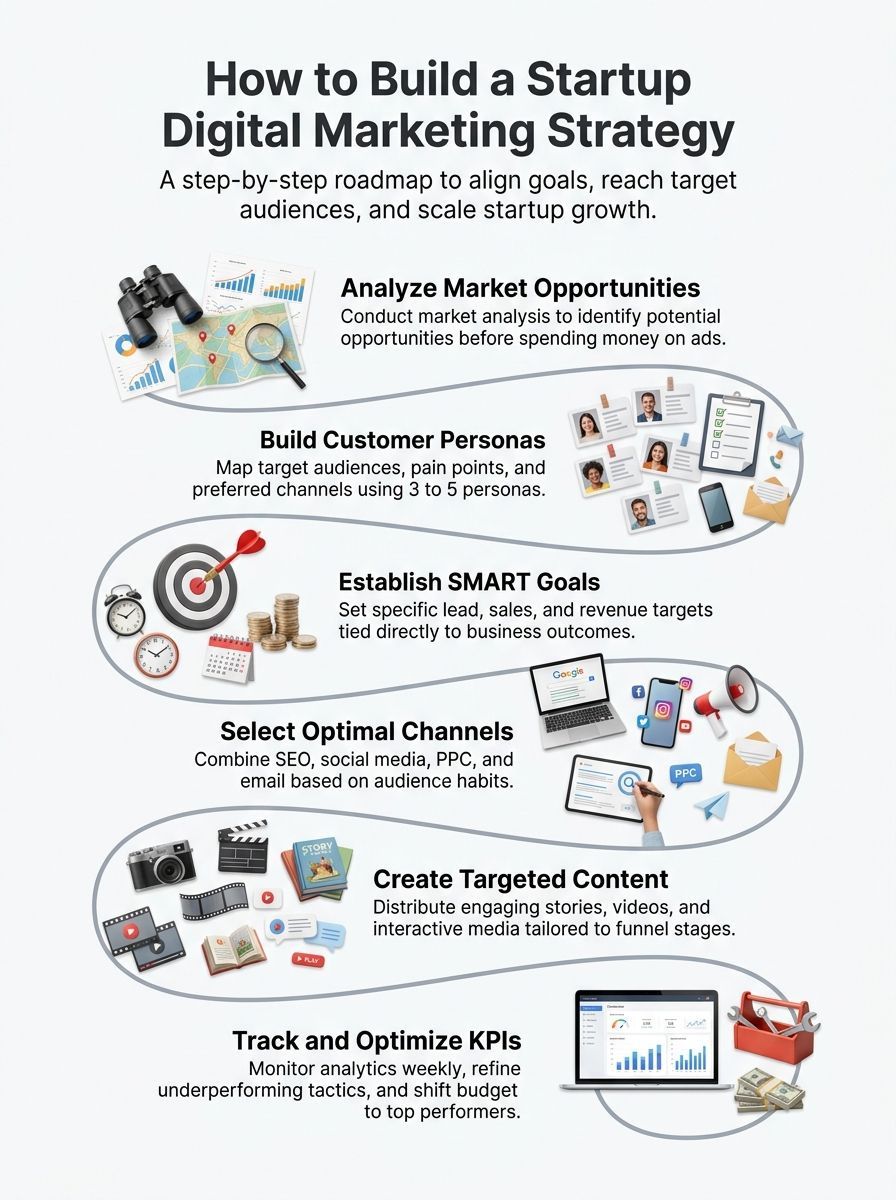
If you want to know how to build a digital marketing strategy for a startup, start with the business, not the channels.
That means clear revenue goals, a sharp market analysis, and a short list of customer problems you can solve better than anyone else. Once that is clear, your Digital Marketing plan gets much easier to build because every tactic has a job.
The best startup plans usually follow four simple parts: goals, audience, channels, and measurement. Get those right, and your SEO, Content Marketing, Social Media, Online Advertising, and Brand Development start working as one system instead of five separate projects.
Brief overview of why a digital marketing strategy is essential for startups
Startups need a clear plan because random posting and random ad spend usually create random results. A good Startup Strategy ties Digital Marketing to business outcomes like qualified demos, free trials, booked calls, or first-time sales.
Market Analysis comes first because it helps you spot where demand already exists. In the U.S., digital channels matter more every year, and McKinsey reported in 2026 that many B2B companies now see a large share of revenue flow through digital channels, which tells you marketing can no longer sit on the side of the business.
- Goals: decide what success looks like in numbers
- Audience: define who you want to reach and why they buy
- Channels: choose where you will show up
- Measurement: track what brings leads and revenue
That structure keeps Brand Development and Lead Generation connected instead of competing for budget.
The role of digital marketing in building brand awareness and driving growth
Digital marketing helps startups do two jobs at once: get noticed now and create demand later. Paid search can drive faster leads, while SEO and Content Marketing build compounding traffic over time.
HubSpot’s 2026 marketing statistics page says website, blog, and SEO remain the top ROI-generating channel for many marketers. That is a strong reason to treat your website like a sales asset, not just an online brochure.
Social Media, email, and retargeting help you stay visible after the first visit. That repeat exposure matters because most people do not convert the first time they see a young brand.
Identify and Understand Your Target Audience
Your audience shapes every part of your digital marketing strategy for a startup, from the message you write to the ad platform you pay for.
If you skip this step, you usually end up paying to reach people who were never a fit.
Conduct market research to define your ideal customer
Start with a basic market analysis before you launch any Online Advertising. Look at search demand, competitor messaging, review sites, Reddit threads, and sales calls to find the pains people already talk about in their own words.
Google Ads Keyword Planner is useful here because it shows keyword ideas and search interest. That helps you see whether people are actively looking for the problem you solve, which is a much better starting point than guessing.
Build your research around a few questions:
- What problem feels expensive or urgent to the buyer?
- What words do buyers use when they search for help?
- Who already serves this audience, and where are they weak?
- Which channels appear most often in the buying journey?
This is where many competing articles stay vague. You want named competitors, repeated objections, and real phrases from buyers, because those details turn into better copy, better SEO topics, and better ad targeting.
Develop customer personas to guide your approach
Keep your personas practical. For most startups, three personas are enough: the buyer, the influencer, and the user.
Each persona should include job title, company size, trigger event, biggest fear, success metric, and likely objection. That is far more useful than broad traits like age alone.
| Persona field | What to write | Why it helps |
|---|---|---|
| Role | Founder, marketing manager, ops lead, or end user | Shapes your offer and CTA |
| Pain point | High churn, low lead volume, slow reporting | Gives you the hook for ads and landing pages |
| Buying trigger | New funding, hiring push, product launch | Improves campaign timing |
| Preferred channel | Google Search, LinkedIn, Instagram, email | Helps you choose the right platform |
A pro tip from experienced B2B marketers is to build one persona from won deals and one from lost deals. The contrast shows you where your positioning attracts the wrong people.
Tailor messaging and value propositions to audience needs
Once your personas are clear, write a value proposition for each one. Do not force the same message onto every audience segment.
A founder may care about revenue growth and speed. A marketing manager may care about lead quality and reporting. An operations lead may care about setup time and clean handoffs.
Your message should answer one question fast: why should this person care right now?
Then match the message to the channel. Search ads work best with direct problem-solution language. Social Media often performs better with proof, examples, and a sharper point of view. Email works well when you speak to the next step, not just the product.
Set Clear Marketing Goals and Objectives
Clear goals turn Digital Marketing from a cost center into a decision tool.
If your startup cannot say what result it wants, it cannot tell which channel deserves more budget next month.
Establish SMART goals (Specific, Measurable, Achievable, Relevant, Time-bound)
SMART goals work because they remove fuzzy targets like “grow awareness” and replace them with numbers you can act on. A startup goal should name the metric, the target, the time frame, and the channel owner.
For example, a better goal is “generate 150 demo requests from SEO and content within six months at a cost per lead below $90.” That tells your team exactly what to measure.
Use one primary metric and two supporting metrics:
- Primary: leads, demos, trials, or revenue
- Supporting: conversion rate and cost per acquisition
- Diagnostic: click-through rate, landing page bounce rate, or email open rate
This setup keeps your team from celebrating traffic spikes that never turn into sales.
A simple SMART goal example makes this easier to picture. One early-stage startup began with 120 monthly leads from organic blog traffic after market analysis showed a high-intent research segment. The team set a six-month goal, published three SEO-focused pillar posts each month, and added two gated assets tied to those topics. Content production cost $3,600 in total. After six months, monthly leads reached 420, and lead-to-demo conversion improved from 4.5% to 6.8%. Weekly lead tracking showed which topics actually moved buyers closer to a sale.
Align marketing objectives with overall business goals
Your marketing goals should connect to the business model. If you are pre-revenue, you may focus on signups, qualified calls, or waitlist growth. If you already sell, you may focus on pipeline, new customer revenue, or retention.
This alignment matters because different business goals call for different channels. A startup trying to validate demand may put more weight on search ads and founder-led Social Media. A startup with stronger product-market fit may invest harder in SEO, case studies, email automation, and Brand Development.
Write the connection down in plain language:
- Business goal: grow monthly recurring revenue
- Marketing objective: increase qualified demos
- Channel plan: SEO for demand capture, PPC for fast testing, email for follow-up
Set benchmarks to measure progress
Benchmarks give you context. Without them, you do not know if a 2% landing page conversion rate is fine, weak, or worth fixing first.
Google Search Console helps here because its Performance report shows clicks, impressions, and query-level data. If impressions are rising but clicks stay flat, your titles and descriptions likely need work before you create more content.
| Metric | Good early question | What to do next |
|---|---|---|
| Organic clicks | Are the right pages getting seen? | Improve titles, search intent match, and internal links |
| Cost per lead | Are we buying efficient traffic? | Pause weak keywords and tighten landing pages |
| Lead-to-sale rate | Are leads actually qualified? | Refine offers, forms, and targeting |
| Email click rate | Does follow-up content move interest forward? | Test subject lines, CTAs, and segmentation |
Select the Most Effective Digital Marketing Channels
You do not need every channel. You need the few channels that match how your audience discovers, compares, and buys.
Most startups do better with a focused channel mix than a scattered one.
Start by comparing channels on four points: speed, cost, targeting, and staying power. PPC usually gives faster feedback. SEO and Content Marketing usually take longer, but they can keep producing after the spend slows down.
Google Search is strong when people already know the problem they need to solve. LinkedIn tends to be stronger for U.S. B2B startups selling to specific roles. Meta can work well for broad consumer audiences and retargeting.
A short paid channel audit can prevent waste. In one 60-day pilot, a startup tested LinkedIn Ads, Google Search, and Facebook Ads with a $9,000 budget. Google Search produced 75 leads at a $120 cost per acquisition. LinkedIn produced 18 leads at $340. Facebook delivered 22 leads at $95, but lead quality was weak. The smart next move was to shift more budget into Google Search, keep Facebook for retargeting, and stop judging channels by low lead cost alone.
For content channels, the 2025 Content Marketing Institute benchmark found short articles, videos, and case studies stayed among the most-used B2B formats. That is helpful because it points startups toward formats they can realistically publish without a huge team.
Choose platforms that best reach your target audience
Do not choose platforms based on popularity alone. Choose them based on buyer behavior in the U.S. market you want.
Pew Research reported in late 2025 that half of U.S. adults use Instagram, which makes it a serious option for visual products, creator-led brands, and remarketing support. For intent-heavy buying, Google Search is still one of the best places to capture demand because people go there with a problem already in mind.
- Use SEO and Google Search Ads when buyers search for solutions directly
- Use LinkedIn when job title and company targeting matter
- Use Instagram or Facebook when visuals, community, or retargeting support the sale
- Use email when the sales cycle needs follow-up and nurture
The right platform is the one that gets you qualified attention, not the one with the biggest audience.
Consider a multichannel strategy for greater reach
A multichannel plan works best when each channel has one clear role. That keeps your budget from getting spread too thin.
Here is a simple way to divide the work:
- SEO: capture steady demand from high-intent searches
- Content Marketing: educate buyers and support search visibility
- Social Media: build familiarity and distribute content
- Email: move interested people back to the site
- Online Advertising: test offers and speed up lead generation
This is also where a lot of startup guides miss the hard part. Channel overlap matters. Someone may first see you on LinkedIn, search your brand on Google, read a case study, and then convert through email. If you judge every channel in isolation, you can end up cutting one that quietly assists your best conversions.
Create and Distribute Engaging Content
Content gives your startup something useful to say before a prospect is ready to buy.
It also gives SEO, Social Media, email, and sales follow-up something stronger than a generic pitch.
Develop a content plan that resonates with your audience (blogs, videos, infographics, etc.)
Build your content plan around buyer questions, not around what your team feels like posting. A good starting point is one pillar topic per major pain point, then smaller pieces that support it.
Google Search Central says helpful, useful content has a bigger impact on search visibility than most technical tweaks. For a startup, that means the fastest win is often a stronger page or article that matches search intent, not a giant site rebuild.
| Format | Best use | Why it helps startups |
|---|---|---|
| Blog post | Answer search questions | Supports SEO and educates buyers |
| Case study | Show proof | Improves trust near conversion |
| Short video | Explain a pain or feature fast | Works well on social and landing pages |
| Infographic | Simplify data or a process | Easy to reuse in email and social |
Start small. One strong pillar post, one short case study, and one short video per month can do more than a high-volume calendar full of weak content.
Use storytelling and consistent brand voice to build relationships
People connect faster with a point of view than with polished corporate language. If your startup exists to solve a frustrating problem, say it clearly and say it the same way across your site, ads, emails, and Social Media.
A simple founder story can work well here. Explain what problem pushed the company to exist, what broke in the old way, and what result your product helps create. That keeps your Brand Development human and easy to recognize.
Consistency beats cleverness. A message people recognize is usually more useful than a new slogan every week.
If you sell a complex product, storytelling also helps explain why the problem matters before you ask for a conversion.
Leverage user-generated content and interactive media
User-generated content can lower trust friction because buyers get proof from other users, not just from you. Reviews, customer screenshots, creator clips, and short customer quotes can all support conversion.
Meta’s business guidance on lead ads also shows how native forms and simple follow-up paths can support lead generation. For consumer-facing startups, that makes quick polls, quiz ads, and form-based offers worth testing when you need faster feedback on audience interest.
Interactive content works best when it helps the buyer make a decision:
- Use a quiz to segment visitors by need
- Use a calculator to show savings or ROI
- Use polls to learn what objections show up most often
- Use customer reviews near forms to improve trust
The common mistake is adding interaction for novelty. If it does not help the buyer choose or move forward, it is probably just noise.
Measure, Analyze, and Optimize Your Strategy
Measurement is where startup marketing becomes repeatable.
You do not need dozens of dashboards. You need a short set of numbers that tell you what is attracting the right people and what is wasting money.
Track key performance indicators (KPIs) using analytics tools
Use a small tool stack first. For many startups, Google Analytics 4, Google Search Console, your ad platform dashboards, and a simple CRM are enough.
GA4 matters because conversions are created from events, which lets you measure key actions across organic, email, social, and paid traffic in one place. That is helpful when your buyers touch more than one channel before they convert.
- In GA4: track form submits, booked demos, purchases, and trial starts
- In Search Console: track clicks, impressions, top queries, and top pages
- In ad platforms: track cost per click, cost per lead, and conversion rate
- In your CRM: track lead quality, pipeline, and closed revenue
If possible, name your conversions by business value. “Book demo” tells you much more than a generic “submit.”
Regularly review results and adjust tactics for improvement
Review performance every week, but do not change everything every week. The goal is to spot patterns, not to panic.
A simple review rhythm works well:
- Check top-line results such as leads, sales, and cost per acquisition
- Find the best and worst channel by efficiency
- Inspect one step deeper, such as keyword quality, ad creative, landing page conversion, or email clicks
- Choose one test for the next period
LinkedIn’s guidance for Lead Gen Forms notes that if form opens are high but lead volume is low, reducing fields or revising the wording can help. That is a good example of a small platform-specific fix that can improve results without changing your whole strategy.
Embrace continuous learning to refine and scale your marketing efforts
The startups that improve fastest usually run more small tests, not bigger guesses. They test headlines, offers, keyword groups, landing pages, and follow-up emails in short cycles.
They also learn which signals matter most. A low cost per lead can still be a bad outcome if those leads never turn into sales. A slower SEO channel can be a strong investment if it keeps bringing qualified traffic month after month.
Use this simple learning loop:
- Find one bottleneck
- Test one fix
- Measure the business result
- Keep, drop, or refine the change
That habit is what turns Digital Marketing into a real growth system for your Startup Strategy.
Final Thoughts
How To Build A Digital Marketing Strategy For A Startup comes down to a few smart moves: know your audience, set clear goals, pick the right channels, create useful content, and measure what brings real leads and sales.
Start small. Use SEO, Content Marketing, Social Media, email, and Online Advertising only where they support your business goals. Then keep improving based on what the numbers show.
FAQs about How To Build A Digital Marketing Strategy For A Startup
1. What is a digital marketing strategy for a startup?
A digital marketing strategy for a startup is a clear plan to find customers online, and drive customer acquisition. It uses market research, target audience work, SEO, content marketing, social media, email marketing, and analytics.
2. How do I start building one?
Begin with market research, learn who your customers are, and set simple goals. Pick a small set of channels that match your budget, like a basic website, SEO, content, social media, or paid ads, then do keyword research and make a content plan.
3. How do I measure if it works?
Use analytics to watch traffic, conversion rate, and customer acquisition cost. Run simple A/B tests, track results, and adjust, test, tweak.
4. Do I need outside help or can I do it myself?
You can start on your own, many founders wear many hats early on, and learn fast. Use tools for marketing automation and analytics, but hire help for scaling SEO, paid ads, or when you need more content marketing at volume.