
I used to end my workdays completely drained, staring at a to-do list that somehow looked longer than when I started. I felt like I was working non-stop, but at 5:00 PM, I couldn’t point to a single meaningful thing I had actually finished. That was until I learned about how to run a time audit.
I realized the problem wasn’t a lack of time; it was a lack of awareness. As humans, we are naturally terrible at estimating how long tasks take, a cognitive blind spot known as the Planning Fallacy. If you give yourself four hours for a two-hour task, your brain will subconsciously stretch the work to fill that entire block.
A time audit forced me to stop guessing and look at the hard data. It showed me exactly where my hours were leaking.
Why We Avoid Time Audits [And Why We Need Them]
If I am being honest, I put off tracking my time for months. There is a deep psychological resistance to it because, deep down, we know we are wasting time and we do not want the physical proof staring back at us.
But you cannot fix a leak if you refuse to look at the pipes. A time audit is simply a diagnostic tool. It strips away your optimism bias and replaces it with reality. Once I got over the fear of seeing my own bad habits on paper, the process actually became liberating.
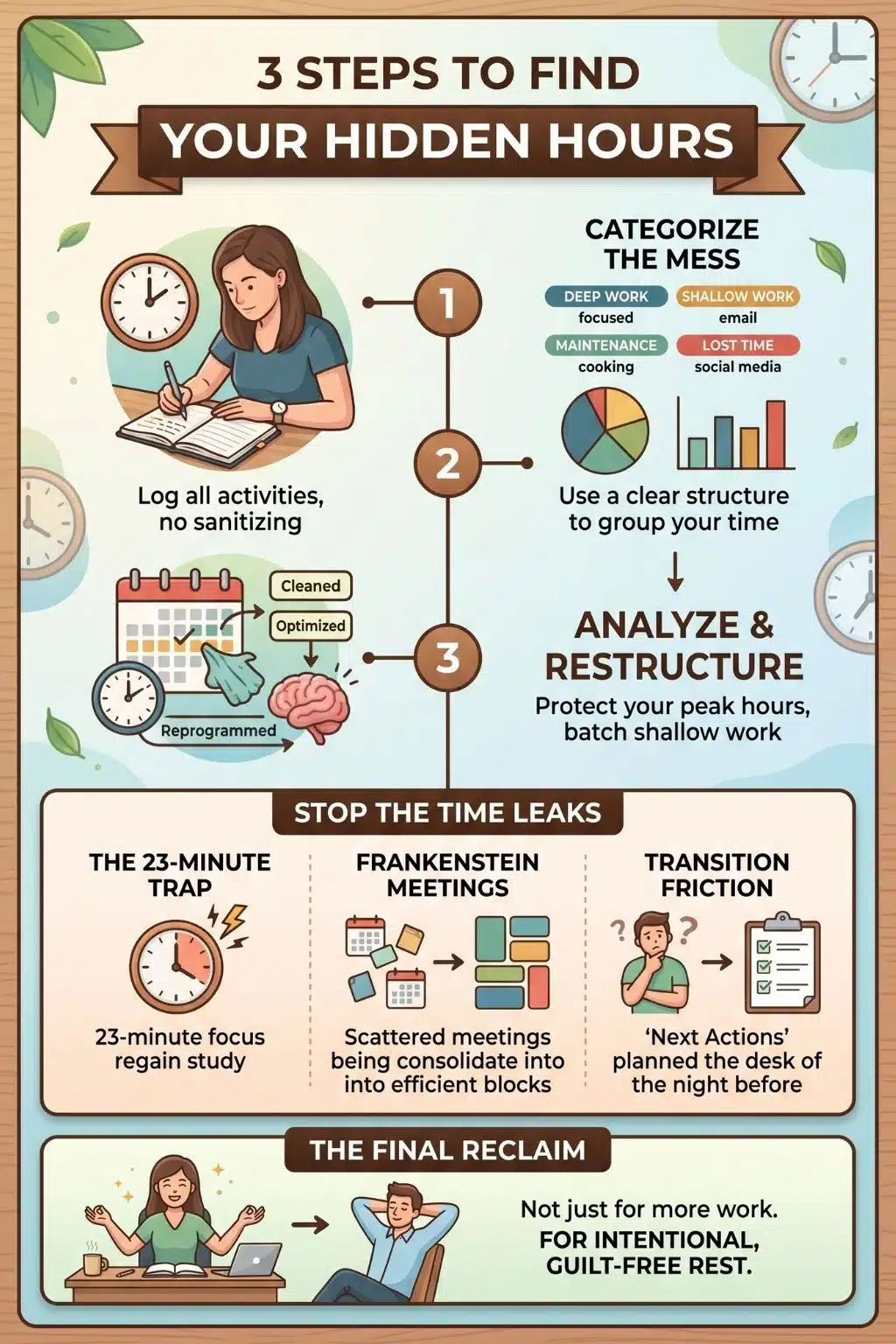
My 3-Step Time Audit Process
The idea of tracking every minute sounds exhausting, I know. But this isn’t a permanent lifestyle change, it is a temporary diagnostic test. I designed this three-step process to be as painless as possible, requiring just a few days of raw observation to yield months of improved focus. Here is exactly how I did it.
1. Track Brutally and Honestly
For three normal workdays, I tracked everything. I didn’t change my habits to look better on paper. If I spent 45 minutes scrolling through social media when I should have been doing deep work, I logged it. You can use a notepad, a spreadsheet, or a free timer app. The tool doesn’t matter; the brutal honesty does. Pick a method with zero friction so you don’t abandon it by noon.
2. Categorize the Mess
At the end of the three days, I grouped my logged activities into distinct buckets:
- Deep Work: Focused, high-impact tasks moving the needle forward.
- Shallow Work: Emails, slack messages, and quick administrative chores.
- Maintenance: Commuting, eating, and prepping for the day.
- Lost Time: Doomscrolling, staring at the wall, and unnecessary multitasking.
This step is where the truth hurts, but it is entirely necessary to see the big picture of your week.
3. Analyze and Restructure
I looked for the gaps between my intentions and my reality. I realized I was trying to do high-energy deep work in the mid-afternoon when I was tired, and I was wasting my sharpest morning hours on emails. I used this data to restructure my calendar, batching my shallow tasks into specific 30-minute windows and fiercely protecting my mornings for the heavy lifting.
The 3 Biggest Mistakes to Avoid During Your Audit
If you are going to do this, you want accurate data. Over the years, I have seen people try to run audits and fail because they fall into one of these traps:
- The “Perfect Day” Trap: Do not suddenly become a productivity guru on the days you track. If you naturally slack off at 2:00 PM, let it happen and write it down. You need baseline data, not a fantasy.
- The Micro-Tracking Trap: Don’t track time in three-minute increments. You will drive yourself crazy. Tracking in 15-to-30-minute blocks provides plenty of actionable data without burning you out.
- The Guilt Trap: The data you collect is neutral. Do not use your lost time as an excuse to beat yourself up. Treat yourself like a scientist observing an experiment.
Where My “Hidden Hours” Were Actually Hiding
When I reviewed my audit, my time wasn’t disappearing into big, obvious black holes. It was bleeding out through a thousand tiny cuts.
The 23-Minute Trap
It takes an average of 23 minutes and 15 seconds to regain deep cognitive focus after an interruption. I realized that checking my inbox “just for a second” was costing me nearly half an hour of mental momentum every single time.
Frankenstein Meetings
I used to have 30-minute meetings scattered randomly throughout the day. But a 30-minute meeting also requires 15 minutes of prep and 15 minutes of mental recovery. By bunching my meetings together back-to-back in the afternoons, I reclaimed hours of previously fragmented time.
Transition Friction
I was losing 15 to 20 minutes between tasks just deciding what to do next. Now, I plan my top three tasks the night before. When I sit down at my desk, the decision is already made.
Time is Non-Refundable: Make Yours Count
Running a time audit isn’t about becoming a relentless, unfeeling productivity machine. It is about intentionality.
By finding my hidden hours, I didn’t just make time to get more work done. I finally made time to step away from my desk, log off at 5:00 PM, and actually enjoy my evenings without that lingering guilt of an unfinished day. Your time is your most non-refundable asset, it is worth knowing exactly where you are spending it.
Frequently Asked Questions on How to Run a Time Audit
1. How many days do I actually need to track?
Three to five days is the sweet spot. Anything less won’t give you a true pattern of your habits; anything more becomes exhausting and you will likely quit. Make sure you pick a standard workweek, not a holiday or vacation week.
2. Should I track my personal time, or just work hours?
Start with just your work hours. Tracking your entire waking life from day one is overwhelming. Once you master auditing your workday, you can apply the same principles to your evenings if you want to find more time for hobbies or side projects.
3. What if I forget to log something in the moment?
Do not stress about it. Just estimate the time block as soon as you remember. The goal isn’t down-to-the-second perfection; it is spotting broad trends and identifying your biggest time sinks.
4. What is the best tool for a time audit?
The best tool is the one you will actually use consistently. I started with a pen and a cheap notebook on my desk because it was impossible to ignore. If you prefer digital, a basic spreadsheet or an app with a simple start/stop timer works beautifully.
5. How often should I do this?
I run a time audit once every quarter. Our habits naturally drift over time, and a quick three-day audit every three months is the perfect reset button to keep your schedule aligned with your actual priorities.