

Hearing allows us to connect with the world around us. The sounds of nature, music, and the voices of loved ones – all these enrich our lives significantly. Understanding how we hear and the complex processes involved in turning soundwaves into meaningful information can help us appreciate and protect this vital sense. In this guide, we will explore the anatomy of the ear, how it converts sound waves into neural signals, common hearing disorders, and how hearing can be tested and protected. Gaining insight into the auditory system provides a window into the marvels of the human body and motivates us to safeguard our hearing health.
Anatomy of the Ear
The ear is divided into three main sections: the outer ear, middle ear, and inner ear. Each part plays a role in receiving sound waves from the environment and transforming them into electrical signals that travel to the brain.
The outer ear consists of the pinna and ear canal. The pinna is the visible part of the ear that protrudes from the side of the head. Its ridges and curves help collect and funnel soundwaves into the ear canal. The ear canal is a tunnel approximately 2.5 cm long that runs from the pinna to the eardrum. It amplifies sounds within the 3,000 – 12,000 Hz frequency range, which includes most of the audible spectrum for humans.
Vibrations travel from the ear canal and cause the eardrum, also known as the tympanic membrane, to vibrate in turn. The eardrum marks the beginning of the middle ear section. On the other side of the eardrum lie three minor bones known as ossicles – the malleus, incus, and stapes. As the eardrum vibrates, it passes these vibrations to the ossicles, which transmit and amplify them.
The stapes bone is connected to the oval window, a membrane covering the inner ear. When the stapes bone presses against the oval window, it causes vibrations within the fluid-filled inner ear or cochlea.
The cochlea has a snail-like spiral shape and contains the auditory portion of the inner ear. Vibrations from the stapes bone ripple through the cochlear fluid and displacing hair cells lining the interior cochlea walls. The hair cells convert these mechanical disturbances into electrical signals by triggering action potentials that travel down the auditory nerve to the brain.
Auditory Transduction
The conversion of a soundwave into neural signals within the cochlea occurs through a process called auditory transduction. Understanding how this works provides insight into how the ear interprets the wide range of audible frequencies.
The basilar membrane within the cochlea plays a key role in auditory transduction. This membrane runs the length of the cochlea, getting progressively narrower from base to apex. Different locations along its length are selectively sensitive to specific frequencies – the wider base responds optimally to high frequencies, while the narrower apex is tuned for low frequencies.
When vibrations enter the inner ear, the basilar membrane moves in response. Due to its varying width, each section only bends in response to a specific subset of frequencies. This excites the hair cells in that area, prompting them to send signals about those frequencies to the brain. In this manner, a soundwave consisting of multiple frequencies triggers hair cells across the length of the basilar membrane. Their combined input produces a signature pattern of neural activity for that particular sound.
Hair cells have bundles of stereocilia protruding from their tops. When sufficiently bent, these open ion channels that lead to an influx of positively charged ions. This change in polarization triggers an action potential that gets passed down the auditory nerve via a synapse with another neuron.
Damage to hair cells or the basilar membrane can interfere with this finely tuned system and cause hearing impairment. However, the ear has some ability to compensate for loss of sensitivity at certain frequencies by upregulating responsiveness in neighboring regions of the cochlea. This plasticity helps maintain auditory function but has limits.
Common Types of Hearing Loss
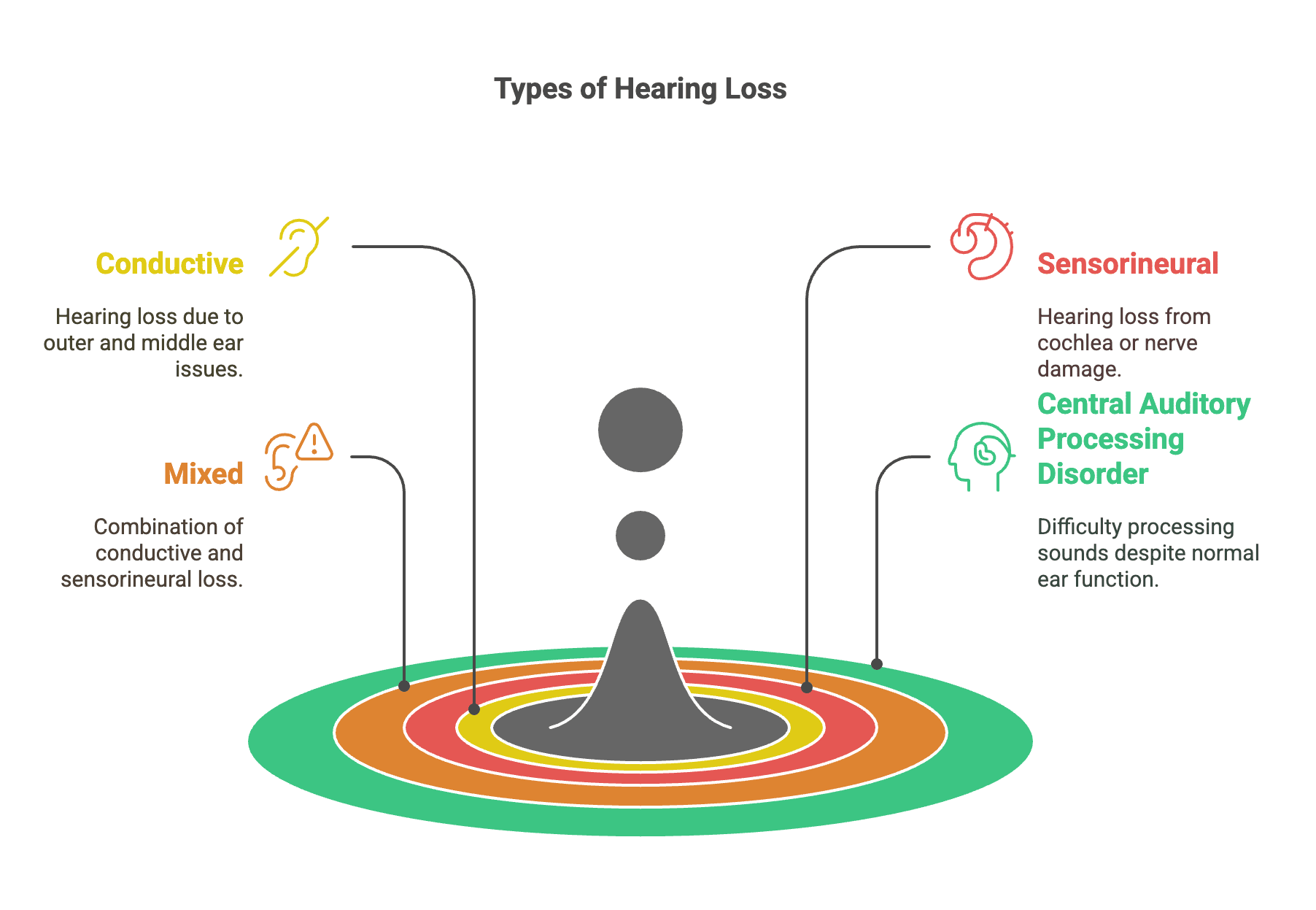
Damage to any portion of the auditory system can lead to hearing loss. This can be partial or complete, temporary or permanent. Some common types of hearing loss include:
- Conductive – Caused by obstruction, damage, or infection in the outer and middle ear. This prevents sound waves from being transmitted efficiently to the cochlea. Potential causes include earwax buildup, punctured eardrum, auditory ossicle dislocation, or otosclerosis (abnormal bone growth in the middle ear).
- Sensorineural – Results from damage to the cochlea or auditory nerve pathways to the brain. The most common cause is noise-induced hearing loss stemming from chronic loud noise exposure. Loss of hair cells in the cochlea from aging also leads to sensorineural degradation.
- Mixed – A combination of both conductive and sensorineural loss. Treatment aims to resolve the conductive portion while amplifying sounds to address sensorineural components.
- Central auditory processing disorder – Difficulty processing auditory information at the level of the brain despite normal ear structure and function. Those affected may have trouble filtering background noise or interpreting degraded speech sounds. CAPD often arises from neurological conditions like stroke, brain injury, or Alzheimer’s disease.
Monitoring Hearing Loss
Routine hearing tests allow early detection of hearing impairment, providing an opportunity to seek treatment and prevent further loss. Some options for monitoring hearing health include:
- Whisper test – A healthcare provider stands behind the patient at arm’s length and whispers a combination of numbers and words. The patient repeats back what they hear. Missing words indicates possible hearing trouble.
- Tuning fork test – A vibrating tuning fork is placed against the forehead or behind the ear to test which frequencies can be detected via bone conduction. Comparison with hearing results via air conduction gives clues about the type of loss.
- Speech audiometry – The patient repeats back words spoken at different volumes and against background noise. Measures the softest understandable volume for speech sounds.
- Online hearing test – Some websites provide online tests using your computer or phone to screen hearing.
Our hearing provides a conduit for experiencing and connecting with the rich world of sound. The ear is a complex organ that has evolved to translate air vibrations into neural code. Within the inner ear, delicate mechanoreceptive hair cells serve as the interface between mechanical disturbances and electrical signals sent to the brain. An orchestra of anatomical structures and physiological processes work in unison so we can hear a symphony.