Hey there, are you feeling lost with all the tech talk about web hosting? Maybe you’ve got a cool idea for a website, but terms like “domain name” and “bandwidth” sound like a foreign language, right?
Guess what? Web hosting is the key to getting your site live on the internet, and it’s not as tricky as it seems. Here’s a fun fact, tons of different hosting plans exist, from shared hosting to cloud hosting, each fitting different needs.
Don’t worry, though, I’ve got your back. In this post, “Hosting Terms Explained For Non-Techies,” we’ll break down 10 big words into simple bits. You’ll learn what a web server does, why uptime matters, and more.
Stick around, it’s gonna be easy!
Key Takeaways
- Web hosting is like renting a home for your website, storing files on web servers to keep it online.
- Domain names, like coolsite.com, act as your site’s internet address, managed by the DNS system.
- Shared hosting splits a server among many sites for a low cost, often with 99.9% uptime.
- Bandwidth handles data flow, with limits like 100 Mbps affecting site speed during high traffic.
- Uptime, ideally at 99.9%, ensures your site stays live, avoiding downtime headaches.
Web Hosting
Web hosting is the backbone of any website, folks. Think of it as renting a cozy spot on the internet where your web pages live. It’s like a home for your site, storing all your files, images, and data on powerful computers called web servers.
Without web hosting services, no one could see your site, plain and simple. It’s a must for website owners, and understanding this term helps you pick the right setup for your needs.
Now, let’s chat about why this matters to you. Good web hosts provide solid infrastructure, keeping your site fast and secure in data centers packed with tech. They offer expert guidance too, which is a lifesaver if tech isn’t your thing.
Different hosting plans, like shared or dedicated hosting, fit various needs, whether you’re starting small or running a big operation. Stick with a reliable provider, and you’ve got a strong foundation for your spot on the web.
Domain Name

Think of a domain name as your website’s home address on the internet. It’s what people type into their web browser, like Google Chrome or Mozilla Firefox, to find your site. Examples include coolsite.com or myblog.org.
Without this address, folks would have a hard time finding your web page among millions online. The domain name system, or DNS, is key here. It converts these user-friendly names into IP addresses, which are simply strings of numbers that computers use to link up.
Now, let’s talk about protecting your information with domain privacy. When you secure a domain name through a domain registrar, your personal details might appear in public records.
That’s far from ideal, isn’t it? Domain privacy safeguards your data from unwanted attention. Also, nameservers hold DNS records to direct traffic to the correct hosting servers.
So, choosing a strong domain, whether it’s a .com or .org, lays the foundation for your online presence. Isn’t that amazing?
Hey there, let’s talk about shared hosting, a fantastic choice for beginners stepping into the online space. Think of it as renting a room in a large house, where you split the cost with others.
Multiple websites reside on a single server, dividing resources like disk space and bandwidth. It’s budget-friendly, making it an ideal option for newcomers or small sites. Plus, most providers guarantee a reliable 99.9% uptime, ensuring your site remains accessible nearly all the time.
Now, envision splitting a pizza with friends—that’s shared hosting at its core. You’re not the only one on the server, so expenses remain low, but you’re reliant on shared capacity.
If one site uses up too many resources, others could experience a slight slowdown. Even so, for launching a simple website or a small blog with a content management system, this plan suits perfectly.
Wondering about setup? It’s usually quite simple with helpful tools available!
VPS Hosting
VPS Hosting, or Virtual Private Server, is like renting a private room in a big house. You get your own space with dedicated server resources, but at a much lower cost than a full dedicated server.
Think of it as a sweet spot, balancing affordability with the power and control you need. It allocates private server space, so your website runs faster and smoother than on shared hosting.
Imagine having more grip over your web applications and databases without breaking the bank. With VPS hosting, you enjoy better performance for dynamic web pages, thanks to that isolated setup.
Companies like Liquid Web offer top-notch solutions in this space, giving you advanced tools to manage your site. It’s a smart pick if you want to step up from shared hosting without jumping to a pricey dedicated server.
Dedicated Hosting
Now, let’s chat about dedicated hosting, a powerhouse choice for your website. Imagine having a whole house just for yourself, no roommates, no sharing. That’s what a dedicated server offers, full access to an entire server for one user.
You get every bit of power, storage, and speed all to yourself. Companies like ScalaHosting provide top-notch dedicated server solutions for those needing this setup. It’s perfect if your site gets tons of visitors or needs heavy resources.
Think of it as driving a sports car instead of a shared bus. With dedicated hosting, you gain root access, which means admin-level control over server settings. Want to tweak the operating system or install specific software? Go for it, you’re in charge.
Sure, the cost is higher compared to shared or VPS options, but the performance is unmatched. If your business relies on a fast, secure website with loads of data storage, this could be your best bet.
Cloud Hosting
Cloud hosting is like having a team of helpers ready to jump in when you need them. It uses a bunch of interconnected servers to keep your website running smoothly, even if one server stumbles.
This setup offers high availability, meaning your site stays online no matter the hiccups. Plus, it’s got scalability, so as your traffic grows, the system adjusts to handle the load.
Imagine a stretchy balloon that expands without bursting, that’s the magic here.
Think of cloud hosting as a safety net with extra perks. It often comes with top-notch tools like NVMe SSDs for super-fast performance and minimal lag. You also get bandwidth up to 100 Mbps, handling 100 megabits of data every second.
Whether you’re using a content delivery network or managing dynamic content, this hosting type keeps things zippy. It’s like having a speedy highway for your web site traffic, no jams allowed!
Bandwidth
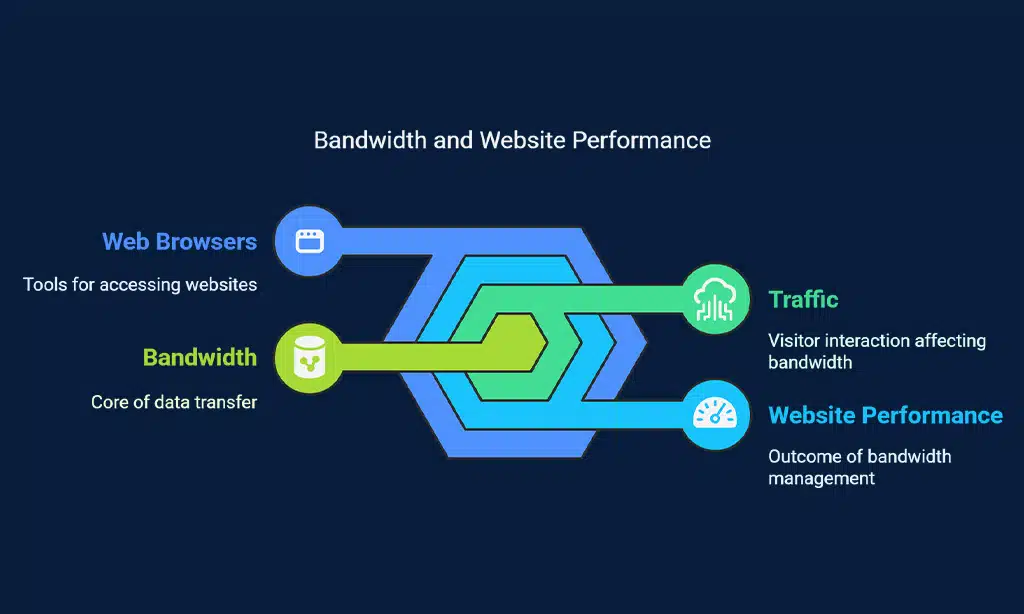
Hey there, let’s talk about bandwidth, a vital part of the web hosting equation. Think of it as the roadway for your website’s data. It’s the volume of data moved each month between your site and its visitors.
If your site is bustling, a high number of visitors and page views can add up quickly. Guess what? Too much traffic could reach your bandwidth capacity, slowing things down or even causing your site to fail.
That’s a real challenge, isn’t it?
Now, imagine this as a water pipe. A wider pipe allows more water to pass through, just like greater bandwidth, say 100 Mbps, manages more data per second. This reflects how effectively your site can handle incoming visitors.
So, if you’re managing a blog or store, pay attention to this metric. It’s the core of seamless browsing with your preferred web browsers. Stay with me to discover more hosting insights!
Uptime
Let me break this down for ya, folks. Uptime is all about how often your website stays live and ready for visitors. Think of it as your site’s heartbeat, always pumping to keep things running.
Most hosting providers aim for a solid 99.9% uptime, which means your site is almost always up and accessible. If that number drops, well, you’ve got downtime, and that’s a real pain.
It messes with how people reach your site and can hurt its performance big time. So, a reliable hosting setup is key to keeping that heartbeat steady.
Now, imagine your website as a 24/7 shop. Downtime is like shutting the doors when customers wanna come in, and nobody likes that! Good hosting plans focus on strong systems to cut down on these closures.
They build setups that grow with your needs, keeping things smooth. Whether you’re using shared hosting or a dedicated server, uptime shapes how folks see your online space. Stick with providers who prioritize this, and you’ll dodge a lot of headaches.
SSL Certificate
Hey there, let’s talk about SSL Certificates, a crucial element for securing websites. Consider them a digital ID, verifying a site’s authenticity while encrypting data to prevent hackers from prying.
They’re essential for platforms like eCommerce sites, ensuring safe transactions to protect your credit card details.
Now, imagine this, without an SSL Certificate, your data is like mail on a postcard, easily readable by anyone. With it, particularly through HTTPS, it’s akin to a secured box, accessible only to the intended recipient.
This not only protects your information but also improves a site’s visibility on search engines for enhanced SEO. Pretty neat, huh?
Control Panel
Think of a control panel as the command center for your website, folks. It’s like the dashboard of your car, putting all the important tools right at your fingertips. With a control panel like cPanel, you can manage your hosting accounts without breaking a sweat.
Want to tweak settings or check on your site? Just click a few buttons, and you’re good to go.
This interface makes server management a breeze, even if tech isn’t your thing. Take Softaculous, for example, a handy tool inside many control panels. It lets you install apps like WordPress in mere minutes, no coding needed.
Getting familiar with a control panel simplifies everything, from handling files to setting up email clients. So, dive right in, and take charge of your web hosting setup!
Takeaways
Wrapping up, let’s keep it simple, folks. These 10 hosting terms, like web hosting and SSL certificates, are your ticket to understanding the online game. Got a website or dream of starting one? Knowing these basics, from bandwidth to uptime, helps you chat with tech pals without breaking a sweat.
Drop a question below if something’s still fuzzy, and I’ll jump in to help!
FAQs
1. What exactly is web hosting, and why should I care?
Hey, think of web hosting as renting a cozy little spot on the internet for your website to live. It’s the foundation that keeps your site up and running, using things like disk space and an IP address to make it accessible. Without it, your online presence is just a dream floating in cyberspace!
Sure thing! Shared hosting is like living in an apartment building where you split the rent, or rather the server, with other websites. It’s budget-friendly but means you share resources like random access memory with others.
3. What’s this domain name stuff I keep hearing about?
Ahh, a domain name is just your website’s street address on the internet, like “yourcoolshop.com.” It’s tied to the DNS (Domain Name System), which acts like a phonebook, matching your name to an IP address. Without it, folks would have to type weird numbers to find you, and who wants that hassle?
4. What does FTP mean, and do I need to know it?
FTP, or File Transfer Protocol, is your go-to tool for moving files from your laptop or tablet to your web server. Think of it as a digital courier service for getting stuff uploaded. It’s handy if you’re tweaking your site with hypertext markup language or other programming language bits!
5. Tell me about dedicated hosting, is it worth it?
Well, dedicated hosting means you get a whole dedicated server just for your website, no roommates! It’s pricier than shared or reseller hosting, but you’ve got all the power, from databases in a database management system to top-notch DDoS protection. Perfect if your site’s a big deal and needs that extra muscle.
6. What’s the deal with HTTPS and secure sockets layer?
Listen up, HTTPS, or Hypertext Transfer Protocol Secure, is like a bodyguard for your website, keeping data safe with a secure socket layer. It’s vital for protecting user info, especially if you’re handling email addresses or payments. Without it, you’re leaving the door wide open to digital snoops, and nobody wants that mess!