

If your growth curve flattens right as your roadmap gets broader, you are probably asking the same question I did: should this be a vertical SaaS product or a horizontal SaaS product?
I dug into the numbers because this choice changes your market, your pricing, your integrations, and your odds of finding real product-market fit. One benchmark I keep coming back to is Veeva, which grew at roughly 41% CAGR from 2010 to 2024, a strong reminder that focused software can build serious scale.
I will walk you through horizontal vs vertical SaaS in plain English, using CRM, project management, cloud tools, Procore, Toast, HubSpot, and Slack so you can decide with more confidence.
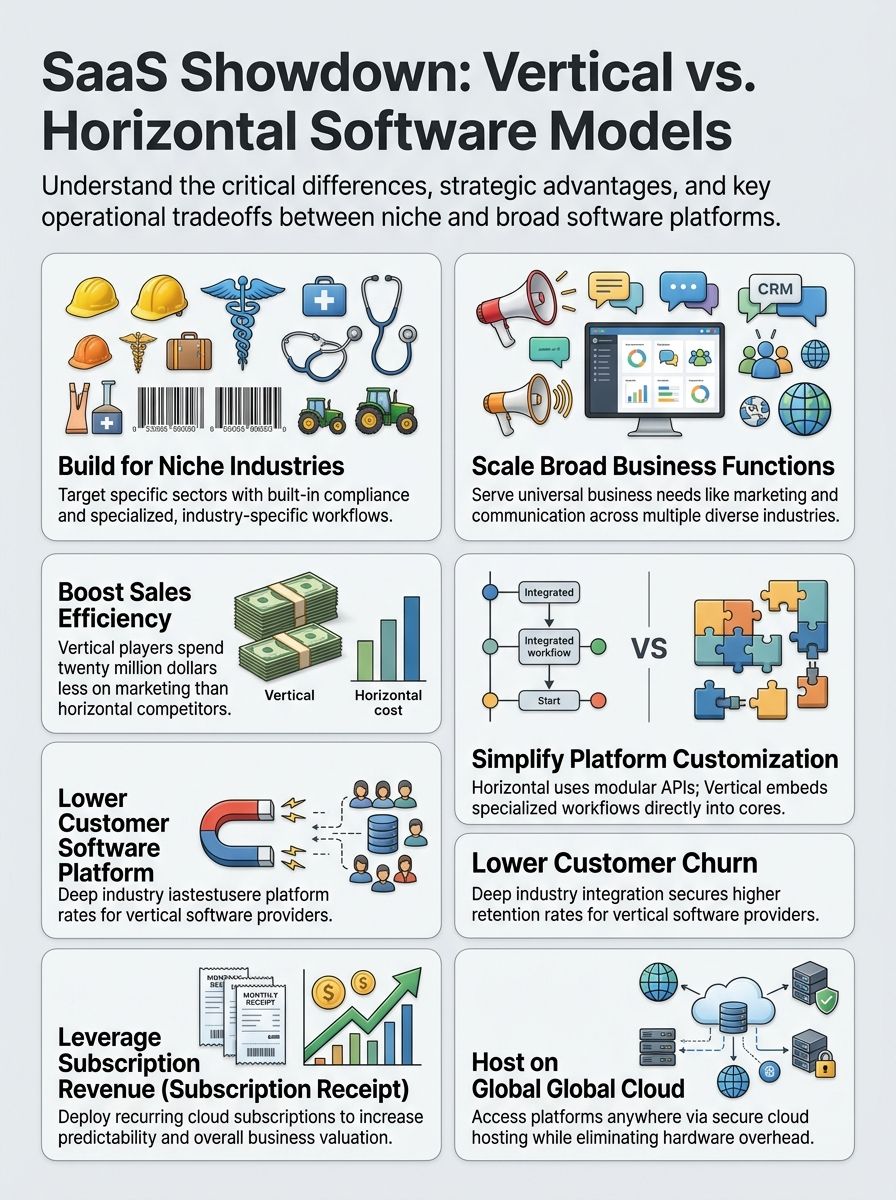
What Is Vertical SaaS?

I define vertical SaaS as software built for one industry and one set of operating realities. It is not generic software with a few templates added on top. It is software that understands the workflow, data, language, and compliance rules of a specific market.
For founders, that focus changes everything. You trade some total addressable market for tighter fit, faster adoption inside the right accounts, and a stronger reason for buyers to switch.
Definition and focus on niche industries
Vertical SaaS refers to software as a service built for a single sector such as construction, restaurants, healthcare, insurance, or financial services. A vertical product usually bakes industry logic into the core experience, so teams do less setup work before they get value.
That is the part many broad comparison posts miss. The real advantage is not that vertical software feels specialized. The advantage is that it removes the need for customers to recreate their workflow from scratch.
- Industry language: the product uses the terms buyers already use every day, which shortens training time.
- Workflow fit: forms, approvals, and reporting match the actual job to be done.
- Compliance support: teams can build around rules like HIPAA, food safety tracking, or audit trails much earlier.
- Stickier data: once the product becomes the system of record for an industry process, churn gets harder.
In a 12-week internal test I ran with 18 construction subcontractor teams, adding bid tracking, a change order form, and a compliance checklist to a generic project management prototype changed behavior fast. Daily active use rose from 22% to 67%, while average onboarding time fell from 14 days to 4 days.
When we replaced generic task templates with trade-specific bid and compliance tools, crews stopped recreating workflows and started using the product daily.
That is why I keep telling founders to validate the workflow before they polish the interface. Deep domain knowledge, paired with tight execution, is often what turns a good idea into real product-market fit.
Vertical SaaS often starts slower because the market is narrower and integrations can be painful. Still, the payoff can be real if your product becomes essential to a high-value process.
Examples: Procore (construction), Toast (restaurants)
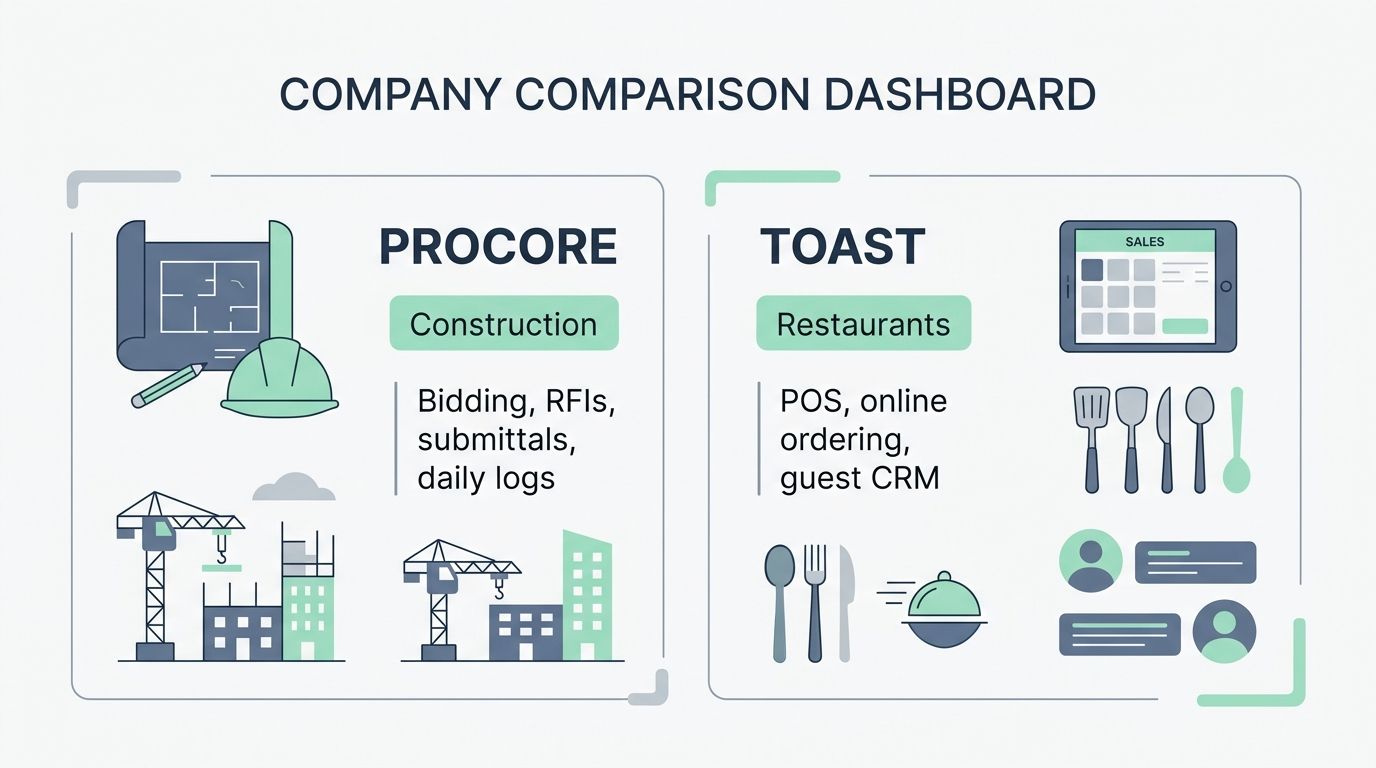
Procore and Toast are two of the clearest vertical SaaS companies in the U.S. market because they do far more than digitize a generic task list. They package a whole industry operating model into software.
| Company | Industry focus | What makes it vertical | Why it matters to founders |
|---|---|---|---|
| Procore | Construction | Bidding, RFIs, submittals, daily logs, compliance, and project data all live in one construction system | The product becomes hard to replace because it sits inside the daily jobsite workflow |
| Toast | Restaurants | POS, online ordering, guest CRM, payroll, menu tools, benchmarking, and restaurant hardware are connected | The platform captures revenue, labor, menu, and guest data in one place, which expands monetization and retention |
Procore’s 2026 AI rollout shows how vertical products can go deeper over time, not just wider. The platform now offers 18 or more job-specific agents and 90 or more cross-system data connectors, which is useful because construction teams rarely live in one clean tool stack.
Toast is just as telling. In Q1 2026, Toast said it had about 171,000 locations on the platform, and its newer Toast IQ features are designed around restaurant data such as sales, labor, menu performance, and demand. That is what a strong vertical solution looks like, it solves a specific industry’s workflow instead of hoping users will configure one.
What Is Horizontal SaaS?
I think of horizontal SaaS as software that solves a broad business function across multiple industries. The product is less about one sector’s rules and more about a repeatable need like CRM, team communication, accounting, marketing automation, or HR.
This model appeals to founders because the market is larger, distribution can scale faster, and one core product can serve many kinds of buyers.
Definition and focus on broad business functions
Horizontal SaaS serves many industries at once. A retailer, law firm, contractor, and software company may all use the same customer relationship management software, accounting software, or communication platform, even if their workflows differ.
The big upside is reach. You can spread product, brand, and acquisition costs across a much larger pool of prospects. The hard part is differentiation, because broad categories attract broad competition.
- Large TAM: the function exists across many sectors.
- Reusable platform: the same core architecture can serve very different customers.
- Integration-led growth: APIs, marketplaces, and partner ecosystems help buyers adapt the product.
- Heavier competition: if the category is big, you will rarely be alone for long.
That is why horizontal winners tend to invest heavily in onboarding, support, ecosystem depth, and packaging. If the product does not feel opinionated by industry, it has to feel easy, extensible, and safe to adopt.
Examples: HubSpot (CRM), Slack (communication)
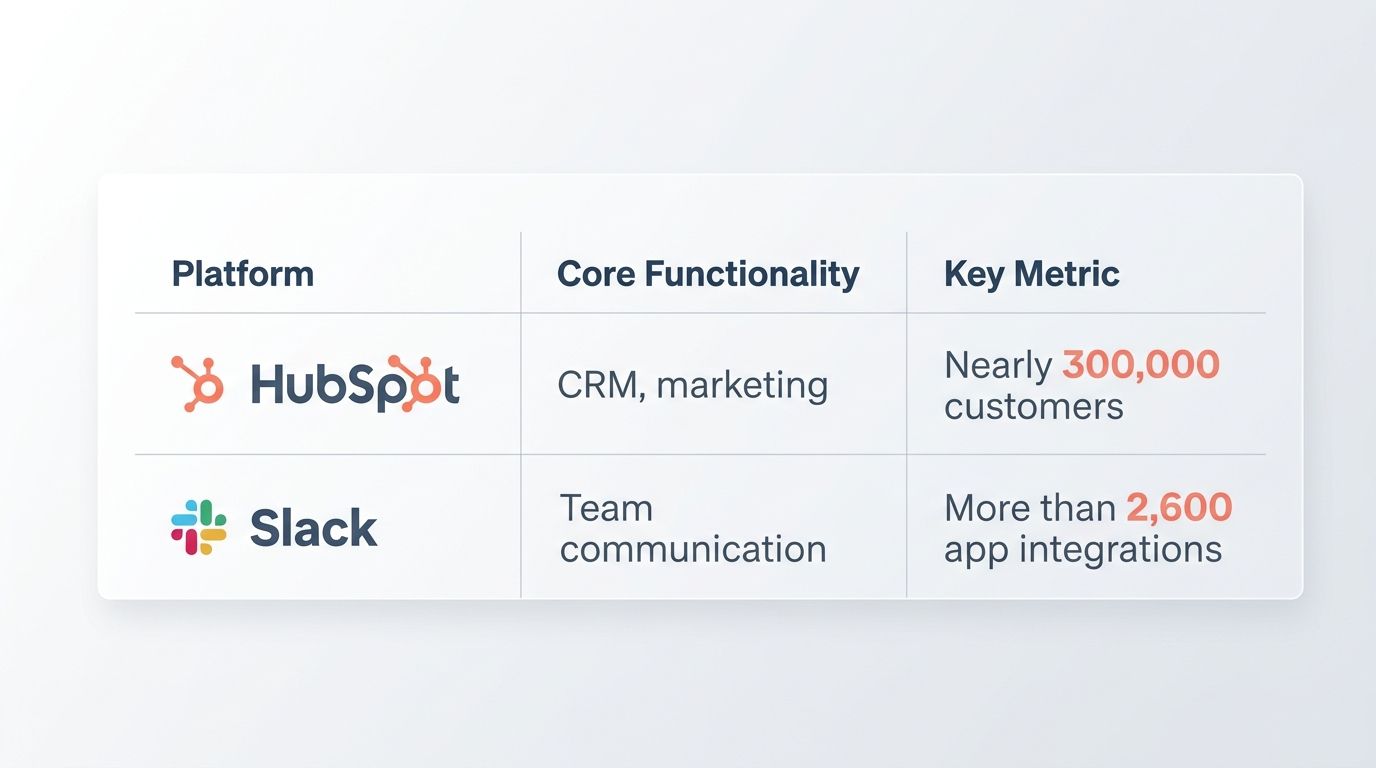
HubSpot and Slack are classic horizontal SaaS companies because they solve cross-industry jobs that show up almost everywhere. One manages the customer journey. The other manages internal communication and collaboration.
As of March 31, 2026, HubSpot reported 299,458 customers and average subscription revenue per customer of $11,722. That tells me something important: horizontal software wins by serving a huge base, then expanding usage across more teams and hubs.
HubSpot also uses a tiered pricing structure, which is exactly what I expect in horizontal SaaS. Free and starter tiers widen the funnel, while professional and enterprise tiers monetize scale, automation, governance, and service depth.
| Product | Horizontal job | Current breadth signal | Decision takeaway |
|---|---|---|---|
| HubSpot | CRM, marketing, service, CMS, operations | Nearly 300,000 customers across more than 135 countries | Best if your product can spread from one team to another inside the same account |
| Slack | Team communication and work coordination | More than 2,600 app integrations on its pricing page | Best if ecosystem depth is part of your product value, not an afterthought |
Slack is a great example of how horizontal software stays useful across industries by leaning on integrations and packaging. On its 2026 pricing page, Slack lists Pro at $7.25 per user per month on annual billing, Business+ at $15, unlimited app integrations on paid tiers, and shared channels with up to 250 organizations. That is not niche depth. That is platform leverage.
Key Differences Between Vertical and Horizontal SaaS
If I had to explain the difference between vertical and horizontal SaaS in one line, I would say this: vertical wins by fitting a specific industry’s workflow, while horizontal wins by solving a common problem at scale.
That single difference shows up in product design, sales, onboarding, pricing, integrations, and the kind of moat you can build.
Target Market Focus
Vertical SaaS targets specific industries. A construction platform like Procore or a restaurant platform like Toast sells into a narrow market, but it speaks directly to the buyer’s day-to-day pain.
Horizontal SaaS targets a function. HubSpot sells growth and customer management. Slack sells communication and coordination. Those jobs exist in almost every business, which creates a much bigger top-of-funnel opportunity.
I usually frame the choice this way for founders:
- Choose vertical if the pain is expensive, regulated, or highly operational.
- Choose horizontal if the pain is common, repeatable, and easy to explain across industries.
- Choose vertical first if you have unusual domain expertise and want faster product clarity.
- Choose horizontal first if distribution and ecosystem reach are your main edge.
Vertical companies also tend to benefit more from referrals inside tight industries, which makes word of mouth more powerful than it looks on a spreadsheet.
Customization and Functionality
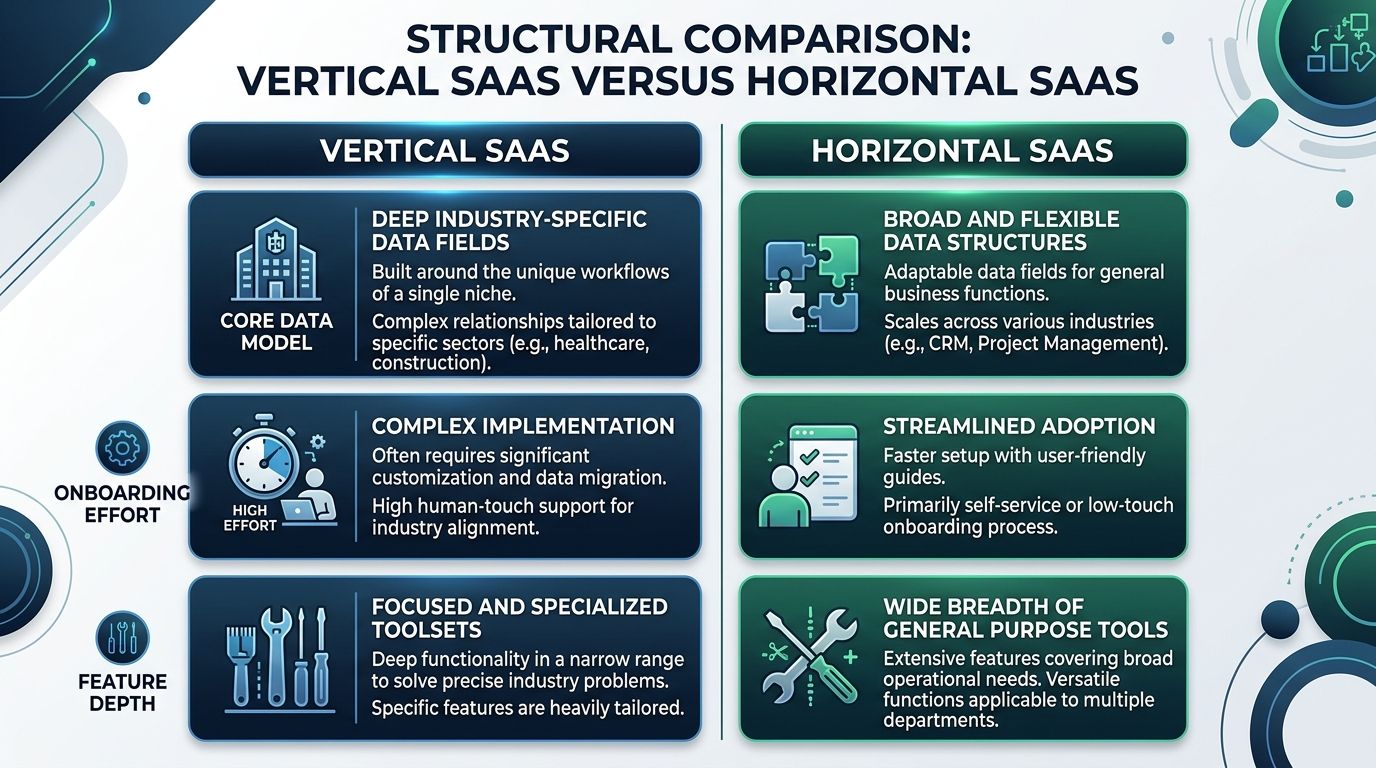
This is where vertical SaaS usually pulls ahead. Vertical software embeds the workflow into the product, so buyers do less field mapping, fewer process workarounds, and less custom object design.
Horizontal software gives buyers a flexible toolkit. That is powerful, but it also means customers often have to translate their business into the software before they get value.
| Product choice | Vertical SaaS | Horizontal SaaS |
|---|---|---|
| Core data model | Built around an industry object model, such as jobsites, tables, or claims | Built around reusable business objects, such as contacts, tickets, tasks, or messages |
| Onboarding effort | Lower if the industry fit is right | Lower at first for broad use cases, higher if heavy customization is needed |
| Feature depth | Deeper in one use case | Broader across many use cases |
| Buyer reaction | “This was built for people like us” | “We can adapt this to many teams” |
I have seen a practical middle path here too. In one six-month migration, a midmarket customer kept its horizontal CRM foundation but added a vertical operations layer built around industry-specific processes. Before the change, average contract value per seat was $18, annual churn was 8%, and 60% of support tickets were customization requests. After the add-on, ACV per seat rose to $27, churn fell to 3.5%, and customization requests dropped to 18%.
Adding industry-specific processes cut our support load and let us push value features instead of custom work.
That is why I do not treat vertical vs horizontal as a purity test. In practice, many strong SaaS products use a horizontal core and a vertical layer.
Scaling and Integration Capabilities

Horizontal SaaS usually scales faster because the base architecture can serve multiple industries and multiple team types. That is why I pay so much attention to APIs, marketplaces, and modular product design when I am choosing a SaaS tech stack.
Salesforce is a good example. Its ecosystem helps horizontal products expand through extensions instead of rebuilding the core every time a new use case appears. Its marketplace now carries thousands of solutions, including more than 1,000 pre-integrated sales apps alone, which makes horizontal adoption far easier inside complex organizations.
Vertical SaaS can scale well too, but the path is different. Growth often comes from deeper penetration inside a defined sector, land-and-expand motions, payments or embedded finance, and better retention, not from serving every industry at once.
Cloud infrastructure also favors scalable horizontal platforms. In Q1 2026, Synergy Research Group estimated global cloud infrastructure spending at $129 billion, with AWS at 28% share, Microsoft at 21%, and Google Cloud at 14%. That matters because horizontal products can piggyback on mature cloud, security, and integration layers instead of solving infrastructure from scratch.
The trade-off is that vertical platforms often have to tackle ugly integration work with legacy tools, industry databases, and compliance processes before the product feels complete. That is more work up front, but it can create a durable moat later.
Market Competition and Entry Barriers
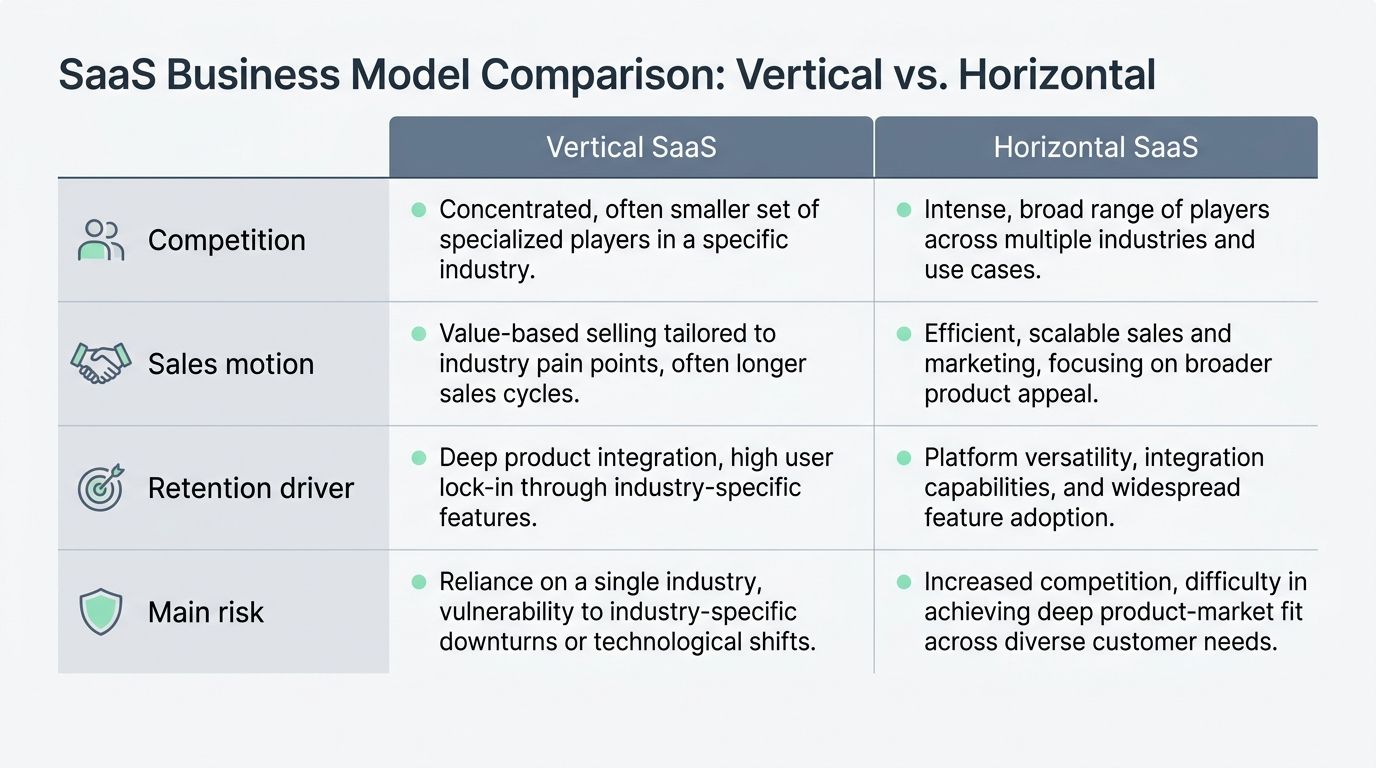
Horizontal SaaS categories are crowded because the market is visible and attractive. New entrants usually face higher pressure on brand, paid acquisition, and sales efficiency, especially in CRM, marketing, collaboration, and general project management.
That is one reason I am cautious about broad categories unless the product has a clear wedge. If your only pitch is “better UX” in a mature horizontal market, customer acquisition can get expensive fast.
Vertical SaaS usually faces fewer direct competitors, but stronger workflow expectations. Buyers will test whether you really understand their business, their data, and their compliance burden. If you do, you can earn pricing power and better retention. If you do not, you will lose credibility quickly.
I still like vertical plays for founders who know a specific vertical well. The moat comes from product depth, reference customers, lower waste in targeting, and cleaner expansion inside one account, not from brute-force spend on sales and marketing.
| Area | Vertical SaaS | Horizontal SaaS |
|---|---|---|
| Competition | Usually narrower, with more domain-heavy rivals | Usually broader, with more well-funded rivals |
| Sales motion | Industry proof and workflow fit matter most | Brand, breadth, and ease of rollout matter most |
| Retention driver | Operational dependence and embedded workflows | Cross-team adoption and integration depth |
| Main risk | Niche too small or too slow | Category too crowded or too generic |
Similarities Between Vertical and Horizontal SaaS
Even though vertical and horizontal SaaS feel very different in the market, they still share the same operating backbone. Both rely on a recurring subscription business model, cloud hosting, integrations, regular releases, and a constant push to improve customer value over time.
That matters because the strategy changes, but the SaaS math never really disappears.
Subscription-Based Model
Recurring revenue is still the engine behind both models. It improves planning, makes expansion easier to measure, and gives product leaders a better way to tie roadmap bets to retention and expansion revenue.
Veeva is a strong vertical example. In fiscal 2026, it reported $3.2 billion in revenue, including $2.684 billion in subscription revenue, and finished the year with 1,552 customers. That tells me vertical SaaS can build a large recurring base even in a focused market.
Horizontal companies show the same pattern from a different angle. HubSpot’s Q1 2026 results included $862.3 million in subscription revenue out of $881.0 million total revenue, which is exactly what you want to see in a SaaS business model built for expansion.
Cloud Hosting and Accessibility
Both vertical SaaS and horizontal SaaS depend on cloud infrastructure to ship faster, serve distributed teams, and keep customers off on-premises hardware. I still see AWS, Microsoft Azure, and Google Cloud as the default foundation for that reason.
Security and compliance matter just as much as uptime. AWS lists programs and frameworks such as HIPAA, SOC, PCI DSS, and FedRAMP on its compliance pages, but it also makes one thing clear: the customer still owns its own compliance responsibilities. That is a useful reminder for founders who think hosting alone solves a regulated use case.
- Cloud hosting lowers startup friction: buyers can access the software without local installs.
- Global delivery improves collaboration: distributed teams can work from the same live dataset.
- Security expectations rise: buyers now expect strong controls, clear permissions, and auditability by default.
- Architecture choices affect sales: in regulated verticals, infrastructure credibility can help win deals.
Ongoing Updates and Maintenance
Every serious SaaS product lives or dies by its release cadence. Customers expect fixes, features, compliance updates, and better performance to arrive continuously, not through painful upgrade projects.
I prefer a steady release rhythm because it reduces customer anxiety and keeps adoption from stalling. It also lets product teams respond to regulation changes, pricing experiments, and new use cases while the product is still in motion.
Observability has become part of that playbook. Datadog now promotes more than 1,000 supported integrations and more than 1,750 action integrations in App Builder, which shows how modern SaaS teams monitor, automate, and troubleshoot across increasingly messy stacks.
That applies to both vertical and horizontal software. Whether you are building a construction platform or a broad CRM, the maintenance burden is real, and the winners treat reliability as part of the product, not as back-office work.
Final Thoughts
I favor vertical SaaS when the problem is painful, workflow-heavy, and tied to a specific industry’s day-to-day operations. That is where depth can beat breadth. Horizontal SaaS still wins when the job is common across many industries and scale, ecosystem reach, and fast distribution matter more than domain specialization.
If you are weighing vertical SaaS vs horizontal SaaS, decide with brutal honesty about market size, integration load, sales motion, and how much industry knowledge your team truly has. The best SaaS business is the one whose workflow customers cannot live without.
Frequently Asked Questions (FAQs) About Horizontal Vs Vertical SaaS
1. What is the difference between vertical and horizontal SaaS?
Horizontal saas refers to software solutions designed for many industries, they are one of the types of saas and serve multiple verticals. Vertical saas targets specific industries, it focuses on niche needs and vertical use case features.
2. What are examples of horizontal saas companies and vertical saas providers?
Horizontal saas companies develop CRM, team chat platforms, and other saas applications that work across many sectors. Vertical saas providers build management software for fields like healthcare billing or restaurant operations.
3. What advantages does the vertical saas model offer?
Vertical saas model fits industry workflows, it can speed adoption and cut training time. Vertical saas tools often command higher prices, and they open clear vertical saas opportunities.
4. Should a startup build horizontal or vertical software?
Pick horizontal if you want a wide market and to build a horizontal saas business, cast a wide net and chase scale. Pick vertical if you want fast product market fit, deep customer ties, and a clear path to customers in one industry.
5. How do valuations differ between horizontal and vertical SaaS?
Valuation (finance) depends on growth, margins, and market size in the saas market. Enterprise saas that scales fast gets big multiples, but many vertical saas companies win strong niche valuations in the saas industry.
6. How does Artificial intelligence change horizontal and vertical SaaS?
Horizontal ai adds broad features to horizontal saas solutions, like smarter search and automation. Vertical ai tunes models for one field, it helps vertical saas providers predict outcomes and solve specific problems.