
Freemium vs free trial looks like a pricing question, but it is really a product, growth, support, and conversion question. That is where many SaaS teams get it wrong.
They see a competitor offering a free plan and think, “We need freemium.” Or they see another company using a 14-day trial and think, “Let’s copy that.” Then the problems start. Free users flood in but never upgrade. Trial users sign up but do not activate. Support costs rise. The team cannot tell whether the product is weak, the offer is wrong, or the wrong users are entering the funnel.
The truth is simple: freemium and free trials are not interchangeable.
A freemium model SaaS strategy works when users can get ongoing value from a limited version and naturally hit a reason to upgrade. A free trial SaaS model works when users need a focused window to experience the full product before making a buying decision.
Both can work beautifully. Both can also quietly damage growth if they do not match the product.
This guide will help you decide between freemium, free trial, reverse trial, and hybrid options using practical criteria: product complexity, time to value, support cost, user intent, conversion path, sales motion, and long-term SaaS growth.
What Is Freemium in SaaS?
Freemium is a SaaS model where users can access a free version of the product for an unlimited period, while paid plans unlock more features, usage, seats, storage, automation, integrations, reporting, or support.
The key idea is that the free product is useful enough to attract and retain users, but limited enough to create upgrade demand. Freemium is not the same as “free forever with no strategy.” A strong freemium model has a clear upgrade path. Users should understand why the paid version exists and when they need it.
Common freemium limits include:
- Feature limits
- Usage limits
- Seat limits
- Storage limits
- Export limits
- Branding limits
- Automation limits
- Integration limits
- Reporting limits
- Collaboration limits
- Support limits
For example, a design tool may let users create simple projects for free but charge for team collaboration, brand kits, advanced exports, or shared workspaces.
A project management tool may offer a free plan for small teams but charge when users need more seats, dashboards, automation, or permissions. The free plan is not just a giveaway. It is an acquisition and adoption engine.
What Is a Free Trial in SaaS?
A free trial gives users access to the product for a limited time before they need to pay. The trial may last 7, 14, 21, or 30 days, depending on the product and buying cycle. Some free trials require a credit card up front. Others do not.
A free trial SaaS model is built around urgency and evaluation. The user gets a limited window to experience the product, test key features, invite teammates, understand value, and decide whether it is worth paying for.
Free trials work well when the product’s value can be experienced quickly and when the user has enough intent to evaluate the product seriously.
Common free trial models include:
- No-credit-card free trial
- Credit-card-required free trial
- Full-access trial
- Limited-feature trial
- Usage-based trial
- Demo-assisted trial
- Team trial
- Enterprise pilot trial
A free trial is usually better when the product is too valuable, too expensive, too operationally heavy, or too support-intensive to keep free users forever.
Freemium vs Free Trial: The Core Difference
The biggest difference between freemium and free trial is not price. It is time and access. Freemium gives limited access for an unlimited time. Free trial gives broader access for a limited time. That difference changes user behavior.
With freemium, users can adopt slowly. They may explore casually, return later, invite others, and upgrade when they hit a limit.
With a free trial, users are under time pressure. They need to reach value quickly, or the trial expires before the product becomes important.
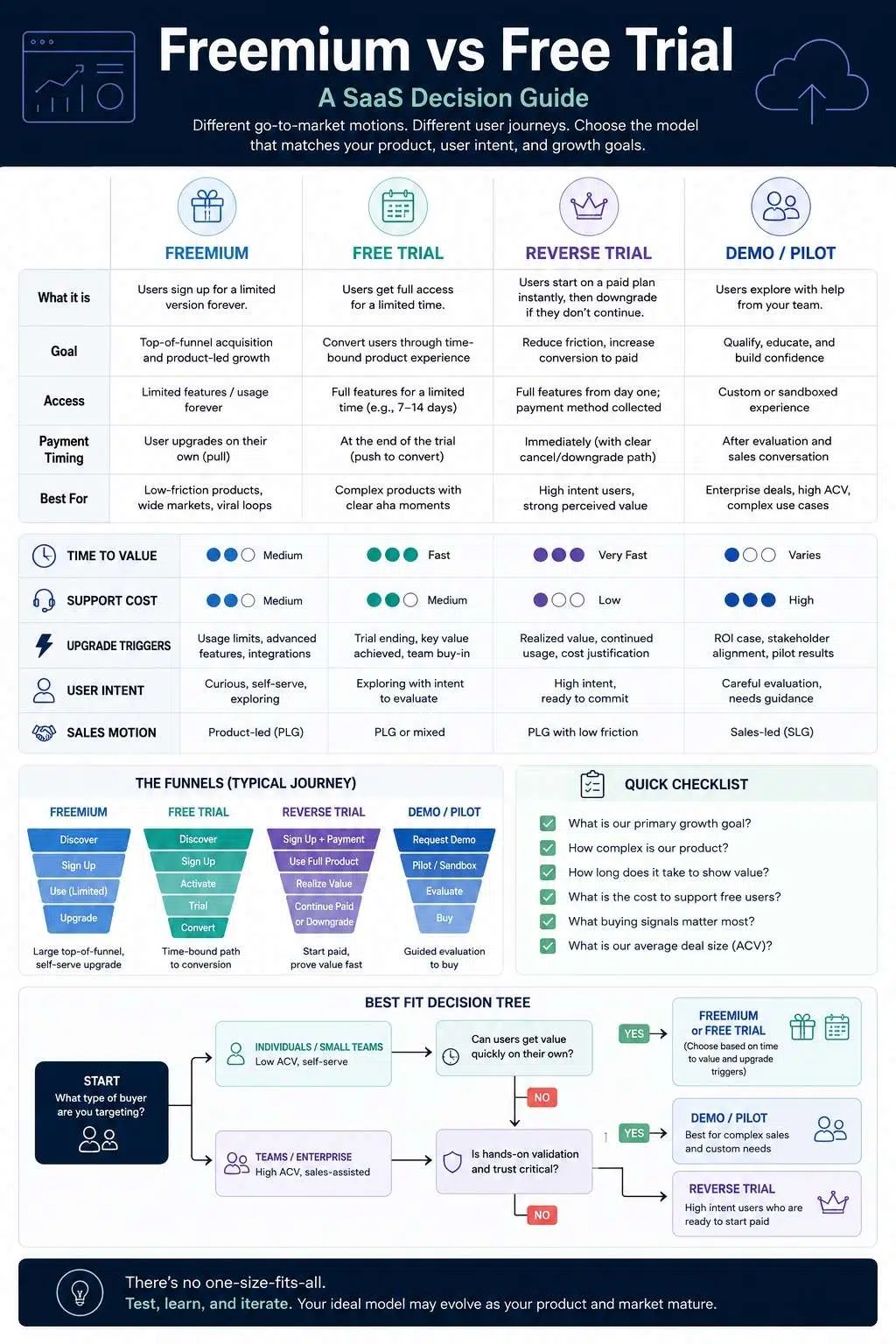
Here is the simple comparison:
| Model | Access | Time Limit | Best For |
| Freemium | Limited product access | No time limit | Simple, viral, self-serve products with low support cost |
| Free Trial | Full or broad product access | Limited time | Products that need urgency, complete evaluation, or higher intent |
| Reverse Trial | Full access first, then free plan downgrade | Trial period plus free tier | Products that want users to experience premium value before settling into free |
| Demo/Pilot | Guided access | Custom timeline | Complex B2B SaaS with buying committees or implementation needs |
This is why the trial vs free decision should start with product behavior, not competitor behavior.
Why This Decision Matters for SaaS Growth
The wrong model can create a messy funnel. If you choose freemium too early, you may attract thousands of low-intent users who consume product resources but never pay. Your team may feel busy while revenue barely moves.
If you choose a free trial for a product with a slow learning curve, users may expire before they understand the value. You may blame the pricing page when the real problem is time to value.
If you require a credit card too early, you may reduce signups. If you avoid credit cards entirely, you may attract less serious users.
If you offer too much for free, users may have no reason to upgrade. If you offer too little, they may never experience enough value to trust the product.
The model affects:
- Signup volume
- User quality
- Activation rate
- Support burden
- Product adoption
- Conversion rate
- Sales workload
- Customer acquisition cost
- Lifetime value
- Churn
- Expansion potential
That is why choosing between freemium vs free trial is not a small pricing-page decision. It shapes the whole SaaS growth system.
Choose Freemium When the Product Can Spread Naturally
Freemium works best when the product can grow through usage. This usually means users can start quickly, get value without a sales call, and invite others naturally.
Freemium is a strong fit when:
- The product is easy to understand
- Setup is simple
- Time to value is short
- Support cost per free user is low
- The free version has real value
- The paid version has obvious upgrade triggers
- Users can invite teammates or collaborators
- The product benefits from network effects
- The free user base can become a marketing channel
- The product has broad appeal
- Usage creates a habit over time
Freemium can work especially well for tools like:
- Design software
- Note-taking tools
- Project management apps
- Collaboration tools
- File-sharing tools
- Communication tools
- Developer tools
- AI tools with usage limits
- Scheduling tools
- Lightweight productivity apps
The best freemium products let users feel value quickly without needing a long explanation. If the user needs a setup call, a migration plan, custom training, or heavy configuration before value appears, freemium may become expensive and frustrating.

Choose Free Trial When Full Product Value Needs to Be Experienced
A free trial works well when users need to test the real product before buying. This is common when the paid product has important features that cannot be fully understood from a limited free plan.
A free trial is a better fit when:
- Users have stronger purchase intent
- The product solves a painful business problem
- Full access is needed to experience value
- The product has a clear evaluation window
- The buying decision happens quickly
- Support costs are manageable for trial users
- The trial can guide users to activation fast
- The product has a meaningful paid outcome
- There is a sales or onboarding team to assist
- The price point needs more trust before purchase
Free trials often work well for:
- B2B SaaS tools
- Analytics platforms
- Marketing automation tools
- CRM systems
- Sales software
- HR platforms
- Finance tools
- Reporting software
- Security tools
- Team productivity platforms
- SaaS products with strong premium features
A free trial gives users a focused experience. The challenge is that the trial clock starts immediately. If onboarding is weak, users may waste the trial period figuring out the basics.
Use a Credit Card Trial Carefully
A credit-card-required free trial can increase buyer seriousness, but it can also reduce signups. This model works when the product has strong demand, clear value, and enough trust before signup.
A credit card trial may be useful when:
- The product is expensive to provide
- You want to reduce low-intent users
- You sell to serious buyers
- The product has strong brand trust
- Users understand the value before starting
- The trial experience is polished
- The cancellation policy is clear
- Billing reminders are honest and timely
But be careful. If users feel tricked, they may cancel angrily, request refunds, or distrust the brand. A credit card trial should never depend on users forgetting to cancel. That may create short-term revenue, but it damages long-term trust.
If you use this model, make the rules clear:
- Trial length
- Billing date
- Plan after trial
- Cancellation process
- Reminder emails
- Refund policy
- Usage limits
A serious SaaS company should win paid customers through value, not confusion.
Use No-Credit-Card Trials When You Need More Product Evaluation
A no-credit-card free trial usually creates more signups because the barrier is lower. It works well when your team wants more users to experience the product before asking for payment.
This model is useful when:
- Users need to explore before trusting the product
- The market is competitive
- Brand awareness is still low
- The product is self-serve
- The trial can activate users quickly
- The sales team can identify product-qualified leads
- You want to reduce signup friction
- You have strong lifecycle emails or in-app guidance
The downside is that user intent may be weaker. Some people will sign up out of curiosity and never return. That is not always bad. It just means you need strong activation tracking.
Watch:
- Trial signup rate
- Setup completion
- First value moment
- Core feature usage
- Return visits
- Upgrade intent
- Demo requests
- Trial-to-paid conversion
- Support volume
A no-credit-card trial works best when your product can quickly separate serious evaluators from casual browsers.
Consider a Reverse Trial When You Want the Best of Both
A reverse trial gives users full premium access for a limited time. When the trial ends, they can either upgrade or continue on a limited free plan. This model combines the urgency of a trial with the long-term acquisition benefits of freemium.
Reverse trials can work well when:
- Premium features show value quickly
- You still want a free user base
- Users may not convert immediately
- Long-term free users can upgrade later
- The product has strong usage-based upgrade triggers
- You want users to understand what they lose after the trial
- Free users still provide growth value
For example, a user may start with all advanced features for 14 days. After that, they move to a free plan with limited seats, exports, automations, or reports unless they upgrade. This can be powerful because users first experience the full product.
They do not have to guess what the paid version feels like. But reverse trials need careful design. If the downgrade feels harsh or confusing, users may feel punished. Make the transition clear before the trial ends.
Freemium vs Free Trial Decision Framework
Use this framework before choosing a model.
1. How Fast Can Users Reach Value?
This is the first question. If users can reach value in minutes, freemium may work well. If users need setup, data import, team approval, training, or multiple sessions, a free trial or guided trial may be better.
Ask:
- Can users understand the product without help?
- Can they complete the first important action quickly?
- Does the product need customer data before it becomes useful?
- Does the user need teammates involved?
- Does the product need integrations?
- Can the value be felt in one session?
- Does the product require habit formation over time?
If the value is fast and simple, freemium has a chance. If the value is slower and deeper, a free trial needs strong onboarding and enough time.
2. How Expensive Are Free Users?
Free users are not free for the company. They may create costs through:
- Server usage
- AI credits
- Storage
- Bandwidth
- Support tickets
- Customer success time
- Abuse prevention
- Data processing
- Email volume
- Compliance risk
- Community moderation
A freemium model SaaS strategy only works if free users are affordable at scale. If every free user costs real money, you need limits.
Examples:
- AI tools may limit credits or generations
- Storage tools may limit file size
- Email tools may limit sends
- Analytics tools may limit tracked events
- Automation tools may limit workflows
- API tools may limit requests
The free plan should let users experience value without turning the business into a charity.
3. Does the Product Have Natural Upgrade Triggers?
Freemium needs clear upgrade moments. Users should eventually run into a limit that makes sense.
Good upgrade triggers include:
- Need more seats
- Need more projects
- Need advanced reporting
- Need integrations
- Need automation
- Need team permissions
- Need higher usage limits
- Need branding removed
- Need exports
- Need support
- Need security controls
- Need admin features
Bad upgrade triggers feel artificial. For example, blocking a basic action too early can stop users before they experience value. Giving away too much can remove any reason to pay. The best upgrade trigger appears after the user already understands the product’s value. That timing matters.
4. How Complex Is the Buying Decision?
Some SaaS products are bought by one person. Others require a team, manager, finance department, security review, or procurement process. Freemium works better when an individual user can start and expand usage naturally. Free trials or pilots work better when the product requires a more serious buying process.
Ask:
- Is this a solo purchase or a team purchase?
- Does the buyer need approval?
- Does IT need to review it?
- Does finance need to approve it?
- Does the product affect sensitive data?
- Does setup require migration?
- Does the customer need training?
- Does the customer need proof before buying?
If the buying process is complex, a simple freemium plan may not be enough. You may need a guided trial, demo, proof of concept, or pilot.
5. What Type of Users Do You Want to Attract?
Freemium attracts a wider audience. That can be good if your product grows through volume, community, templates, referrals, or user-generated momentum. But it can also attract users who are not close to paying. Free trials usually attract fewer users but often with stronger intent.
Ask:
- Do we want maximum adoption or higher-intent evaluation?
- Can we handle many free users?
- Do free users help growth even if they do not pay?
- Are we building a broad user base or qualifying serious buyers?
- Does our team need more usage data or more sales-ready leads?
- Are we trying to educate the market or convert existing demand?
There is no universal answer. A product-led design tool may benefit from many free users. A niche B2B compliance platform may not.
6. How Strong Is Your Onboarding?
A free trial exposes onboarding weaknesses quickly. If users cannot reach a value before the trial ends, they will not convert. Freemium is more forgiving because users can return later. But that does not mean onboarding can be weak. If users do not understand the product, they may never build the habit that leads to upgrading.
For both models, onboarding should answer:
- What should users do first?
- What is the first value moment?
- What can wait until later?
- Where do users drop off?
- What help appears at the right time?
- What emails are triggered by behavior?
- What templates or sample data reduce friction?
- How do users know they made progress?
A pricing model cannot rescue bad onboarding.
7. What Is Your Sales Motion?
Your sales motion should shape the model.
Product-Led SaaS
Freemium or no-credit-card trials often work well when users can self-serve and upgrade through product usage.
Sales-Assisted SaaS
Free trials, guided trials, or reverse trials often work better when sales can help serious users evaluate the product.
Enterprise SaaS
A pure freemium model is usually less useful unless individual users can adopt first and later influence enterprise buying.
Enterprise buyers often need demos, pilots, security reviews, procurement steps, and custom onboarding.
Hybrid SaaS
Some SaaS companies use freemium for individuals and sales-assisted motion for teams or enterprise accounts. This can work well if the handoff is clear.
For example:
- Individual user starts free
- Team usage grows
- Product signals show account potential
- Sales reaches out with a team plan
- Customer success helps adoption
This is where product-qualified leads become important.
8. What Will You Measure?
Choosing freemium or a free trial without measurement is guessing.
For freemium, track:
- Free signup rate
- Activation rate
- Free-to-paid conversion
- Product-qualified leads
- Feature limit hits
- Upgrade page visits
- Active free users
- Team invites
- Retention of free users
- Support cost per free user
- Paid conversion by cohort
- Revenue from converted users
For free trials, track:
- Trial signup rate
- Trial activation rate
- Time to first value
- Trial engagement
- Trial-to-paid conversion
- Credit-card vs no-card conversion
- Trial extension requests
- Sales-assisted conversion
- Support usage during trial
- Drop-off points
- Payment conversion
- Trial churn after first payment
For reverse trials, track:
- Premium feature usage
- Trial-to-paid conversion
- Downgrade-to-free rate
- Free user retention after downgrade
- Later upgrade rate
- Feature loss reactions
- Expansion from free users
The best model is not the one that sounds good. It is the one your data can support.
When Freemium Is the Better Choice
Freemium is usually better when the product has low friction, low marginal cost, and broad adoption potential.
Choose freemium when:
- Users can start without help
- The product is easy to explain
- The free version is useful
- Upgrade triggers are natural
- Free users can invite others
- The product can spread through teams or by sharing
- Support costs are controlled
- You can handle high signup volume
- Free users create brand awareness
- Paid plans unlock meaningful business value
Freemium is not ideal if the product is expensive to provide, hard to onboard, or useful only after deep setup. A weak freemium plan can create a graveyard of free accounts. A strong freemium plan creates a pipeline of users who already understand the product.
When Free Trial Is the Better Choice
A free trial is usually better when the product needs focused evaluation, and the buyer has a stronger intent.
Choose a free trial when:
- Users need premium access to judge value
- The product solves a serious business problem
- Setup can happen within the trial window
- The product has higher pricing
- The team needs fewer but stronger leads
- Sales can support high-intent trials
- The trial experience is polished
- The product has clear success milestones
- The value can be proven before payment
- Free users would be expensive to support forever
A free trial is not ideal if users need months to build value or if onboarding is too confusing. The clock should create focus, not panic.
When You Should Use Neither
Sometimes neither freemium nor a standard free trial is the right choice. You may need a demo, pilot, consultation, paid trial, or proof of concept.
This is often true when:
- The product is enterprise-focused
- Setup is complex
- Data migration is required
- A security review is needed
- Pricing is custom
- Success requires implementation
- The buying committee is large
- The product affects critical operations
- A poor setup could damage trust
- The buyer needs a guided evaluation
In these cases, a “start free” button may create the wrong experience. A guided demo or pilot may convert better because it matches how the buyer actually decides.

Common Mistakes When Choosing Freemium vs Free Trial
1. Copying Competitors Without Understanding Their Funnel
A competitor’s pricing page does not show their activation data, support costs, conversion rates, sales motion, or churn.
Do not copy the visible part of a model while ignoring the hidden economics.
2. Giving Away Too Much in Freemium
If the free plan solves the whole problem for your best users, they may never upgrade.
Free should be useful, not complete.
3. Giving Away Too Little in Freemium
If the free plan is too restricted, users never experience value.
Then, freemium becomes a bad demo instead of a growth engine.
4. Making the Trial Too Short
A 7-day trial may work for simple tools. It may fail for products that need setup, team adoption, data import, or workflow change.
Trial length should match time to value.
5. Using Credit Card Trials to Trap Users
This may increase short-term revenue, but it hurts trust if users feel misled.
Clear reminders and easy cancellation are better for long-term brand health.
6. Ignoring Support Cost
A large free user base can overwhelm support if the product is confusing.
Freemium needs strong self-serve education.
7. Not Designing Upgrade Triggers
Upgrade prompts should appear when users understand the value and need more capability.
Random paywalls feel annoying. Timely paywalls feel logical.
8. Treating Trial Users the Same
A user who has completed setup needs different guidance from a user who has not logged in since signing up.
Behavior-based onboarding matters.
Freemium vs Free Trial Comparison
| Decision Factor | Freemium Works Better When | Free Trial Works Better When |
| Time to value | Value appears quickly | Value needs full product access |
| Product complexity | Simple and self-serve | Moderate to complex |
| User intent | Broad audience | Higher-intent evaluators |
| Cost to serve | Low cost per free user | Higher product/support cost |
| Upgrade path | Natural limits drive upgrades | Trial deadline drives decision |
| Sales motion | Product-led growth | Product-led or sales-assisted |
| Support needs | Mostly self-serve | More guided support possible |
| Best conversion moment | After usage habit forms | After focused evaluation |
| Ideal product type | Viral, collaborative, simple tools | Business-critical or premium tools |
| Main risk | Too many free users, low conversion | Trial expires before value appears |
This table should not make the decision for you. It should help you ask better questions.
A Simple Decision Tree
Use this quick decision tree.
Choose Freemium If:
- Users can get value quickly
- The product is easy to use
- Free users are cheap to support
- The product can spread naturally
- Upgrade triggers are clear
- You want long-term product-led acquisition
Choose Free Trial If:
- Users need full access to evaluate
- The product has a clear value window
- The buyer has a stronger intent
- Support cost is higher
- Paid conversion needs urgency
- The product has a more serious business use case
Choose Reverse Trial If:
- Premium value is much stronger than free value
- You want users to feel the paid experience first
- You still want a free plan after the trial
- Long-tail free users may upgrade later
Choose Demo or Pilot If:
- The product is complex
- Setup requires guidance
- Security or procurement is involved
- Pricing is custom
- The customer needs a business case
- The buying committee is large
The right model should match the way users experience value.
How to Test the Model Before Fully Committing
You do not need to make a permanent decision on day one.
Test carefully.
Test Freemium With Clear Limits
Start with a free plan that includes enough value to activate users, but enough limits to encourage upgrading.
Watch:
- Do users activate?
- Do they return?
- Do they hit limits?
- Do they understand the paid plan?
- Do they invite others?
- Do support costs stay manageable?
- Do free users become qualified leads?
Test Free Trial With Strong Onboarding
Run a trial with clear activation goals.
Watch:
- How many users complete the setup?
- How long does it take to reach value?
- Which trial users convert?
- Where do users drop off?
- Does sales assistance improve conversion?
- Does trial length affect behavior?
Test Reverse Trial for Premium Discovery
Let users experience premium features first, then downgrade to free if they do not upgrade.
Watch:
- Which premium features drive conversion?
- How many users downgrade?
- Do downgraded users stay active?
- Do they upgrade later?
- Does the downgrade feel fair?
Do not judge the model only by signup volume. A pricing model should be judged by activation, conversion, retention, revenue, and customer fit.
How Long Should a SaaS Free Trial Be?
The right trial length depends on time to value.
- A simple SaaS product may only need 7 days.
- A business workflow tool may need 14 days.
- A team-based or data-heavy product may need 21 or 30 days.
Instead of guessing, ask:
- How long does setup take?
- How long until the user sees real value?
- Does the user need teammates?
- Does the user need data import?
- Does the user need approval?
- Does the product require repeated use?
- Does support or sales need time to help?
- Does a shorter trial create urgency or anxiety?
Short trials can increase urgency, but they can also punish users who need more time. Long trials can improve evaluation, but they can also reduce urgency. A good trial is long enough to reach value and short enough to encourage action.
Should a SaaS Free Trial Require a Credit Card?
This depends on your goals. A credit card trial may reduce low-intent signups and create a cleaner trial funnel. But it may also reduce total signups because users feel more risk. A no-credit-card trial usually brings more users into the product. But many may be casual and less likely to convert.
Use a credit card trial when:
- The product has strong trust
- The value is obvious before signing up
- The trial is expensive to provide
- You need serious evaluators
- The market accepts this model
- Your cancellation process is transparent
Use a no-credit-card trial when:
- You need more product exposure
- The brand is still building trust
- Users need to explore first
- The product is self-serve
- You have strong activation systems
- You want more product-qualified leads
The answer is not moral. It is strategic. But the execution must be honest either way.
How to Design a Freemium Plan That Converts
A freemium plan should help users succeed, but it should not remove the need for paid plans.
Use these principles:
Give Enough Value to Build Trust
Users should be able to complete a real use case.
If the free plan is useless, it will not create adoption.
Limit Based on Growth, Not Random Friction
Good limits feel natural:
- More seats
- More projects
- More usage
- More automation
- More storage
- More exports
- More integrations
- More reporting
Bad limits block basic understanding.
Put Team and Business Value Behind Paid Plans
Many SaaS users pay when the product becomes important to a team, workflow, or business result.
Paid features often include:
- Collaboration
- Admin controls
- Advanced reporting
- Permissions
- Integrations
- Automation
- Security
- Support
- Branding
- Compliance
- Higher usage limits
Show Upgrade Prompts at the Right Moment
Upgrade prompts should appear when users understand why they need more.
For example:
- User hits seat limit
- User wants an advanced report
- User needs export
- User connects more tools
- User creates more projects
- User wants team permissions
The prompt should feel helpful, not random.
How to Design a Free Trial That Converts
A free trial should be built around activation. Do not simply unlock the product and hope users figure it out.
A strong free trial includes:
- Clear welcome screen
- One primary activation goal
- Setup checklist
- Sample data or templates
- Behavior-based emails
- In-app guidance
- Helpful empty states
- Trial progress reminders
- Clear upgrade path
- Optional demo or support
- Trial-ending reminder
- Post-trial follow-up
The trial should answer:
- What should the user do today?
- What result should they reach?
- What is the next step?
- What value have they already seen?
- Why should they continue after the trial?
Trial conversion usually improves when users reach value early. The payment page is not where conversion begins. It begins inside onboarding.
Trial vs Free: Which One Is Better for B2B SaaS?
For B2B SaaS, the answer depends on product complexity and buying motion. Freemium can work well for B2B products when individual users can adopt first and later bring the product into a team.
This is common in:
- Collaboration tools
- Developer tools
- Design tools
- Productivity platforms
- Project management tools
- Lightweight analytics tools
Free trials often work better when the product requires evaluation by a business buyer.
This is common in:
- CRM
- HR software
- Finance software
- Security software
- Marketing automation
- Sales enablement
- Reporting platforms
- Customer support software
Enterprise SaaS may need guided pilots instead of either model. The more complex the buying decision, the more important guided evaluation becomes.
What About Paid Trials?
A paid trial can work when setup is costly, buyer intent needs to be serious, or the product requires expert involvement. Paid trials are less common in simple self-serve SaaS, but they can make sense for:
- Enterprise software
- Implementation-heavy products
- Consulting-assisted SaaS
- Data migration tools
- AI tools with high usage costs
- Specialized B2B platforms
- Security or compliance tools
A paid trial should offer real value, not just access. For example, a paid pilot may include onboarding, custom setup, training, support, and a success review. Use paid trials when free access would attract the wrong audience or incur too much cost.
Final Recommendation: Match the Model to the Value Journey
Freemium vs free trial is not about which model is trendier. It is about how your users reach value. Choose freemium when users can start fast, adopt naturally, and upgrade when their needs grow. Choose free trial when users need focused access to experience the full product before paying.
Choose reverse trial when premium value is important to experience, but you still want a free tier for long-term adoption. Choose a demo or pilot when the product is complex, expensive, or tied to serious business decisions.
The wrong model creates noise. The right model creates momentum. Before copying a competitor, study your own product:
- How fast do users reach value?
- What does it cost to serve free users?
- What behavior predicts payment?
- What limits create fair upgrade demand?
- What model brings the right users?
- What onboarding path converts interest into adoption?
- What does retention look like after conversion?
A good SaaS pricing model does not just increase signups. It helps the right users experience value, understand the product, and choose the paid path when the timing makes sense. That is the real decision.
Frequently Asked Questions About Freemium vs Free Trial
1. What is the difference between freemium and free trial?
Freemium gives users limited access to a product for an unlimited time, while a free trial gives users access for a limited period. Freemium is better for ongoing adoption and broad product-led growth, while free trials are better for focused product evaluation.
2. Is freemium better than a free trial for SaaS?
Freemium is better when the product is easy to adopt, inexpensive to support, and has clear upgrade triggers. A free trial is better when users need full access, stronger intent, or a focused period to evaluate value before paying.
3. When should a SaaS company use a free trial?
A SaaS company should use a free trial when users can reach value within a defined time window, the product has a serious business use case, full access helps evaluation, and the company can guide users toward activation before the trial ends.
4. When should a SaaS company use a freemium model?
A SaaS company should use a freemium model when the product is simple to start, free users are inexpensive to support, the product can spread naturally, and paid upgrades are triggered by usage, team growth, advanced features, or business needs.
5. What is a reverse trial in SaaS?
A reverse trial gives users premium access for a limited time. When the trial ends, users can either upgrade to a paid plan or continue on a limited free plan. It combines the urgency of a trial with the long-term acquisition benefits of freemium.
6. Should a SaaS free trial require a credit card?
A SaaS free trial should require a credit card only when the product has strong trust, clear value, and a serious buyer audience. No-credit-card trials are better when the company wants lower signup friction, more product exposure, and more product-qualified leads.