
Procrastination is rarely a character flaw or a simple lack of discipline. More often, it is an emotional regulation problem. When a project feels overwhelming, vague, or boring, your brain protects you from discomfort by steering your focus toward easier, more immediate activities, like checking email, scrolling social media, or tidying your workspace.
Waiting for motivation to strike before starting a difficult task is a trap. Motivation usually follows action, not the other way around. Learning how to overcome procrastination today requires lowering the physical and mental barriers that keep you from taking the very first step.
Here are 10 practical strategies designed to break inertia and restore momentum to your workflow.
10 Practical Strategies to Overcome Procrastination Today
1. Shrink the Initial Commitment to Five Minutes
Focusing on the hours of effort required to complete a complex project causes immediate mental resistance. Tell yourself you only have to work on the task for five minutes. If you want to stop after five minutes, give yourself explicit permission to do so.
In most cases, crossing the starting line breaks the initial paralysis, helping you overcome procrastination today without waiting for perfect energy levels or ideal working conditions.
2. Break Down Vague Tasks Into Next Physical Actions
A line on your to-do list that says “Tax Return” or “Quarterly Report” is too broad. Your brain views vague tasks as complex threats, making you more likely to avoid them.
Translate nebulous projects into single, concrete physical actions. Instead of writing “Tax Return,” write “Find last year’s W-2 form in the blue file folder.” Clarifying the immediate physical step eliminates the decision fatigue that triggers delay.
3. Separate Planning from Execution
Trying to figure out what to do at the exact moment you sit down to work creates unnecessary friction. Deciding which email to answer or which draft to edit consumes valuable energy before you even begin.
Spend five minutes at the end of each afternoon mapping out your primary priorities for the following morning. When you start work the next day, you can jump straight into execution without wasting mental clarity on decision-making.
4. Use Implementation Intentions to Trigger Action
Vague goals like “I will write tomorrow” rarely lead to consistent action. Implementation intentions use a simple conditional formula: “When situation X arises, I will perform response Y.”
For example, tell yourself, “When I sit down with my morning coffee, I will open the project proposal draft.” Tying a target behavior to a specific time, place, or existing daily routine creates an automatic mental trigger that bypasses hesitation.
5. Remove Environmental Friction Points
If starting a task requires hunting for files, clearing off your physical desk, or searching for forgotten login credentials, that extra friction gives your brain an easy excuse to postpone the work.
Prepare your environment in advance. Open the relevant software tabs, place physical notebooks where you can see them, and move distracting devices into another room before your focus session begins.
6. Swap Artificial Deadlines for Short Work Sprints
Distant deadlines encourage delay because there is no immediate pressure to act. Instead of relying on a deadline that is three weeks away, set a timer for a 25-minute work sprint.
Knowing that the effort is strictly time-bound makes high-friction work feel manageable. Once the timer rings, step away for five minutes to stretch before deciding whether to launch another sprint.
7. Practice Productive Procrastination Strategically
If you find yourself resisting your primary task, direct that restless energy toward secondary items that still hold value for your day.
Reorganize your digital file folders, clear out administrative backlog, or respond to routine inquiries. While you are delaying your main project, you are still completing necessary tasks. Once those minor items are out of the way, your mind is often ready to tackle the main project with less clutter.
8. Address the Underlying Fear of Imperfection
Perfectionism is a primary driver of chronic delay. When the expectation is flawless execution, starting feels risky and intimidating.
Lower your standards for the initial draft. Give yourself permission to produce a rough, imperfect first attempt. You can edit, polish, and improve mediocre work, but you cannot edit a blank page. Accepting imperfection is a necessary mindset shift when attempting to overcome procrastination today.
9. Pair Low-Motivation Tasks with Immediate Rewards
Tasks that offer no immediate satisfaction are easily pushed aside in favor of quick entertainment. Combine a tedious activity with something enjoyable to balance the experience.
Listen to an engaging podcast while sorting through financial receipts, or work on a routine spreadsheet at a favorite local cafe. Pairing immediate positive feedback with a dry administrative task reduces your natural resistance.
10. Establish a Clean Daily Off-Ramp
Working without a clear end point breeds mental exhaustion, making you dread starting again the next morning.
Set a firm stopping time for your workday and honor it. When you know there is a definite boundary where work ends and personal life begins, you are less likely to drag tasks out across the entire evening. A predictable end to the workday restores cognitive energy for the tasks ahead.
What Most Anti-Procrastination Advice Gets Wrong
Standard advice often recommends pushing through resistance with sheer willpower or enforcing rigid, minute-by-minute schedules. This approach fails to address the root cause of procrastination: negative emotional association with the task.
When you dread a task because it feels boring, difficult, or tied to potential failure, no amount of force will create sustainable focus. Real progress comes from modifying the task itself, lowering the entry barrier, and creating immediate momentum. Focus on reducing friction rather than attempting to force discipline.
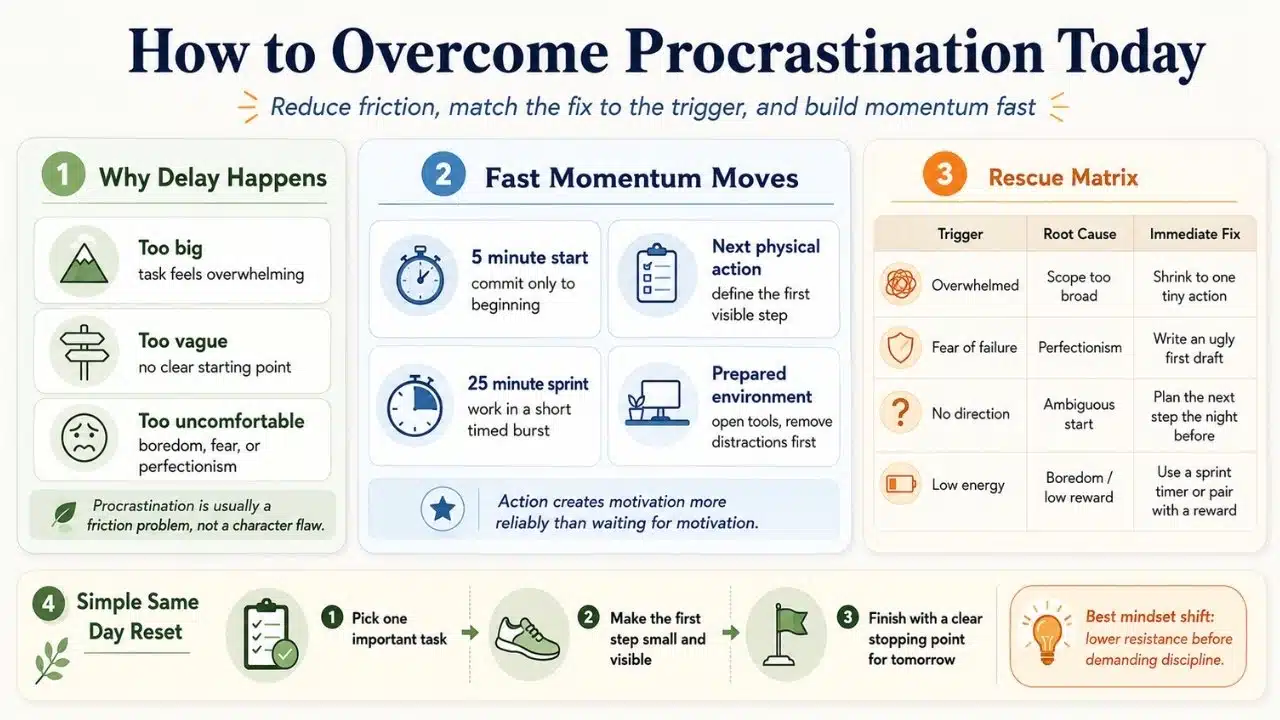
Procrastination Rescue Matrix
Use this matrix to identify your specific delay trigger and apply an immediate fix:
| Procrastination Trigger | Underlying Root Cause | Immediate Actionable Fix |
| Task feels overwhelming | Scope is too broad | Isolate one tiny physical action that takes under two minutes. |
| Dread of failure | High perfectionism standards | Write a deliberate “ugly draft” to remove standards pressure. |
| Lack of direction | Ambiguous starting point | Map out step-by-step physical actions the evening before. |
| Boredom and low energy | Lack of immediate reward | Pair the task with an engaging podcast or work sprint timer. |
Final Thoughts on How to Overcome Procrastination Today
Breaking chronic delay is not about completely changing your personality or adopting complex management software. It is about recognizing the moments when you resist a task and applying targeted friction reduction. By taking small, concrete steps and keeping initial commitments manageable, you can build steady momentum and overcome procrastination today.
Frequently Asked Questions (FAQs) About Overcoming Procrastination
Why do I procrastinate even on tasks I actually want to complete?
Procrastination can occur even on meaningful projects if expectations feel too high or if the process lacks immediate structure. When the pressure to succeed creates anxiety, your brain reacts to that pressure by seeking temporary relief through delay, regardless of how much you value the end goal.
Is chronic procrastination a sign of ADHD or burnout?
While procrastination is a common human tendency, chronic difficulty starting tasks can be linked to executive dysfunction, ADHD, or emotional burnout. If task paralysis causes significant distress across all areas of life despite using low-friction strategies, consulting a healthcare professional can offer tailored guidance.
What is the single fastest way to break procrastination right now?
The fastest way to break delay is to reduce your target action to a task so small it creates zero mental resistance. Open the document, write a single sentence, or set a timer for two minutes. Focus purely on crossing the starting line rather than finishing the broader project.