Have you ever stopped to wonder how your phone knows exactly what you want to type next? Or why your streaming app recommends the perfect movie for a rainy Friday night? We rarely think about it, but the reality is that artificial intelligence quietly operates behind the scenes of our routines. From the moment your alarm goes off to the time you set your security system at night, AI in daily life plays a massive part in shaping your decisions, entertainment, and productivity.
According to recent data, about 1.8 billion consumers use automated tools regularly, and 78% of global companies are expected to use these systems by the end of 2025. You might not even realize it, but these invisible algorithms help the average worker save up to 2.5 hours a day. Let’s break down exactly how these systems operate under the radar and change the way you live.
1. Smart Home Devices and Personal Assistants
Artificial intelligence brings an incredible level of convenience to our living spaces. These smart tools learn our habits, adjust to our preferences, and automate the mundane chores we used to do manually. You no longer have to worry about leaving the lights on or adjusting the thermostat before you leave for work, because the system handles it all for you.
Transforming the Modern Living Space
Voice-activated assistants like Alexa and Siri rely on advanced natural language processing to understand your spoken commands. When you ask for the weather forecast or tell your speaker to play a specific song, the device translates your voice into data, processes it through cloud servers, and instantly delivers the result. These systems do much more than just set cooking timers. They manage your home’s energy consumption, control smart locks, and adapt your lighting based on the time of day.
This seamless integration turns an ordinary house into a highly responsive environment. The technology actually anticipates your needs before you explicitly communicate them. For example, your smart thermostat learns what temperature you prefer at bedtime and automatically adjusts it right before you go to sleep.
Here is a quick look at how automated home systems impact your everyday routine.
| Smart Device Category | Primary Function | Everyday Impact |
| Thermostats | Learns heating and cooling preferences | Reduces monthly energy bills automatically |
| Security Cameras | Identifies familiar faces versus strangers | Sends targeted alerts to your smartphone |
| Smart Speakers | Processes voice commands via internet | Controls multiple home appliances hands-free |
| Lighting Systems | Adjusts brightness based on natural light | Improves sleep cycles and saves electricity |
2. Personalized Content and Entertainment Algorithms
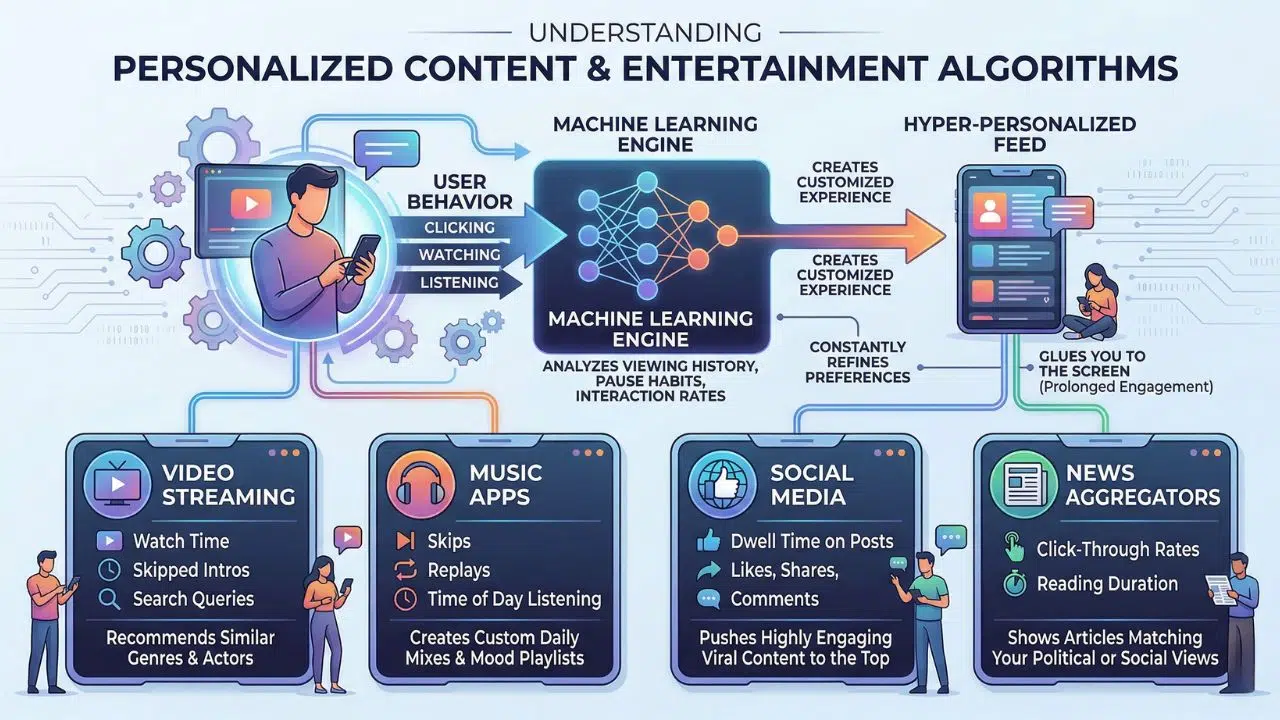
The media we consume is no longer a product of random channel surfing. Highly sophisticated predictive models now dictate what articles we read, what videos we watch, and what music we listen to. These systems track your behavior to keep you engaged as long as possible.
The Psychology of Streaming and Scrolling
Streaming platforms and social media networks utilize machine learning to analyze your viewing history, pause habits, and interaction rates. Every time you like a post, skip a song, or binge-watch a series, you feed valuable data into the system. The platform then uses this massive amount of behavioral data to create a hyper-personalized feed designed specifically for your tastes.
This is why two people opening the exact same app will see completely different homepages. The algorithms constantly refine their understanding of your individual preferences. They know if you prefer action movies on weekends or short comedy clips during your lunch break. While this makes discovering new content effortless, it also keeps you glued to your screen longer than you probably intended. We experience AI in daily life most frequently through these endless, customized scrolls.
Below is a breakdown of how different platforms use your data to curate content.
| Entertainment Platform | Data Tracked | Resulting Action |
| Video Streaming | Watch time, skipped intros, search queries | Recommends similar genres and actors |
| Music Apps | Skips, replays, time of day listening | Creates custom daily mixes and mood playlists |
| Social Media | Dwell time on posts, likes, shares, comments | Pushes highly engaging viral content to the top |
| News Aggregators | Click-through rates, reading duration | Shows articles matching your political or social views |
3. Healthcare, Wearables, and Predictive Medicine
Medical technology has completely shifted from reactive treatments to proactive health monitoring. Intelligent algorithms now live right on our wrists, keeping a constant watch over our vital signs. This technology helps catch potential issues long before they become emergencies.
Your Invisible Medical Monitor
Wearable fitness trackers and smartwatches monitor your heart rate variability, blood oxygen levels, and sleep cycles in real-time. These devices use advanced analytics to establish your personal health baseline. If your heart rate spikes abnormally while you are resting, the watch can alert you to potential anomalies before any physical symptoms arise. I find it amazing that a simple watch can now detect irregular heart rhythms like atrial fibrillation.
On a larger scale, doctors and hospitals use similar predictive models to scan medical imaging. These tools help radiologists spot early signs of diseases like cancer or pneumonia with an accuracy rate that frequently surpasses traditional diagnostic methods. The integration of AI in daily life through health apps means you now carry a preventative medical tool wherever you go. About 12% of adults report their healthcare providers already use these advanced tools for diagnosis and treatment planning.
This table highlights the main ways intelligent algorithms support personal health.
| Health Technology | Key Feature | Patient Benefit |
| Smartwatches | Continuous heart rate and ECG monitoring | Early detection of irregular heartbeats |
| Sleep Trackers | Analyzes deep sleep and REM cycles | Provides actionable tips for better rest |
| Medical Imaging | Scans X-rays and MRIs for anomalies | Speeds up accurate disease diagnosis |
| Virtual Health Apps | Triage symptoms via chatbot | Reduces unnecessary urgent care visits |
4. Financial Security and Fraud Detection
The stability of our digital financial systems relies heavily on automated sentinels. These silent programs monitor every single transaction you make, looking for suspicious behavior. You probably don’t notice them until they save you from a stolen credit card charge.
Safeguarding Digital Transactions with AI in Daily Life
Every time you swipe a debit card or buy something online, artificial intelligence evaluates the transaction against millions of data points within milliseconds. These systems analyze your physical location, usual spending habits, and the merchant’s history to identify anomalous patterns. If you buy a coffee in New York and then try to purchase a television in Paris ten minutes later, the system instantly flags the transaction and blocks the card.
Beyond basic security, these same predictive capabilities help determine your credit score, automate stock trading, and provide personalized financial advice. Robo-advisors analyze market trends and automatically adjust your investment portfolio based on your risk tolerance. Around 77% of financial institutions already utilize these algorithms for wealth management, proving just how deeply embedded this technology is in modern banking.
Here is a look at the automated tools keeping your money safe.
| Financial Tool | Primary Function | Consumer Benefit |
| Fraud Detection | Flags unusual spending behavior instantly | Blocks unauthorized credit card transactions |
| Biometric Logins | Analyzes unique facial or voice features | Secures mobile banking apps from hackers |
| Robo-Advisors | Automates investment portfolio changes | Maximizes returns based on personal risk profiles |
| Credit Assessment | Evaluates thousands of financial data points | Speeds up mortgage and loan approval processes |
5. Education, Learning, and Smart Workflows
The way we learn and work has undergone a massive transformation. Automated systems now help students understand complex topics and allow professionals to blast through their daily tasks. We are moving away from one-size-fits-all education and tedious administrative work.
Boosting Productivity and Personalizing Education
Platforms like Duolingo and Khan Academy use smart algorithms to adapt lessons based on how an individual student learns. If you struggle with a specific math concept, the system notices your mistakes and generates more practice problems focused entirely on that weak spot. Recent surveys indicate that 43% of higher education students utilize these powered tools to enhance their studying.
In the workplace, these tools are just as powerful. From summarizing long email threads to generating meeting notes in real-time, AI in daily life frees up hours of our week. Programs can scan your inbox, extract actionable items, and create tasks in your project management software automatically. This eliminates the mental overhead of manually processing emails and ensures important requests never fall through the cracks. Workers using these tools report saving up to four hours a week, giving them more time for creative and strategic thinking.
This table details the everyday tools improving how we work and study.
| Smart Application | Use Case | Time-Saving Benefit |
| Adaptive Tutors | Customizes lesson plans for students | Focuses study time only on weak areas |
| Meeting Assistants | Transcribes and summarizes video calls | Eliminates the need for manual note-taking |
| Grammar Checkers | Suggests tone and clarity improvements | Speeds up the writing process for emails |
| Schedule Managers | Finds optimal meeting times for teams | Removes back-and-forth calendar negotiations |
Embracing the Next Technological Leap
The transition from visible technological tools to invisible digital partners is already well underway. You don’t need to be a computer scientist to benefit from these advancements. Whether it is a smartwatch tracking your sleep, a bank securing your purchases, or a streaming service finding your next favorite show, the impact of AI in daily life is undeniable.
Future developments will likely focus on even more predictive automation, where systems handle complex logistical tasks without requiring any human input at all. While this promises unprecedented convenience, it also requires us to stay informed about data ownership and privacy. The key is to view these tools as assistants rather than replacements. By understanding how they work behind the scenes, you can take full control of the technology shaping your routine and make it work perfectly for your specific needs.
Frequently Asked Questions (FAQs)
You probably still have a few questions about how these systems operate. Here are some uncommon but highly searched questions regarding the unseen influence of automated tech.
How does my phone know what I am going to type next?
Your smartphone keyboard uses a predictive text model that constantly learns from your personal typing history. It analyzes the context of your sentence, your most frequently used words, and the people you talk to most often to guess the next logical word with high accuracy.
Are smart speakers constantly recording my conversations?
Smart speakers are designed to listen locally for a specific wake word, like “Hey Siri” or “Alexa.” They constantly overwrite a short loop of audio until they hear that trigger. They only transmit audio to external cloud servers for processing after the wake word is activated.
Why do two people living in the same house see different prices for the same airline ticket?
Dynamic pricing algorithms analyze dozens of factors, including past browsing history, device type, time of day, and local demand. If the system knows you frequently travel for business on short notice, it might show you a higher price than a casual browser looking months in advance.
Can an algorithm actually be biased or racist?
Yes. Machine learning models are trained on massive datasets created by humans. If the historical data contains human biases, the algorithm will inadvertently learn, replicate, and sometimes amplify those biases, especially in areas like hiring software or criminal justice risk assessments.
What happens to my data when I use a free chatbot or writing tool?
In many cases, the text prompts you enter into free tools are stored and used as training data to improve the company’s future models. You should never enter sensitive personal information, passwords, or confidential company data into a public chatbot.