
The sun hangs low over the narrow lanes of Okinawa, Japan. Here, it is common to see a ninety year old gardener moving with the fluid grace of someone half their age. These elders belong to one of the world’s rare Blue Zones, where reaching a century is a quiet norm rather than a medical miracle. One of their key longevity practices is not found in a laboratory or a complex supplement stack. It is found on their dinner plates through the Hara Hachi Bu lifestyle. This simple practice of mindful eating is the foundation of their legendary health.
Most of us were raised with a different command. We were told to clean our plates until every scrap was gone. This habit forces us to ignore our natural internal signals. We eat until we feel physically heavy or need to loosen a belt. In the West, fullness is often defined as being stuffed. In Okinawa, that feeling is seen as a sign of physical stress. It is an unnecessary burden on the heart and the digestive system.
The Hara Hachi Bu lifestyle flips this logic entirely. The phrase is a Confucian reminder to stop eating when your stomach is eight parts full. It is a sophisticated biological hack hidden in a simple piece of advice. By the time you feel eighty percent satisfied, you have typically consumed close to what your body requires. The remaining twenty percent is often the result of habit or social pressure. This small gap is where longevity lives.
The Origin Story: Philosophical Roots
This lifestyle is not a modern fitness trend; it is an ancient piece of wisdom with roots in the principle of moderation. While the practice is famously Okinawan, its foundation lies in Confucian philosophy, which taught that true health comes from balance and self-restraint. Long before calorie counts existed, these scholars viewed the body as a temple of harmony. In old Okinawa, the phrase Hara Hachi Bu was often repeated as a mantra before every meal. It served as a humble reminder of our place in the natural order: eating was seen as a way to sustain life, not a way to entertain boredom. This mindset transformed a simple physical act into a spiritual practice of discipline.
 Reverence for the Plate
 Reverence for the Plate
Japanese culture approaches food with a deep sense of reverence. There is a sharp distinction between gluttony and satisfaction. Gluttony is viewed as a loss of control that disrupts the internal harmony of the body. Satisfaction, however, is a state of quiet gratitude. This is often linked to the Zen Buddhist concept of Ichigo Ichie, which translates to “one encounter, one chance.” It suggests that every meal is a unique moment in time that will never happen again. When you value the quality of that single, fleeting experience, you no longer feel the need for excessive quantity.
The Discipline of Satisfaction
Modern science supports this practice, noting that it takes the brain approximately 20 minutes to receive the signal that the stomach is full. By focusing on the beauty of a single bowl of rice or a fresh piece of fish, the eater becomes fully present. You notice the textures, the steam, and the subtle aromas. This cultural focus on “one chance” makes it easier to stop at the 80% mark… the point where you are no longer hungry, but not yet full. You are not missing out on more food; instead, you are protecting the integrity of the meal you just enjoyed. In this tradition, leaving the table slightly hungry is not a sacrifice, but a sign of a disciplined and graceful life.
| Feature | Hara Hachi Bu | Western Eating Culture |
| Primary Goal | Physical sustenance and energy | Maximum fullness and satiation |
| Cultural Root | Confucian balance and restraint | Consumerist abundance and excess |
| Physical Cues | Stopping at 80% satiety | Eating to 100% or “stuffed” feeling |
| Digestion Speed | Slow and intentional | Fast and often distracted |
| Biological Outcome | High energy and longevity | Post-meal lethargy and weight gain |
The Biology of the 20-Minute Gap
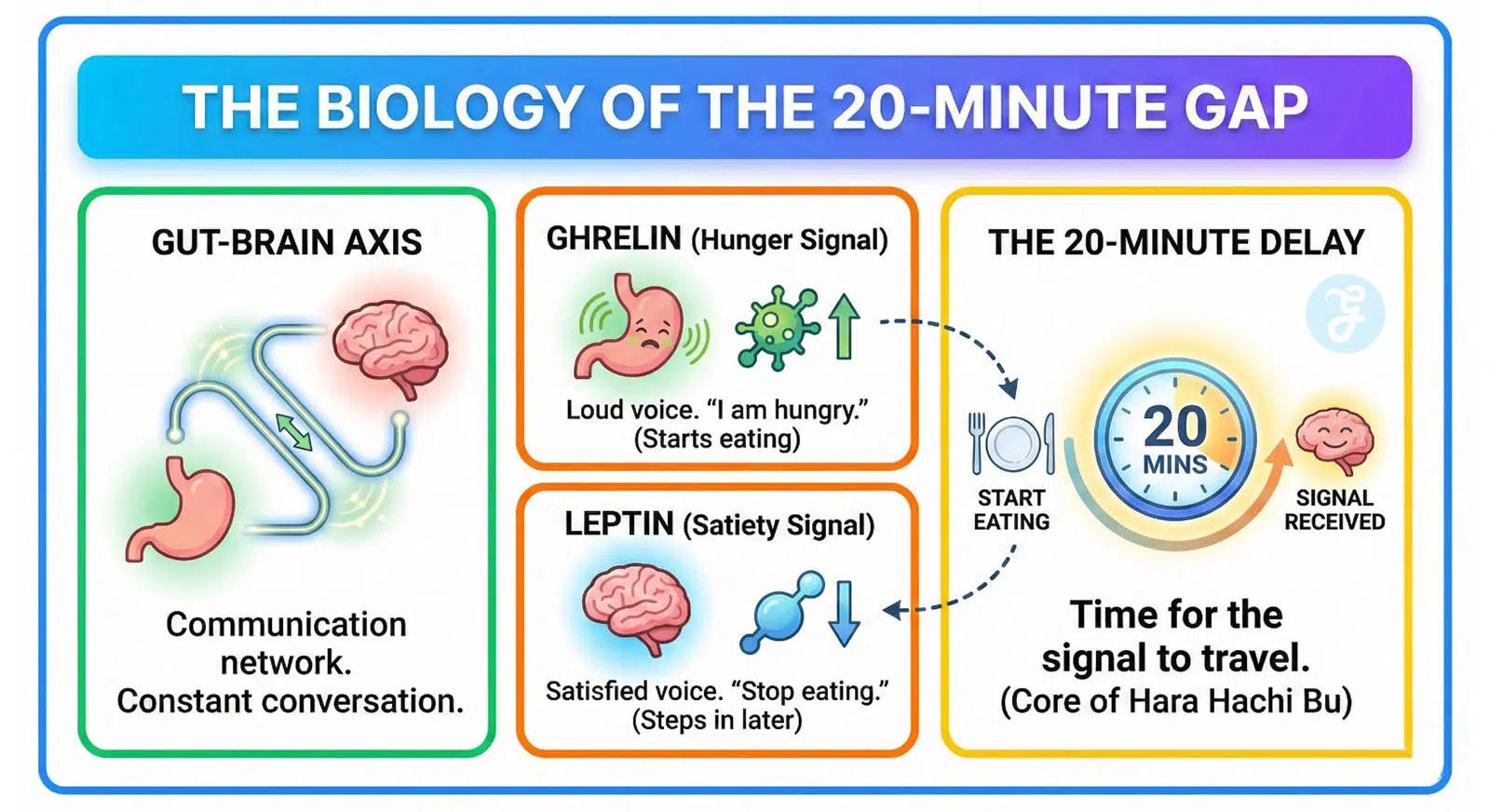
The genius of the Hara Hachi Bu lifestyle is backed by hard science. Your body operates on a complex communication network called the gut brain axis. This is a constant conversation between your stomach and your mind. Two main hormones lead this discussion: Ghrelin and Leptin. Ghrelin is the loud voice that tells you that you are hungry. It rumbles in your stomach and demands attention. Once you start eating, satiety hormones and neural signals eventually step in to signal that you are satisfied.
The Science of Satiety and the Vagus Nerve
The effectiveness of the Hara Hachi Bu lifestyle rests on the biological delay between the stomach and the brain. When you ingest food, the physical distension of the stomach walls activates stretch receptors. These receptors send electrical impulses via the vagus nerve to the hypothalamus, the brain’s hunger control centre. However, this neural communication is not instantaneous. It typically takes twenty minutes for the brain to process these signals and respond to leptin, the hormone responsible for feeling satisfied. By stopping when you perceive yourself to be eighty percent full, you are accounting for this physiological lag. This prevents the common mistake of eating until you are physically stuffed, which actually indicates you have already consumed twenty percent more than your body requires for optimal energy.
The Signal Delay
This chemical conversation is not instant, and that creates a high-risk window for overconsumption. While the vagus nerve is busy transmitting data, your fork is likely still moving. In this twenty minute danger zone, it is remarkably easy to consume an extra three hundred to five hundred calories before the brain can even process a satiety response.
The consequence of ignoring this lag is a sudden, aggressive spike in blood glucose. Your body is forced to dump massive amounts of insulin into the bloodstream to manage the surge. This doesn’t just lead to fat storage; it causes the classic “food coma” or post-meal lethargy. By the time you actually feel full, you have already overshot your metabolic requirements, leaving your system to struggle with the excess fuel.
The Risk of Fast Eating
If you eat quickly until you feel full, you have already gone too far. By the time the brain registers one hundred percent fullness, your blood chemistry is actually overloaded. Your insulin levels spike and your energy begins to crash. This is why you often feel sluggish or sleepy after a large meal. You have surpassed your biological limit before your sensors could warn you. By adopting the Hara Hachi Bu lifestyle, you give your hormones the lead time they need to work correctly.
Finding the Safety Margin
The eighty percent threshold is the perfect safety margin. When you stop at that point, you are giving your hormones time to catch up. By the time that twenty minute window closes, your blood chemistry has reached total satisfaction. You feel light, clear-headed, and energized. You have bypassed the physical stress of digestion and kept your metabolism in a high state of efficiency.
The Cellular Advantage of 80%
Overeating is more than just a matter of tight waistbands; it creates a form of internal friction known as oxidative stress. When you flood your system with more fuel than it can process, you overload your mitochondria, the power plants of your cells. This excess forces them to create metabolic sludge in the form of harmful free radicals. These unstable molecules act like rust within your body, damaging your DNA and leading to premature ageing. Data from the Comprehensive Assessment of Long-Term Effects of Reducing Intake of Energy (CALERIE) study shows that even a mild reduction in calories allows these cellular engines to run with greater efficiency. Think of it like a car engine: if you constantly redline the RPM, the motor wears out quickly. When you stop at the eighty percent mark, your mitochondria produce energy cleanly and keep your tissues youthful for much longer.
Furthermore, when your body is not constantly exhausted by digesting excess food, it can shift its focus to a vital process called autophagy. This is the body’s natural “spring cleaning,” where it identifies and destroys damaged cell components to make room for newer, healthier ones. By maintaining this slight caloric gap, the Hara Hachi Bu lifestyle may help support this recycling process. It may contribute to lower systemic inflammation, help prevent metabolic exhaustion, and support internal resilience as you age.
The Blue Zones Evidence
The evidence for this philosophy is written in the lives of the Okinawans themselves. The Okinawa Centenarian Study has tracked thousands of elders for decades. The findings are staggering.
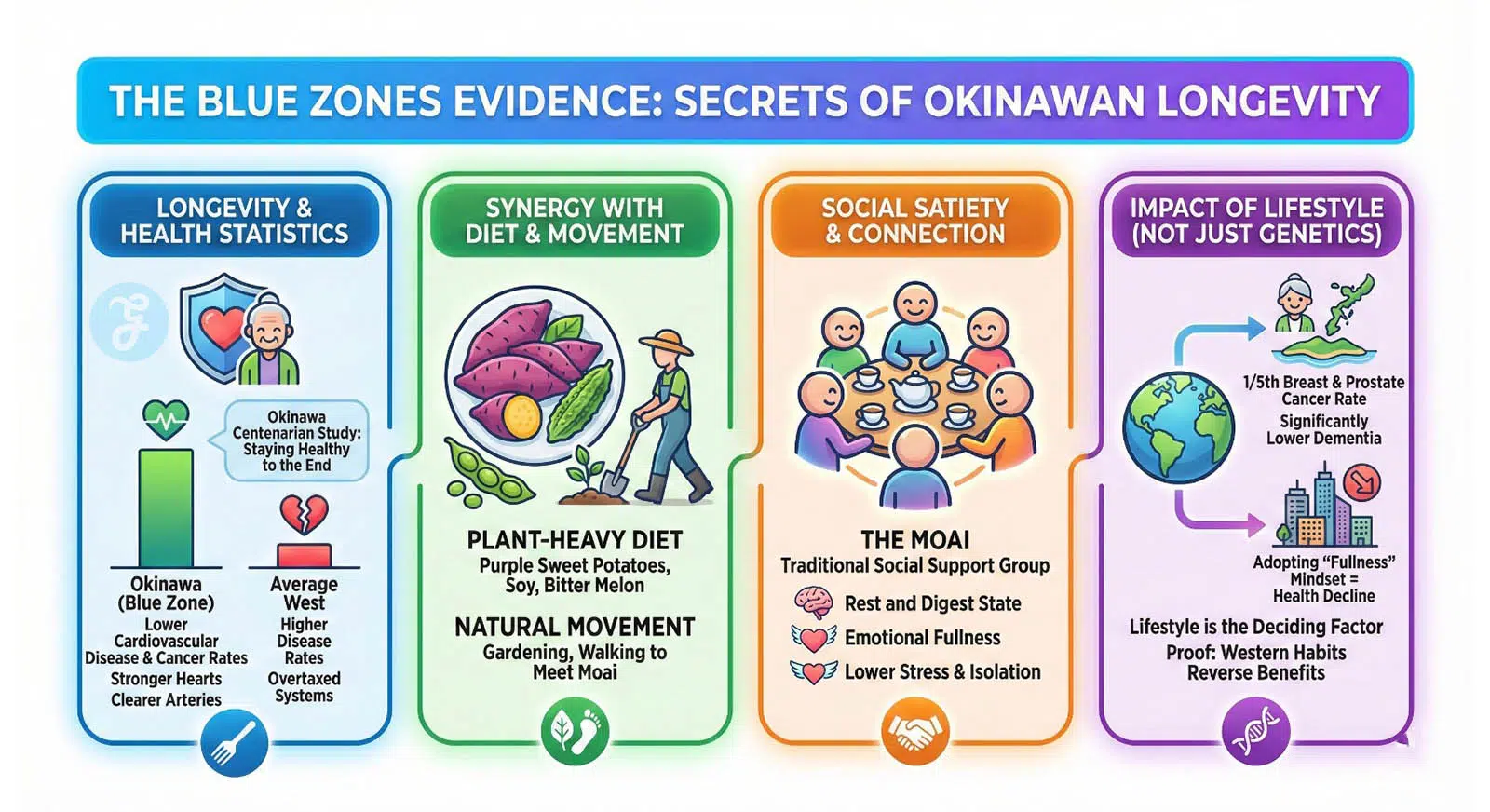 Compared to the average person in the West, these Okinawans have significantly lower rates of cardiovascular disease and cancer. They are not just living longer; they are staying healthy until the very end. Their hearts are stronger and their arteries are clearer, in part because they have not spent a lifetime overtaxing their systems.
Synergy with Diet
However, this rule does not exist in a vacuum. It is part of a larger ecosystem of health. The Hara Hachi Bu lifestyle works so well because it is paired with a plant-heavy diet. They eat massive amounts of purple sweet potatoes, soy, and bitter melon. They also prioritise natural movement. Instead of sitting at desks all day, they garden and walk to meet their Moai. This is a traditional social support group that ensures no one ever feels lonely or stressed.
Social Satiety
This social connection is a vital part of the puzzle. When you eat with friends in a relaxed environment, your body stays in a “rest and digest” state. This makes it much easier to notice when you have reached that eighty percent mark. Stress and isolation often lead to emotional binge eating. In Okinawa, the community provides the emotional fullness that food can never truly replace.
The Statistics of Health
Research on traditional Okinawan cohorts studied in the late twentieth century showed about one fifth the rate of breast and prostate cancer compared to North Americans. Their rates of dementia are also significantly lower. This is not just genetics. When Okinawans move to Western countries and adopt a “fullness” mindset, their health profiles begin to match the locals. This strongly suggests that the Hara Hachi Bu lifestyle is a major contributing factor in their legendary longevity.
Practical Mastery: How to Feel 80%
Learning to feel eighty percent full is a skill that requires practice. Most of us have forgotten how to listen to our bodies. A helpful way to start is by using a Satiety Scale from one to ten. On this scale, one is starving and ten is painful fullness where you cannot move. Your goal is to aim for a seven or an eight. This is the point where you are no longer hungry and you feel a light lift in your energy. You could easily eat a few more bites, but you choose to stop.
Small Plate Psychology
You can use simple psychology to make this easier. The Delboeuf Illusion is a famous trick involving plate size. If you put a small portion on a massive plate, your brain feels cheated. But if you put that same portion on a small, beautiful ceramic dish, your eyes tell your stomach that you are eating a feast. Using smaller bowls is one of the easiest ways to adopt the Hara Hachi Bu lifestyle without feeling deprived.
The Power of the Pause
Finally, you must reclaim the Power of the Pause. Put your fork down between every single bite. This breaks the rhythm of mindless shovelling and gives your vagus nerve time to talk to your brain. It is also vital to remove digital distractions. No screens, no phones, and no frantic emails at the dinner table. When you focus entirely on your food, you become an expert on your own biology. You will begin to notice that exact moment when hunger vanishes and satisfaction begins.
Listen to the Sigh
There is a subtle physical cue that many people miss. It is often called the “gastric sigh.” This is a deep, involuntary breath that occurs when the stomach reaches a comfortable capacity. If you pay close attention, you will find this happens right around the eighty percent mark. When you hear or feel that sigh, it is your body’s way of saying “I am done.”
| Mastery Level | Primary Goal | Practical Description |
| Beginner | Scale Awareness | Identifying the specific difference between a 7 and a 10 on the Satiety Scale. |
| Intermediate | Mindful Pacing | Consistently putting the fork down between bites and removing all digital screens. |
| Advanced | Intuitive Listening | Recognising the “gastric sigh” and stopping the meal naturally without using a scale. |
Overcoming the Modern Environment
Living this way in a modern city is a challenge. We live in a world of Super Size deals and massive restaurant portions. There is a constant social pressure to finish everything we buy. Many of us grew up with the idea that leaving food on a plate is wasteful. We think we are saving money by eating every last bite of a large meal. In reality, we are paying a much higher price with our health.
The Body is Not a Bin
The solution is a simple shift in mindset. You must realise that your body is not a bin. If you eat food that your body does not need, it is still wasted. It is just wasted inside your arteries and your fat cells. Start seeing the act of leaving food behind as an investment in your longevity. Ask for a takeaway container as soon as your meal arrives. Move half of the portion away before you even take your first bite. This small act of defiance against plate-clearing culture is how you reclaim your metabolism.
When eating out with friends, it can be hard to stop when others are still eating. Use the social aspect to your advantage. Focus on the conversation rather than the plate. If someone asks why you stopped, tell them you are trying the Hara Hachi Bu lifestyle. You might find they are curious about it too. Being the first one to stop eating is not a sign of weakness; it is a sign of high-level discipline.
On the 80% Life
The Hara Hachi Bu lifestyle is ultimately an act of profound self-respect. It is an invitation to walk away from the table feeling light and sharp. When you stop at eighty percent, you are choosing a life of clarity over a moment of heavy indulgence. You are trading a few extra minutes of chewing for years of vibrant health. This ancient Japanese wisdom reminds us that we do not eat to be full. We eat to be fuelled. By leaving a little room in your stomach, you make a lot more room for life.
Whether you are looking to lose weight, boost your energy, or simply live a longer life, this practice offers a path that requires no expensive equipment or complex recipes. It only requires your attention. Start with your very next meal. Pay attention to the textures, the flavours, and the signals your body is sending. Stop when you are satisfied, not when you are stuffed. Your future self will thank you.