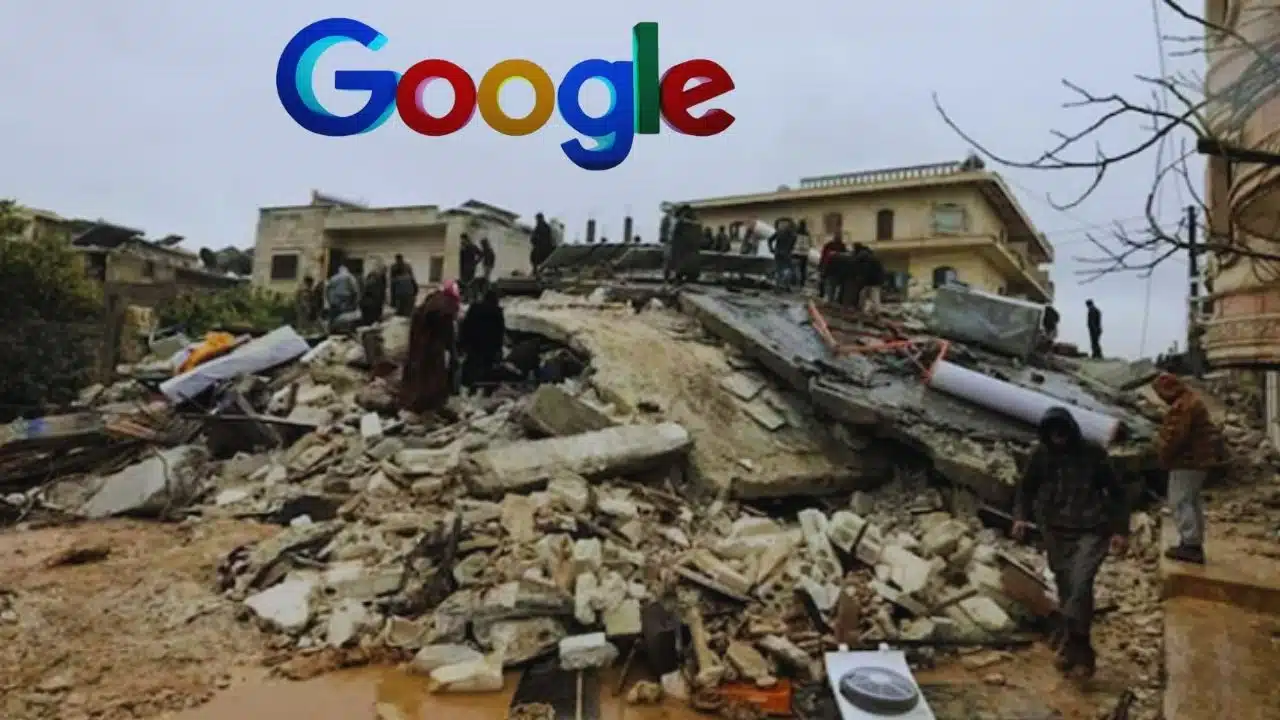
On February 6, 2023, southeastern Turkey was rocked by one of the deadliest natural disasters in its history—a magnitude 7.8 earthquake, followed hours later by another massive shock. The destruction was staggering: over 55,000 lives were lost, and more than 100,000 people were injured. Buildings crumbled as families slept, entire neighborhoods collapsed, and survivors described the experience as a living nightmare.
Yet, amid the tragedy, questions began to emerge: why weren’t people warned? Google’s Android Earthquake Alerts System (AEA)—a tool promoted as a cutting-edge safety net for countries without official seismic warning infrastructure—was active in Turkey at the time. But it failed to deliver serious alerts to most people in harm’s way.
What Google Promised—and What Really Happened
The AEA system was developed by Google to detect seismic activity using data from Android smartphones. When these devices sense earthquake-like shaking, they send that information to Google’s servers, which use algorithms to estimate the location and magnitude of the quake. If the tremors meet certain thresholds, the system issues alerts to Android users in the affected areas.
There are two types of alerts:
- Take Action: For intense shaking that can cause harm. This alert overrides Do Not Disturb settings, sets off a loud siren, and displays a full-screen message urging immediate safety action.
- Be Aware: For lighter shaking. This alert does not trigger loud alarms and doesn’t override phone settings.
On the morning of February 6, when the first quake struck at 04:17 local time, many residents were asleep. This is exactly the kind of moment when the Take Action alert could have saved lives—by waking people up before the worst shaking began.
But instead of sending millions of serious alerts, Google’s system triggered only 469 Take Action warnings. According to the company, about half a million users received the lighter Be Aware notification, which would not have interrupted sleep or grabbed attention during a deadly emergency.
The Warning System Was Technically Live—But Functionally Silent
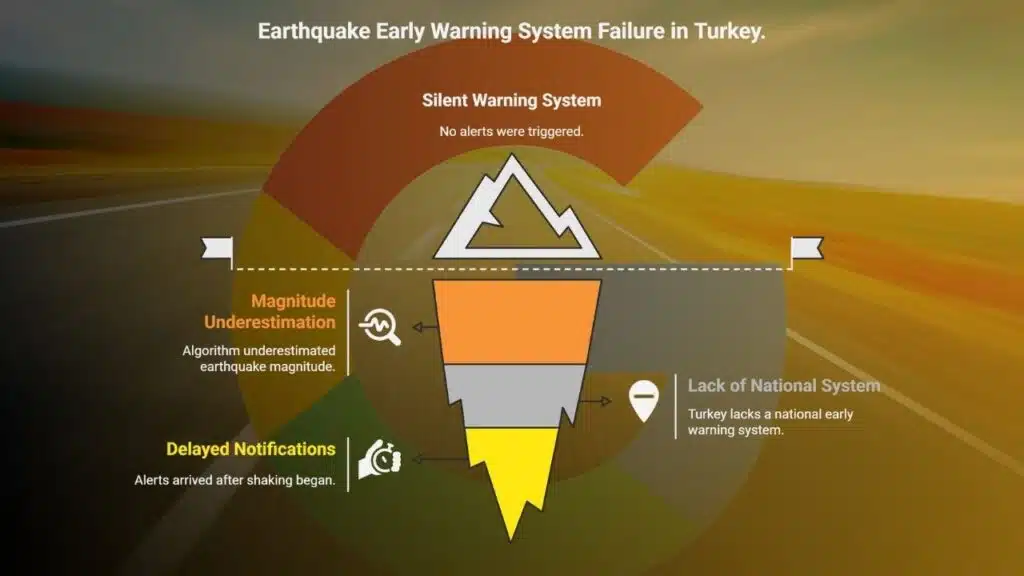
Turkey, with over 70% of its population using Android phones, was one of the largest markets where the AEA system was enabled. It was meant to fill a critical gap, as Turkey lacks a national earthquake early warning system similar to those in Japan or the U.S.
Google confirmed that the system was operational during the 2023 quake. However, the detection algorithm severely underestimated the magnitude of the first earthquake, estimating it at 4.5 to 4.9 MMS instead of the actual 7.8 MMS. This miscalculation led to no large-scale alerts being triggered, despite millions being within range of catastrophic shaking.
In the aftermath, the BBC investigated the system’s failure, spending months speaking to earthquake survivors across towns and cities in the impacted zone. They could not locate a single individual who received the more serious Take Action alert before the quake struck. Many survivors reported receiving no alert at all, while others were only notified after buildings had collapsed or shaking had already begun.
Google’s Initial Defense and Later Admissions
In the months following the earthquake, Google initially defended the AEA, telling BBC that the system had “performed well.” However, later that year, the company acknowledged the system’s failure in more detail. In an academic paper published in the journal Science, Google engineers admitted that the detection algorithm used in February 2023 was not calibrated for such high-magnitude events.
Post-event simulations showed a stark contrast in what the system could have done with improved algorithms. Re-running the data with the new model, the AEA would have sent:
- 10 million Take Action alerts to people at immediate risk
- 67 million Be Aware alerts to individuals farther from the epicenter
This admission came nearly two years after the event, drawing criticism from researchers, emergency response officials, and digital safety advocates.
Experts Raise Alarm About Transparency and Accountability
Elizabeth Reddy, an assistant professor at the Colorado School of Mines and an expert in risk communication, expressed strong concern over the delay in transparency.
“I’m really frustrated that it took so long,” she told the BBC. “We’re not talking about a little event—people died—and we didn’t see a performance of this warning in the way we would like.”
Other seismologists and disaster preparedness experts have echoed similar concerns, noting that many governments might wrongly assume Google’s system can replace a proper national early warning infrastructure. This is especially dangerous in countries where no official system exists.
Harold Tobin, director of the Pacific Northwest Seismic Network, warned:
“Would some places make the calculation that Google’s doing it, so we don’t have to? That’s the risk.”
What Went Wrong: The Technical Breakdown
The AEA’s algorithm was tuned for smaller earthquakes and relied on a detection model that could not quickly identify rare, high-magnitude quakes. During the 2023 event, the system misjudged both the strength and potential danger of the seismic waves.
Because earthquakes travel relatively slowly through the Earth’s crust, a functioning early warning system has a small but critical window—sometimes up to 30 seconds—to alert people ahead of damaging waves. The AEA is designed to capitalize on that window, but only if it detects the correct magnitude quickly and accurately.
In this case, the algorithm lagged, resulting in too little data being processed too slowly. And when the second major quake hit later that day, the system did better—but still underperformed:
- It issued 8,158 Take Action alerts
- And just under 4 million Be Aware alerts
These numbers were still far below the potential reach, given the scale of the disaster and the density of Android users in Turkey.
Has the System Improved Since Then?
Following intense scrutiny and academic review, Google claims it has significantly upgraded the AEA system. The company says the new model is better at detecting large-magnitude events, adjusting dynamically to evolving seismic signals, and minimizing both false positives and missed alerts.
The system has now been expanded to 98 countries, and Google continues to describe it as a supplementary safety net, not a replacement for government-run warning infrastructure.
Still, critics argue that unless Google becomes more transparent and accountable, the public and policymakers will remain uncertain about how well the system actually works.
Silence on More Recent Quakes
In 2025, another large earthquake struck Myanmar, a country also covered by Google’s alert system. The BBC reached out to Google to inquire about the system’s performance during this recent quake but has not yet received a response.
This continued lack of prompt feedback has once again raised concerns about whether Google is prioritizing public safety and transparency over corporate optics and liability protection.
A Wake-Up Call for Tech and Governments Alike
The failure of Google’s Android Earthquake Alerts system during the 2023 Turkey quake is a sobering reminder that technology, no matter how advanced, must be rigorously tested, openly evaluated, and responsibly deployed. While Google’s system has potential—especially in underserved regions—it is no substitute for national readiness, infrastructure, and clear lines of accountability.
More than two years later, the world continues to learn from this tragedy. As climate-related and seismic disasters become more frequent and deadly, the role of tech giants like Google in public safety must be better defined and closely monitored.
The Information is Collected from BBC and Yahoo.