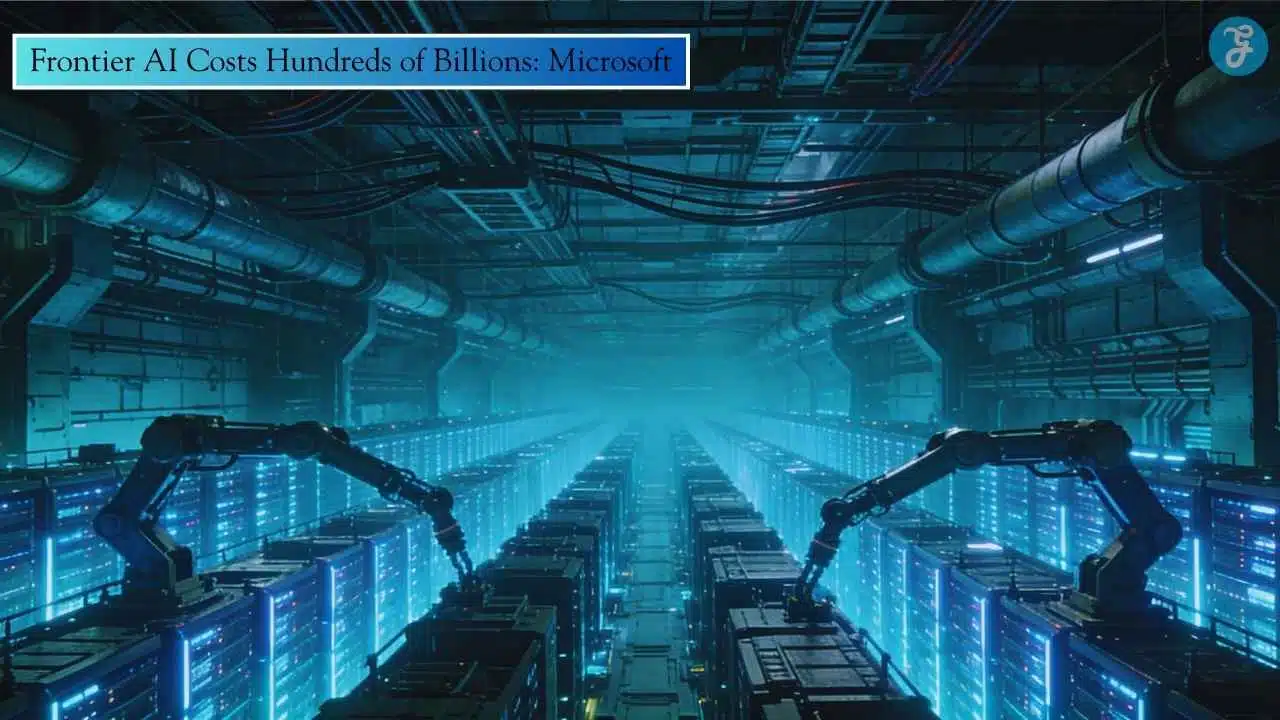
Microsoft AI chief Mustafa Suleyman says staying competitive at the frontier of AI will cost “hundreds of billions of dollars” over the next five to 10 years, as the race shifts from software breakthroughs to chips, data centers, power, and scarce expert talent.
A costly new phase of the AI race: who said what, and what it signals?
Mustafa Suleyman, who leads Microsoft’s AI organization, has issued one of the clearest warnings yet about what it now takes to compete at the top end of artificial intelligence. In a recent public interview, he said the frontier AI race will require “hundreds of billions of dollars” in investment over the next five to 10 years.
His point was not that AI is becoming less important—almost the opposite. The comment reflects a reality that is becoming harder to ignore across the industry: the most advanced models and the systems around them are no longer “just software.” They are increasingly a capital-intensive industrial project.
Suleyman described the effort in infrastructure-heavy terms, comparing the scale to a modern construction operation. That framing lines up with what is happening across the AI supply chain: hyperscale data centers expanding quickly, major chip orders tied up years in advance, and energy planning that now affects where and how AI can grow.
The statement also arrives at a moment when Microsoft is trying to balance three overlapping goals at once:
- Keep AI features improving inside products people already use, including workplace tools and developer platforms.
- Strengthen long-term independence in building and operating advanced models, rather than relying on any single external model supplier.
- Build frontier capability while keeping safety, reliability, and governance in the loop, because advanced systems raise new risks along with new opportunities.
At the center of this is money—and not just in one budget line. Frontier AI spending spans equipment, facilities, electricity, networking, talent, and ongoing operations. When Suleyman says “hundreds of billions,” he is effectively describing a multi-year expansion of physical capacity and human expertise that very few organizations can realistically sustain.
Where the money goes: chips, data centers, power, and people?
To understand why the number is so large, it helps to break frontier AI into the major categories of cost. Training large models is expensive, but so is running them at scale once they are deployed. Many companies are discovering that the operational “serving” phase can be just as financially demanding as training—especially when AI features are used by millions of people every day.
Key spending categories in frontier AI
| Spending area | What it includes | Why costs keep rising |
| AI compute hardware | GPUs/accelerators, high-end CPUs, memory, storage | Frontier training needs huge parallel compute and fast memory access |
| Networking | High-speed interconnects, switches, fiber, specialized fabrics | Model training depends on moving data quickly between thousands of chips |
| Data centers | New buildings, retrofits, cooling, racks, security, fire safety | AI hardware runs hot and dense; facilities must be purpose-built |
| Electricity and grid work | Utility hookups, substations, backup, long-term power deals | AI clusters can demand power at the scale of large industrial sites |
| Talent | Top researchers, infrastructure engineers, security and safety teams | Elite talent is scarce; hiring and retention costs are high |
| Operations | Monitoring, reliability, model evaluation, red-teaming, compliance | Always-on AI services require constant oversight and improvement |
Suleyman has also pointed to the cost of technical staff as a significant part of the equation. That matters because frontier AI is not only about buying hardware; it’s about assembling teams that can design training runs, optimize performance, ensure safety, and keep complex systems stable under real-world usage.
Why the bill is getting bigger, not smaller?
Even as chips improve, frontier systems are scaling in multiple directions at the same time:
- More compute for training: Bigger and more capable models often require more training steps, more parameters, or more sophisticated data mixtures.
- More compute for inference: Once a model is popular, the cost to serve it can grow rapidly. A successful AI product can generate huge volumes of queries every minute.
- Higher reliability expectations: Enterprises want predictable performance, strong privacy controls, and minimal downtime.
- More safety and governance: Advanced models require evaluation for misuse and failure modes, plus guardrails that add development and operational work.
In short, the “frontier” is expensive because it is not a single project. It is a continuous cycle: build capacity, train, deploy, scale usage, upgrade, and repeat—while competitors do the same.
Microsoft’s direction: self-reliance, multi-model flexibility, and “humanist” superintelligence
Microsoft’s AI posture in recent years has been shaped by two seemingly competing ideas that can actually fit together.
On one hand, Suleyman has argued publicly that it can be rational to remain slightly behind the absolute frontier—measured in months—because it can reduce cost and focus investment on what matters most to customers: reliability, integration, and practical performance. On the other hand, Microsoft has also signaled a desire to develop deeper in-house frontier capability, including building teams aimed at pushing toward more advanced systems sometimes described in the industry as superintelligence.
Why “self-reliant AI” is now a strategic priority?
The simplest way to interpret Microsoft’s push toward self-reliance is risk management. Depending too heavily on any single external model pipeline can create vulnerabilities:
- uncertainty about future pricing and access,
- limited control over model roadmaps,
- challenges in tailoring models to specific enterprise needs,
- constraints on safety approaches and evaluation methods,
- and potential disruptions if partnerships change.
Microsoft’s strategy increasingly appears to be building a broader foundation—where it can use strong external models when they are the best fit, while also developing internal capability to train, fine-tune, and deploy models under its own control.
The “humanist” framing and the safety question
As frontier AI gets more capable, the safety debate becomes harder to separate from the business debate. In public remarks, Suleyman has emphasized that building very advanced systems should be paired with clear values, strong safety practices, and boundaries—ideas often summarized as aligning AI behavior with human intent and preventing harmful outcomes.
This matters for two reasons:
- Regulators and enterprises increasingly expect safety evidence, not just promises.
- Safety failures can be extremely costly, not only in reputational damage but also in legal exposure and product disruptions.
A long-term frontier AI roadmap, especially one that aims at very advanced capabilities, will almost certainly need more investment in evaluation, monitoring, and governance. That becomes another multiplier on cost—one that is easier for large, well-funded organizations to absorb.
A practical “both/and” approach
Microsoft’s direction can be understood as “both/and”:
- Build and deploy cost-effective AI systems that work at scale today, and
- Invest in the infrastructure and talent needed to remain viable at the frontier tomorrow.
Suleyman’s “hundreds of billions” point reinforces the second half of that equation. Frontier competition is becoming a long game, and the winners may be determined less by a single breakthrough and more by sustained investment and execution.
Industry-wide context: why Big Tech can spend what smaller labs can’t?
Suleyman’s warning also highlights a widening gap between the companies that can finance frontier scale and those that cannot. The frontier race increasingly rewards organizations that can do all of the following at once:
- commit to multi-year capital spending,
- secure chip supply in a tight market,
- build or lease data center capacity rapidly,
- negotiate long-term power access,
- and hire or retain scarce specialists.
The capital cycle behind frontier AI
Frontier AI investments tend to cluster in waves:
- Massive capital expenditure (chips + data centers)
- Training and launch costs
- Rapid scaling of usage (inference spending)
- Revenue catch-up (monetization through subscriptions, cloud usage, or enterprise licensing)
- Next wave of capital expenditure
One key tension is timing. Costs arrive early and continuously, while monetization can take longer—especially in enterprise markets, where adoption cycles are slower and customers require proof of value.
AI as a balance-sheet advantage
Large tech firms can fund frontier AI more easily because they often have:
- strong cash flow from cloud, software, ads, or devices,
- large balance sheets that support sustained investment,
- global infrastructure footprints,
- and existing enterprise relationships that help distribute AI products quickly.
This does not eliminate startups, but it changes what startups can realistically do. Instead of competing to train the largest possible foundation models, many smaller firms may focus on:
- specialized models tuned for specific sectors,
- efficiency tools that reduce inference costs,
- data and evaluation services,
- AI security and compliance,
- or application layers where domain expertise matters more than raw compute.
Why energy and geography are becoming part of AI strategy?
A subtle but important shift is that AI competition increasingly depends on physical constraints—especially power availability. In many regions, grid capacity, permitting timelines, and water usage can slow data center expansion. As a result, where AI clusters are built is becoming as strategic as which model architecture is chosen.
This reality supports Suleyman’s “construction” analogy. It is not enough to have the best researchers. The frontier also requires land, power, cooling, connectivity, and operational discipline at scale.
What comes next?
Suleyman’s “hundreds of billions” warning is a signal that frontier AI is entering an era defined by sustained investment. The frontier is no longer simply a sprint to publish the next model. It is a multi-year infrastructure buildout paired with talent acquisition and ongoing operating expense.
- Rising capital spending across the largest tech firms, especially tied to data centers and accelerators.
- A continued shift toward multi-model ecosystems, where companies use different models for different tasks to manage cost and performance.
- More public focus on safety, governance, and evaluation, as the capabilities of systems expand and expectations rise.
- New constraints driven by electricity and permitting, which may shape where AI capacity is built and who can scale fastest.
If the frontier truly costs “hundreds of billions” over the next decade, it will likely concentrate the most advanced model training in the hands of a few organizations. At the same time, it may also create an enormous downstream economy—applications, tools, and services built on top of these models—where many more companies can still compete and win.