
A language platform can look impressive in a demonstration and still create more work for teachers. The best language learning platforms for schools must do more than offer vocabulary games. They should support assignments, classroom management, assessment, progress tracking, and meaningful language use.
These nine platforms meet different needs. Some can support a complete course, while others focus on speaking, assessment, independent practice, or English-language development. The right choice depends on what a school actually needs the software to accomplish.
1. Education Perfect for Languages
Best for schools seeking one platform for lessons, assignments, and assessment
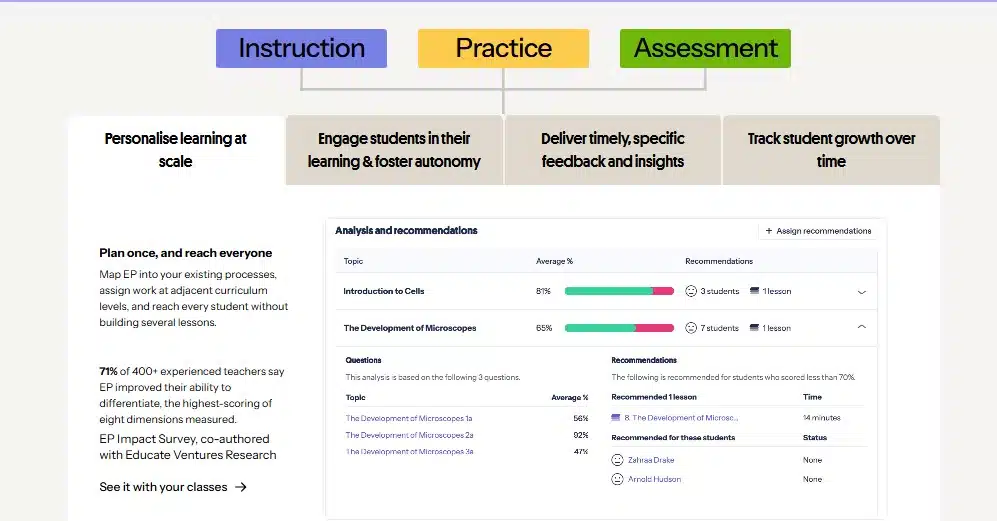
Education Perfect provides more than 5,000 language lessons and assessments. Its catalog covers French, Spanish, German, Italian, Chinese, Japanese, Arabic, Indonesian, Māori, and beginner Samoan.
Teachers can assign work to individuals or groups, adapt existing content, create assessments, and follow student progress. Automated marking reduces routine grading, while recordings and extended-response activities cover more than vocabulary recall.
The platform connects with systems such as Google Classroom, Canvas, Schoology, Brightspace, and Schoolbox. Its balanced combination of content, assessment, and reporting makes it one of the strongest all-around choices. However, schools needing a language outside its catalog will have to look elsewhere. Pricing is customized rather than consistently published.
2. Mango Classroom
Best for schools and districts needing a large language catalog
Mango Classroom offers more than 70 world languages and over 20 English-learning courses. Lessons combine conversation, listening, pronunciation, grammar, and cultural context.
The education product adds lesson plans, workbooks, reporting, single sign-on, and rostering. Some institutional packages also extend access to students’ families, making Mango useful beyond scheduled classes.
Schools should look beyond the headline language count. Mango Fresco is a complete four-level Spanish curriculum for middle and high school, while many other languages work better as independent study or supplementary practice. Mango Navigators also provides exploratory materials for Spanish, French, Mandarin, and American Sign Language.
3. Languagenut
Best for engaging elementary and early secondary learners
Languagenut uses games, visual activities, pronunciation practice, phonics, grammar, and printable resources to support younger students. Its elementary platform covers more than 25 languages and includes listening, speaking, reading, and writing activities.
Coverage becomes narrower in later grades. Middle and high school resources focus on French, Spanish, German, Italian, Arabic, Urdu, and Mandarin. Teachers can assign performance tasks, organize content, and review results through the gradebook.
Languagenut is a strong fit for schools that need structured practice without relying entirely on text-heavy lessons. Its guided elementary course is currently limited to French and Spanish, so schools should inspect the exact pathway offered for their chosen language.
4. Lingco
Best for departments that want to customize their courses
Lingco gives teachers more control over course structure than many fixed-content platforms. They can arrange lessons into modules, adapt published materials, build new activities, manage rosters, and apply flexible rubrics.
Students can complete adaptive exercises, use spaced-repetition activities, join discussions, and submit audio or video responses. The platform also supports teacher feedback and common learning-management functions.
Lingco’s complete published programs primarily cover Spanish and French, progressing from Novice Low to Intermediate High. Other languages may require more teacher-created material. This flexibility is valuable, but schools should consider whether teachers have enough planning time to build and maintain customized courses.
5. Speakable
Best for expanding speaking and writing practice
Speakable is designed for K–12 world-language and English-learner programs. It supports more than 40 languages and provides immediate AI-assisted feedback on speaking and writing.
Teachers can collect student portfolios, set proficiency benchmarks, assign standards-based activities, and review performance across classes. Assessment options include time limits, browser controls, and the ability to hold AI-generated scores until a teacher reviews them.
The platform works with several common rostering and learning systems, although some advanced integrations depend on the plan. Its automated feedback can help students practise more often, but it should not be treated as a final judgment of fluency. Accents, dialects, speech differences, and high-stakes assessments still require careful human review.
6. Extempore
Best for structured speaking assessments
Extempore concentrates on spoken communication. Teachers can collect recorded answers, conduct live conversations, organize interpersonal speaking tasks, and respond with audio, video, or written feedback.
Shared rubrics and common assessments make it useful across a department or district. It can also support preparation for language and English-proficiency assessments, including AP, AAPPL, STAMP, ACCESS, and TELPAS.
Extempore integrates with several major learning-management systems and can support rostering and grade synchronization. It is an assessment and speaking layer, however, not a complete curriculum. Teachers still need appropriate lesson content and communication tasks.
7. Sanako Connect
Best for live pair and group conversations
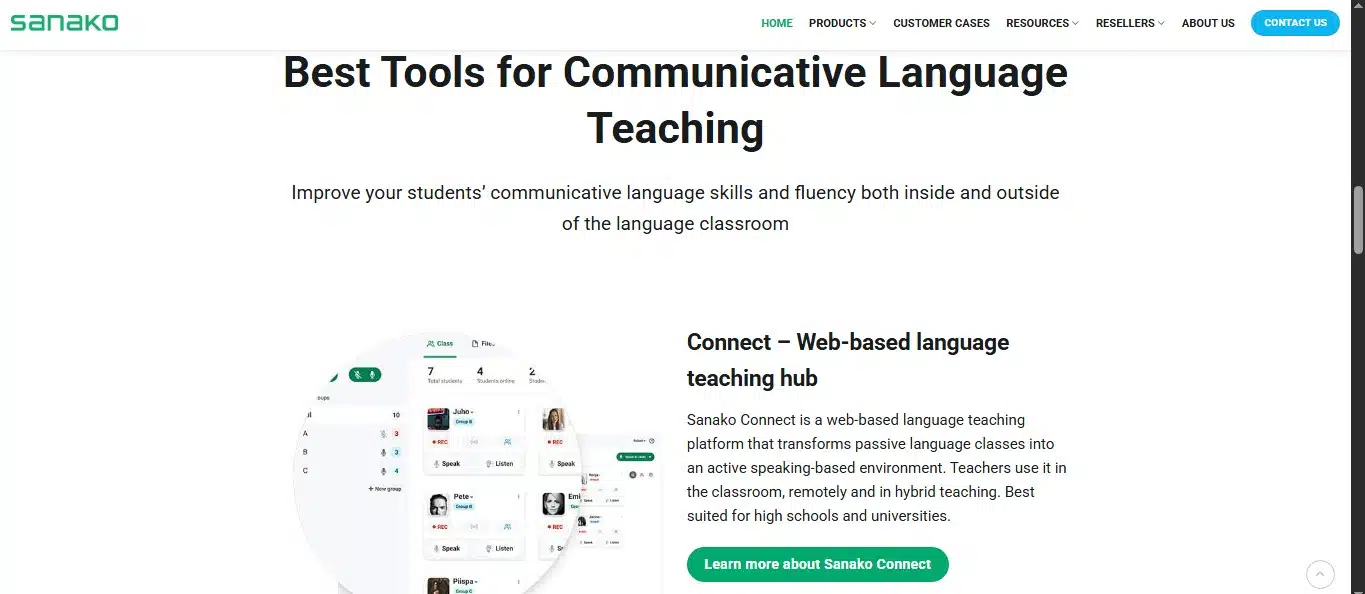
Sanako Connect brings the functions of a traditional language lab into a web browser. Teachers can run simultaneous speaking activities, pair students for conversation, organize group discussions, collect recordings, and monitor participation.
It supports classroom, remote, and hybrid instruction, along with asynchronous assignments. Its biggest advantage is allowing many students to speak at the same time instead of waiting for individual turns.
Sanako Connect does not supply a complete course. Schools will need their own curriculum, dependable internet access, and working microphones or headsets. Any automated pronunciation feature should also be checked for the specific language being taught.
8. Transparent Language Online for Education
Best for less commonly taught languages
Transparent Language Online offers more than 100 languages, the broadest advertised catalog in this list. Teachers can create classes, assign lessons, set deadlines, build custom activities, and review reports by learner, class, assignment, or language.
The platform is particularly useful for independent preparation and flipped learning. Students can work on vocabulary, listening, and comprehension before using class time for conversation and collaborative work.
Its large catalog does not mean every language has the same depth. Schools should examine the available proficiency levels, lesson quality, audio, and teacher resources for the exact language they plan to offer.
9. Off2Class
Best for secondary English-language development
Off2Class focuses on English learners rather than world-language courses. It provides more than 1,500 teacher-led lessons across listening, speaking, reading, and writing.
Placement testing identifies skill gaps and helps teachers select appropriate learning paths. The platform also includes assignments, progress monitoring, and classroom analytics. Its materials are mapped to frameworks including WIDA and ELPA21, and it supports Clever and ClassLink for rostering and sign-on.
Off2Class is a practical choice for middle school, high school, newcomer, and multilingual-learner programs. It is not intended for departments teaching Spanish, French, Mandarin, or other world languages.
Why Duolingo for Schools Is Missing
Duolingo for Schools is not included because new school accounts and classrooms can no longer be created. The school product is scheduled to close on July 31, 2027. Existing classrooms may continue during the transition, but it is not a suitable long-term recommendation for a school choosing a new platform.
Choose the Platform That Solves the Right Problem
The strongest platform is not necessarily the one with the most languages or the longest feature list. It is the one that fits the school’s curriculum, reduces teacher friction, and gives students more meaningful opportunities to use the language.
A focused pilot, followed by feedback from teachers and students, will reveal more than any product comparison. Choose according to the classroom you have, not the demonstration you were shown.
Frequently Asked Questions on the Best Language Learning Platforms for Schools
1. What is the best overall language learning platform for schools?
Education Perfect provides one of the most balanced combinations of lessons, assignments, assessment, customization, and reporting. The best choice still depends on whether it supports the required language and grade level.
2. Which platform offers the most languages?
Transparent Language Online advertises more than 100 languages, followed by Mango Classroom with more than 70. Course depth varies, so schools should inspect the specific language rather than compare catalog numbers alone.
3. Which platform is best for speaking practice?
Speakable suits repeated speaking practice with automated feedback. Extempore is stronger for recorded, rubric-based assessments, while Sanako Connect is designed for live pair and group conversations.
4. What is the best platform for English learners?
Off2Class is the most specialized option here for teacher-led secondary English-language development. Mango and Languagenut also provide English-learning materials, but they use different instructional models.
5. Can language learning software replace a teacher?
No. Software can organize practice, collect assignments, provide feedback, and reduce routine grading. Teachers remain essential for conversation, cultural context, individual support, and fair assessment.