


Digital innovation has steadily claimed its place in the legal profession. Technologies like artificial intelligence (AI) and blockchain—first popularized in finance and logistics—are now reshaping legal practice. Personal injury attorneys across Florida are adopting these tools to deliver faster, safer, and more transparent services to their clients.
AI in Legal Practice: Boosting Efficiency and Predictive Insight
Traditionally, law firms relied on teams of legal aides and paralegals for time‑consuming tasks such as document review, case‑file management, and legal research. AI now automates much of this work, freeing attorneys to focus on strategic, client‑centered matters.
Predictive analytics is a key AI application: by analyzing vast legal databases, AI systems can estimate likely case outcomes and suggest reasonable compensation ranges based on prior judgments and precedents.
The Florida Bar has already addressed the ethical and secure use of AI in legal services, signaling that AI‑powered tools are no longer speculative—they are actively being implemented in firms nationwide. In 2024, the Bar’s Standing Committee on Technology issued updated guidance outlining best practices for data privacy, algorithmic transparency, and attorney supervision of AI‑generated work product. Continuing Legal Education (CLE) courses now cover topics such as machine‑learning bias and automated document review, and several Orlando‑based firms have launched pilot programs that use natural‑language AI to streamline client intake and accelerate e‑discovery.
Together, these initiatives demonstrate Florida’s commitment to integrating cutting‑edge technology while safeguarding professional ethics and client confidentiality.
Blockchain and Legal Traceability: Decentralized Trust in Litigation
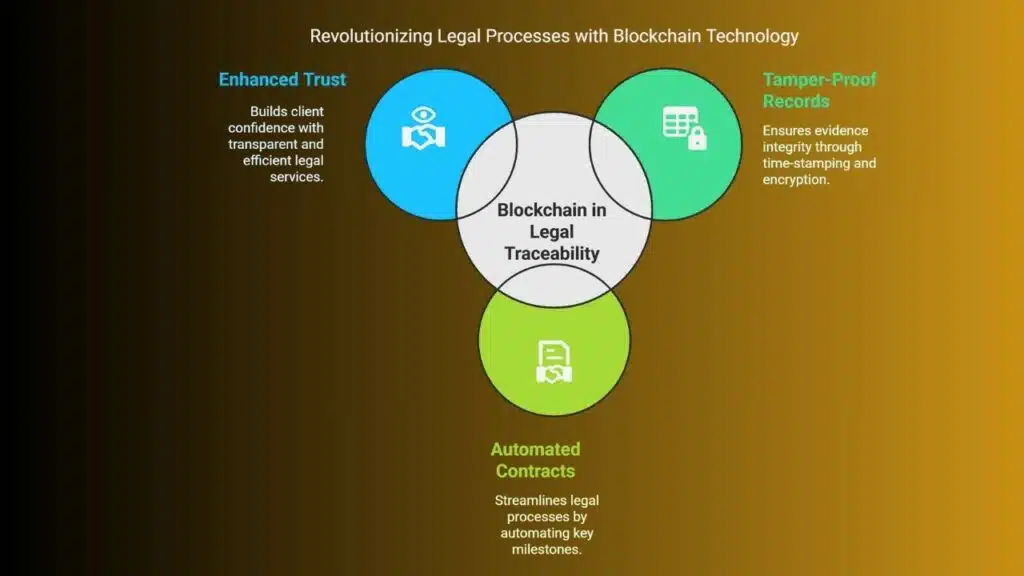
Alongside AI, blockchain is transforming evidence management and contract execution. Its core strength lies in recording documents, contracts, and statements in tamper‑proof, transparent ledgers.
In a state like Florida—home to some of the nation’s busiest highways and a year‑round tourism boom—the stakes are especially high. Orlando alone welcomes more than 70 million visitors annually, and its dense network of theme parks, resorts, and distribution hubs leads to a steady flow of accident claims. In this environment, maintaining a clear, immutable chain of custody for medical records, police reports, and surveillance footage is crucial. Blockchain accomplishes this by time‑stamping and encrypting every file, ensuring no one can alter evidence after the fact.
Smart contracts built on these ledgers can also automate key milestones—such as releasing settlement funds once both parties digitally sign an agreement—dramatically reducing administrative lag. This is particularly beneficial in Florida, where no‑fault insurance rules and strict filing deadlines often create paperwork bottlenecks.
The technology shift not only streamlines workflows but also strengthens client trust. For accident victims in Central Florida, working with an Orlando personal injury lawyer who embraces blockchain means faster access to authenticated evidence, quicker settlement payouts, and greater transparency throughout the legal process.
Ethical Considerations and the Government’s Role
New challenges arise as these technologies merge with legal practice. Concerns about transparency, data protection, and algorithmic bias have prompted regulators to step in.
The U.S. Department of Justice, for instance, has issued guidelines for assessing AI’s impact on civil rights, ensuring automated systems in legal contexts do not result in discrimination or unequal treatment. Such frameworks are especially relevant in diverse metropolitan areas like Orlando, helping to deliver fair, inclusive legal services.
A Lasting Transformation Demanding Adaptation
Technology is reshaping every facet of law. Tasks once handled solely by human judgment now benefit from intelligent digital systems. Legal professionals must master both statutory knowledge and innovative tools.
In cities like Orlando, where personal injury claims are common, embracing technology is no longer optional; it is essential. While even more advanced tools will emerge, what distinguishes today’s attorneys is their capacity to use current technologies ethically, efficiently, and with unwavering client focus.
























