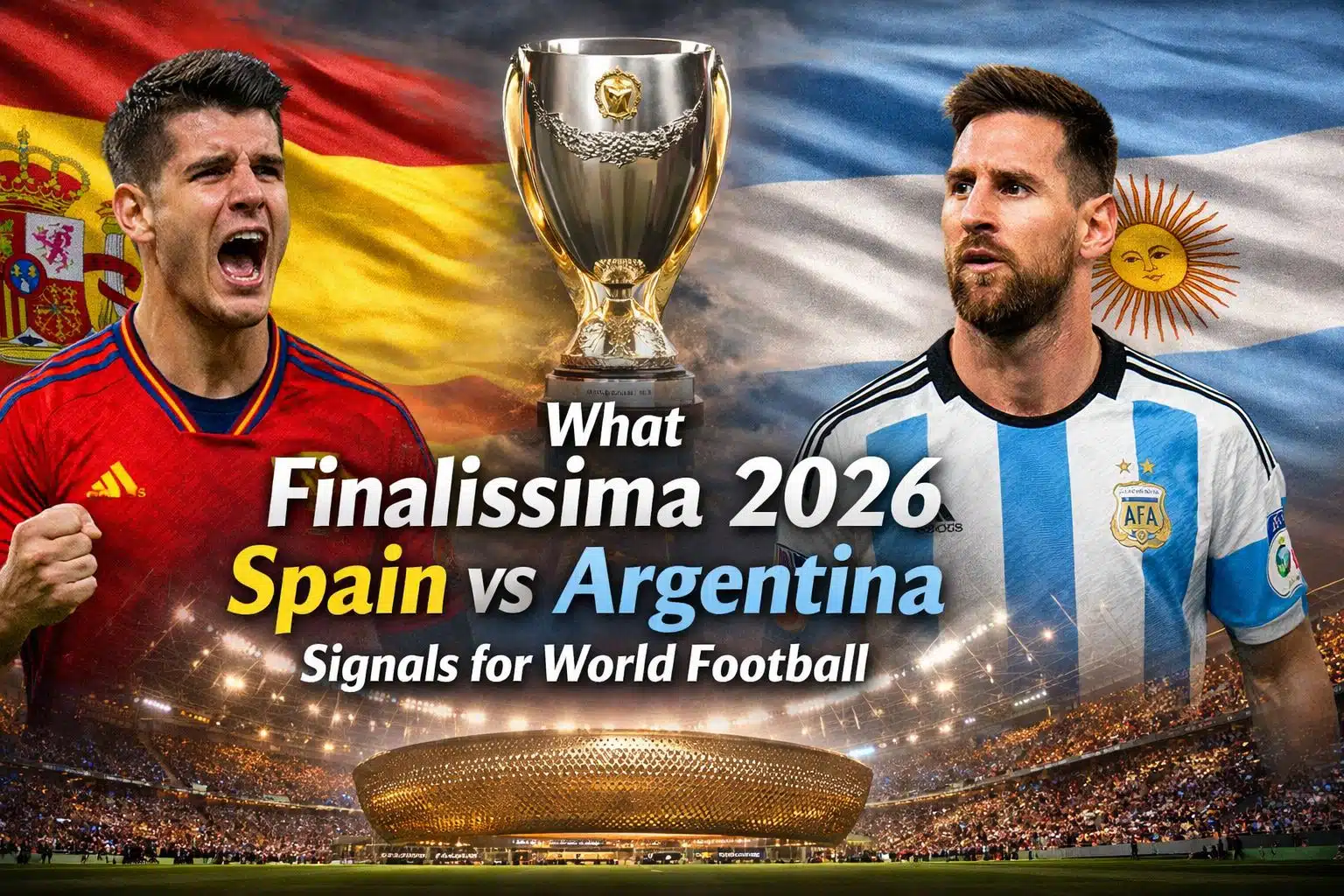
Finalissima 2026 Spain vs Argentina is significant now because it turns a “glamour match” into a stress-test: Qatar’s hosting strategy, football’s overloaded calendar, and the Messi-to-Yamal generational handoff collide nine months before the World Cup.
What we know (confirmed match facts)
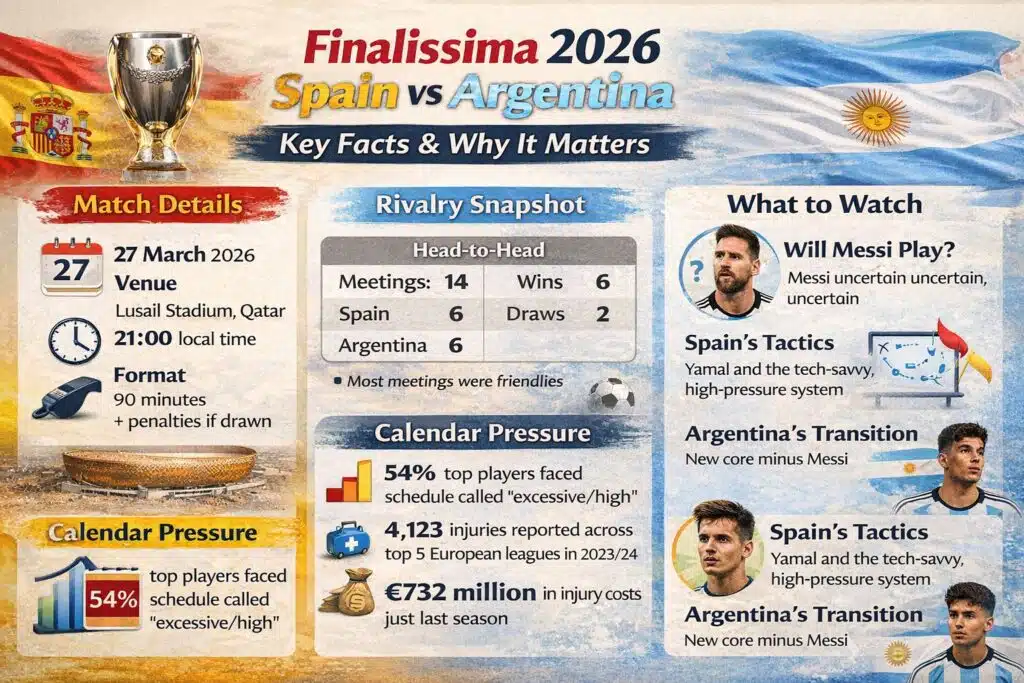
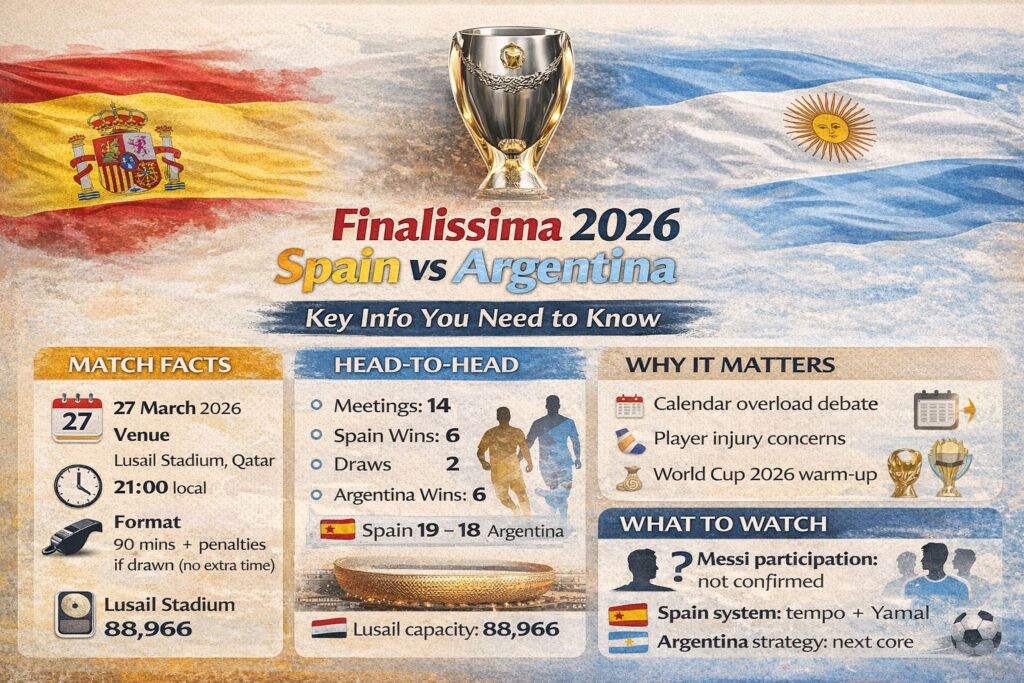
UEFA and CONMEBOL have formally set the Finalissima 2026: Spain vs Argentina at Lusail Stadium, Qatar, on Friday, March 27, 2026, kickoff 21:00 local time (19:00 CET / 15:00 ART).
Match snapshot table
| Item | Detail |
| Match | Spain vs Argentina |
| Competition | Finalissima (CONMEBOL–UEFA Cup of Champions) |
| Date | Friday, March 27, 2026 |
| Kickoff | 21:00 local (19:00 CET / 15:00 ART) |
| Venue | Lusail Stadium, Qatar |
| Stakes | One-off match; if level after 90 minutes → straight to penalties (no extra time) |
| Champions | Spain (UEFA EURO 2024), Argentina (Copa América 2024) |
Contextual background: how we got here
Finalissima is not new—it’s a revived idea. The modern edition is part of expanded UEFA–CONMEBOL cooperation formalized through a renewed Memorandum of Understanding (December 2021), and it’s positioned as a “champions vs champions” bridge between continents.
Historically, the event has been rare enough to feel special. UEFA notes only three captains have lifted the trophy across the earlier editions and the modern revival—Platini, Maradona, Messi—which is a neat marketing line, but also a reminder of how selectively football’s institutions deploy “heritage” when it serves a strategic purpose.
This is also why the location matters. Lusail Stadium is not a neutral choice in the usual sense—it’s a globally recognizable venue built for the 2022 World Cup and already symbolically linked to Argentina’s biggest modern achievement. FIFA itself frames Lusail as the iconic 88,966-capacity showpiece ground of Qatar 2022.
Core analysis: why it matters and what comes next
On paper, Spain vs Argentina is about continental champions. In practice, the site selection tells you how international football is being staged: not merely “where fans are,” but where a hosting ecosystem can deliver premium broadcast and hospitality at speed.
UEFA explicitly says the match will be delivered by Qatar’s Local Organising Committee for Football Events. That phrasing matters: it treats elite national-team football as a product that can be “ported” into a proven event-operating machine. Lusail is already the type of venue that satisfies global broadcast expectations (capacity, infrastructure, security, logistics)—exactly what sponsors and rights-holders prioritize.
The forward-looking implication is that “neutral” finals may increasingly be strategic showcases, not geographic compromises. Qatar is signaling continuity: the post-2022 world isn’t “after Qatar,” it’s “Qatar as a recurring hub,” especially for one-off, made-for-TV fixtures.
Counterpoint to keep it honest: football’s credibility is still tied to authenticity—supporter access, atmosphere, and “football culture.” Hosting big national-team matches far from both fan bases risks the perception that the game is being optimized for partners more than people. But UEFA/CONMEBOL’s willingness to do it anyway is itself an insight into where decision-making weight sits.
2) The calendar squeeze: Finalissima as a welfare flashpoint
The Finalissima pitch is romantic—champions meet, world watches. The scheduling reality is industrial: this match lands inside an ecosystem already under stress.
FIFPRO’s Player Workload Monitoring reporting is blunt: in its 2024 workload findings, 54% of monitored players experienced excessive or high workload demands in the 2023/24 season, with many exceeding matchday squad inclusion thresholds. The union’s broader warning is not just “too many games,” but that the system is stripping out recovery time and increasing injury and burnout risk.
Meanwhile, Howden’s injury index quantifies what clubs quietly fear: the top five European leagues recorded 4,123 injuries in 2023/24, costing €732.02 million, and 14,292 injuries over four seasons costing €2.3 billion. When injury becomes a line item measured in hundreds of millions, every additional “elite obligation” becomes a policy argument—not a celebration.
A late-March 2026 date also sits uncomfortably close to World Cup planning cycles. Coaches and clubs will weigh whether the marginal prestige of winning a one-off trophy is worth the marginal risk to key players—especially veterans.
This is where Messi becomes more than a name: he is the most visible “load management” storyline in football. Reuters reported Messi expressing uncertainty about the 2026 World Cup due to age and fitness concerns, even after high-profile performances and qualification context. Scaloni has repeatedly left the decision to Messi’s timing, emphasizing there is no final call yet.
So, “Will Messi play?” is less about a single lineup card and more about how football’s calendar treats its most valuable assets. The closer the sport gets to saturation, the more star participation becomes conditional—managed rather than assumed.
Key statistics (calendar & welfare)
- 54% of monitored men’s players experienced excessive/high workload demands (FIFPRO PWM 2024 key findings page).
- 4,123 injuries in Europe’s top five leagues in 2023/24; €732.02m in associated costs.
- 14,292 injuries over four seasons in the top five leagues; €2.3bn cost.
- Match logistics locked: March 27, 2026 in Qatar, 21:00 local.
3) A tactical and generational referendum: Spain’s “system peak” vs Argentina’s “era management”
Finalissima 2026 arrives at an interesting inflection point for both teams:
- Spain are coming off an identity reset that culminated in EURO 2024 success—won with depth, control, and the confidence to play without needing a single talisman. Reuters’ Euro final reporting highlighted Spain’s cohesion and the decisive impact of substitutes and squad depth across the tournament.
- Argentina remain defined by a historic core, but the system is now built to function with or without Messi—a message Scaloni has leaned into while still acknowledging Messi’s centrality when available.
This is why the event will be marketed as “Messi vs the next era,” but a smarter read is: structure vs structure. Finalissima’s format—single match, high stakes, penalties if tied—rewards teams that can stay calm in volatility. Spain’s recent narrative is control; Argentina’s is emotional resilience plus ruthless transitions. On neutral ground, those identity claims become more testable.
And because it’s March 2026, the match will likely be interpreted as a World Cup barometer whether it deserves that weight or not. That creates pressure to treat it seriously—which in turn raises the workload dilemma again.
4) The rivalry isn’t frequent—but the history is unusually “swingy”
Here’s the data that adds texture: Spain and Argentina have played surprisingly few senior men’s internationals, and the results are balanced.
From 11v11’s compiled record, Spain’s head-to-head vs Argentina shows:
- Won: 6
- Drawn: 2
- Lost: 6
- Total meetings listed: 14
Transfermarkt’s matchup view corroborates the 14 matches and also shows the aggregate goal count 19:18 and average attendance for listed meetings.
The AFA’s official “Historial ante España” page (posted March 26, 2018) lists the match-by-match series up to 2010 and frames it as 13 meetings at that time (before the 2018 friendly), with a summary line that differs from other databases—useful as a reminder that “official” and “compiled” records can diverge depending on what’s counted and when the page was written.
Argentina vs Spain head-to-head table (men’s senior)
| Source | Meetings | Spain W-D-L | Notes |
| 11v11 | 14 | 6-2-6 | Includes the 2018 6–1 friendly and lists match-by-match results. |
| Transfermarkt | 14 | 6-2-6 | Shows aggregate goals 19:18 and attendance by match. |
| AFA (official page) | 13 (as of 26 Mar 2018 post) | Summary differs; list runs through 2010 | Written before the 2018 match took place. |
Why this matters for analysis: the last two “modern reference points” are blowouts in opposite directions—Argentina 4–1 Spain (2010) and Spain 6–1 Argentina (2018)—which underlines how misleading single-match conclusions can be.
This history supports a sober prediction: Finalissima 2026 will be treated like destiny, but it will probably function like a snapshot—a high-quality snapshot, yet still only one frame.
The “pro-Finalissima” case (institutional and commercial):
UEFA positions the match as a celebration of excellence and a symbol of confederation cooperation, explicitly elevating it as a “prestigious occasion” that reflects football’s global reach. For federations, it’s also a low-risk commercial win: one match, global rights interest, sponsor inventory, and narrative clarity (champion vs champion).
The “player-welfare” critique (union and risk management):
FIFPRO’s workload findings and Howden’s injury economics both point to a football ecosystem where “just one more marquee match” isn’t neutral—it compounds cumulative risk. In that framing, the question isn’t whether Finalissima is entertaining; it’s whether the sport is trading long-term quality for short-term spectacle.
The “sporting integrity” question (fans and analysts):
Finalissima sits between friendly and tournament. UEFA’s rules (no extra time, straight to penalties) sharpen competitiveness, but it’s still a one-off outside a multi-match competition arc. Critics will argue it can’t crown a “true” intercontinental best team; supporters will argue that’s exactly why it’s valuable—clean, high-stakes, and accessible.
Future outlook: what to watch next (and what comes after)
Near-term milestones
- Ticketing and broadcast details: UEFA says more info on organization and ticket sales will follow in coming weeks.
- Squad-management signals: watch March 2026 call-ups and minutes management in the clubs’ final stretch seasons—this will reveal whether teams treat Finalissima as a priority or a risk.
- Messi’s status: expectations should stay conditional. Reuters has captured both sides of the story—Scaloni saying Messi is interested but undecided, and Messi himself noting age/fitness uncertainty closer to the tournament.
What comes next (clear, labeled projections)
- Likely: Finalissima becomes a more regular, premium “tentpole” on the international calendar because it’s commercially efficient and narratively simple—especially when hosted in proven event markets. (Inference based on UEFA/CONMEBOL’s framing and Qatar’s role.)
- Also likely: player unions and clubs intensify pressure for enforceable rest protections, because the data trendlines (workload and injury costs) are moving in the wrong direction.
- Uncertain but plausible: Messi’s involvement becomes the symbol of the new reality: star availability is no longer assumed; it’s negotiated with biology, schedule, and risk.