

On a quiet October evening in 2025, Bangladesh lost one of its gentlest voices. The news spread like an unfinished sentence—Syed Manzoorul Islam is no more. For readers, students, and admirers, it felt as if an entire chapter of the nation’s literary consciousness had come to an end.
He was not just a writer, or an academic, or a critic. He was the rare kind of storyteller who saw life as a manuscript—full of metaphors, humor, heartbreak, and unfinished dreams. His passing on October 10, 2025, in Dhaka marked the close of an era that began in classrooms and blossomed through stories that defied conventions.
But even as the world bids farewell, his voice—calm, reflective, and curious—continues to echo through the corridors of Bangladeshi literature. This is not just a goodbye; it’s a gentle goodnight to a storyteller whose words refuse to fade.
The Making of a Modern Sage
Born on January 18, 1951, in the serene town of Sylhet, Syed Manzoorul Islam grew up surrounded by the lyrical rhythms of rural Bengal. His early fascination with stories and language would eventually shape one of the most remarkable literary minds in modern Bangladeshi history.
He pursued his B.A. and M.A. in English from the University of Dhaka, graduating at a time when the country itself was discovering its own voice. The young scholar’s journey mirrored the nation’s—idealistic, searching, and deeply rooted in the love of words.
A Global Scholar with a Local Heart
In 1981, Islam earned his Ph.D. from Queen’s University, Canada, where he explored the spiritual influences of Emanuel Swedenborg on W.B. Yeats’s poetry. His time abroad opened him to the vast canvas of Western literary thought, yet he always carried the pulse of Bengal within him.
Even as he taught in North America as a Fulbright Scholar at the University of Southern Mississippi in 1989, he longed to return home. The world might have offered him prestige, but Bangladesh offered purpose—to teach, to write, and to shape future thinkers.
The Teacher Who Lit Countless Lamps
Back in Dhaka, Islam joined the Department of English at the University of Dhaka, where generations of students still remember him not for his grades or lectures, but for his stories. He would turn a literary theory class into a conversation about life—linking T.S. Eliot to Tagore, or Yeats to the Bangladeshi psyche.
Later, at the University of Liberal Arts Bangladesh (ULAB), he continued mentoring young minds, encouraging them to write, question, and dream. To his students, he wasn’t just a professor; he was a companion in thought—one who taught them that to understand literature is to understand humanity.
The Writer Who Turned Reality into Magic
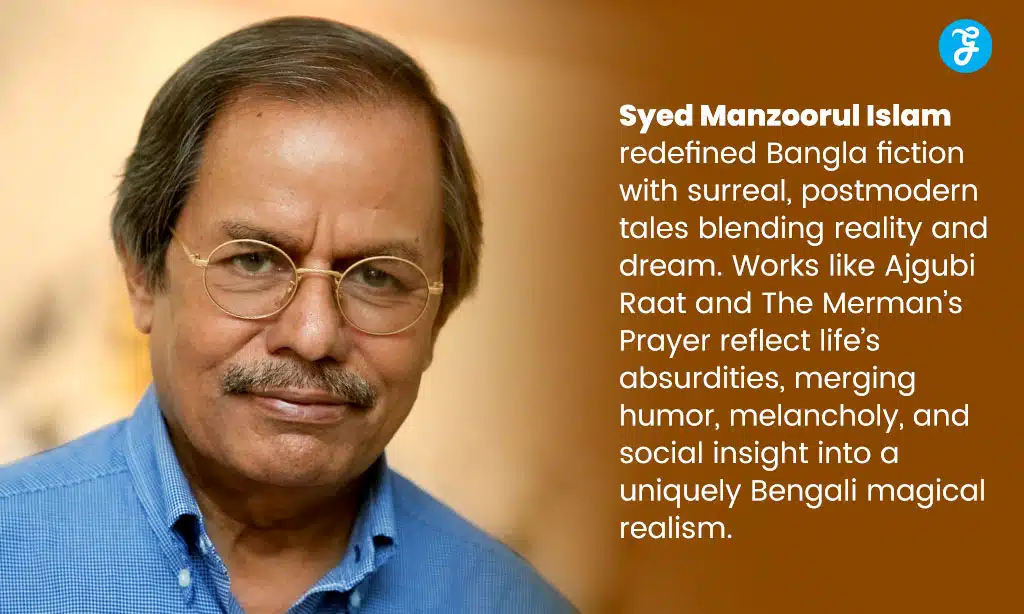
In the 1980s, Syed Manzoorul Islam emerged as one of the most distinctive storytellers in Bangla fiction. His writing broke free from linear realism and embraced the absurd, the surreal, and the self-reflexive.
He once described himself as “a critic by training, a writer by compulsion.” That compulsion gave rise to some of Bangladesh’s most original postmodern literature—tales where dreams converse with memory, and time bends under the weight of imagination.
Ajgubi Raat—The Absurd Night of Our Existence
His 2010 novel, Ajgubi Raat (Absurd Night), stands as a milestone in Bangla literature. It blurred the line between wakefulness and dream, offering readers a haunting reflection on the absurdities of modern life. Characters in his stories wandered through strange yet familiar landscapes—much like citizens of a world constantly negotiating meaning.
When the book was later translated into English as Absurd Night, it revealed how deeply his storytelling resonated across cultures—rooted in local soil but reaching toward universal truths.
The Merman’s Prayer—English Voice of a Bengali Dreamer
In The Merman’s Prayer and Other Stories, Islam invited global readers into his world—where fishermen prayed to forgotten gods, lovers searched for logic in chaos, and cities whispered to the sea. Critics hailed the book for its fusion of humor, melancholy, and mystery—a kind of Bengali magical realism infused with philosophy.
He built a bridge between the real and the unreal, showing that fantasy was often the truest mirror of human despair.
A Bridge Between Realism and Reverie
Unlike writers who escaped into fantasy, Islam used surrealism as confrontation. Beneath his whimsy lay sharp insights into social injustice, loneliness, and the disorientation of modernity. His stories were mirrors that refused to flatter—reflecting both the tenderness and tragedy of being human.
In the world of Bangla fiction, he was both a dreamer and a diagnostician.
The Philosopher of Language and Nation
Beyond fiction, Syed Manzoorul Islam was a profound essayist and cultural thinker. His writings on the Language Movement of 1952, compiled in Essays on Ekushey, reminded readers that language was not just a means of communication—it was an act of liberation.
He argued that the Bangla language was a living organism, constantly evolving, and that dialects and regional expressions were vital parts of the national voice. His essays carried both the precision of a scholar and the passion of a patriot.
The Art of Thinking in Bangla
In collections like Nandantattwa, Rabindranther Jyamiti o Anyanya Shilpaprashanga, and Olosh Diner Haowa, Islam blended Western critical theory with Bengali aesthetics. He wrote about the geometry of Tagore’s imagination, the philosophy of leisure, and the poetry of everyday life.
For him, literature wasn’t an escape—it was a way to confront reality with grace. He believed that art must awaken empathy, not merely entertain intellect.
The Human Behind the Words
Though soft-spoken, Islam was never silent when truth was under threat. As President of PEN Bangladesh (2018–2025), he championed freedom of expression and stood by writers who faced censorship. His activism was subtle yet steadfast—his belief that “writing itself is a form of resistance” defined his leadership.
He saw literature as a moral act—a dialogue between the writer’s conscience and the reader’s courage.
Mentor, Friend, and Eternal Student
To his students, Syed Manzoorul Islam was less of a lecturer and more of a life guide. He often stayed back after classes, sipping tea while discussing philosophy, cinema, or cricket. His humility made him accessible; his intellect made him unforgettable.
Those who met him recall his warm smile, his quiet humor, and his unending curiosity. Even at 74, he was still reading, still questioning, still learning.
Awards, Recognition, and Reverence
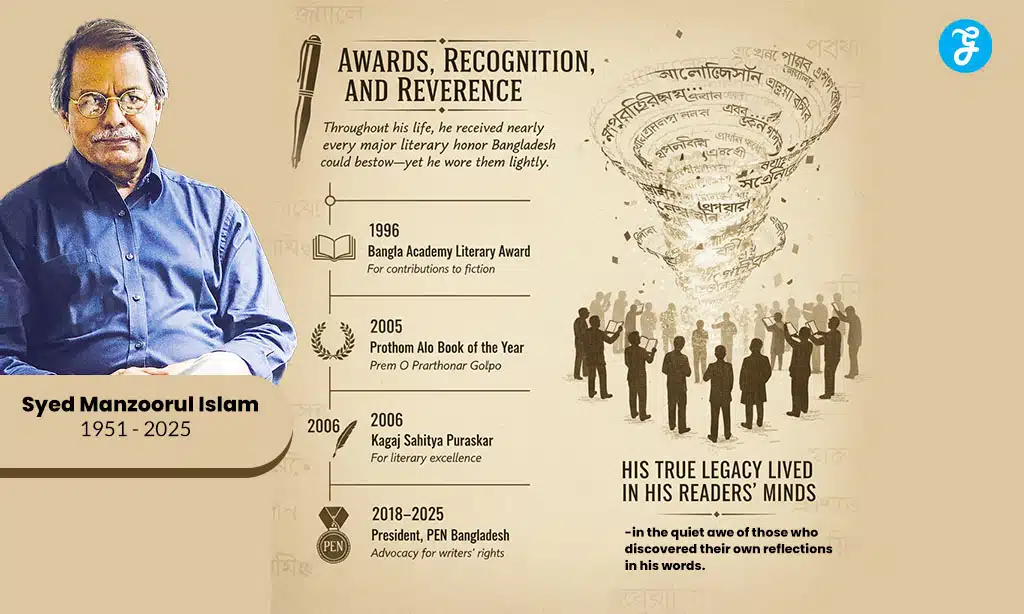
Throughout his life, he received nearly every major literary honor Bangladesh could bestow—yet he wore them lightly.
| Year | Award/Role | Institution / Description |
|---|---|---|
| 1996 | Bangla Academy Literary Award | For contributions to fiction |
| 2005 | Prothom Alo Book of the Year | Prem O Prarthonar Golpo |
| 2006 | Kagaj Sahitya Puraskar | For literary excellence |
| 2018 | Ekushey Padak | National honor for literature |
| 2018–2025 | President, PEN Bangladesh | Advocacy for writers’ rights |
Beyond awards, his true legacy lived in his readers’ minds—in the quiet awe of those who discovered their own reflections in his words.
The Final Chapter—October 10, 2025
When the news of his passing broke, social media turned into a collective mourning space. Writers, journalists, and former students flooded timelines with tributes.
At the University of Dhaka, candles burned late into the night. At ULAB, students placed handwritten notes beside his photograph: “Thank you for teaching us how to see.”
He passed away due to cardiac complications, but for many, it felt like a heartbreak shared by an entire nation. Newspapers called him “a conscience of literature,” while readers simply said, “We lost our storyteller.”
The Silence That Spoke Volumes
His death left a silence that words struggle to fill. For decades, he had questioned meaning, mocked pretension, and illuminated absurdity—now, in his absence, even absurdity felt hollow.
But perhaps this was his final lesson: that all stories must end, but the meaning they leave behind keeps rewriting itself in the hearts of those who listen.
The Legacy That Refuses to Sleep
Even in death, Syed Manzoorul Islam’s legacy continues to awaken minds. His works—Ajgubi Raat, The Merman’s Prayer, Adhakhana Manush, and Tin Parber Jiban—are being reprinted and translated anew. His essays are being revisited by students who once feared theory but now see it as poetry.
Writers influenced by him—from emerging fictionists to established novelists—carry forward his fearless introspection. Discussions are underway to create a “Syed Manzoorul Islam Literary Archive” at ULAB, preserving his manuscripts, letters, and lecture notes.
In every classroom where a teacher dares to make literature personal, in every story that blends humor with heartbreak, his spirit quietly persists.
Saying Goodnight, Not Goodbye
Syed Manzoorul Islam once wrote that stories never really end—they “pause, breathe, and wait for another reader to continue.” Perhaps that’s why this farewell feels incomplete.
He taught us that literature is not just about language—it’s about courage, compassion, and curiosity. His passing is a loss for Bangladesh, but his legacy is a gift to humanity.
So tonight, as readers close their books or students recall his voice, let us not say goodbye. Let us whisper what his stories taught us to believe:
Goodnight, Storyteller. Your words will keep us awake.






















