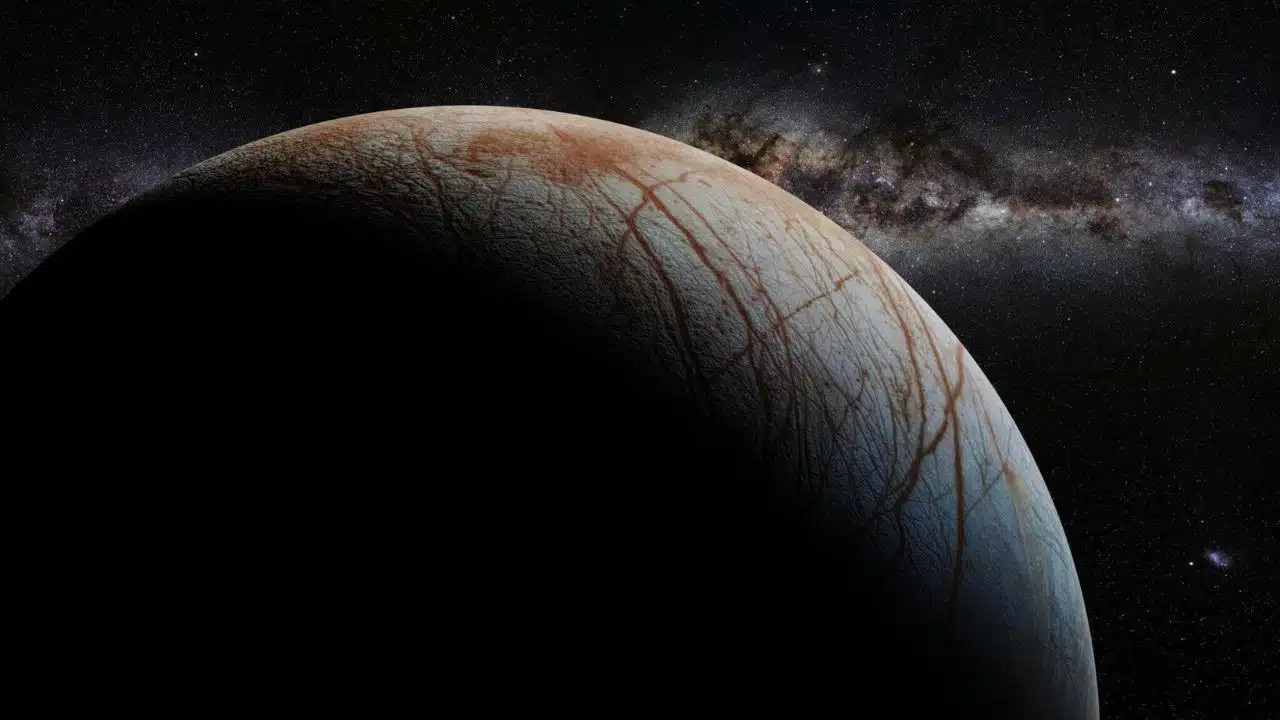
Scientists announced on Monday, March 4, that they have successfully measured the amount of molecular oxygen around Jupiter’s moon Europa, which is the type of oxygen we breathe on Earth.
Researchers have previously estimated the oxygen content of the icy moon, but this is the first time a direct measurement has been made.
In short, the outcome did not meet some very optimistic earlier predictions. Does this suggest that Europa, thought to have a vast ocean of salty water under its icy surface, may not be as conducive to the development of life as we had anticipated? Or perhaps, to life as we know it? It’s not a definite answer, but the topic is intriguing and worth exploring further.
Based on the study, certain past calculations of Europa’s oxygen levels were deduced from atomic oxygen emissions linked to the moon. Atomic oxygen consists of only one oxygen atom, unlike molecular oxygen, which is composed of two. This type is the one we cannot inhale, but researchers probably determined that understanding the amount of it present around Europa would provide some limitations on the total breathable oxygen the moon generates.
The analysis, along with other remote observations, imposed some restrictions on the association of the material with the Jovian moon. However, the latest study managed to further refine these predictions. The researchers successfully measured Europa’s oxygen content using NASA’s Juno probe and some ice chemistry.
Essentially, according to the team’s explanation in the study’s abstract, Europa’s water-ice shell could potentially undergo a water-splitting process. Some reactions can transform Europa’s frozen water molecules into molecular hydrogen (composed of two hydrogen atoms) and molecular oxygen. If such reactions did occur, evidence would be found in the form of oxygen and hydrogen ions near the moon. These ions would carry electrical charges. The theory was well-supported, as scientists were aware that Europa’s orbital path passes through one of Jupiter’s radiation belts. This belt contains numerous charged particles that may affect the moon’s surface, possibly initiating the water-splitting process.
Indeed, in September 2022, when Juno passed within 220 miles (354 kilometers) of Europa, it managed to detect evidence of water-splitting activity, as the team clarifies. According to NASA, the probe found hydrogen and oxygen ions that were likely the result of interactions with charged particles. Jupiter’s magnetic field then attracted these ions as it passed by the moon.
According to the study, H2+ and O2+ pickup ions were seen directly after Europa’s water-ice surface broke apart. This proved that these species are the main parts of the atmosphere.
Regarding certain figures, scientists determined that the moon’s atmosphere produces 26 pounds of molecular oxygen every second (12 kilograms per second). According to previous estimates, the range varies from a few pounds to over 2,000 pounds per second (about 900 kilograms per second.)
When NASA’s Galileo mission passed by Europa, it revealed the intricate and ever-changing relationship Europa has with its surroundings. Juno introduced a new ability to measure the composition of charged particles released from Europa’s atmosphere, and the team was eager to explore more of this intriguing water world,” stated study lead author Jamey Szalay from Princeton University, who is one of Juno’s instrument scientists. “What we didn’t anticipate was how Juno’s observations would provide us with such a precise limit on the oxygen produced on Europa’s icy surface.”
As the value turned out to be lower than initially believed, the team mentioned in the study that this finding suggests “a more limited range to support habitability in Europa’s ocean.” There is concern because this water-production method could be how Europa’s subsurface oasis receives its oxygen.
However, according to a statement from NASA, there is an alternative perspective to consider. “The ice-covered Jovian moon produces 1,000 tons of oxygen every 24 hours—sufficient to sustain a million individuals breathing for a day,” the statement says. Would life on an exotic moon, even if it’s life as we know it, have unique oxygen requirements? Keep an eye out for updates.