The rapid evolution of Web3 has paved the way for groundbreaking innovations, with emerging altcoins in Web3 playing a critical role in shaping the ecosystem.
As blockchain technology advances, these altcoins are driving the development of decentralized applications (dApps), smart contracts, and other Web3 solutions that redefine how we interact with the internet.
In this article, we’ll explore 10 emerging altcoins in Web3 that are set to revolutionize the industry, offering insights into their potential impact and why they deserve your attention.
What Are Altcoins and Their Role in Web3?
Defining Altcoins
Altcoins, or alternative cryptocurrencies, refer to all digital currencies other than Bitcoin. They are designed to address specific limitations of Bitcoin or introduce new functionalities. Unlike Bitcoin’s primary focus on being a digital store of value, many altcoins aim to enhance scalability, security, or interoperability within the blockchain ecosystem.
For instance, Ethereum introduced smart contracts that allowed developers to create decentralized applications, while Solana optimized transaction speed and scalability.
These advancements demonstrate how altcoins address unique challenges in the blockchain industry, making emerging altcoins in Web3 essential for innovation.
Altcoins in the Web3 Ecosystem
In the context of Web3, altcoins power a diverse range of applications. They provide the foundation for dApps, enable decentralized finance (DeFi), and facilitate secure, transparent transactions across blockchain networks.
Altcoins like Ethereum and Solana are vital to supporting smart contract functionality, making them indispensable in the Web3 ecosystem.
Take Chainlink, for example, which bridges the gap between blockchain and real-world data. By providing decentralized oracles, it ensures the accuracy and reliability of data used in smart contracts, showcasing the importance of altcoins in expanding Web3 capabilities.
Criteria for Selecting These 10 Emerging Altcoins
- Technology and Innovation: Altcoins must introduce unique features or technological advancements that set them apart. For example, Polkadot’s parachain architecture enhances interoperability among blockchains.
- Market Potential and Adoption: The altcoin’s ability to gain widespread adoption and maintain a strong market presence is crucial. Solana’s rapid ecosystem growth demonstrates this potential.
- Team and Community Support: A robust development team and active community backing are critical for long-term success. Cardano’s research-driven development approach is a testament to this.
Why These Criteria Matter?
The success of emerging altcoins in Web3 depends on their ability to address real-world problems, attract users, and sustain innovation. By focusing on these factors, we can identify altcoins that hold the greatest potential to shape the future of Web3.
10 Emerging Altcoins Set to Shape the Web3 Space
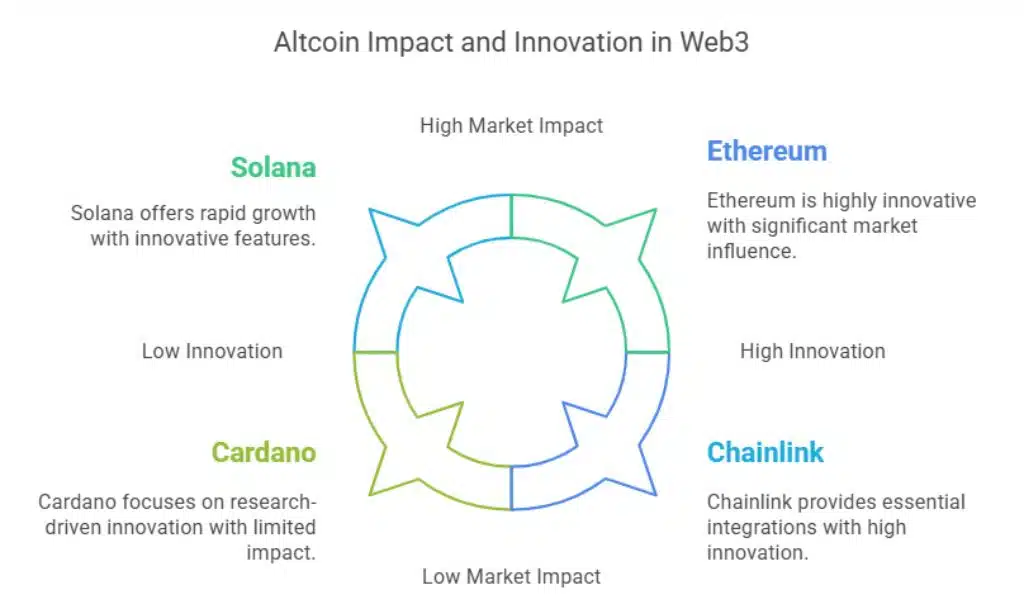
To better understand how these altcoins are shaping the future of Web3, we’ll examine their unique features and contributions to the blockchain ecosystem.
| Altcoin | Key Features | Primary Use Cases | Market Position |
| Ethereum | Smart contracts, dApps | DeFi, NFTs | Leading platform |
| Solana | High speed, low fees | Gaming, NFTs | Rapid ecosystem growth |
| Polkadot | Interoperability, parachains | Cross-chain communication | Innovative technology |
| Avalanche | Three-layer blockchain | Enterprise, DeFi | Scalable solution |
| Cardano | Research-driven, sustainable | Governance, education | Expanding ecosystem |
| Chainlink | Decentralized oracles | Data feeds, insurance | Essential integration |
| Tezos | Self-amending blockchain | NFTs, enterprise | Governance updates |
| Cosmos | Blockchain interoperability | Scalability, communication | Developer growth |
| Algorand | High-speed, sustainable | DeFi, carbon-neutrality | Market expansion |
| Arbitrum | Ethereum Layer 2 scaling | dApps, lower fees | Growing adoption |
1. Ethereum (ETH)
Ethereum’s smart contract platform has revolutionized blockchain technology, serving as the backbone for countless dApps and DeFi projects. Its transition to Ethereum 2.0, known as the Merge, introduced a more energy-efficient proof-of-stake consensus mechanism. With scalability solutions like rollups and Layer 2 chains, Ethereum remains a cornerstone of the Web3 revolution.
| Feature | Details |
| Consensus Mechanism | Proof of Stake |
| Use Cases | DeFi, NFTs, dApps |
| Notable Upgrades | Ethereum 2.0, Rollups |
| Daily Transactions | Over 1 million |
2. Solana (SOL)
Solana’s high-speed blockchain, capable of processing over 65,000 transactions per second, has made it a favorite for developers. It uses a unique Proof of History (PoH) mechanism to optimize performance. Solana’s ecosystem includes popular NFT platforms like Magic Eden and top-tier DeFi projects.
| Feature | Details |
| Consensus Mechanism | Proof of Stake + Proof of History |
| Use Cases | DeFi, Gaming, NFTs |
| Transaction Speed | ~65,000 TPS |
| Total Value Locked (TVL) | $1.2 billion |
3. Polkadot (DOT)
Polkadot focuses on interoperability, allowing blockchains to communicate and share data securely. Its parachain architecture ensures scalability and flexibility. Polkadot’s ecosystem includes Moonbeam and Acala, which bring DeFi and cross-chain functionalities to life.
| Feature | Details |
| Key Innovation | Parachain Architecture |
| Use Cases | Cross-chain Transfers, DeFi |
| Ecosystem Growth | 500+ Projects |
| Developers | Over 1,000 active contributors |
4. Avalanche (AVAX)
Avalanche’s three-layer blockchain design enhances scalability while maintaining high security. It is widely adopted for enterprise blockchain solutions, including partnerships with Deloitte. Avalanche also supports DeFi platforms like Pangolin and Benqi.
| Feature | Details |
| Unique Design | Three-layer Blockchain |
| Use Cases | Enterprise, DeFi |
| Key Partners | Deloitte, Chainlink |
| Transactions Per Second | Over 4,500 |
5. Cardano (ADA)
Cardano’s research-driven approach ensures a secure and sustainable blockchain. Its focus on real-world applications includes projects like Atala PRISM for digital identities and initiatives in education and agriculture.
| Feature | Details |
| Core Philosophy | Research-driven Development |
| Use Cases | Digital Identity, Education |
| Recent Developments | Hydra Scalability Solution |
| Ecosystem Size | 1,200+ dApps |
6. Chainlink (LINK)
Chainlink’s decentralized oracle network connects smart contracts with external data sources. Its integrations with DeFi platforms like Aave and Compound demonstrate its critical role in providing real-world data for blockchain applications.
| Feature | Details |
| Key Functionality | Decentralized Oracles |
| Use Cases | DeFi, Insurance |
| Notable Integrations | Aave, Compound |
| Daily API Calls | Over 5 billion |
7. Tezos (XTZ)
Tezos’ self-amending protocol allows seamless upgrades without disruptive hard forks. Its governance model empowers token holders to vote on protocol changes. Tezos is widely used for NFT marketplaces like Objkt and enterprise applications.
| Feature | Details |
| Governance Model | On-chain Voting |
| Use Cases | NFTs, Enterprise |
| Upgrade Mechanism | Self-amending Protocol |
| Ecosystem Applications | 400+ Projects |
8. Cosmos (ATOM)
Cosmos, known as the “Internet of Blockchains,” fosters interoperability with its Inter-Blockchain Communication (IBC) protocol. Popular projects like Osmosis and Terra utilize Cosmos’ robust infrastructure.
| Feature | Details |
| Key Protocol | Inter-Blockchain Communication (IBC) |
| Use Cases | Cross-chain Communication |
| Ecosystem | 200+ Connected Blockchains |
| Transactions Daily | 1 million+ |
9. Algorand (ALGO)
Algorand’s eco-friendly blockchain processes transactions in under 5 seconds. Its partnerships include collaborations with governments for digital currencies and sustainability-focused initiatives.
| Feature | Details |
| Unique Feature | Carbon-neutral Blockchain |
| Use Cases | DeFi, Government Partnerships |
| Speed | ~5-second Finality |
| Partnerships | FIFA, Marshall Islands |
10. Arbitrum (ARB)
Arbitrum scales Ethereum through its Layer 2 solution, reducing gas fees and improving transaction speed. It is increasingly adopted by dApps looking to enhance user experience without compromising security.
| Feature | Details |
| Focus Area | Ethereum Scaling |
| Use Cases | Lower Fees, Faster dApps |
| Growth | Expanding Developer Adoption |
| TVL | $2 billion |
The Future of Web3 and the Role of Emerging Altcoins
The Web3 space continues to evolve, with trends like decentralized governance, metaverse applications, and AI integration gaining momentum. Altcoins play a pivotal role in driving these innovations.
For instance, the growing adoption of NFTs by major brands and institutions highlights the expanding relevance of altcoins like Tezos and Ethereum. Similarly, Polkadot’s cross-chain capabilities enable projects to leverage multiple blockchains seamlessly, showing why emerging altcoins in Web3 are integral to innovation.
Potential Challenges
Despite their promise, emerging altcoins face challenges such as scalability, regulatory uncertainties, and competition. Addressing these obstacles is crucial for their success. For example, Ethereum’s Layer 2 solutions like Arbitrum aim to resolve scalability issues by offloading transactions from the main chain.
Opportunities for Growth
By fostering collaboration, enhancing technology, and expanding use cases, altcoins can unlock new opportunities and cement their place in the Web3 ecosystem. The rise of DeFi insurance platforms powered by Chainlink demonstrates how emerging altcoins in Web3 continue to find innovative applications.
How to Invest in Emerging Altcoins?
Do Your Research
Understand the technology, team, and market potential before investing in any altcoin. For example, Solana’s Proof of History mechanism offers a unique edge in transaction processing.
Diversify Your Portfolio
Spread your investments across multiple altcoins to minimize risk and maximize returns. Including tokens like Algorand for sustainability and Polkadot for interoperability provides balance.
Stay Updated
Keep track of market trends and developments to make informed investment decisions. Platforms like CoinGecko and Messari offer real-time data to guide investors.
Takeaways
The 10 emerging altcoins in Web3 outlined in this article highlight the immense potential of blockchain technology to transform industries and redefine the internet.
By staying informed and exploring these altcoins, you can position yourself at the forefront of this exciting revolution. Embrace the opportunities that Web3 and its innovative altcoins have to offer.