Choosing among the best e-commerce platforms for dropshipping is the single most critical technical decision you will make when launching a modern retail business in 2026. The dropshipping model—where you sell products without holding physical inventory—relies entirely on seamless data flow between your storefront, your payment gateway, and your global suppliers. If your platform suffers from sync delays, poor mobile optimization, or high transaction fees, your profit margins will vanish. Today’s top platforms offer advanced automation, AI-driven product descriptions, and native integrations with massive supplier networks like AliExpress, Spocket, and Zendrop.
The following guide details the premier software solutions designed to help you build, scale, and automate a highly profitable dropshipping operation.
How We Selected the Best E-commerce Platforms for Dropshipping
When evaluating the market for our 2026 review, we focused strictly on platforms that eliminate the friction between customer orders and supplier fulfillment. A beautiful website means nothing if the backend routing fails. Below are the core metrics and criteria we used to rank the industry leaders.
| Criteria | Evaluation Metric | Why It Matters |
| Supplier Integrations | Native apps for DSers, Spocket, Printify, etc. | Determines how easily you can import products and automate order fulfillment. |
| Cost & Fees | Monthly subscriptions and transaction fee percentages | Dropshipping margins are notoriously tight; high platform fees can erode profitability. |
| Automation | Inventory syncing and automated order routing | Prevents selling out-of-stock items and ensures suppliers receive orders instantly. |
| Developer Control | API access and headless commerce capabilities | Essential for backend developers wanting to build custom micro-services or custom mobile apps. |
| SEO & Performance | Adherence to Google E-E-A-T and Core Web Vitals | Organic traffic is vital for long-term profitability to offset rising paid advertising costs. |
The 10 Best E-commerce Platforms for Dropshipping
From open-source frameworks ideal for technical founders to drag-and-drop builders meant for absolute beginners, these 10 platforms dominate the dropshipping landscape today.
1. Shopify
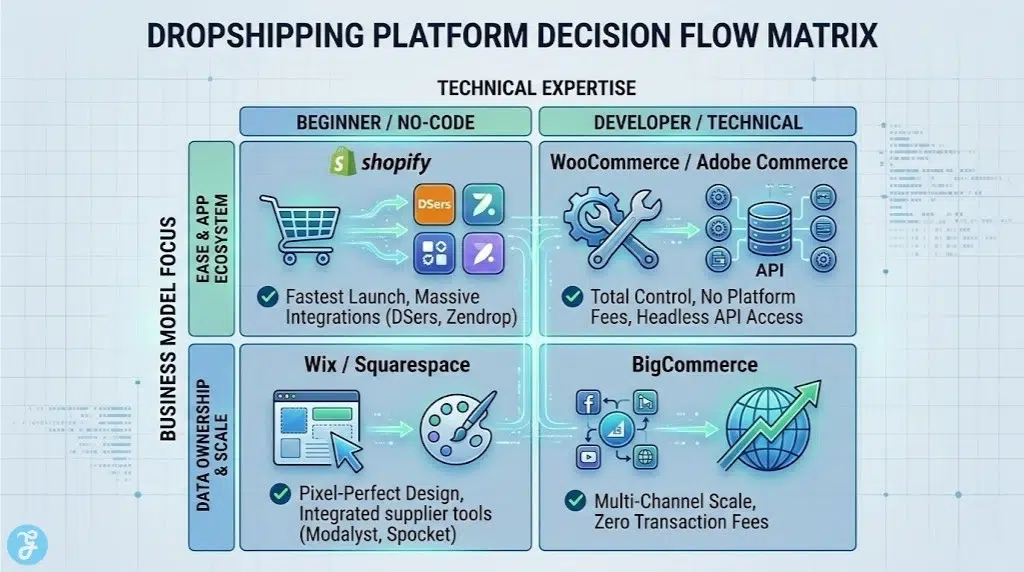
Shopify is practically synonymous with dropshipping. It remains the undisputed industry leader due to its massive App Store, which houses native integrations for virtually every dropshipping supplier on the planet (DSers, Zendrop, CJ Dropshipping, Spocket). In 2026, Shopify’s ecosystem is heavily fortified with AI tools that automatically draft product descriptions and optimize checkout conversions. It provides a flawless infrastructure that scales effortlessly from your first sale to millions in revenue.
-
Best features: The largest dropshipping app ecosystem and the highly converting Shop Pay checkout.
-
Pros: Unmatched ease of use for beginners; infinite scalability for massive brands.
-
Things to consider: Monthly costs increase quickly once you start adding premium third-party apps, and they charge transaction fees if you don’t use Shopify Payments.
2. WooCommerce
WooCommerce is a free, open-source plugin that transforms a standard WordPress site into a powerhouse e-commerce store. It is the premier choice for backend developers, content writers, and technical founders who want total ownership of their data and codebase. Because it is open-source, you can utilize its REST API to build custom micro-services, connect proprietary supplier databases, or completely customize the checkout flow. It natively supports major dropshipping plugins like AliDropship.
-
Best features: Complete data ownership, endless customization, and deep API accessibility.
-
Pros: No monthly platform fees (just hosting); the most SEO-friendly platform on the market.
-
Things to consider: You are entirely responsible for site security, hosting stability, and fixing plugin conflicts.
3. BigCommerce
BigCommerce is a robust, cloud-based platform designed to handle massive catalogs and high transaction volumes without the need for extensive third-party apps. Unlike Shopify, BigCommerce does not charge additional transaction fees, regardless of which payment gateway you use. This makes it highly attractive for high-volume dropshippers operating on thin margins. It integrates smoothly with major dropshipping networks like Spocket and Printful.
-
Best features: Zero transaction fees and powerful native multi-channel selling (social media, Amazon).
-
Pros: More built-in features than Shopify out of the box; excellent B2B capabilities.
-
Things to consider: The pricing structure is revenue-based, meaning your monthly subscription automatically upgrades as your sales volume increases.
4. Wix
Wix has evolved from a simple portfolio builder into a highly capable e-commerce platform. It is famous for its unstructured drag-and-drop editor, allowing complete beginners to design a beautiful, pixel-perfect storefront without writing a single line of code. Wix has partnered closely with Modalyst (which it acquired) and Spocket to provide a deeply integrated, seamless dropshipping experience right from the main dashboard.
-
Best features: True visual drag-and-drop design and native Modalyst integration.
-
Pros: The easiest learning curve for absolute beginners with no technical background.
-
Things to consider: Once you choose a website template, you cannot switch it without completely rebuilding your site from scratch.
5. Squarespace
Squarespace is the platform of choice for entrepreneurs who prioritize aesthetics and modern, clean design. If you are dropshipping high-end lifestyle products, apparel, or home decor, Squarespace’s award-winning templates will make your brand look premium on day one. It seamlessly integrates with Spocket and Printful, allowing you to easily populate your beautiful storefront with curated products.
-
Best features: Industry-leading aesthetic templates and excellent built-in blogging tools.
-
Pros: Makes dropshipped products look like high-end boutique items; easy to use.
-
Things to consider: It lacks the deep, granular e-commerce features and massive app store found in Shopify or BigCommerce.
6. Ecwid (by Lightspeed)
Ecwid is unique because it is designed as “headless” commerce. Rather than building a brand new website, Ecwid provides a widget that you can embed into any existing website, blog, or social media page (WordPress, Joomla, Tumblr, etc.). If you have already built a successful digital publication or content site and simply want to add a dropshipping store to it without migrating platforms, Ecwid is the ultimate solution.
-
Best features: Embeddable storefront technology for existing websites.
-
Pros: Turns any current web property into a fully functional dropshipping store in minutes.
-
Things to consider: The standalone storefront builder is very basic compared to dedicated site builders like Wix.
7. Adobe Commerce (formerly Magento)
Adobe Commerce is an enterprise-level, open-source platform built for massive scale. It is not for beginners. However, for a team modernizing an established SME or a developer building a highly complex, multi-region dropshipping operation, it offers unmatched power. It can handle hundreds of thousands of SKUs and route orders intelligently across multiple global suppliers based on customer location.
-
Best features: Enterprise-grade scalability, advanced B2B functionality, and complex order routing.
-
Pros: Total control over the server environment and limitless custom development potential.
-
Things to consider: Extremely steep learning curve; requires dedicated developers and expensive dedicated hosting.
8. Shift4Shop
Shift4Shop caused a massive disruption in the industry by offering its enterprise-grade e-commerce platform completely free—as long as you use their native Shift4 payment processor (and are based in the US). It comes packed with features that other platforms charge extra for, including an affiliate marketing dashboard, abandoned cart emails, and a built-in CRM. It integrates seamlessly with Doba and AliExpress dropshipping apps.
-
Best features: 100% free enterprise plan (for US merchants using Shift4 payments).
-
Pros: Incredible value with no monthly software fees; very strong built-in SEO tools.
-
Things to consider: The backend interface feels a bit dated and clunky compared to modern competitors like Shopify.
9. Sellfy
Sellfy was originally built for creators selling digital products, but it has expanded into a streamlined dropshipping powerhouse via its native print-on-demand (POD) integration. If your goal is to launch a merchandise line (t-shirts, mugs, hoodies) alongside digital downloads like e-books or online courses, Sellfy handles both effortlessly. You do not need to connect a third-party app; the print-on-demand supplier is built directly into the software.
-
Best features: Native print-on-demand dropshipping and seamless digital product delivery.
-
Pros: The fastest way for a content creator to launch physical merch; incredibly simple setup.
-
Things to consider: It is strictly for print-on-demand dropshipping; it does not integrate with traditional AliExpress suppliers.
10. PrestaShop
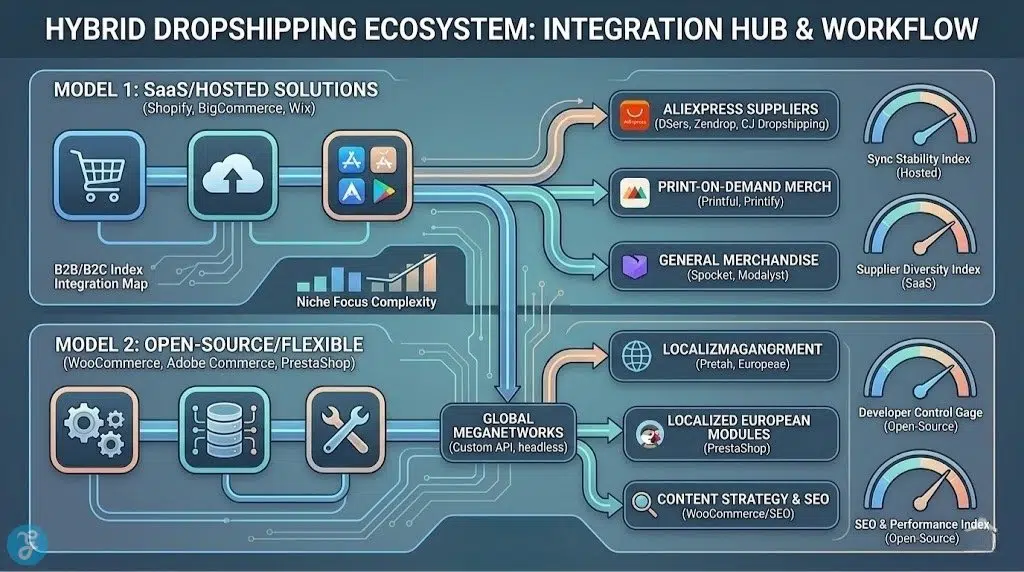
PrestaShop is a fantastic open-source alternative to WooCommerce, particularly popular in the European market. It strikes a balance between the user-friendliness of a hosted platform and the developer control of open-source software. The PrestaShop Addons marketplace features hundreds of modules specifically designed to sync inventory and orders with major dropshipping suppliers across Europe and Asia.
-
Best features: Open-source flexibility with a massive marketplace of localized international modules.
-
Pros: Excellent multi-language and multi-currency support for global dropshipping operations.
-
Things to consider: While the core software is free, premium modules (which are often necessary for dropshipping) can be quite expensive.
Quick Overview
The following table summarizes the core features of these platforms, ensuring you can quickly identify the best foundation for your business model.
Comparison Table
| Platform | Platform Type | Best Dropshipping Integrations | Transaction Fees |
| Shopify | Hosted SaaS | DSers, Spocket, Zendrop | Yes (Unless using Shopify Payments) |
| WooCommerce | Open-Source Plugin | AliDropship, Spocket | None (Gateway fees only) |
| BigCommerce | Hosted SaaS | Spocket, Printful | None |
| Wix | Hosted SaaS | Modalyst, Spocket | None (Gateway fees only) |
| Squarespace | Hosted SaaS | Spocket, Printful | Varies by plan |
| Ecwid | Headless / Embed | Printful, Spocket | None (Gateway fees only) |
| Adobe Commerce | Enterprise Open-Source | Custom API / Mega-networks | None |
| Shift4Shop | Hosted SaaS | Doba, AliExpress | None (Must use Shift4 Payments) |
| Sellfy | Hosted SaaS | Native Print-on-Demand | 0% |
| PrestaShop | Open-Source | Localized Add-on Modules | None (Gateway fees only) |
Quick Picks
If you need a fast recommendation based on your technical background and business goals:
-
Best for Absolute Beginners & Massive App Variety: Shopify
-
Best for Developers & Complete Data Ownership: WooCommerce
-
Best for High-Volume Scaling (No Transaction Fees): BigCommerce
-
Best for Creators Selling Merch & Digital Goods: Sellfy
Final Thoughts On Dropshipping E-commerce Software
Choosing among the best e-commerce platforms for dropshipping will dictate the daily operational flow of your digital business. If you are looking for the path of least resistance and the largest selection of supplier apps, Shopify remains the gold standard. However, if you are applying a modern digital business blueprint and possess backend development skills, leveraging an open-source solution like WooCommerce will give you absolute control over your SEO, data architecture, and long-term profit margins. Make your choice based on how much technical maintenance you are willing to handle versus how much out-of-the-box convenience you are willing to pay for.