
Migrating software architecture to the cloud without careful capacity planning or security governance can spiral into runaway hosting bills and catastrophic downtime. Recognizing critical cloud migration mistakes early empowers engineering and DevOps leaders to safeguard data integrity, control cloud infrastructure budgets, and prevent project delays.
| Migration Mistake | Primary Engineering Risk | Financial Impact | Prevention Strategy |
| 1. Lift-and-Shift Without Refactoring | Carries legacy bottlenecks into the cloud | Unoptimized resource usage and high compute fees | Redesign core services for cloud-native elasticity |
| 2. Inadequate Cloud Cost Modeling | Unpredicted infrastructure spend spikes | 50% to 200% over budget within six months | Implement FinOps monitoring and auto-scaling rules |
| 3. Skipping Comprehensive Data Audits | Migrating corrupt or redundant database bloat | Wasted storage and slow query performance | Cleanse and archive historical data pre-migration |
| 4. Neglecting Identity & Access (IAM) | Over-permissioned user and service accounts | High vulnerability to cloud security breaches | Enforce least-privilege role-based access control |
| 5. Ignoring Network Latency & Egress | Slow application response and data transfer fees | Unexpected egress charges on cross-region data | Optimize VPC topologies and leverage CDNs |
| 6. Vague Disaster Recovery Testing | Unverified backup failures during system outages | Extended customer downtime and SLA penalties | Execute routine automated failover simulation tests |
| 7. Hardcoded Secrets and Configs | Accidental credential leaks in public repositories | Security compromises and data exposure | Integrate secret managers like Vault or AWS Secrets |
| 8. Monolithic Big-Bang Deployment | Massive rollback complexity during failure | Total service outage for end-users | Adopt phased strangler-fig or canary rollouts |
| 9. Forgetting Observability & Logging | Blind spots during production incidents | Extended Mean Time to Resolution (MTTR) | Establish unified APM and centralized telemetry |
| 10. Underestimating Team Skill Gaps | Inefficient architecture configuration by novices | Delayed timelines and architectural debt | Invest in targeted cloud certifications and training |
| 11. Neglecting Compliance and Governance | Failure to meet SOC 2, HIPAA, or GDPR rules | Costly regulatory penalties and lost deals | Integrate compliance-as-code into CI/CD pipelines |
| 12. Skipping Post-Migration Tuning | Running over-provisioned VMs indefinitely | Wasted monthly cloud expenditure | Right-size instance types based on real-world usage |
12 Critical Cloud Migration Mistakes SaaS Teams Regret
1. Executing a Blind “Lift-and-Shift” Without Refactoring
Moving a monolithic legacy application straight into cloud virtual machines without redesigning its architecture often carries old performance bottlenecks directly into the new environment. While lift-and-shift projects offer speed upfront, they fail to leverage cloud elasticity, resulting in bloated compute bills and rigid scaling limitations.
2. Inadequate Pre-Migration Cloud Cost Modeling
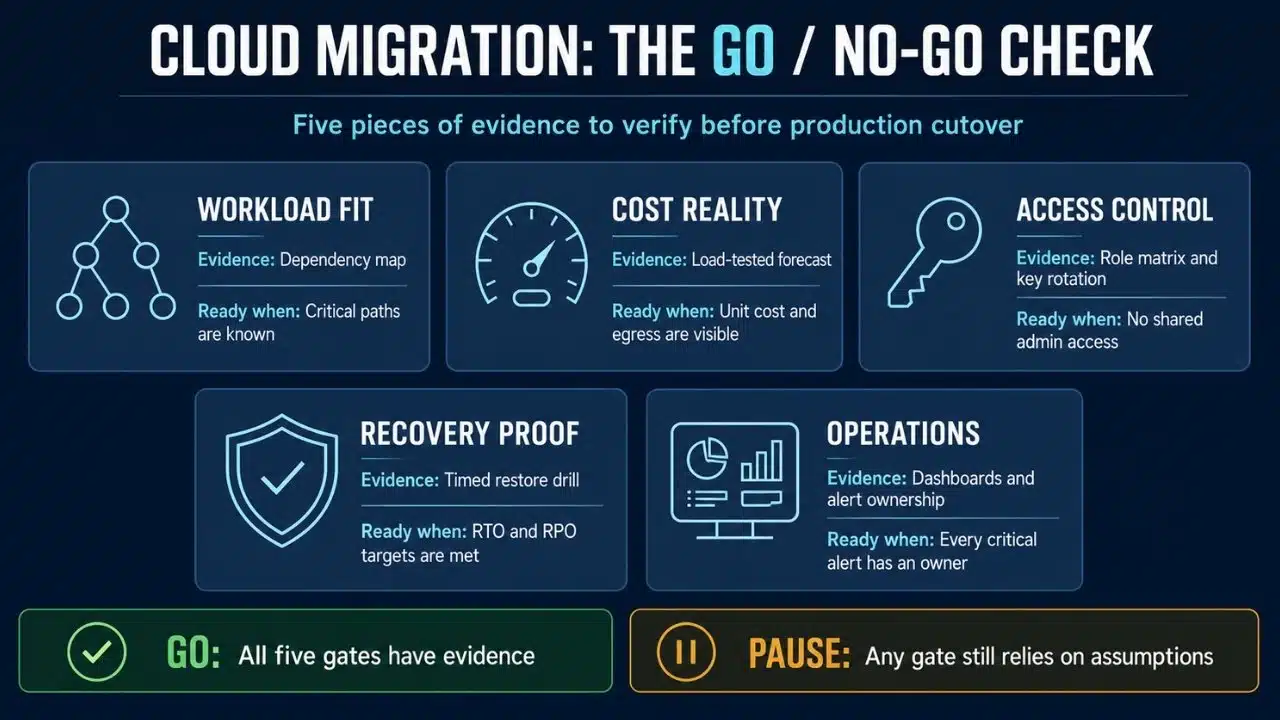
Failing to forecast cloud consumption accurately leads to severe budget overruns once production workloads go live. Many teams assume cloud hosting will automatically reduce data center costs, only to face massive monthly bills driven by unoptimized storage tiers and unmonitored API request volumes. Implementing disciplined FinOps cost-governance frameworks prevents unexpected financial surprises.
3. Skipping Comprehensive Database and Data Audits
Migrating years of uncleaned logs, redundant tables, and orphaned user records into a cloud database wastes storage and drives up input/output operations per second (IOPS) costs. Cleaning, indexing, and archiving historical data before moving instances significantly accelerates transfer speeds and shrinks cloud storage overhead.
4. Neglecting Strict Identity and Access Management (IAM)
Treating cloud security access as an afterthought often results in overly permissive root credentials and shared service keys. Following established cloud security guidelines ensures teams enforce strict least-privilege access rules, multi-factor authentication, and segmented role policies across all cloud environments.
5. Ignoring Cross-Region Network Latency and Egress Fees
Moving services across different availability zones or cloud providers without mapping data transfer paths introduces hidden latency and exorbitant egress fees. Designing network topologies with local caching, private endpoints, and content delivery networks keeps inter-service communication fast and cost-effective.
6. Failing to Test Disaster Recovery and Backup Failovers
Backing up data is useless if recovery procedures have never been tested under load. Teams frequently discover during live outages that their snapshot restorations are incomplete, corrupted, or take hours longer than their SLA permits. Regular, automated disaster recovery drills are mandatory for production resilience.
7. Hardcoding API Keys, Secrets, and Configurations
Embedding database passwords or third-party API keys directly into source code repositories creates severe security vulnerabilities. Transitioning configuration management to dedicated secret-management solutions prevents credential leakage and simplifies secret rotation across staging and production clusters.
8. Adopting a Risky “Big-Bang” Migration Strategy
Attempting to move an entire SaaS platform in a single weekend deployment creates massive risk if critical bugs emerge. Utilizing phased rollouts—such as migrating non-critical microservices first or running canary deployments—isolates failures and allows teams to rollback safely without a total system blackout.
9. Overlooking Centralized Observability and Telemetry
Without unified application performance monitoring (APM) and centralized log aggregation, debugging distributed cloud infrastructure feels like searching for a needle in a haystack. Deploying robust telemetry before cutting over traffic ensures engineers can track error rates, latency spikes, and resource constraints in real time.
10. Underestimating Internal Engineering Skill Gaps
Assuming developers experienced in on-premise environments can instantly configure complex cloud-native architectures leads to costly misconfigurations. Bridging the knowledge gap through certified cloud training and bringing in experienced cloud architects prevents architectural mistakes that take years to unwind.
11. Overlooking Regulatory Compliance and Governance
SaaS providers handling sensitive customer data must ensure their cloud environments comply with frameworks like SOC 2, HIPAA, or GDPR. Neglecting compliance requirements during configuration can lead to regulatory fines, failed audits, and lost enterprise sales opportunities.
12. Skipping Post-Migration Resource Right-Sizing
After a migration completes, engineering teams often leave virtual machine instances and database clusters over-provisioned “just to be safe.” Reviewing performance metrics after 30 days of live traffic allows teams to right-size compute resources and slash wasted monthly cloud expenditures.
The Uncomfortable Reality of SaaS Cloud Economics
The most uncomfortable truth in cloud architecture is that moving to the cloud rarely reduces expenses out of the box, it often increases them. Cloud vendors market limitless scalability as an operational superpower, but they rarely highlight the invisible friction of data transfer fees, over-provisioned instances, and unoptimized queries. For scaling SaaS companies, treating the cloud as a simple virtual data center is a direct path to margin erosion.
Looking ahead, as multi-cloud strategies and serverless architectures mature, the engineering challenge is shifting from mere infrastructure migration to active workload optimization. The future belongs to teams that treat cloud architecture as code: continuously monitoring resource efficiency, automating cost governance, and refactoring applications to run only when computational demand explicitly requires it. Cloud migration is not a one-time IT project; it is a permanent operational discipline.
Frequently Asked Questions (FAQs) About Cloud Migration Mistakes
What is the most common mistake made during cloud migration?
Lifting and shifting legacy applications without refactoring is the most common error. It carries old technical debt into the new environment, preventing the app from utilizing cloud elasticity and driving up hosting costs.
How can SaaS companies prevent budget overruns during cloud migration?
Implement strict FinOps cost modeling, set up real-time budget alerts, and right-size cloud instances immediately after migration based on actual production performance metrics.
Why is a big-bang cloud migration dangerous for SaaS platforms?
A big-bang migration moves all systems simultaneously, making it extremely difficult to isolate bugs or rollback safely if a catastrophic failure occurs during the cutover window.
How does a lack of IAM governance impact cloud security?
Over-permissioned accounts and shared credentials create wide attack surfaces, allowing malicious actors or compromised services to access critical databases and customer records across the entire platform.
When should disaster recovery testing happen in a migration?
Disaster recovery and backup restoration protocols must be fully tested in a staging environment before any production traffic is migrated to the new cloud infrastructure.