
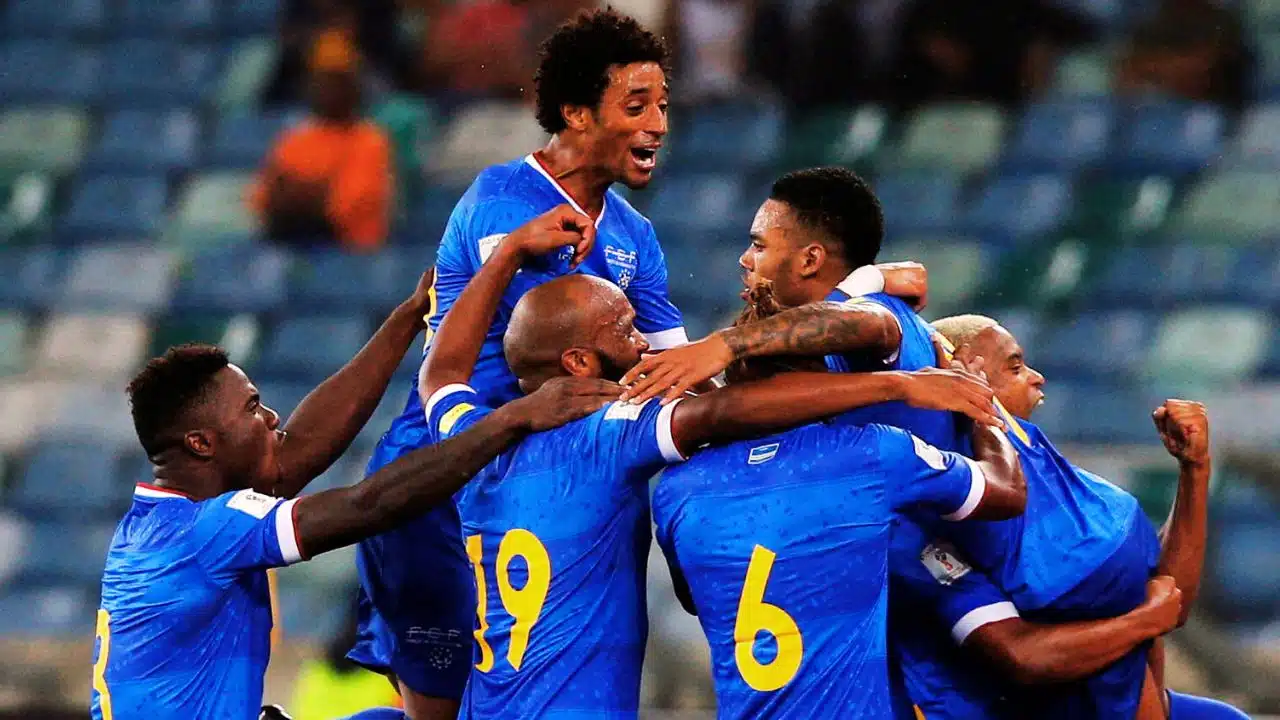
Cape Verde has etched its name into football history by qualifying for the 2026 FIFA World Cup following a commanding 3-0 home victory over Eswatini. That result secured top position in their qualifying group, ensuring the island nation a place in the global tournament lineup ahead of continental heavyweight Cameroon. The celebration that followed was not just for a match win—it marked a milestone for a small nation punching far above its presumed weight in world football.
The Match That Sealed It
The decisive game took place in Praia under the evening sky at the island’s National Stadium, which holds about 15,000 fans. In the first half, the two teams traded chances but failed to break through, and tension built as the home crowd watched nervously. The breakthrough came just minutes after halftime when Dailon Livramento seized upon a loose ball inside the six-yard box and put the hosts ahead. The atmosphere shifted instantly.
Shortly after, Willy Semedo added a second with a well-timed volley, capitalizing on a well-executed knockdown from a teammate. His strike extended Cape Verde’s lead and dampened hopes of an Eswatini comeback.
Even though the game was largely settled, the hosts added to their tally in stoppage time when veteran defender Stopira intervened to convert a loose ball in the box for a third goal. That final strike triggered exuberant celebrations across the stands, as fans and players reveled in the moment.
With that win, Cape Verde became the sixth African nation to secure qualification for the 2026 World Cup. Their success reverberated across the country and across the continent as a symbol of what a well-organized, passionate team can achieve.
Understanding the Context: Population, Identity, and Football Legacy
Small in Population, Big in Impact
Cape Verde, an archipelago of ten islands in the Atlantic, has a population under 525,000. Yet this relatively small population does not preclude the nation from making waves in international sport. With this qualification, Cape Verde becomes one of the world’s smallest nations to reach the World Cup stage—only Iceland, with fewer inhabitants, has done so in recent decades.
The islands gained independence from Portugal in 1975. In the years since, the nation’s football ambitions have been modest but steadily progressing. Their attempt to qualify for the 2002 World Cup was among their earliest serious forays into global competition. Over time, they have made a name for themselves in continent-level tournaments like the Africa Cup of Nations (AFCON), where they performed above expectations—making the quarter-finals in their debut appearance in 2013 and again in 2023.
Today, with their place in the 2026 tournament secured, Cape Verde reaffirms that smaller nations can compete on the world stage with the right vision, talent sourcing, and organizational discipline.
The Qualifying Road: Upsets, Grit, and Strategy
Key Results and Turning Points
Their path to qualification was not a straight walk. A critical moment came in their group when they hosted Cameroon, a traditional African football power, and earned a narrow but decisive 1-0 win. That victory was pivotal in putting them in pole position to top the group.
Earlier, Cape Verde endured a challenging away game in Libya, where they fell two goals behind but mounted a determined comeback to level the match at 3-3. A dramatic twist occurred late in stoppage time when they thought they had produced a winning goal—only for it to be disallowed for offside, denying them a much-needed full sweep.
The Cameroon side, despite their pedigree and expectations, failed to capitalize. Their campaign was marred by dropped points in away draws against Libya, Angola, and Eswatini. Those missed opportunities ultimately spelled their drop from direct qualification contention. To complicate matters further, Cameroon now faces the prospect of navigating both a continental and inter-confederation playoff path if it’s to earn a place in the finals. They ended their final game in Group D with a 0-0 draw against Angola, giving Cape Verde the space to claim supremacy.
Value of Expanded Slots
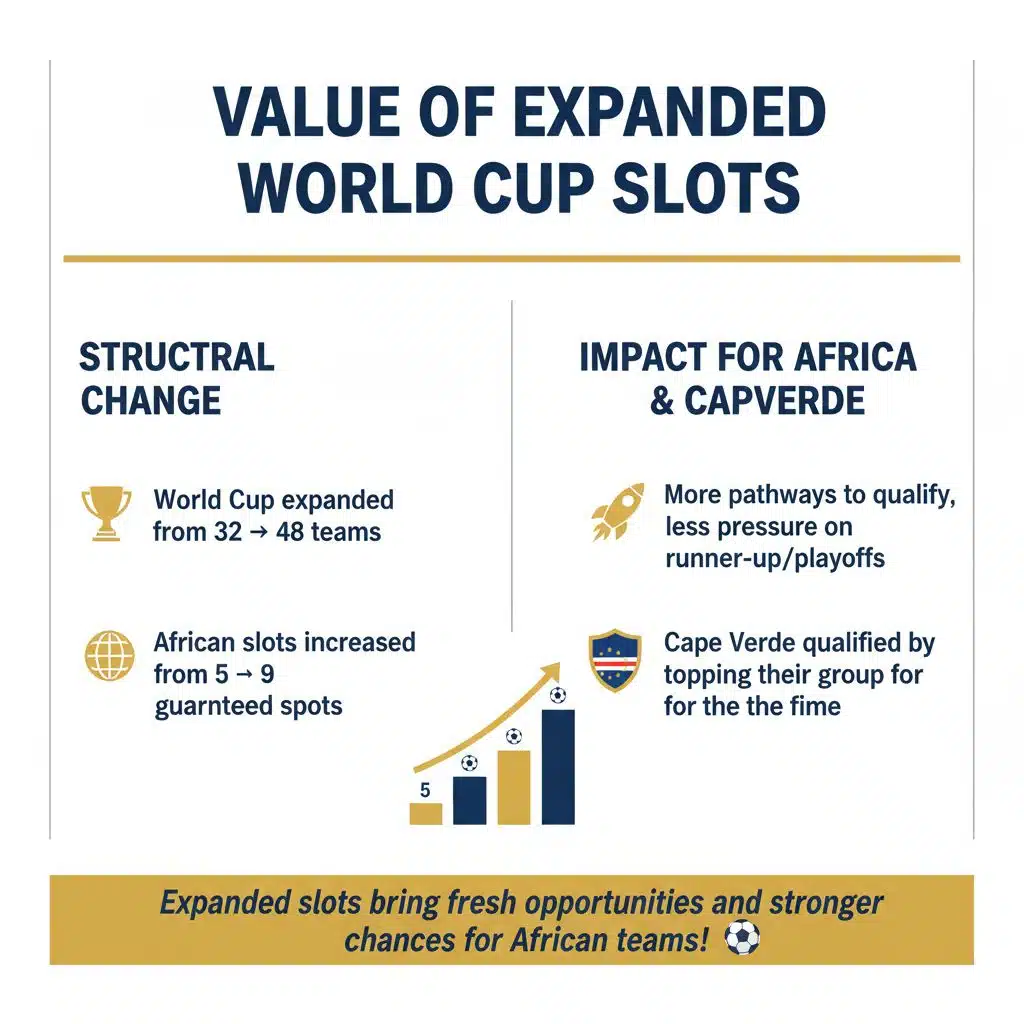
One structural change worked in Cape Verde’s favor—the expansion of the World Cup from 32 to 48 teams, and specifically, the increase in allocated slots to the African confederation. Africa will now have nine guaranteed spots, up from five in the Qatar 2022 cycle. This adjustment gives competitive African nations more breathing room to plan campaigns with multiple viable paths to qualification. For Cape Verde, this meant a group-topping finish was enough to guarantee place in the finals—not just traditional runner-up or playoff dependence.
How the Islanders Built Their Team: Diaspora, Strategy, and Stability
Tapping the Diaspora for Talent
Cape Verde’s domestic league is small, with around twelve top-tier teams. That raises challenges in producing international-level talent internally. To address that, the national federation has proactively sought players from the diaspora or those with Cape Verdean heritage who ply their trade abroad. Many squad members developed in foreign leagues before joining the national team setup.
Roberto “Pico” Lopes is a particularly vivid emblem of this approach. He plays his club football in Ireland (Shamrock Rovers) and his inclusion in the squad reportedly came through professional networking outreach, illustrating how the federation tracks talent beyond traditional scouting pipelines. Lopes roots himself in a family story of migration—his father left his home island of São Nicolau in his youth—and his career reflects how Cape Verde mobilizes its global diaspora for national success.
Interestingly, none of the players in the 2026-qualified squad currently compete in Europe’s top five leagues. Their leading goalscorer in qualifying, Livramento, plays in Portugal’s Primeira Liga, which—while competitive—is outside the elite league tiers. This reality highlights how Cape Verde’s strategy emphasizes opportunity spotting, cohesion, and collective identity over marquee signings.
Coaching & Long-Term Strategy
A pillar of Cape Verde’s success has been consistency in technical leadership. Since January 2020, the team has been led by coach Bubista, who instilled a disciplined, well-organized style. Under his stewardship, the squad developed a compact defensive foundation, a functional midfield, and a positional attacking threat that has yielded success against stronger African competition. Even after failing to qualify for a recent AFCON tournament, the national federation rewarded patience and long-term vision by retaining Bubista. That continuity now appears vindicated as the team heads to its first World Cup finals.
Looking Ahead: What 2026 Holds
With their World Cup berth cemented, Cape Verde’s attention turns to preparation, draw strategy, and global matchup planning. The draw for the finals is scheduled for December 4, 2025, in Washington, D.C., where the Blue Sharks will discover their opponents in Group play alongside countries from across the Americas, Europe, Africa, Asia, and Oceania.
For the archipelago, this qualification may well transform their sporting identity. Beyond the immediate focus on performance, the narrative of Cape Verde in 2026 could inspire renewed investment in youth development, stadium upgrades, infrastructure, and broader football governance. It also offers a point of national pride and exposure for a country that seldom commands global attention outside tourism.
On the continental front, Cape Verde joins a rising list of African qualifiers—including Morocco, Tunisia, Egypt, Algeria, and Ghana—with more still to clinch their spots in upcoming qualification windows. Their ascent underscores the growing competitiveness in African football, where traditional hierarchies are being challenged, and smaller nations are earning seats at the global table.
The Information is Collected from ESPN and Yahoo.