


The cessation of reciprocal rights between the United Kingdom and the European Union has redefined the logistics of crossing the English Channel. As of early 2026, the initial post-transition friction has evolved into a sophisticated digital landscape where biometric data and pre-travel authorizations are the new standard. Navigating Brexit and free movement today requires more than just a valid passport; it demands an understanding of the 90-day limitation, the upcoming ETIAS mandates, and the unique exceptions that still exist within the British Isles.
How We Selected Our 7 Best Brexit and Free Movement Facts
To provide the most accurate 2026 perspective, we analyzed the latest Home Office “Permission to Travel” statements and the European Commission’s April 2026 update on the Entry/Exit System (EES). Our selection criteria prioritized changes that directly impact travel friction, such as the new mandatory biometric registration and the phasing out of physical stamps. We filtered for facts that clarify the distinction between “visiting” and “residing,” focusing on the legal barriers that replaced the former open-border policy. These seven points represent the core operational realities for anyone crossing the UK-EU border this year.
7 Essential Truths About the New Era of Cross-Border Travel
The following guide outlines the primary shifts in mobility that define the relationship between the UK and the EU in the current fiscal year.
1. The Strict 90/180-Day Schengen Rule
For British citizens, the most significant change is the loss of the right to stay indefinitely in the Schengen Area. You are now limited to 90 days in any 180-day period. This is a “rolling” window, meaning you must count back 180 days from every day you are in the EU to ensure you haven’t overstayed your welcome.
Best for: retirees, second-home owners, and long-term travelers.
Why We Chose It:
-
It is the fundamental legal barrier that replaced free movement for individuals.
-
Overstaying can lead to entry bans and heavy fines across the entire Schengen zone.
Things to consider:
-
Time spent in non-Schengen EU countries like Cyprus or Ireland does not count toward this 90-day total.
2. Full EES Implementation (April 10, 2026)
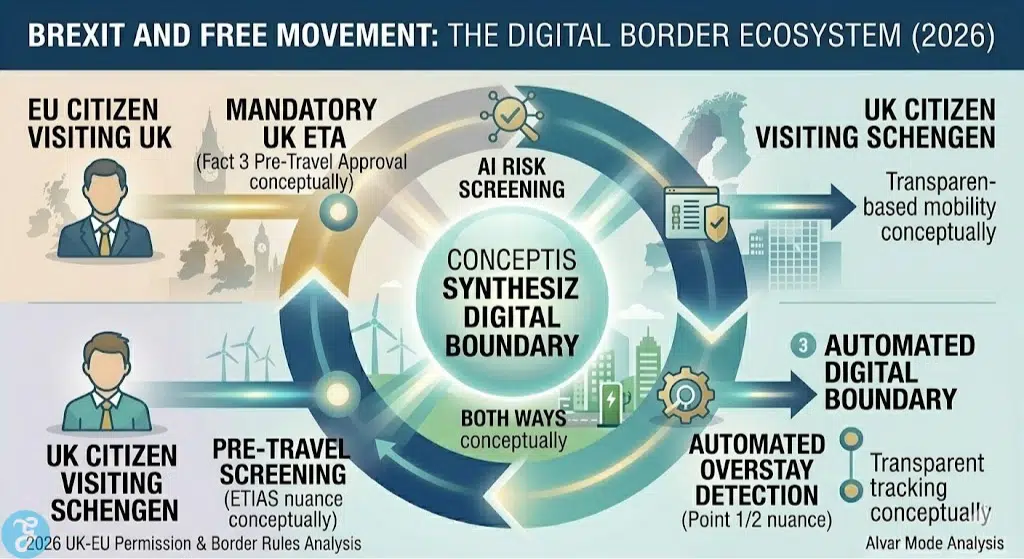
April 10, 2026, marks the date the European Entry/Exit System becomes fully operational. This system replaces manual passport stamping with a digital record of every entry and exit. It captures biometric data, including facial images and fingerprints, which are then used to automatically detect overstayers across 29 participating European countries.
Best for: ensuring border security and automating the tracking of short-stay visits.
Why We Chose It:
-
It represents the technological end to the “manual” border era.
-
The data collected allows EU authorities to instantly identify anyone exceeding their 90-day limit.
Things to consider:
-
Travelers will face longer queues during their first trip after this date as their biometrics are initially registered.
3. Mandatory UK ETA for EU Nationals
As of February 25, 2026, the UK has moved to full enforcement of its Electronic Travel Authorisation (ETA) scheme for EU nationals. Unless you hold British or Irish citizenship, or a valid long-term visa, you must apply for an ETA before traveling to the UK. This digital permission is linked to your passport and is checked by carriers before boarding.
Best for: short-term visitors from the EU traveling to the UK for tourism or business.
Why We Chose It:
-
It is a new mandatory requirement for 2026 that can result in denied boarding if ignored.
-
It brings the UK’s border security in line with the systems used by the US and Canada.
Things to consider:
-
An ETA is valid for two years but does not guarantee entry; Border Force still makes the final decision.
4. The Upcoming ETIAS Requirement
While EES tracks movement, the European Travel Information and Authorisation System (ETIAS) is the pre-travel screening tool for the EU, expected to launch in late 2026. Once active, UK citizens will need to pay a small fee and receive digital approval before flying to the Schengen Area. This adds a “permission to travel” layer that did not exist during the free movement era.
Best for: screening visa-exempt travelers for security and health risks.
Why We Chose It:
-
It is the final piece of the EU’s digital border puzzle for 2026.
-
It mirrors the UK’s ETA, creating a symmetrical digital barrier between the two regions.
Things to consider:
-
There will be a six-month grace period once the system is launched to allow travelers to adapt.
5. The Common Travel Area (The CTA Exception)
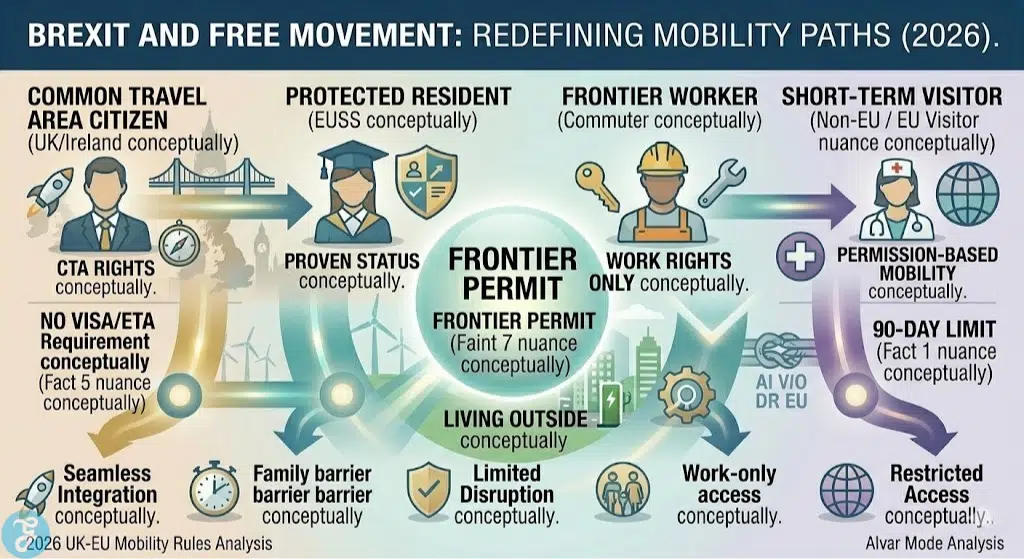
The biggest exception to the end of Brexit and free movement is the Common Travel Area between the UK and the Republic of Ireland. British and Irish citizens retain the right to live, work, study, and access healthcare in each other’s countries without needing a visa or an ETA.
Best for: citizens of the UK and Ireland moving between the two nations.
Why We Chose It:
-
It preserves the pre-Brexit status quo for these two specific nationalities.
-
It is a unique bilateral agreement that operates independently of EU-wide rules.
Things to consider:
-
You still need to prove your citizenship (usually with a passport) when traveling by air or sea.
6. The “Reasonable Grounds” EUSS Barrier
For EU citizens already in the UK, the EU Settlement Scheme (EUSS) is the path to residency. However, as of 2026, making a late application is exceptionally difficult. Following changes in 2023, applicants must now provide “objectively verifiable evidence” of why they missed the 2021 deadline, and “forgetting” or “not knowing” is no longer considered a reasonable excuse.
Best for: identifying the closing window for historical residency claims.
Why We Chose It:
-
It highlights the hardening of the UK’s stance on late residency applications.
-
It emphasizes the shift from “presumed rights” to “proven status.”
Things to consider:
-
If a late application is rejected as invalid, there is no right to appeal or administrative review.
7. Frontier Worker Permits for Cross-Border Labor
If you are an EU citizen who lives outside the UK but worked in the UK on or before December 31, 2020, you may still be eligible for a Frontier Worker Permit. This allows you to keep your work rights in the UK as long as your work remains “genuine and effective” and you continue to live primarily outside the country.
Best for: employees and self-employed individuals who commute across the border for work.
Why We Chose It:
-
It is a specific protection for those whose livelihoods spanned the border before the transition.
-
It allows for continued economic activity without the need for a full Skilled Worker visa.
Things to consider:
-
The permit is free to apply for and can be renewed indefinitely as long as you maintain your working status.
Strategic Summary of Mobility Changes
The transition from free movement to a digital “permission” model has created a permanent infrastructure of oversight. For travelers in 2026, the key to a smooth journey is no longer just holding the right passport, but ensuring that all digital authorizations (ETA or ETIAS) are secured well in advance and that the 90-day clock is meticulously managed.
A Quick Comparison of Travel Permissions in 2026
The data presented below illustrates how the requirements differ based on your destination and your citizenship status in the current year.
2026 Permission and Access Summary
This summary compares the various digital and physical requirements for crossing the UK-EU border as of early 2026.
| Traveler Profile | Traveling To | Requirement | Stamping Status |
| UK Citizen | Schengen EU | 90/180 Rule + EES (Biometrics) | Digital Record (No Stamp) |
| EU Citizen | United Kingdom | UK ETA (Electronic Travel Auth) | Digital Record |
| British/Irish Citizen | UK or Ireland | Common Travel Area (No Visa) | No Stamping |
| EU Resident (EUSS) | United Kingdom | eVisa / Digital Record | No Stamping |
| Frontier Worker | United Kingdom | Frontier Worker Permit | No Stamping |
Our Top 3 Picks and Why?
-
The 90/180-Day Rule: This is our top pick because it is the most common point of failure for travelers. It requires active management and has the most severe consequences for non-compliance.
-
The Common Travel Area: We chose this because it is the “gold standard” of post-Brexit mobility. It is a vital reminder that for millions of people, free-movement-style rights still exist between the UK and Ireland.
-
UK ETA for EU Nationals: This is an essential pick for 2026 because it is a new “enforcement” milestone. Many EU travelers still expect to enter the UK with just an ID card or passport, making the ETA a critical piece of knowledge.
How to Choose the Right Mobility Strategy by Yourself?
Planning your movement in 2026 requires a proactive approach to digital paperwork. You should treat your digital permissions with the same level of care as your physical passport.
The Selection Framework
-
Audit Your Recent Stays: Before booking an EU trip, use a Schengen calculator to check your remaining “90-day” budget. Remember that the 180-day window is calculated backwards from today.
-
Confirm Your ETA Status: If you are an EU citizen, apply for your UK ETA at least 72 hours before travel. While many are granted instantly, some can take longer if manual checks are required.
-
Prepare for Biometric Onboarding: For your first trip after April 10, 2026, allow an extra 30 to 45 minutes for border checks. The initial EES registration involves facial scans and fingerprints.
-
Check Your Dependant Rights: If you are an EU citizen with UK residency (EUSS), ensure your non-EU family members have the correct EUSS Family Permit, as visitor rules for them are significantly more restrictive.
The comparison below can help you determine which travel permission applies to your next journey.
Decision Matrix Table
This decision matrix matches common travel goals with the necessary 2026 permission or rule.
| If your goal is… | Choose X if… | Choose Y if… |
| A 2-week vacation | Use 90/180 Rule (UK to EU). | Apply for ETA (EU to UK). |
| Moving to Dublin/London | Use CTA rights (If British/Irish). | Apply for Skilled Worker (If EU/Other). |
| Working in the UK | Frontier Worker Permit if you worked there pre-2021. | Skilled Worker Visa for new hires in 2026. |
| Bringing a Dog | Animal Health Certificate for each EU trip. | EU Pet Passport if living in an EU country. |
The Final Checklist: 5-Point Border Readiness Plan
-
Run a 90/180-day calculator check for all your Schengen travel in the last six months.
-
Verify your UK ETA or EU ETIAS status and ensure it is linked to your current passport.
-
Update your eVisa or digital record if you have recently renewed your passport.
-
Book an appointment for an Animal Health Certificate (AHC) at least 10 days before any trip with a pet.
-
Check your airline’s “Permission to Travel” guidelines to ensure they recognize your digital status.
Living with the Digital Border
The end of free movement has not stopped travel, but it has added layers of administrative friction that require careful management. In 2026, the border is no longer a physical line marked by a stamp; it is a digital entry in a centralized database. By mastering the nuances of the 90-day rule and staying ahead of the ETA and ETIAS mandates, you can ensure that your global mobility remains intact. The key to successful post-Brexit travel is transparency and preparation—ensuring the authorities know who you are and how long you intend to stay before you even reach the gate.






















