

With one punch, careers can begin and end, and titles can change hands. Considered the “sweet science,” boxing, from the featherweight to the heavyweight division, is arguably the most brutal and physical sport compared to mixed martial arts. While we can spend several articles arguing who the all-time greatest boxer is, I think we can agree that the boxers listed in this article are truly undisputed champions inside and outside the ring.
1) Rock Marciano
Even though his reign as heavyweight champion only lasted four years (1952 to 1956), according to Betting Top 10, Rocky Marciano, one of boxing’s true sluggers, is the only man to retire undefeated as the heavyweight champion. Few boxers were feared for their punching and relentlessness than Marciano.
Not afraid to mix it up and take a punch, Marciano won over boxing fans and became an American hero for his gutsy performances and his open love for America as a son of Italian immigrants. Like Joe Louis, a personal friend that he knocked out in Louis’ last fight, Marciano also retired with a jaw-dropping knockout percentage of over 85%.
Unlike other boxers, Marciano has an interesting journey to boxing greatness. After serving in World War 2, Marciano took up boxing. He also tried out for the Cubs minor league baseball team. However, in 1948, Marciano devoted his life full-time to boxing.
In 1952, shortly after knocking out his friend and idol Joe Louis, Marciano finally received a title fight against “Jersey” Joe Walcott, who, at the time, was the oldest man to win the heavyweight championship. Despite a dominant performance by Walcott, which included Marciano being knocked down for the first time in a dramatic left hook in the 13th round, Marciano knocked out Walcott to become the heavyweight champion.
Marciano would defeat Walcott in a first-round rematch. He would also beat Ezzard Charles twice, who became the only man to go the 15-round distance against Marciano. Marciano would defend his title for the final time against Archie Moore. Moore would go on to be the trainer of future heavyweight champion George Foreman.
Outside the Ring
After briefly flirting coming out of retirement, Marciano became a successful television personality, often for championship boxing matches. He guest starred in an episode of the hit show “Combat!” Besides boxing commentary, Marciano also had a successful career as a referee. In 1969, one day before his 46th birthday, in a plane crash, Marciano died.
2) George Foreman
The recently late George Foreman first punched his way to our attention in the 1968 Olympics in Mexico. After beating his Soviet Union opponent, Jonas Cepalis, into submission, Foreman proudly waved the American flag, sporting his gold medal victory. Shortly after his Olympic gold medal win, Foreman transitioned into the pro heavyweight division.
After a string of amazing knockouts, including eight in two rounds or less, Foreman challenged the legendary Joe Frazier for the heavyweight crown in Kingston, Jamaica, in 1973. After knocking down Frazier six times in two rounds, including the immortal call by Howard Cossell, “Down Goes Frazier,” Foreman captured his first heavyweight championship.
After a string of early knockouts, including one against Ken Norton Sr., Foreman signed a contract to fight legendary fighter Muhammad Ali in Zaire, an African country now known as the Democratic Republic of the Congo. With Don King as the fight promoter, this legendary fight became known as “The Rumble in the Jungle.”
Despite the champion Foreman being the overwhelming favorite, an estimated 50 million tuned in the overnight and early morning hours to watch Ali pull off a surprising upset. After a brief flurry of punches towards the end of the eighth round sent Foreman down for the count. Ali, besides Floyd Patterson and Joe Louis, became only the third man in boxing history at the time to regain the heavyweight championship.
For Foreman, the devastating loss sent his career into doubt. Despite a rematch victory of Joe Frazier, Foreman would lose to Jimmy Young, thus ending his first career in 1977.
Outside the Ring
Upon his fire retirement, Foreman proceeded to become a full-time minister at a Houston, Texas ministry. Also, at this time, Foreman opened a youth center named after him. Having grown up in poverty, Foreman gave generously to the disadvantaged youth.
Stepping Back into the Ring
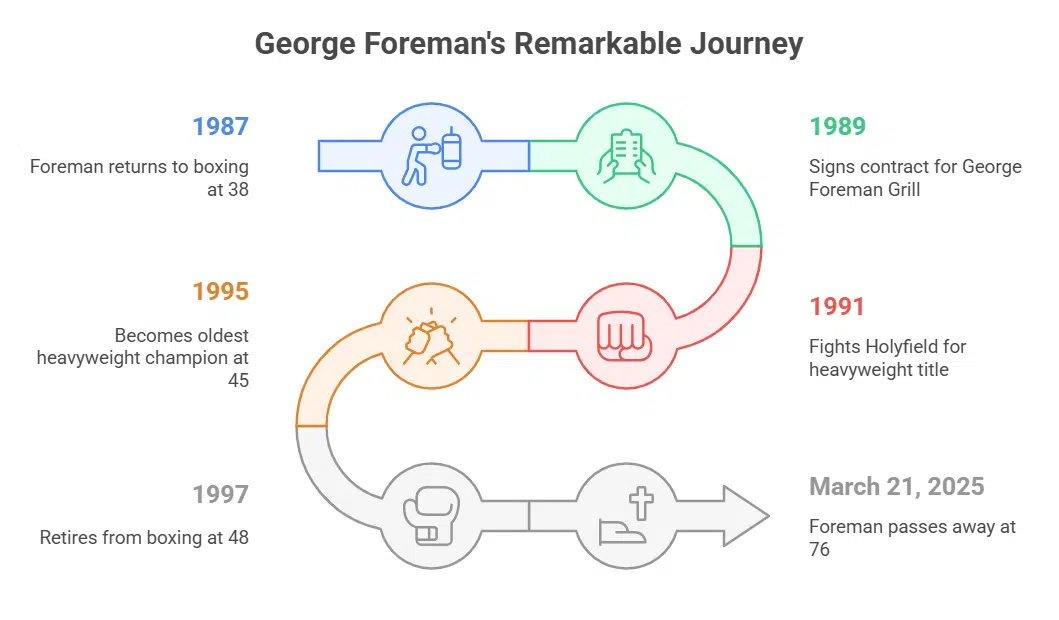
However, Foreman was far from boxing glory. In 1987, despite being 38 years old, he decided to put his boxing trunks back and step into the ring. Noticeably heavier, “Big George Foreman” quickly silenced the critics with an amazing string of knockouts.
In 1989, en route to his second title fight, Foreman went on to sign a lucrative contract for his world-famous “George Foreman Grill.” Such a sensation, the George Foreman Grill has since sold over 100 million units.
In 1991, Foreman received a second chance to become heavyweight champion at 40 years old against the new champion, Evander “Real Deal” Holyfield. Despite going the distance, Foreman lost in a unanimous decision.
It was also at this time that Foreman began an impressive side career as a boxing commentator for HBO. He also self-starred in the ABC sitcom “George.” Not giving up in his quest to regain the heavyweight championship, Foreman, in 1995 at the age of 45, took on current champion Michael Moorer.
Moorer, 19 years younger, easily controlled the fight with his speed and combinations. However, late in the 10th round, Foreman landed a devastating right cross, sending Moorer down for the count, becoming the oldest heavyweight champion in history. After a controversial loss to Shannon Briggs, Foreman retired for good at the age of 48 in 1997. After a career in the media and as an inspirational figure, Foreman died at the age of 76 on March 21, 2025.
3) Oscar De La Hoya
While most remember the 1992 Olympics in Barcelona for the NBA Dream Time, however, another memorable moment was the birth of the boxing legend Oscar “Golden Boy” De La Hoya. After winning a gold medal as a lightweight, De La Hoya transitioned to the pros in the Super Featherweight division.
With 12 fights under his belt, all wins thanks to his lightning-quick flurries and evasion, De La Hoya received his first title fight against Jimmy Bredahl. After ten rounds of dominant boxing, De La Hoya won the WBO Junior Lightweight Title.
After one title defense, De La Hoya took his skills to the lightweight division. Picking up where he left off, De La Hoya quickly won the Lightweight championship. Not stopping there, in 1995, De La Hoya won the Super Featherweight title in a unanimous decision.
In 1996, De La Hoya moved up into the Light Welterweight division to fight fellow Mexican boxing legend Julio Caesar Chavez for the lineal and WBC Light Welterweight championship. After absorbing tremendous punishment and with several cuts, the bout was halted in the fourth in favor of De La Hoya.
Graduating to the Welterweight class, De La Hoya took on his toughest battle yet against Pernell Whitaker. Despite a dominant performance by Whitaker, De La Hoya squeaked out a win against Whitiker. De La Hoya also won Ring Magazine’s prestigious “Boxer of the Year” award.
De La Hoya suffered lost for the first time against Felix Trinidad in 1999, in a highly controversial decision. In 2000, De La Hoya suffered his second pro defeat at the hands of Sugar Shane Mosley. Throughout the 2000s, De La Hoya had more wins but also lost in a controversial rematch against Mosley and was knocked out against Bernard Hopkins in a unification match.
After heartbreaking defeats against Manny Pacquiao and Floyd Mayweather Jr., De La Hoya hung up his gloves in 2009.
Outside the Ring
Capitalizing on his boxing fame, De La Hoya secured major endorsements, including the cover of the smash-hit boxing games Fight Night 3 and Knockout Kings 2001. In 2000, De La Hoya won a Grammy for a self-titled record, “Oscar De La Hoya,” a Spanish pop album.
In addition to developing a clothing line, De La Hoya formed a development company to foster business growth in Latin American communities. As a business mogul, De La Hoya, in 2008, became a 25% owner of the MLS soccer team, Houston Dynamo.






















