
Bank fees are one of those tiny monthly leaks that feel harmless until you check your statement and realize your money has been quietly escaping through the back door. In South Africa, the good news is that consumers now have more affordable banking options than ever, from digital-first zero-fee accounts to traditional bank accounts with modest monthly charges. The tricky part is knowing which Bank Accounts with Low Monthly Fee are genuinely affordable and which ones simply look cheap until transaction fees join the party.
For this list, I focused on South African accounts with zero or low monthly fees, practical everyday use, digital access, transaction value, and suitability for different users. Since banks update fees regularly, always confirm the latest pricing before opening an account. The figures below are based mainly on 2025 pricing guides and current bank product pages where available.
Our Selection Criteria
Choosing a low-fee bank account is not only about picking the lowest monthly fee. A free account can become expensive if it charges heavily for withdrawals, debit orders, card replacements, or instant payments.
Here is the selection logic used for this list:
| Selection Factor | Why It Matters |
|---|---|
| Monthly account fee | The first cost most users notice every month |
| Digital banking access | App and online banking reduce branch-related costs |
| Card purchase fees | Free card swipes help everyday users save money |
| Cash withdrawal costs | Important for users who still rely on cash |
| Debit order and EFT fees | Crucial for bills, rent, subscriptions, and transfers |
| Account accessibility | Some accounts are for adults, kids, youth, or digital-only users |
| Overall value | Rewards, savings pockets, budgeting tools, and account flexibility add value |
The aim was not to crown one universal winner. The better goal is to help readers match the account to their lifestyle.
Whom This Is For
This guide is useful for South Africans who want to reduce banking costs without giving up everyday banking convenience.
It is especially relevant for:
- students and young workers;
- low-income earners;
- digital-first users;
- families opening accounts for children;
- freelancers and side hustlers;
- people tired of paying high monthly banking fees;
- anyone who wants a simple pay-as-you-use account.
Now let’s move into the actual options and see which accounts deserve attention.
10 Best Bank Accounts with Low Monthly Fee in South Africa for 2025
The accounts below include a mix of digital banks, traditional banks, youth accounts, and pay-as-you-use options. Some have no monthly fee at all, while others charge a small monthly amount but offer useful branch networks, card access, or banking tools.
1. Bank Zero Zero Account
Bank Zero is one of the strongest choices for users who want a truly digital, zero-fee banking experience. Its 2025 pricing guide states that having an account costs nothing, with a monthly fee of zero and no minimum balance. It also lists zero fees for debit orders, EFTs, in-store card payments, online card payments, and phone-tap payments.
Best for:
- Digital-first users who want zero monthly account fees
- People comfortable banking through an app-only model
Why We Chose It:
- Zero monthly account fee
- No minimum balance requirement
- Free EFTs and debit orders listed in the 2025 pricing guide
- Strong value for users who avoid branch banking
Things to consider:
- App-only banking may not suit users who prefer branches
- Cash-heavy users should check ATM and cash service costs carefully
2. TymeBank EveryDay Account
TymeBank remains a strong low-cost banking option for South Africans who want digital access without monthly account fees. The bank’s own money skills pages describe its account as having no monthly fee, while Pick n Pay’s TymeBank service page also notes that the EveryDay account has no monthly fees and that many everyday transactions are free.
Best for:
- Everyday digital banking
- Users who like supermarket-linked access and savings pockets
Why We Chose It:
- No monthly account fee
- Quick digital account opening
- GoalSave savings tools add value
- Useful for users who do not need a traditional branch-heavy bank
Things to consider:
- Cash withdrawal and card replacement fees can still apply
- Some users may prefer a bank with a broader physical branch network
3. FNB Easy Zero Account
FNB Easy Zero is designed as a zero-monthly-fee account for basic banking needs. FNB’s product page says the account has a R0 monthly fee, and its 2025 pricing guide also lists the monthly account fee as “No charge.”
Best for:
- Entry-level banking
- Users who want access to FNB’s ecosystem without a monthly account fee
Why We Chose It:
- R0 monthly fee
- Backed by a major traditional bank
- Useful for basic sending, receiving, and spending
- Good option for users who want simple banking with a recognizable bank
Things to consider:
- The account is more limited than full-service FNB accounts
- Users who need debit orders or broader features should compare restrictions carefully
4. Standard Bank (sum)1 Account
Standard Bank’s (sum)1 Account is a youth-focused option designed for children under 16. Its 2025 pricing guide states that the monthly fee remains free in 2025, and the current product page describes it as a kids’ account with zero monthly fees and no monthly income requirement.
Best for:
- Parents opening a first bank account for children
- Teaching kids early money habits
Why We Chose It:
- No monthly fee
- Built specifically for children under 16
- Helps families introduce saving and spending discipline
- Backed by Standard Bank’s infrastructure
Things to consider:
- Not suitable as a general adult current account
- Parents should check transaction limits and access controls
5. OM Bank Personal Account
OM Bank is one of the newer low-cost banking options in South Africa. Old Mutual’s bank page says users can get a Personal Account from R4.95 per month, with a savings account carrying zero monthly fees.
Best for:
- Users looking for a newer digital-first bank with low monthly costs
- Old Mutual customers who want banking tied to a broader financial ecosystem
Why We Chose It:
- Low R4.95 monthly fee
- Digital-first banking approach
- Zero-monthly-fee savings account option
- Clear positioning around simple pricing
Things to consider:
- It is newer than South Africa’s older retail banks
- Users should review service availability, app experience, and transaction fees before switching fully
6. Absa Transact Account
Absa Transact is designed as an affordable everyday account for budget-conscious users. Absa’s value-for-money page lists the Transact Account at only R6.50 per month and highlights free life cover for the first 12 months, while Absa’s current product page also presents it as a low-fee account for tight budgets.
Best for:
- Budget-conscious users who still want a major bank
- First-time bankers who want low monthly costs
Why We Chose It:
- Low monthly fee
- Access to Absa’s larger banking network
- Useful for everyday card and digital banking
- Value-added features may appeal to entry-level users
Things to consider:
- Fees may differ depending on the latest pricing cycle
- Transaction costs should be checked before heavy monthly use
7. Nedbank MiGoals Account
Nedbank MiGoals is a low-cost everyday banking account with a modest monthly maintenance fee. Nedbank’s 2025 everyday banking pricing guide lists MiGoals at R7 monthly maintenance, while Nedbank’s current product page lists MiGoals at R8 monthly maintenance, showing why users should always confirm the latest fee before opening.
Best for:
- Users who want a traditional bank with a low monthly fee
- People who value savings pockets and in-app notifications
Why We Chose It:
- Low 2025 monthly maintenance fee
- Includes a free MyPocket savings feature
- Works for users who want traditional bank backing
- Free in-app notifications on the current product page
Things to consider:
- The fee may have changed after 2025
- Transaction fees can add up for users who withdraw cash often
8. Capitec Main Account
Capitec remains one of South Africa’s most popular low-cost banking choices. Its 2025 fee update highlighted a simplified pricing structure built around five key price points: R1, R2, R3, R6, and R10; its current main account page lists a R7.50 monthly admin fee and R30 minimum balance.
Best for:
- Everyday users who want simple pricing
- People who value a broad branch and ATM presence
Why We Chose It:
- R7.50 monthly admin fee
- Simple, transparent pricing structure
- Popular among everyday South African users
- Strong app and national presence
Things to consider:
- It is not a zero-fee account
- Minimum balance and transaction fees should be factored into real monthly cost
9. Standard Bank MyMo Account
Standard Bank MyMo is a pay-as-you-use account aimed at users who want low monthly costs without a high income requirement. Standard Bank’s 2025 MyMo pricing guide says the account costs R7.50 per month, and the product page also lists R7.50 monthly fee with no monthly income required.
Best for:
- Users who want a traditional bank with low monthly fees
- Digital users who still want access to Standard Bank services
Why We Chose It:
- Low R7.50 monthly fee
- No monthly income required
- Free unlimited card swipes listed on the product page
- Useful for users who want app access and a recognized bank
Things to consider:
- Pay-as-you-use costs can rise with frequent transactions
- Cash withdrawal costs need careful checking
10. African Bank MyWORLD Account
African Bank’s MyWORLD account is built around shared banking and flexible pockets. African Bank’s banking page positions MyWORLD as a low-fee account, while its later pricing guide indicates a monthly bundle fee of R7 from October 2025.
Best for:
- Users who want shared banking features
- Families or groups who want pockets for different goals
Why We Chose It:
- Low monthly bundle fee in the 2025 pricing guide
- Shared banking structure can be useful for households
- Good for users who like separating money into pockets
- African Bank positions it around low banking fees
Things to consider:
- Pricing changed in 2025, so current costs should be checked
- Users should compare pocket, withdrawal, and transaction charges before choosing it
An Overview Of 10 Bank Accounts with Low Monthly Fee in South Africa
The strongest options depend on how you bank. A digital-only user may save more with Bank Zero or TymeBank, while someone who wants a large traditional bank may prefer Capitec, FNB, Absa, Nedbank, or Standard Bank.
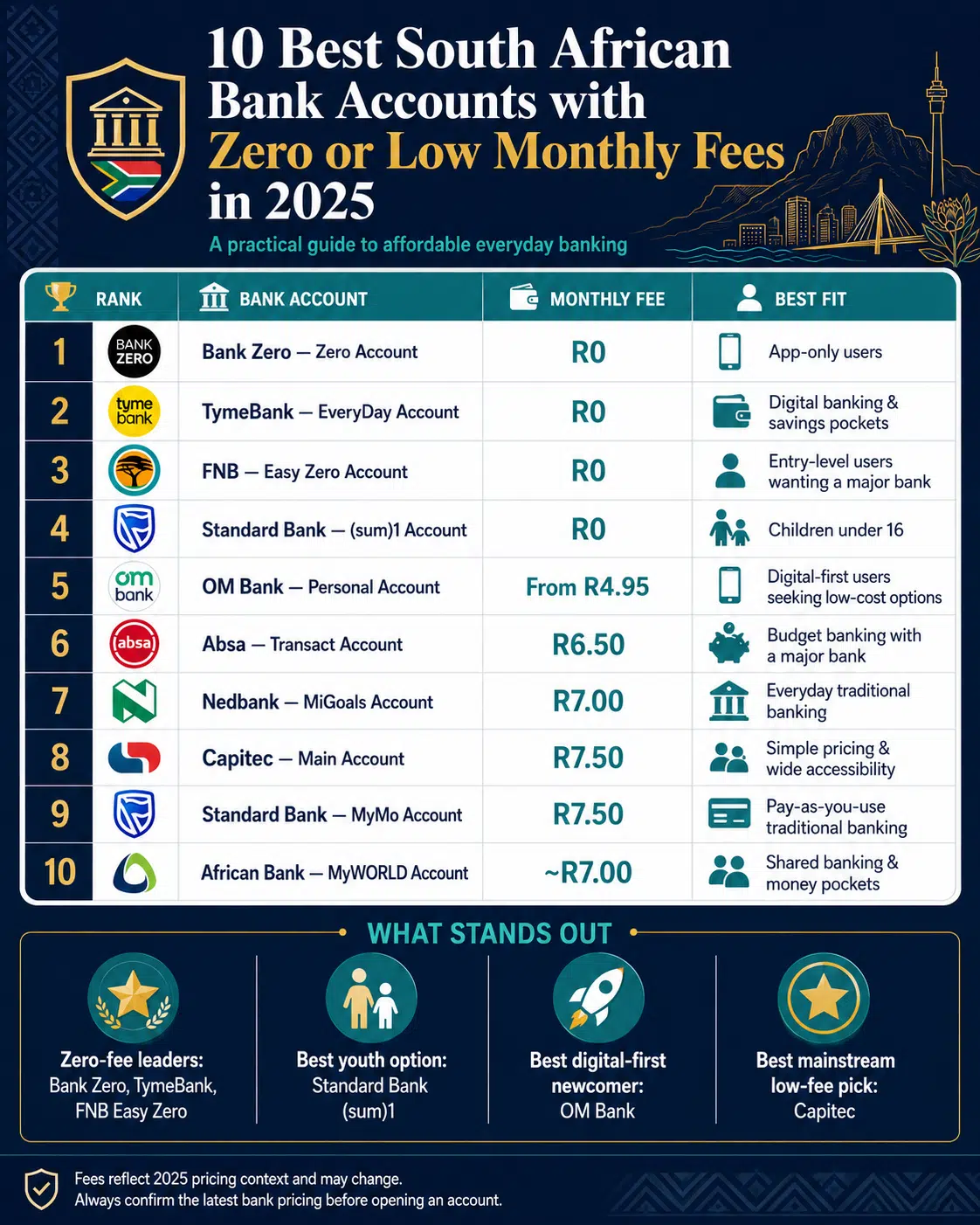
Overview Comparison Table
Here is a quick side-by-side view to help readers compare the accounts at a glance.
| Rank | Account | Monthly Fee in 2025 Context | Best Fit |
|---|---|---|---|
| 1 | Bank Zero Zero Account | R0 | App-only users who want maximum fee control |
| 2 | TymeBank EveryDay Account | R0 | Digital banking and savings pockets |
| 3 | FNB Easy Zero Account | R0 | Entry-level users wanting a major bank |
| 4 | Standard Bank (sum)1 Account | R0 | Children under 16 |
| 5 | OM Bank Personal Account | From R4.95 | Digital-first users seeking a new low-cost option |
| 6 | Absa Transact Account | Around R6.50/R7.50 depending on pricing cycle | Budget banking with a major bank |
| 7 | Nedbank MiGoals Account | R7 in 2025 guide | Everyday traditional banking |
| 8 | Capitec Main Account | R7.50 | Simple pricing and wide accessibility |
| 9 | Standard Bank MyMo Account | R7.50 | Pay-as-you-use traditional banking |
| 10 | African Bank MyWORLD Account | Around R7 from later 2025 pricing | Shared banking and money pockets |
Our Top 3 Picks and Why?
For most readers, the top three choices depend on whether they want zero monthly fees, digital convenience, or traditional bank coverage.
| Pick | Why It Stands Out |
|---|---|
| Bank Zero Zero Account | Best for users who want a serious zero-fee digital banking setup |
| TymeBank EveryDay Account | Best for digital everyday banking with no monthly fee and savings tools |
| Capitec Main Account | Best low-cost traditional-style option with simple pricing and broad reach |
These three are not perfect for everyone, but they represent three useful directions: zero-fee digital banking, supermarket-linked digital banking, and low-cost mainstream banking.
How to Choose the Right Bank Accounts with Low Monthly Fee by Yourself
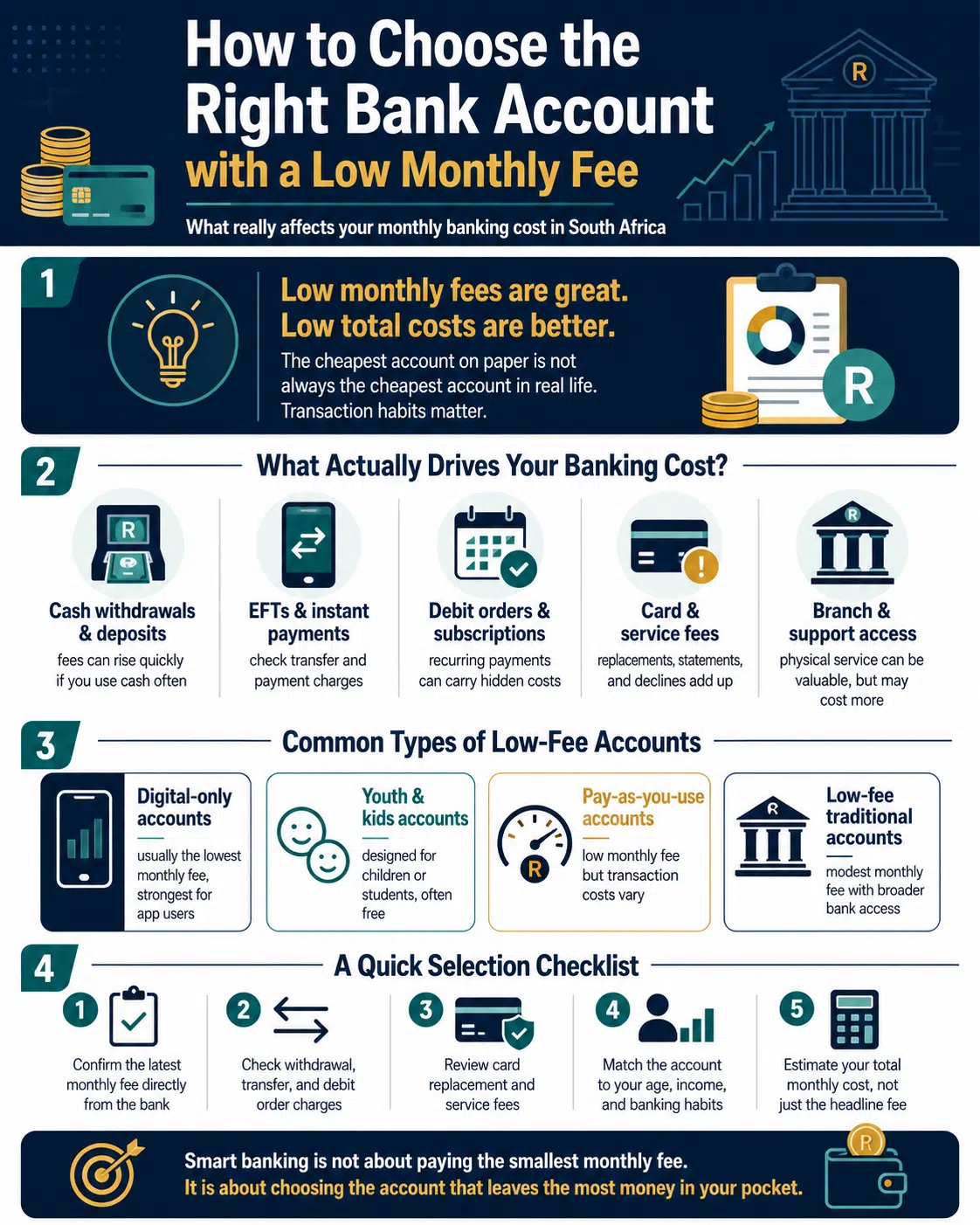
The cheapest monthly fee is not always the cheapest account in real life. Your real banking cost depends on how often you withdraw cash, transfer money, use debit orders, buy prepaid products, or need branch support.
The Selection Framework:
- Check your transaction habits: If you withdraw cash often, ATM fees matter as much as the monthly account fee.
- Look at debit orders and EFTs: A low monthly fee can become costly if every debit order or payment carries a charge.
- Match the account to your lifestyle: Digital-only accounts are great for app users but not ideal for people who need branches.
- Check age and eligibility rules: Youth and kids’ accounts may be free but limited to specific age groups.
The Final Checklist
Before choosing a low-fee bank account, use this quick checklist.
- Confirm the latest monthly fee directly from the bank.
- Check cash withdrawal and deposit fees.
- Compare EFT, debit order, and instant payment charges.
- Review card replacement and declined transaction fees.
- Make sure the account fits your age, income, and banking habits.
The Real Cost of “Cheap” Banking
Low-cost banking in South Africa is moving in the right direction, but the uncomfortable truth is simple: a low monthly fee does not always mean a low-cost banking life. Banks know that many consumers focus on the monthly fee first, while the real money often hides in transaction charges, cash fees, instant payments, and service extras.
That is why Bank Accounts with Low Monthly Fee should be judged by total usage, not just the headline price. A zero-fee digital account can be brilliant for someone who banks mostly online, but frustrating for someone who needs cash access every week. A R7.50 account can be excellent if it saves you time, gives reliable access, and avoids surprise charges elsewhere.
The future of affordable banking in South Africa will likely be shaped by digital banks, app-first products, better pricing transparency, and competition from newer players. But consumers still need to read the pricing guide. The bank with the lowest monthly fee is not always the bank that leaves the most money in your pocket.
Frequently Asked Questions (FAQs) About Bank Accounts with Low Monthly Fee
Which South African bank account has no monthly fee in 2025?
Bank Zero, TymeBank, FNB Easy Zero, and Standard Bank’s (sum)1 youth account are among the options with zero monthly fees in the 2025 context. Always check the latest pricing before applying because banks update fees regularly.
Are zero-fee bank accounts really free?
Not completely. The monthly account fee may be zero, but charges can still apply for withdrawals, deposits, card replacements, instant payments, or certain service actions.
Which low-fee bank account is best for digital users?
Bank Zero and TymeBank are strong choices for digital-first users. They are especially useful for people who do not rely heavily on branch banking.
Which low-fee bank account is best from a traditional bank?
Capitec, FNB Easy Zero, Absa Transact, Nedbank MiGoals, and Standard Bank MyMo are practical options from larger traditional banking groups. The best choice depends on your transaction habits.
Should I choose the account with the lowest monthly fee?
Not automatically. Choose the account with the lowest total cost for how you actually bank, including withdrawals, transfers, debit orders, and cash deposits.