In a landmark enforcement move, the European Commission has fined two U.S. tech giants—Apple and Meta (parent company of Facebook and Instagram)—a combined €700 million for violating the European Union’s Digital Markets Act (DMA), a sweeping new law introduced to promote fair competition and curb monopolistic behaviors by large digital platforms.
This action marks the first time the EU has used the DMA, which became enforceable in 2024, to formally penalize companies for non-compliance. The decisions were issued on Wednesday, April 23, 2025, following extensive investigations into the business practices of both companies.
Apple Fined €500 Million for Restricting Competition in App Store
Violation: App Store “Anti-Steering” Rules
Apple received the larger penalty of €500 million for its longstanding policy of restricting developers from informing iOS users about cheaper or alternative purchasing options outside the Apple App Store.
This practice, known as “anti-steering,” effectively forced developers to rely on Apple’s payment system, allowing the company to maintain its 30% commission fee while preventing direct customer relationships and alternative payment choices.
According to the Commission, these restrictions violate the DMA’s rules on app marketplaces by reinforcing Apple’s dominance and limiting competition and consumer choice.
Cease-and-Desist Order and Future Consequences
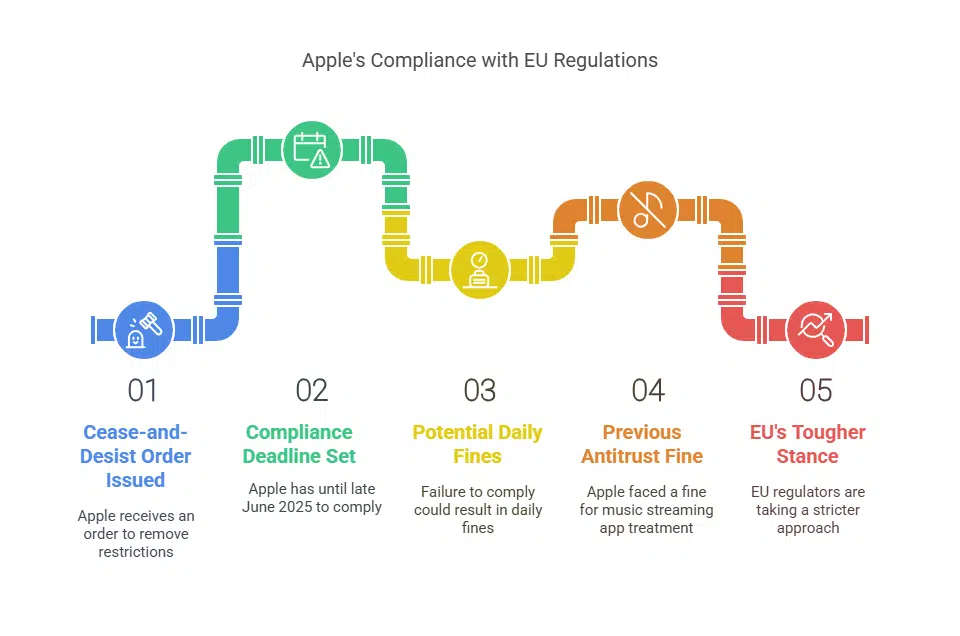
Alongside the fine, Apple was also handed a cease-and-desist order that mandates the removal of these restrictions. The company has until late June 2025 to comply.
If Apple fails to act, the Commission may impose additional daily fines of up to 5% of Apple’s average daily worldwide turnover until compliance is achieved.
This enforcement follows a separate €1.8 billion antitrust fine Apple received last year related to its treatment of music streaming apps like Spotify—a clear sign that EU regulators are taking a tougher stance against tech monopolies.
Meta Penalized €200 Million for “Pay or Consent” Ad Model
Violation: Forcing Choice Between Payment and Privacy
Meta was fined €200 million for its controversial “pay or consent” model introduced across Facebook and Instagram.
The system required users in the EU to either pay for ad-free access to the platforms or consent to personal data tracking for targeted ads. According to the Commission, this binary choice does not constitute freely given consent under the DMA.
While the DMA allows for monetization, companies must offer a real and fair alternative to data collection. The Commission concluded Meta failed to do so during the key investigation period.
Meta’s Response and Ongoing Review
Meta updated its model in late 2024 in an attempt to comply, offering less-personalized ad options without payment, but regulators are still reviewing whether this update meets the law’s criteria.
This fine adds to Meta’s prior troubles in Europe. In 2024, the company was fined €797 million for abusing its market position by promoting its classified ads service through Facebook.
Commission Balances Enforcement with Constructive Engagement
Five Key DMA Decisions Announced
The Commission issued a total of five DMA-related decisions on Wednesday. In addition to the fines and cease orders:
-
Apple received partial relief, as the Commission closed its investigation into Apple’s handling of browser competition and default app settings. Recent updates allowed third-party browsers like Mozilla Firefox to better compete on iOS devices.
-
Meta also got a break—the EU lifted its designation of Facebook Marketplace as a core platform service under the DMA. This means that part of Meta’s business is no longer subject to strict obligations under the new law.
-
However, Apple was also handed a statement of objections related to its broader conduct in alternative app marketplaces, signaling that further investigations and possible fines may follow.
Commission’s Position: Firm but Fair
EU Competition Commissioner Teresa Ribera emphasized the need for balanced but decisive action:
“Apple and Meta have fallen short of compliance with the DMA by implementing measures that reinforce the dependence of business users and consumers on their platforms,” Ribera stated. “As a result, we have taken firm but balanced enforcement action based on clear and predictable rules.”
Tech Giants Push Back: Apple and Meta Defend Their Models
Both companies rejected the Commission’s accusations and announced plans to appeal.
Apple’s Statement
Apple spokesperson Emma Wilson said the company disagrees with the findings, calling the decision “unfair and inconsistent.”
“This is yet another example of the European Commission unfairly targeting Apple. Despite countless meetings, the Commission continues to move the goalposts,” she said.
Apple argues that its App Store policies are designed to protect user privacy and security, and that changes could expose customers to fraud and low-quality apps.
Meta’s Statement
Meta’s Chief Global Affairs Officer Joel Kaplan called the fine a disguised “multi-billion-dollar tariff” on American innovation.
“The European Commission is attempting to handicap successful American businesses while allowing Chinese and European companies to operate under different standards,” he said.
Meta claims its advertising model complies with EU privacy laws and that the Commission’s ruling undermines business freedom and innovation.
International Tensions: U.S. Threatens Trade Retaliation
The crackdown by EU regulators could intensify transatlantic trade tensions.
Earlier this year, the U.S. administration under Donald Trump warned that it may take retaliatory action against EU penalties targeting American companies.
“Europe’s digital rulebook has become a tool of economic coercion,” a White House trade advisor said in February.
Despite political pressure, European Commission President Ursula von der Leyen told POLITICO last week that the bloc would not back down:
“Our digital laws must be enforced consistently, regardless of where the companies are based.”
What This Means for Big Tech in Europe
This week’s fines are only the beginning of a new regulatory era in the EU, with more enforcement actions expected in 2025 and beyond.
The Digital Markets Act is seen as a global model for taming tech monopolies and ensuring open digital ecosystems. Under the DMA:
-
Companies designated as “gatekeepers” must offer interoperability, data portability, and non-discriminatory access to platforms.
-
Violations may lead to fines up to 10% of global turnover and even structural remedies like company breakups for repeated non-compliance.
With the Commission signaling its readiness to go further, other tech giants like Google, Amazon, and Microsoft may be next in line for scrutiny.