Finding SEO tactics that work in 2026 feels strangely harder than it should. Not because SEO is dead. That obituary has been published every year by people who still somehow check rankings the next morning. The real problem is that SEO has become noisier. AI Overviews are changing click behavior. Search results are more crowded. Google’s quality systems are less forgiving. Thin “ultimate guides” are everywhere.
And half the advice online still sounds like it was written for 2016 with a new AI paragraph glued on top. The old shortcut mindset does not travel well into 2026.
You cannot keyword-stuff your way into trust. You cannot publish 300 generic AI articles and call it topical authority. You cannot buy random links, add fake FAQ schema, ignore your site speed, and expect Google to politely reward the chaos.
But SEO still works when it is treated like a real publishing, product, and technical discipline. The tactics below are not magic tricks. They are practical, durable, and still worth doing because they help search engines understand your site and help people trust, use, and return to your content.
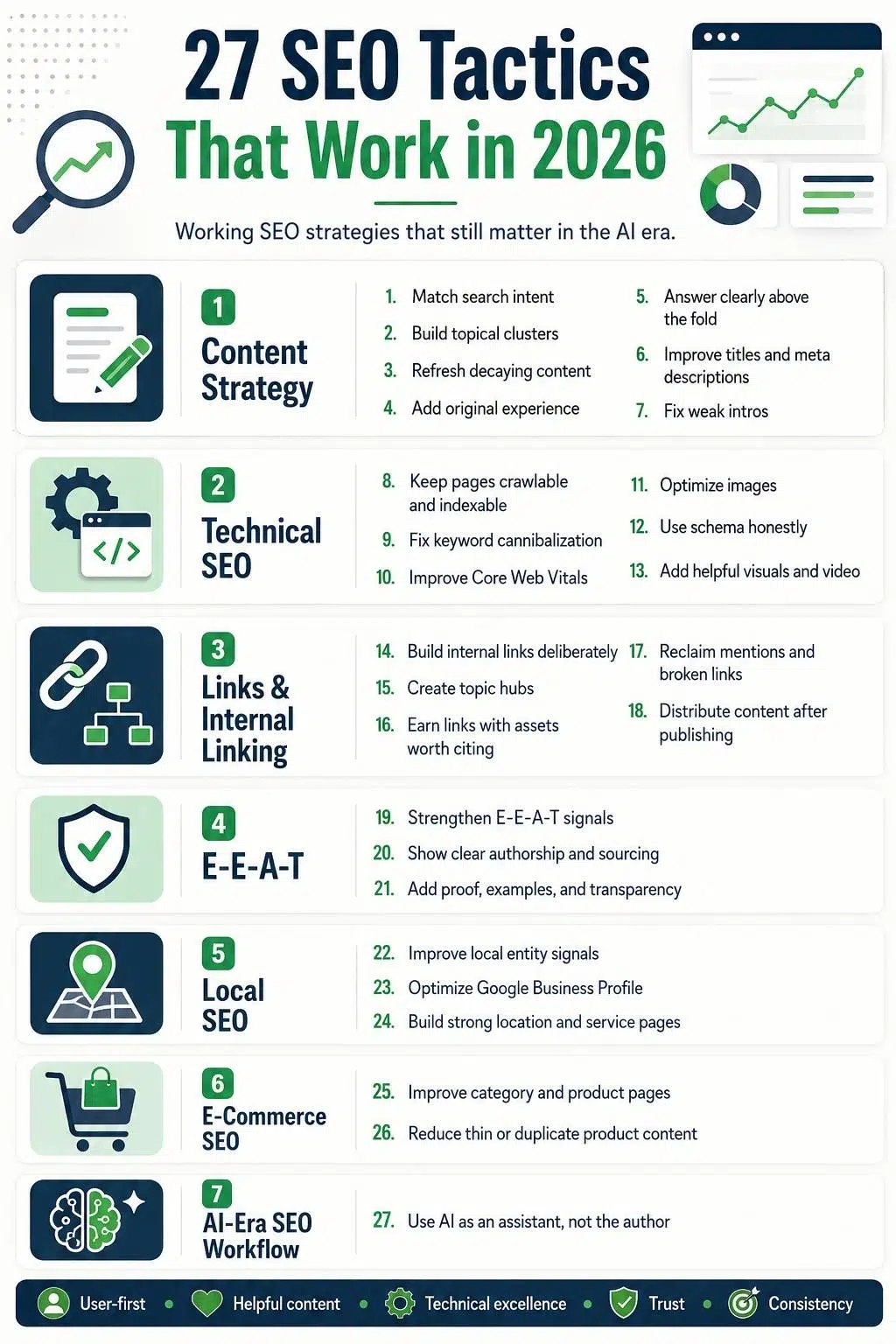
A Quick Overview of the 27 SEO Tactics That Work in 2026
| SEO Tactic | Best Use Case | Priority |
| Match search intent before keywords | Any content page | Very high |
| Build topical clusters | Blogs, publishers, SaaS, affiliates | Very high |
| Refresh decaying content | Existing sites | Very high |
| Add original experience | Review, advice, B2B, YMYL-adjacent content | Very high |
| Strengthen E-E-A-T signals | Trust-sensitive topics | Very high |
| Answer clearly above the fold | Informational pages | High |
| Use entity-rich writing | Competitive topics | High |
| Improve titles and meta descriptions | Pages with impressions but low CTR | High |
| Fix weak intros | Blog posts and guides | Medium |
| Build internal links deliberately | Large and growing sites | Very high |
| Create topic hubs | Pillar-cluster strategies | High |
| Use schema honestly | Reviews, articles, local, products, FAQs | Medium to high |
| Keep pages crawlable and indexable | All sites | Very high |
| Fix keyword cannibalization | Sites with overlapping pages | High |
| Improve Core Web Vitals | Slow sites | High |
| Optimize images | Editorial, e-commerce, local, visual topics | Medium |
| Add helpful visuals and video | Tutorials, reviews, comparisons | Medium to high |
| Earn links through digital PR | Competitive niches | Very high |
| Reclaim brand mentions and broken links | Established sites | Medium |
| Distribute content after publishing | Blogs and media sites | High |
| Improve local entity signals | Local businesses | Very high |
| Optimize Google Business Profile | Local SEO | Very high |
| Improve money pages | Service and e-commerce sites | Very high |
| Optimize category and product pages | E-commerce | Very high |
| Prune or merge weak content | Mature sites | High |
| Use Search Console for priorities | All SEO teams | Very high |
| Use AI with human editorial control | Modern content workflows | High |

27 SEO Tactics That Work in 2026 for Real Search Growth
The best SEO tactics in 2026 are not isolated tricks. They work together. Content quality needs technical access. Internal links need useful pages. Schema needs visible content. E-E-A-T needs real proof. Links need assets worth citing.
1. Match Search Intent Before You Touch the Keyword
A keyword is not a topic by itself. It is a clue about what the searcher wants.
Before writing, check what the searcher is actually trying to solve. Do they want a list, a comparison, a definition, a template, a tool, a product, a local provider, or a step-by-step guide? Many pages fail because they target the right keyword with the wrong format.
For example, someone searching “best schema markup tools” probably wants tool comparisons, pricing context, use cases, and pros and cons. They do not want a history lesson on structured data before seeing a single tool.
In 2026, intent matching matters even more because search results are more answer-heavy. If your page does not satisfy the main job quickly, users leave, and your page becomes easier to replace.
The practical move is simple: study the top results, People Also Ask, related searches, forums, and SERP features before outlining the article. Then create the page that solves the search better than the current results, not just longer than them.
2. Build Topical Clusters Instead of Publishing Random Posts
One good article can rank. A strong topic cluster can build authority.
Topical clusters work because they help readers and search engines understand that your site covers a subject in depth. A pillar page explains the broad topic. Cluster pages answer narrower questions. Internal links connect them in a logical way.
For this article, the pillar is “27 SEO Tactics That Work in 2026.” The cluster pages can cover on-page SEO, link building, schema tools, internal linking tools, E-E-A-T, local SEO, blog SEO, technical SEO, e-commerce SEO, and service business SEO.
The mistake is creating clusters only for keywords. A proper cluster should follow reader problems. Someone learning SEO tactics may later need on-page tactics, internal linking tools, content optimization methods, and technical fixes. That is a natural journey.
A strong cluster feels like a guided library, not a pile of posts.
3. Refresh Content That Is Losing Rankings
Publishing new content is not always the best SEO move. Sometimes the highest ROI is fixing what already has history.
Look for pages that once ranked well but are slowly losing clicks, impressions, or positions. These pages often need updated data, better examples, stronger formatting, improved internal links, refreshed screenshots, clearer headings, or more complete answers.
Content decay is common in SEO, software, finance, health, travel, and product-heavy niches. Even evergreen content can become stale when tools, prices, rules, SERP layouts, or user expectations change.
Do not refresh blindly. Compare the page against the current SERP. Find what changed. Did competitors add comparison tables? Did search intent shift from “what is” to “best tools”? Did Google start showing videos, forums, or product grids?
A good refresh should make the page more useful today, not just change the date.
4. Add Original Experience, Not Rewritten Internet Soup
Generic content is one of the biggest SEO liabilities in 2026.
If your article says the same thing every other article says, in the same order, with the same examples, it becomes replaceable. Search engines do not need another page repeating common knowledge. Readers do not either.
Original experience can come from testing tools, interviewing experts, using screenshots, analyzing real examples, adding editorial judgment, sharing mistakes, comparing workflows, or explaining what actually happens in practice.
For review content, that means showing real use. For business content, it means explaining the market honestly. For how-to content, it means giving warnings that only someone experienced would know. For listicles, it means selection criteria, trade-offs, and practical fit.
The point is not to fake personal experience. The point is to add real editorial value.
5. Strengthen E-E-A-T Signals Across the Page
E-E-A-T is not a plugin setting. It is a trust pattern.
Readers should be able to tell who created the content, why they should trust it, how it was researched, when it was updated, and whether the claims are supported. This matters more in sensitive niches, but it helps almost everywhere.
Good E-E-A-T signals include author bios, expert reviewers where appropriate, transparent sourcing, editorial standards, brand reputation, real examples, original images, accurate dates, and honest limitations.
For a listicle, E-E-A-T also means explaining how the list was selected. Why these tools? Why these brands? Why these tactics? What did you exclude? What should readers be careful about?
A page that sounds confident but gives no proof feels thin. A page that explains its judgment earns more trust.
6. Put the Clear Answer Near the Top
Do not make readers dig through 800 words before they understand the point.
A good SEO page should confirm quickly that the reader is in the right place. That does not mean writing a robotic “short answer” box for everything. It means making the opening useful, specific, and relevant.
For listicles, introduce the pain point, explain the selection logic, and preview what the reader will get. For how-to articles, state the outcome. For comparison pages, show the key difference early. For product pages, clarify who the product is for.
This is especially important in the AI-era search because users scan quickly. If your page wastes the first screen, it loses momentum.
A strong introduction should do three things: earn attention, match intent, and create confidence.
7. Write Around Entities, Not Just Keywords
Old SEO overused exact-match keywords. Modern SEO needs semantic clarity.
If your page is about SEO tactics, related entities naturally include search intent, internal linking, structured data, backlinks, Core Web Vitals, E-E-A-T, Google Search Console, content refreshes, crawlability, indexability, schema markup, local SEO, and topical authority.
Entity-rich writing helps search engines understand the depth and relationships inside your content. It also helps readers because the article feels complete rather than keyword-stuffed.
This does not mean forcing every related term into the article. It means covering the topic like someone who understands it. Use precise terms where they belong. Explain relationships. Add examples. Avoid vague filler.
The best semantic SEO still reads like natural expert writing.
8. Rewrite Title Tags for Searchers, Not Just Search Engines
A title tag has two jobs: help the page be understood and make the right user want to click.
Weak titles are often too vague, too long, too clever, or too stuffed with keywords. Strong titles match intent and set a clear expectation. They also avoid sounding like every other result.
For example, “SEO Tips” is weak. “27 SEO Tactics That Work in 2026” is stronger because it gives quantity, topic, and freshness.
For existing pages, use Google Search Console to find pages with high impressions and poor click-through rate. Then test better titles. Add specificity, audience fit, freshness, or a stronger benefit.
Do not promise what the page does not deliver. Clickbait may earn the click, but it can damage trust.
9. Make Meta Descriptions Useful Again
Meta descriptions do not guarantee rankings, and Google may rewrite them. Still, they matter because they help shape the searcher’s expectation.
A good meta description should summarize the page clearly, include the main keyword naturally, and give the reader a reason to choose your result. It should not sound like a bag of keywords.
For listicles, mention the number and the value. For service pages, mention the problem solved. For e-commerce pages, mention product type, fit, and buyer value. For educational content, mention the outcome.
Think of the meta description as a tiny editorial pitch. It should be accurate, not desperate.
10. Fix Intros That Sound Like They Were Written for Everyone and No One
Many SEO articles lose readers in the introduction.
The common mistake is opening with generic facts everyone already knows. “SEO is important for businesses today.” “Content marketing is changing.” “In today’s digital world…” These lines do nothing. They are verbal furniture.
A better intro starts with the reader’s actual problem. For this article, the problem is not that SEO exists. The problem is that people do not know which SEO tactics still work in 2026 because search is changing, AI answers are rising, and bad advice is everywhere.
That is a real hook.
Your intro should show that you understand the reader’s frustration before you offer the solution. This is where humanized SEO writing beats generic SEO writing.
11. Build Internal Links With Editorial Intent
Internal linking is one of the most underrated working SEO strategies because it helps both users and crawlers.
A good internal link should connect related pages in a way that makes sense. It should use descriptive anchor text, sit inside useful context, and help readers continue their journey.
For this pillar, links should point to cluster articles such as on-page SEO tactics, link building tactics, schema markup tools, technical SEO fixes, and content optimization tactics. Those clusters should link back to the pillar and to each other where relevant.
Avoid dumping 40 random links into a “related articles” block and calling it strategy. Internal linking should feel intentional.
A strong internal link answers the reader’s next likely question.
12. Create Topic Hubs That Are Actually Helpful
A topic hub is not just a category page with a nicer name.
A useful hub organizes related content so readers can understand where to start, what to read next, and how each guide fits into the broader topic. It can include pillar articles, beginner guides, advanced tutorials, tools, templates, case studies, and comparison pieces.
For SEO content, a hub could include sections for technical SEO, content SEO, link building, local SEO, e-commerce SEO, and SEO tools. Each section should have a short description, not just a list of links.
This helps readers navigate your expertise. It also helps search engines understand your site structure. The best topic hubs feel like a curated learning path.
13. Use Schema Markup Honestly
Schema markup still works when it describes what is actually visible and useful on the page.
For articles, the Article schema can help search engines understand headline, author, date, image, and publisher details. For FAQs, the FAQ schema should only be used when the FAQ content is visible on the page and follows current guidelines. For local businesses, the LocalBusiness schema can support business details. For products, the product schema should match real product information.
The trap is treating the schema like a ranking cheat code. It is not. Incorrect, fake, irrelevant, or hidden structured data can create problems. Use schema to clarify, not manipulate.
14. Keep Important Pages Crawlable and Indexable
This sounds basic, but it still breaks many sites.
A page cannot perform well in search if Google cannot access, crawl, render, or index it properly. Common issues include accidental noindex tags, robots.txt blocks, broken canonical tags, JavaScript rendering problems, redirect chains, poor internal linking, and orphaned pages.
This matters more as websites get bigger and more technical. A beautifully written article that sits three clicks too deep with no internal links and a messy canonical setup may struggle.
Run regular crawl checks. Use Search Console. Inspect important URLs. Fix indexation problems before blaming content quality. Technical access comes before ranking improvement.
15. Fix Keyword Cannibalization Before Publishing More
Keyword cannibalization happens when multiple pages compete for the same or very similar intent.
This confuses search engines and splits signals. It also confuses readers. Instead of one strong page, you end up with three mediocre pages that overlap.
The fix is not always deleting content. Sometimes you merge pages. Sometimes you differentiate intent. Sometimes one page becomes a pillar, and another becomes a narrower cluster. Sometimes you update internal links and canonical tags.
Before publishing a new article, search your own site for similar content. If you already have a page targeting the same intent, improve that page instead of creating another competitor.
A tighter content library often performs better than a bloated one.
16. Improve Core Web Vitals Where They Hurt Real Users
Speed and page experience still matter, especially when poor performance frustrates users.
Core Web Vitals measure loading performance, responsiveness, and visual stability. In practice, that means users should not wait forever for the main content, struggle with delayed interactions, or watch the page jump around while ads and images load.
The highest-impact fixes often include compressing images, improving server response, reducing unnecessary scripts, lazy-loading properly, optimizing fonts, controlling ad layout shifts, and removing bloated plugins.
Do not chase perfect scores for vanity. Focus on pages that matter: templates, money pages, product pages, high-traffic articles, and pages with poor engagement.
Good UX supports SEO because people can actually use the page.
17. Optimize Images for Search and Speed
Image SEO is not just alt text. A useful image should support the content, load quickly, have a descriptive file name, use appropriate dimensions, include helpful alt text, and avoid being blocked from crawling where search visibility matters.
For listicles, custom images can improve quality. For tutorials, screenshots can make the article easier to follow. For products, original photos can build trust. For data-heavy content, charts can earn links and shares.
Avoid generic stock images when the topic needs specificity. A random laptop-and-coffee image does not prove expertise. The best images add information, not decoration.
18. Add Video or Visual Assets Where They Solve the Problem Faster
Some topics are easier to understand visually. A technical SEO fix, tool walkthrough, product comparison, local setup process, or content workflow can benefit from screenshots, short videos, GIFs, diagrams, or annotated examples.
This does not mean every article needs a video. It means the format should match the task. If a reader would understand the concept faster by seeing it, add a visual.
Visual assets also create more ways for your content to appear across search surfaces, social platforms, newsletters, and repurposed distribution.
A page with useful visuals feels more complete than a text wall.
19. Earn Links With Assets Worth Citing
Link building still works. Lazy link building is what deserves to die.
The best links usually come from assets other people have a reason to reference: original data, expert quotes, useful templates, comparison tables, calculators, visual explainers, surveys, industry reports, and strong opinion pieces.
If your page offers nothing unique, outreach becomes begging. If your page gives journalists, bloggers, and niche publishers something useful, outreach becomes easier.
Digital PR works best when the story is genuinely interesting. That could be data, a trend, a contradiction, a strong expert angle, or a useful resource.
Build the reason for the link before asking for the link.
20. Reclaim Unlinked Mentions and Broken Links
Not every link-building tactic needs to start from scratch.
If your brand, founder, product, report, or content has been mentioned without a link, ask for attribution where appropriate. If sites link to broken pages on your domain, redirect them to the best current replacement. If competitors have broken backlinks to dead resources, create a better replacement and pitch it carefully.
This works especially well for brands with some existing visibility. It is less useful for brand-new sites with no mentions.
The key is being helpful and specific. Show the editor exactly where the mention is, why a link improves attribution, and which URL fits best. Simple link cleanup can recover value you already earned.
21. Distribute Content After Publishing
Publishing is not distribution.
A strong article should be shared through the channels where its audience already pays attention. That may include newsletters, LinkedIn, Reddit, communities, YouTube, Pinterest, Facebook groups, Slack communities, industry roundups, partner sites, or internal sales teams.
Distribution helps content get discovered, linked, quoted, saved, and discussed. Those signals may not all be direct ranking factors, but they support the ecosystem that makes SEO work.
For a pillar article like this, distribution could include a LinkedIn carousel, newsletter summary, Twitter/X thread, short video, infographic, and internal links from existing SEO articles.
If a page is worth creating, it is worth promoting.
22. Improve Local Entity Signals
For local businesses, SEO is not just about website content. It is about proving that the business is real, relevant, nearby, and trusted.
Local entity signals include consistent business name, address, phone number, opening hours, service areas, categories, reviews, local backlinks, local citations, photos, service pages, and community relevance.
A local plumber, dentist, restaurant, law firm, gym, or home service business needs more than a generic homepage. It needs clear location pages, services, proof, reviews, and locally relevant content.
Local SEO works best when the website, Google Business Profile, reviews, and real-world reputation all support each other.
23. Optimize Google Business Profile Like a Conversion Page
Google Business Profile is often the first impression for local searchers.
A weak profile can lose customers before they ever visit the site. A strong profile includes accurate categories, complete services, real photos, updated hours, clear business descriptions, products or services where relevant, review responses, and regular updates.
This is not just visibility work. It is conversion work. People compare local businesses quickly. They look at reviews, photos, opening hours, distance, and credibility.
Do not treat the profile as a set-it-and-forget-it listing. Keep it alive. For local businesses, this is one of the highest ROI current SEO tactics.
24. Improve Service Pages for Buyer Intent
Service pages often fail because they are too thin or too vague.
A good service page should explain the problem, who the service is for, what is included, how the process works, why the provider is credible, what results are realistic, and what the next step is.
For example, a page about “technical SEO services” should not just say “we improve your rankings.” It should explain audits, crawl fixes, indexation, Core Web Vitals, site architecture, schema, reporting, timelines, and when technical SEO is not the real issue.
Service pages should also include proof: case studies, testimonials, certifications, examples, FAQs, and clear calls to action. A service page must rank and sell. It cannot do only one.
25. Optimize Category and Product Pages for Real Buyers
E-commerce SEO is not only about product descriptions.
Category pages often drive the biggest search opportunity because people search for product types before choosing a specific item. A strong category page needs useful filters, crawlable structure, short buying guidance, internal links, unique copy, strong product data, and clean technical handling of faceted navigation.
Product pages need clear titles, unique descriptions, helpful images, specs, pricing, availability, reviews, shipping details, return information, and structured data that matches the visible content.
Avoid manufacturer copy when possible. If dozens of sites use the same description, your page has little reason to stand out.
Good e-commerce SEO reduces buyer hesitation.
26. Prune, Merge, or Improve Weak Content
More content is not always more authority.
A large site with hundreds of weak, outdated, overlapping, or low-traffic pages can become harder to manage and harder for users to trust. Content pruning is the process of deciding what to improve, merge, redirect, noindex, or remove.
Do this carefully. Do not delete pages just because they have low traffic. Some pages support conversions, internal links, seasonal demand, or long-tail value. Look at impressions, backlinks, conversions, internal link role, freshness, and intent overlap.
The best content libraries are maintained like gardens. You grow what works and remove what drains quality. Pruning is not anti-content. It is pro-quality.
27. Use AI as an Assistant, Not the Author of Your Authority
AI can help with research organization, outlines, clustering, summaries, ideation, briefs, schema drafts, and content refresh planning. It can make SEO workflows faster.
But AI cannot replace editorial judgment, real experience, accurate sourcing, brand voice, product knowledge, expert review, or original insight. If AI produces a generic article and a human only adds a title, that is not a competitive content strategy. That is a content liability with better grammar.
The best use of AI in SEO is controlled and editorial. Use it to speed up the workflow, then add human research, source verification, examples, screenshots, expert input, and real decisions.
In 2026, the winners will not be the sites that publish the most AI content. They will be the sites that publish the most useful content with the strongest editorial discipline.
SEO Tactics That No Longer Deserve Your Time
Some tactics are not just outdated. They are risky.
Keyword stuffing, doorway pages, copied AI summaries, fake author bios, irrelevant backlinks, paid link schemes, fake review schema, hidden text, expired-domain manipulation, parasite SEO, and mass-produced low-value pages should not be part of a serious SEO strategy.
These tactics may create short-term movement in weak SERPs, but they are not durable. Worse, they can damage a site that has long-term publishing goals.
If a tactic depends on hiding something from users, tricking search engines, or creating pages nobody would miss, it is probably not worth building into a 2026 strategy.
Best SEO Tactics by Site Type
| Site Type | Highest-ROI SEO Tactics |
| Blog or publisher | Topic clusters, content refreshes, internal links, original visuals, E-E-A-T, distribution |
| Affiliate site | Real testing, comparison tables, buyer intent, author credibility, product updates |
| E-commerce site | Category SEO, product schema, internal linking, Core Web Vitals, unique product copy |
| Local business | Google Business Profile, service pages, reviews, local links, location pages |
| SaaS company | Use-case pages, comparison pages, product-led content, technical SEO, digital PR |
| Service business | High-intent service pages, proof, FAQs, local SEO, case studies |
| News/media site | Fast indexing, author trust, topical authority, image SEO, and content freshness |
| Enterprise site | Crawl control, content pruning, internal linking, templates, schema governance |
The Best Order to Apply These SEO Tactics
If you try to do everything at once, SEO gets messy fast. Use this order instead:
- Fix crawlability and indexation issues.
- Identify pages with existing impressions and ranking potential.
- Refresh or improve the pages closest to the results.
- Build internal links around priority clusters.
- Strengthen titles, intros, schema, and page structure.
- Add original experience, visuals, and stronger proof.
- Build or earn links to pages that deserve them.
- Expand into new clusters only after the foundation is stable.
- Review performance every month and adjust based on evidence.
SEO is not a checklist you finish once. It is a system you improve repeatedly.
Wrapping Up
The SEO tactics that work in 2026 are not flashy. They are disciplined.
Match search intent. Build clusters. Refresh old content. Add original experience. Strengthen E-E-A-T. Make pages clear, crawlable, fast, and useful. Use internal links with purpose. Add schema honestly. Earn links with assets worth citing. Optimize local, service, and e-commerce pages around real user decisions. Use AI carefully, but do not let it replace expertise.
The future of SEO is not about tricking Google. It is becoming harder to ignore because your content is clearer, more useful, better supported, technically cleaner, and more trustworthy than the pages around it.
Frequently Asked Questions About SEO Tactics That Work
1. What SEO tactics still work in 2026?
The SEO tactics that still work in 2026 include matching search intent, building topical clusters, refreshing old content, improving E-E-A-T signals, using strong internal links, fixing technical SEO issues, optimizing Core Web Vitals, earning quality backlinks, and creating original content that adds value beyond generic summaries.
2. Are keywords still important for SEO?
Yes, keywords still matter, but they should not control the whole article. Modern SEO uses keywords to understand demand and intent, then builds complete content around the topic, related entities, user questions, and practical usefulness.
3. Does AI content rank in Google?
AI-assisted content can rank if it is helpful, accurate, original, and created for users. The problem is low-value, scaled AI content that adds little or nothing new. AI should support research, structure, and editing, but human expertise and editorial judgment are still essential.
4. Is link building still worth doing?
Yes, link building still works when links are earned through useful assets, digital PR, original research, expert content, partnerships, and legitimate outreach. Manipulative link schemes, irrelevant paid links, and spammy guest posts are risky and not worth building a serious strategy around.
5. What is the most underrated SEO tactic?
Internal linking is one of the most underrated SEO tactics. It helps users find related content, supports crawlability, distributes authority across important pages, and strengthens topic clusters when done with descriptive, natural anchor text.
6. How often should SEO content be updated?
SEO content should be updated whenever the search intent, facts, tools, competitors, SERP layout, products, prices, screenshots, or recommendations change. For competitive topics, review priority pages every few months. For stable evergreen topics, a yearly review may be enough.