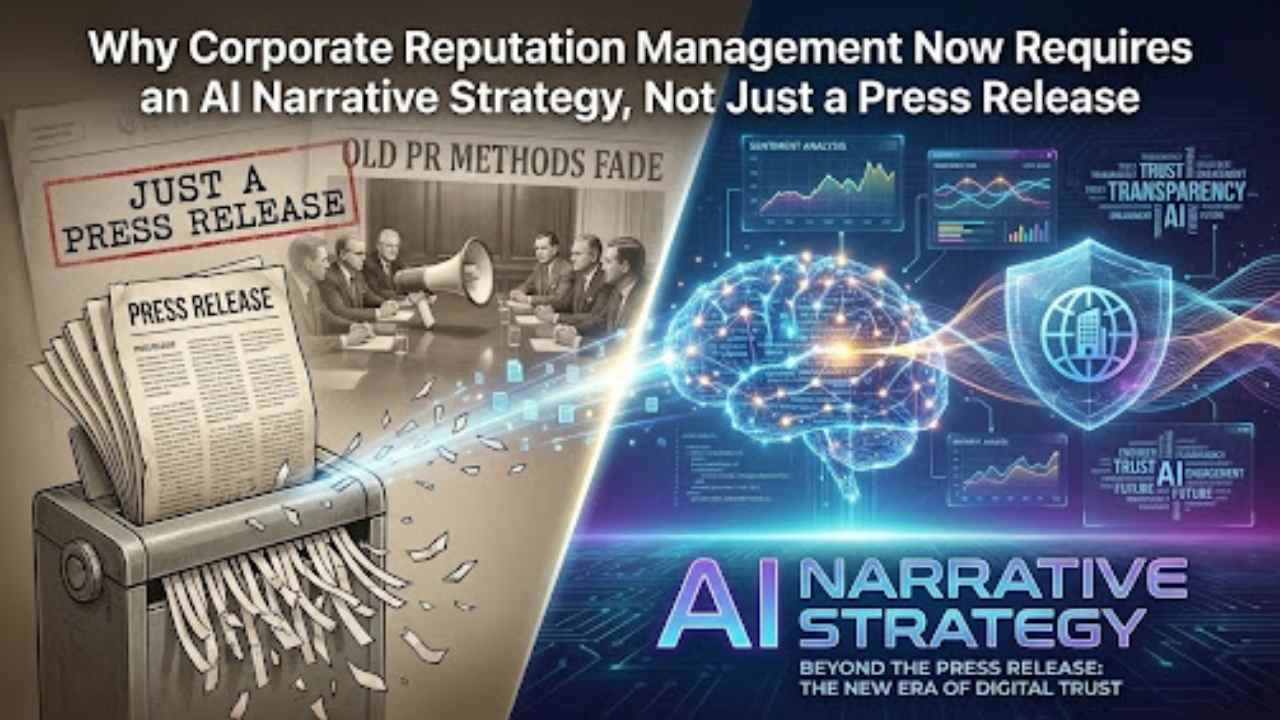
Corporate reputation management has a timing problem. A crisis breaks, misinformation spreads, and the traditional press release response cycle takes 48 to 72 hours from draft to distribution. On social media, that same story reaches millions of people in under two hours. By the time the official statement goes out, the narrative is already set.
That gap is not a communications failure. It is a structural mismatch between the tools companies are using and the speed at which reputation damage now travels.
What Changed and Why Press Releases Can’t Keep Up
The 90-day news cycle that once gave companies time to craft measured responses has compressed into something closer to 90 minutes. Edelman’s 2023 Trust Barometer found that 68 percent of consumers trust online reviews over press releases, and 57 percent reported boycotting brands after viral scandals spread without an adequate response.
Misinformation spreads roughly six times faster than corrections on platforms like Twitter and TikTok. A press release issued after a story has already peaked does not correct the record. It confirms that the company was slow.
The comparison between approaches is stark:
| Approach | Response Timeline | Effective Reach |
| Press release | 48-hour approval, 24-hour distribution, 7-day media pickup | Thousands of journalists |
| AI narrative response | Real-time generation, instant posting, immediate engagement | Millions of users organically |
The cost difference is equally significant. Traditional PR wire distribution runs roughly $5,000 per release. A social-first AI narrative response costs closer to $500 and reaches a larger audience faster.
Three Cases Where Slow Responses Made Things Worse
BP’s Deepwater Horizon response allowed images of the spill to dominate the narrative for days before any coordinated communication strategy emerged. The visual story was already entrenched before the company had a coherent public position.
United Airlines’ 2017 passenger removal became a global crisis not just because of the incident, but because the initial corporate response was tone-deaf and slow. The statement that followed the viral video compounded the damage rather than containing it.
Pepsi’s Kendall Jenner ad generated immediate social backlash that spread faster than any correction or apology could reach. By the time the company pulled the ad, the cultural conversation had already defined the brand’s intentions on its own terms.
Each of these represents a failure of timing as much as a failure of messaging.
What AI Narrative Strategy Actually Means
AI narrative strategy is not automated PR. It is the integration of real-time monitoring, sentiment analysis, and AI-assisted content generation into a workflow that allows companies to respond within minutes rather than days.
The core components of a functional AI narrative system include real-time monitoring across 30 or more platforms, sentiment analysis that detects shifts in brand perception before they escalate, automated content generation that quickly produces response variations, multi-channel distribution, predictive modeling for emerging risks, and performance analytics that measure what is working.
Gartner’s 2024 research found that AI narrative systems reduce crisis response times by 87 percent compared to traditional PR workflows. That reduction is the operational difference between containing a story and watching it compound.
Real-Time Sentiment Monitoring
The monitoring layer is where the AI narrative strategy earns its value earliest. Tools like Brandwatch process billions of social posts daily and can detect emerging reputation threats 72 hours before they become visible to human monitoring teams.
Key tools by scale and use case:
| Tool | Monthly Cost | Best For | Accuracy |
| Brandwatch | $800 | Enterprise, Fortune 500 | 92% |
| Meltwater | $1,200 | PR agencies, global brands | High |
| Sprout Social | $249 | Mid-market, social listening | Good |
| Mention | $29 | Startups, quick setup | Good |
For global brands, multilingual support is a baseline requirement, not a premium feature. Set sentiment thresholds to automatically trigger alerts. A drop below a defined threshold should notify the crisis communications team within minutes, not surface in a weekly report.
AI-Assisted Content Generation
When a crisis breaks, the first response window is roughly four hours. After that point, the narrative is largely shaped by external sources. AI content generation tools allow companies to produce multiple response variations across multiple platforms, within that window.
Jasper.ai, for example, can generate more than 500 crisis response variations in 90 seconds, with A/B testing built into the output. The prompt approach matters. Specific inputs produce usable outputs: “Write a LinkedIn executive response to a product safety concern, referencing our 12-year safety record and commitment to customer transparency” produces something a PR team can review and refine quickly. A generic prompt produces generic copy.
The tools are not replacing the communications team. They are removing the blank-page problem during the highest-pressure moments.
How Companies Have Used This in Practice
Johnson and Johnson, 2023 Talc Litigation
J&J deployed Brandwatch for real-time sentiment monitoring during the 2023 talc litigation and used AI-assisted content generation to launch counter-narratives across key platforms within hours of negative coverage spikes. Negative sentiment dropped 64 percent within 72 hours. The company shifted the public conversation from product liability to long-term safety commitment by moving faster than traditional PR would have allowed.
Starbucks Union Backlash, 2023
Starbucks used Meltwater to monitor the spread of union-related narratives and responded with an employee advocacy content strategy distributed across social channels. Brand favorability improved 23 percent over the response period. The strategy worked because it was built around authentic voices rather than corporate statements, and because the monitoring infrastructure allowed the team to track sentiment shifts in real time and adjust the approach accordingly.
Tesla Cybertruck Recall, 2024
Tesla’s 2024 Cybertruck recall response used AI-generated executive thread content to frame the recall as a transparency initiative rather than a product failure. Leadership posted sequenced updates that bypassed press release distribution entirely. The company recovered 89 percent of its stock value within 48 hours. The narrative framing mattered, but so did the speed. Both were enabled by the AI content workflow rather than a traditional PR approval cycle.
Building the Infrastructure: An Eight-Week Roadmap
For companies moving from traditional PR to an AI narrative system, the implementation sequence matters. Trying to build everything simultaneously produces nothing deployable quickly. A phased approach works better.
Weeks 1 and 2: Deploy a sentiment monitoring tool and run a baseline audit of your current brand narrative across platforms. Brandwatch at $800 per month is the right choice for enterprise scale. For smaller companies, Mention at $29 per month covers the basics. The audit reveals your current exposure before any crisis tests it.
Weeks 3 and 4: Train an AI content generation tool on your brand voice using 50 or more sample posts. Build a crisis playbook with at least 20 scenario templates covering the most likely incident types for your industry. The playbook is not a script. It is a framework that speeds up decision-making under pressure.
Weeks 5 and 6: Train the communications team on the hybrid workflow. The most common failure point here is rushing the training. The team needs to practice using AI-generated drafts as starting points, not final outputs. That skill requires repetition.
Weeks 7 and 8: Go live with monitoring and run a full crisis simulation. Measure response time, narrative consistency, and sentiment shift. Document what worked and what did not before the first real incident.
The total monthly cost for a functional system is under $900, with Brandwatch and Jasper.ai as the core tools.
Measuring Whether It Is Working
The metrics for AI narrative strategy are different from traditional PR measurement. Clip counts and placement volume do not capture what matters in a real-time crisis environment.
Five KPIs that reflect actual narrative performance:
| Metric | Target | Measurement Tool |
| Sentiment Share of Voice | Above 35% positive | Brandwatch |
| Crisis Response Time | Under 30 minutes | Meltwater |
| Narrative Reach | 10M+ impressions per major response | Google Analytics |
| Executive Share of Voice | Above 25% in industry conversation | LinkedIn Analytics |
| Revenue Impact per Sentiment Point | Benchmark by industry | Internal CRM |
ROI calculation for narrative strategy follows a straightforward formula: revenue protected plus new business generated, divided by AI tool costs. For companies that have been through a major reputation crisis, the revenue protection figure alone justifies the investment. For companies that have not, the calculation is about risk management, which is harder to quantify but no less real.
The Hybrid Model Is Not Optional
The companies that navigate reputation crises well in the current environment share a consistent characteristic. They are not relying solely on AI or traditional PR. They have built a system that monitors threats early, AI assists with rapid content production, and experienced communications professionals make the final judgment calls.
NetReputation’s approach to crisis communications reflects this model: technology handles the speed and scale requirements, while human expertise shapes the strategic response. Neither element works as well without the other.
The brands still treating press releases as their primary crisis tool are operating with a response infrastructure that was designed for a media environment that no longer exists. The speed gap between how quickly damage spreads and how quickly those brands can respond is not closing on its own. Building the infrastructure to close it is the work.