Forcing a reluctant child to practice handwriting with a traditional pencil often leads to tears, cramped hands, and intense pushback. Utilizing sensory-rich number tracing tips for kids shifts the focus from stressful paper-and-pencil drills to interactive, tactile experiences that build motor memory, shoulder stability, and spatial confidence naturally.
| Tracing Activity | Core Developmental Focus | Primary Sensory Medium | Preparation Level |
| 1. Salt or Sand Tracing Trays | Tactile feedback & path memory | Coarse salt, colored sand, or rice | Low (baking dish + salt) |
| 2. Wet-Dry-Try Sponge Method | Precise grip & line sequence | Chalkboard, water, & mini sponge | Low (slate + small sponge) |
| 3. Giant Floor Tape Numbers | Gross motor mapping & spatial sense | Masking or painter’s tape on carpet | Medium (floor setup) |
| 4. Playdough Rope Forming | Pincer grasp & curve control | Non-toxic modeling clay | Low (playdough) |
| 5. Vertical Chalk Wall Tracing | Wrist extension & shoulder stability | Wall-mounted chalkboard or easel | Medium (vertical surface) |
| 6. Rainbow Crayon Layering | Pressure calibration & stroke order | Large paper & colored crayons | Low (paper + crayons) |
| 7. Textured Puffy Paint Flashcards | Boundary awareness & tactile cues | DIY raised paint on cardstock | Medium (dry time required) |
| 8. Shaving Foam Table Smear | Low-pressure sensory exploration | Clean shaving cream or gel | Low (tabletop setup) |
| 9. Flashlight Beam Wall Tracing | Visual-motor tracking & focus | Dark room & focused flashlight beam | Low (flashlight + wall poster) |
| 10. Outdoor Water Squirt Tracing | Hand-squeeze strength & target control | Squeeze bottle or water gun | Low (outdoor pavement) |
10 Hands-On Number Tracing Activities (No Pencils Required)
1. Salt or Sand Sensory Tracing Trays
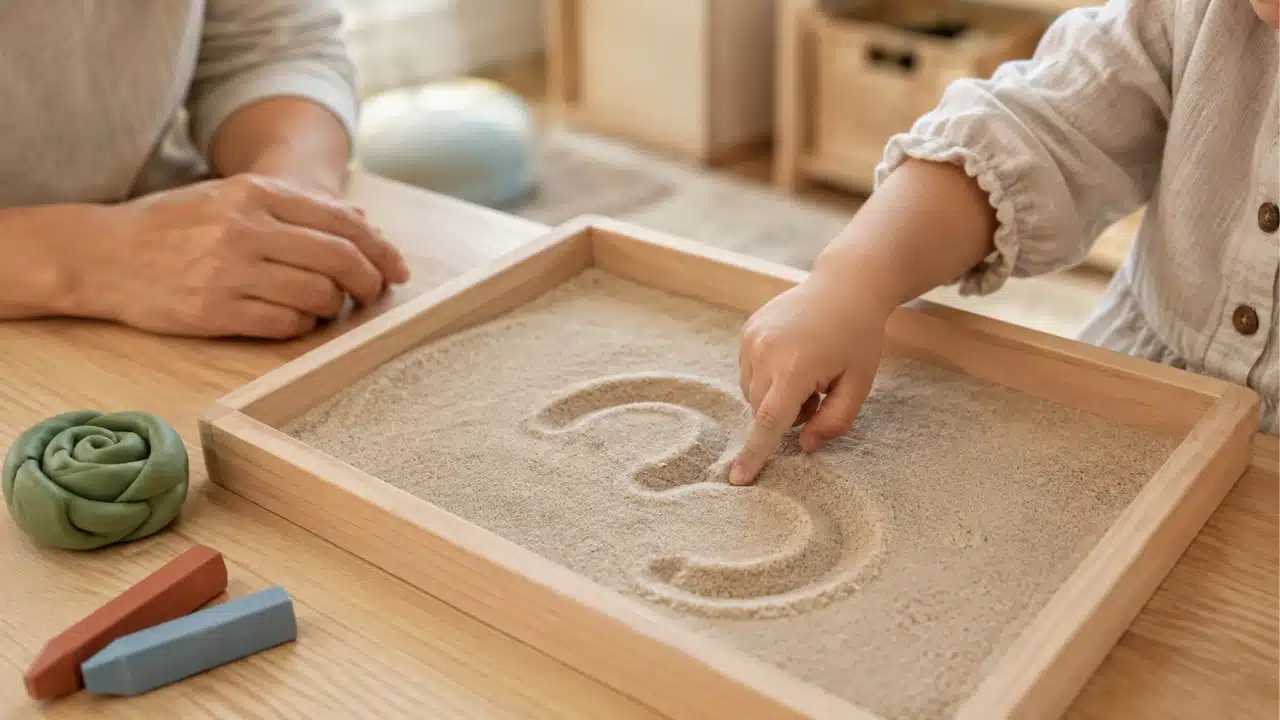
Pour a thin layer of fine sea salt or colored craft sand into a shallow wooden tray or baking dish. Place a single clear number card in front of your child and invite them to trace the shape using their index finger. The physical resistance of the salt grains provides high-definition tactile feedback to the brain, cementing stroke pathways into spatial memory far more effectively than sliding a smooth pencil across paper.
2. The Wet-Dry-Try Slate Method
Write a target digit on a small handheld chalkboard using standard white chalk. Hand your child a tiny, damp sponge cube and instruct them to “erase” the chalk number by tracing directly over your lines. Next, have them trace over the wet mark with a small crumpled tissue to dry it, and finally rewrite the digit with a tiny piece of chalk. Using early childhood motor development research, this three-step sequence reinforces correct stroke direction through repetition while the small chalk piece naturally encourages a proper tripod grip.
3. Giant Floor Tape Numbers for Gross Motor Learning
Use blue painter’s tape to construct massive six-foot-tall numbers directly on your living room rug or hardwood floor. Encourage your child to walk, drive toy cars, or hop along the tape lines in the exact order the number is written. Big-body movement engages the vestibular and proprioceptive systems, helping children who struggle with fine motor control map out spatial turns, tops, and bottoms before translating those movements to a smaller scale.
4. Playdough Rope Building and Outline Tracing
Roll non-toxic playdough into long, flexible snakes or ropes. Show your child how to bend, curve, and cut the dough ropes to match large printed number outlines. After building the dough digit, have them press their index finger along the top of the dough structure to “squish” the path. This builds hand strength while helping reluctant writers feel where numbers curve, intersect, or stop.
5. Vertical Surface Chalk Tracing
Tape large sheets of butcher paper to a wall, or use a wall-mounted chalkboard at your child’s eye level. Writing on a vertical surface forces the wrist into natural extension, which automatically stabilizes the hand muscles and prevents awkward wrist twisting. Incorporating tactile learning strategies for young children highlights that working against gravity builds core shoulder strength, reducing hand fatigue during early writing practice.
6. Rainbow Crayon Stroke Layering
Write a large number (around six inches tall) on a piece of thick paper using a light grey marker. Hand your child five different colored crayons. Instruct them to trace over the grey guide line using one color at a time, building up a vibrant “rainbow number.” This technique turns repetitive line practice into an art activity while helping children learn to calibrate downward hand pressure through visual feedback.
7. Textured Puffy Paint Tactile Flashcards
Create a set of durable number cards using puff paint or hot glue on thick cardstock. Once dry, these lines form distinct, raised borders. Have your child close their eyes and trace the raised paths with their fingertips. The physical ridge keeps their finger from straying off track, providing clear physical boundaries that teach the brain where lines begin and end without relying solely on visual control.
8. Shaving Foam Tabletop Tracing
Squirt a palm-sized dollop of clean shaving cream onto a smooth dining table or plastic tray and spread it thin. Have your child use their finger to sweep lines through the foam to reveal the table surface beneath. If they make a mistake, they simply smooth the foam out and start again. The low-friction medium eliminates the fear of making permanent mistakes, making it an ideal entry point for anxious or easily frustrated learners.
9. Flashlight Beam Wall Tracking
Dim the lights in a room and project a small, sharp flashlight beam onto a wall where a large number poster is hanging. Have your child hold a second flashlight and align their light beam with yours, tracing the digital path along the wall together. This game strengthens visual-motor tracking skills and arm-eye coordination, helping children build visual focus without requiring any hand-to-paper contact.
10. Outdoor Water Squeeze Bottle Tracing
Draw large numbers on outdoor pavement or sidewalk concrete using sidewalk chalk. Fill a plastic squeeze bottle with plain water and challenge your child to “wash away” the chalk lines by squeezing a stream of water directly along the path of the digit. Squeeze bottles build finger flexor strength and grip endurance, which are the exact muscle groups required for holding traditional writing utensils later on.
Rethinking Handwriting: Why Sensory Tracing Beats Premature Pencil Work
The underlying issue for most kids who “hate writing” is not laziness or lack of interest; it is physical discomfort and developmental readiness. Young children often experience muscular fatigue in their hands because the small bones of the wrist and palm are not fully ossified until around age seven. Forcing a child with underdeveloped fine motor control to grip a thin, hard pencil leads to tight hand cramping, awkward joint compensation, and intense emotional avoidance.
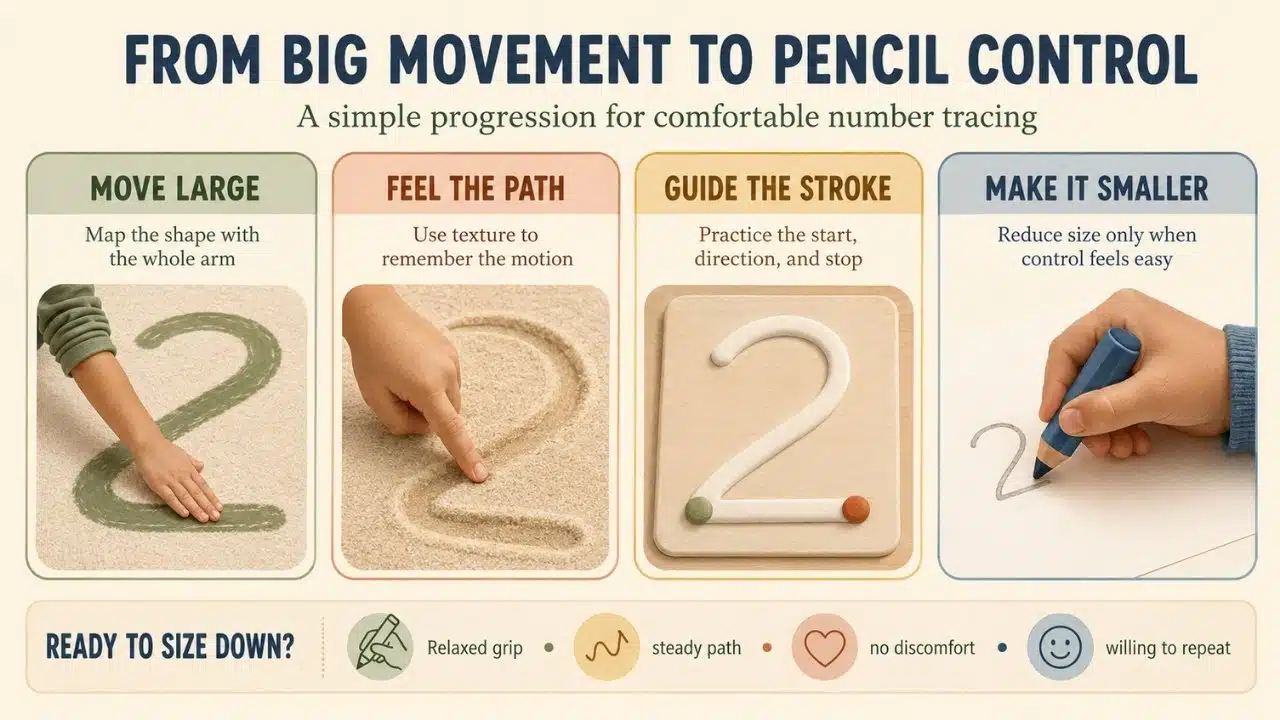
Reframing handwriting as a multi-sensory physical experience bypasses fine motor fatigue completely. When children trace using sand, playdough, large-body movements, or vertical chalkboards, they develop motor memory for letter and number pathways using their larger, fully developed muscle groups. Once the neural pathways for number shapes are firmly established through tactile play, transitioning to pencil-and-paper writing becomes a seamless, stress-free milestone.
Frequently Asked Questions (FAQs) About Number Tracing Tips for Kids
Why does my child get so frustrated when asked to trace numbers with a pencil?
Frustration usually stems from hand fatigue, weak grip strength, or underdeveloped hand-eye coordination. Pencils offer very little physical feedback and require precise muscle control, which can be exhausting for young palms and fingers.
At what age should children start practicing number tracing?
Sensory and gross-motor tracing can begin as early as age 3. Fine-motor paper tracing with crayons or thick markers is typically appropriate between ages 4 and 5, once hand strength and spatial awareness have developed through tactile play.
How do sensory tracing activities help with actual pencil writing later on?
Sensory activities build muscle memory for correct stroke direction and strengthen the intrinsic muscles of the hand. When children already know the physical shape of a number, holding a pencil later requires far less mental energy.
Should I correct stroke order every time my child traces a number?
Gently guide correct stroke order (top-to-bottom, left-to-right) during low-stress sensory play, but avoid constant sharp corrections that ruin the fun. Focus first on building positive engagement, then refine stroke sequence gradually.
What are the best tools for kids transitioning from sensory tracing to pencils?
Transition using short, thick tools like broken golf pencils, triangular crayons, or chubby chalk sticks. Short tools naturally force a tripod grip without requiring awkward finger placement or expensive plastic pencil grips.