We are officially past the pilot phase. For the last few years, artificial intelligence was a novelty—a sandbox for developers and a buzzword for boardrooms. But as I look at the data pouring in for 2026, the narrative has fundamentally shifted. The era of AI evangelism is over, replaced by an era of ruthless evaluation and physical execution. Nations are no longer just building chat interfaces; they are wiring machine learning directly into their power grids, manufacturing assembly lines, and sovereign data centers. If you want to understand where the global economy is heading, you have to look at the Top 12 AI Adoption by Country.
The global race is fracturing into distinct strategies. While the United States and China fight a heavyweight battle over foundational large language models (LLMs) and raw compute power, smaller economies are quietly winning the implementation game. Middle-income countries and agile tech hubs are bypassing the costly model-building phase entirely, focusing instead on rapid enterprise diffusion and public sector modernization. I’ve analyzed the latest indexes—from Stanford HAI’s Global Vibrancy Tool to Tortoise Media and Oxford Insights—to map out exactly who is winning, how they are doing it, and what it means for the rest of us.
The Changing Dynamics of Global Intelligence

When compiling the top tier of international AI players, you have to weigh three distinct pillars: innovation, investment, and implementation. Innovation tracks the raw output of research, patents, and open-source models. Investment looks at the capital flowing into domestic startups and physical infrastructure. Implementation—which I argue is the most critical metric for 2026—measures how deeply these tools penetrate everyday enterprise operations and government services. The data clearly shows that nations excelling in implementation are experiencing the fastest tangible economic growth.
| Ranking Metric Category | Key Indicators Measured | Leading Nations |
| Innovation & R&D | Total AI patents, open-source models, academic citations | United States, China |
| Government Utilization | Public sector AI tools, digitized services, readiness indexes | United Arab Emirates, Singapore |
| Enterprise Diffusion | Share of companies using AI, workforce adoption rates | India, Switzerland, Norway |
| Sovereign Infrastructure | Domestic data centers, energy grids, silicon supply chains | France, Canada, Japan |
How We Measure True Readiness
You can’t just look at venture capital funding to understand AI readiness. The Stanford HAI AI Index and the Oxford Insights Government AI Readiness Index both emphasize that practical adoption requires a foundation of data infrastructure, digital literacy, and regulatory clarity. We are seeing a massive push toward “AI Sovereignty”—the political and structural capability of a nation to run critical models on domestic hardware to protect sensitive data. This shift explains why countries are pouring hundreds of billions of dollars into sovereign cloud facilities and local data centers rather than relying purely on foreign tech giants.
The AI Superpowers Driving Foundational Models
There is no getting around the fact that two nations operate on a scale that dwarfs the rest of the planet. The United States and China hold a bipolar grip on the fundamental architecture of artificial intelligence. However, their approaches couldn’t be more different. The U.S. relies on a massively capitalized private sector pushing the boundaries of generative AI, while China uses aggressive, state-backed industrial policies to dominate hardware, robotics, and patent generation.
| Superpower Comparison | United States | China |
| Global AI Index Rank | 1st | 2nd |
| Primary AI Strength | Generative AI, Commercial Enterprise, Private Capital | Open-source LLMs, Patents, Industrial Manufacturing |
| Recent Private Investment | ~$109.1 Billion | ~$9.3 Billion |
| Strategic Focus | Deregulation and foundational model dominance | Technological self-sufficiency and hardware scaling |
United States
The United States is the undisputed heavyweight champion of the AI world, boasting the most robust commercial ecosystem in existence. Looking at the numbers, U.S. private investment in AI hit $109.1 billion recently, which is roughly twelve times the investment volume seen in China. American institutions produced 61 notable machine learning models in a single year, far outpacing international competitors.
What fascinates me right now is the aggressive regulatory maneuvering happening at the federal level. The U.S. government recently issued Executive Order 14179 to establish a “minimally burdensome national policy framework”. The explicit goal here is to bulldoze over state-level regulations—like Colorado’s strict algorithmic discrimination ban—that tech companies argue stifle rapid development. Furthermore, the America’s AI Action Plan enables employers to offer tax-free reimbursements for AI literacy training, signaling a massive push to rapidly upskill the American workforce and maintain global dominance.
China
China firmly holds the number two spot globally, but it is dominating in areas where the U.S. is surprisingly vulnerable. Chinese entities currently hold a staggering 60% of all AI-related patents worldwide. Their national strategy, heavily tied to the “Made in China 2025” initiative, isn’t just about building clever chatbots; it’s about embedding intelligence directly into manufacturing, energy grids, and physical infrastructure.
Despite facing intense U.S.-led export controls on advanced semiconductors, China has engineered brilliant workarounds. Chinese firms have optimized open-weight models to extreme efficiency. For instance, Alibaba’s DeepSeek and models from Baidu have achieved performance parity with top Western models on key benchmarks, doing so with significantly less compute power. In fact, nine of the top ten open-weight models globally now originate from China, proving that hardware embargoes haven’t slowed their innovation engine.
Asian Innovators Shaping Enterprise and Manufacturing
If you step outside the U.S.-China bubble, the Asian continent presents a dynamic mix of demographic urgency and booming tech ecosystems. Nations like Singapore, South Korea, India, and Japan are securing their spots on the leaderboard by using machine learning to solve highly specific, existential national problems. From offsetting shrinking populations to capturing the global IT outsourcing market, these countries view AI as a sheer necessity for survival.
| Asian Titan Overview | Singapore | South Korea | India | Japan |
| Core Motivation | Smart Nation digital hub | Offsetting labor shortages | Scaling digital enterprise economy | National tech competitiveness reset |
| Enterprise Metric | 15% SME adoption rate | 30.7% diffusion by late 2025 | 87% active enterprise usage | 2.5 million custom GPTs (SoftBank) |
| Government Target | 10,000 SMEs supported | 500 AI-powered factories | 30 state-backed AI applications | ¥1 trillion domestic support fund |
Singapore
Singapore continually ranks at the absolute top for digital adoption and regulatory readiness. Through its National AI Strategy 2.0, the country has fostered an environment that allowed 900 new AI startups to launch recently. The local AI market is projected to hit $4.64 billion, growing at an impressive 28.10% annually. I’m particularly impressed by their “AI Trailblazers” initiative, a government-led bootcamp designed to help 10,000 SMEs integrate AI over the next three years, bridging the gap between high-level tech and mom-and-pop businesses.
South Korea
South Korea is staring down a severe demographic cliff. An aging population and shrinking labor supply threaten to cripple their industrial output, with GDP projected to decline 16.5% by 2050. To combat this, the government launched a blueprint to achieve “AI G3” status (top three globally). Their strategy zeroes in on “Physical AI”—embedding intelligence directly onto the factory floor. They are targeting the creation of 500 fully AI-powered factories by 2030, hoping that massive productivity gains will offset the missing human workforce.
India
India is wielding its massive population and established IT services sector to achieve staggering adoption metrics. The NASSCOM AI Adoption Index reports that 87% of Indian enterprises are actively using AI solutions. Even more impressive, 89% of the 1.8 lakh new startups launched in the country last year incorporated AI into their core services. This technology is expected to add up to $500 billion to India’s GDP. With over 500 Global Capability Centres (GCCs) dedicated specifically to artificial intelligence, India has cemented itself as the world’s premier destination for operational tech talent.
Japan
Japan openly acknowledges that it lagged during the initial digital software revolution. To ensure they don’t miss the AI wave, the government approved its first comprehensive national plan, backed by a ¥1 trillion public support package. Private conglomerates are driving the cultural shift. SoftBank, for example, rolled out an aggressive internal program giving every employee access to generative tools, resulting in the creation of 2.5 million custom GPTs for internal corporate use. They also recently launched a joint venture with OpenAI to dominate the Japanese enterprise market with localized solutions.
European Pioneers Balancing Innovation and Regulation
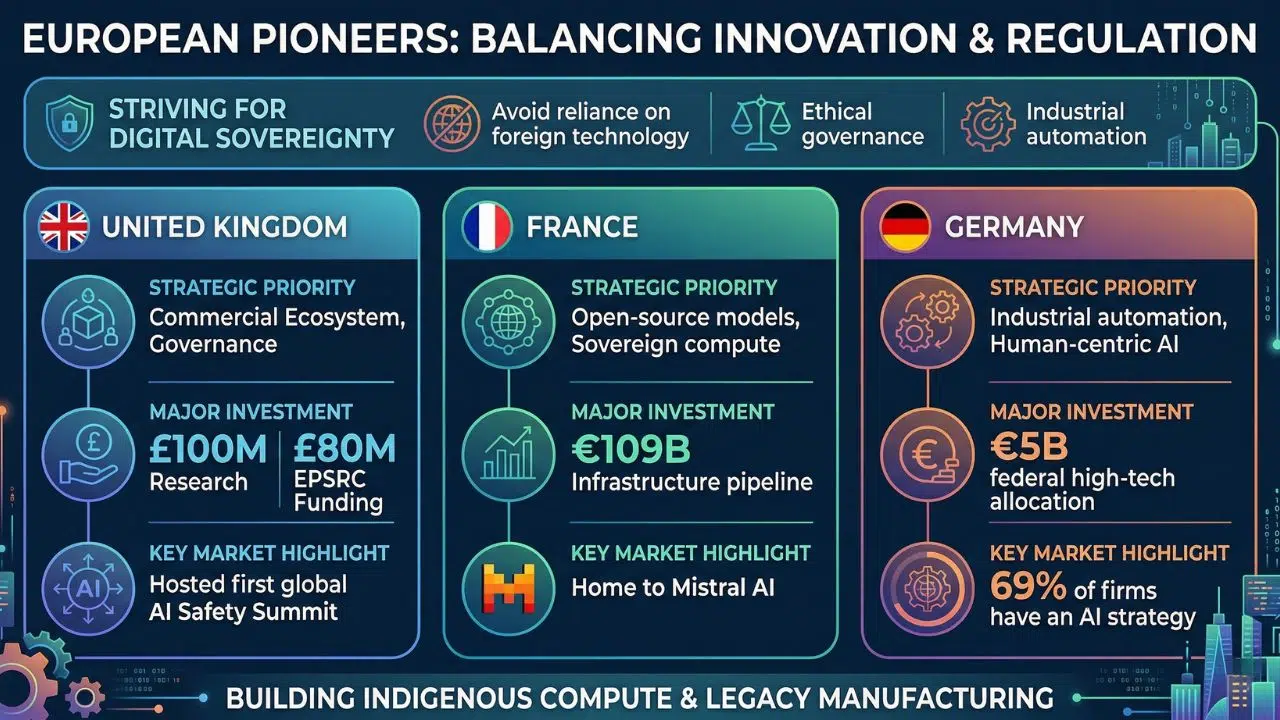
Europe is acutely aware of the risks associated with relying entirely on American or Chinese technology. Consequently, the European strategy revolves heavily around digital sovereignty, strict ethical governance, and industrial automation. The UK, France, and Germany are spearheading initiatives to build indigenous compute infrastructure and ensure their legacy manufacturing sectors aren’t left behind.
| European Champion Specs | United Kingdom | France | Germany |
| Strategic Priority | Commercial Ecosystem, Governance | Open-source models, sovereign compute | Industrial automation, human-centric AI |
| Major Investment | £100M research, £80M EPSRC | €109B infrastructure pipeline | €5B federal high-tech allocation |
| Key Market Highlight | Hosted first global AI Safety Summit | Home to Mistral AI | 69% of firms have an AI strategy |
United Kingdom
The United Kingdom maintains its elite status by aggressively funding domestic research while attempting to lead global conversations on AI safety. The UK government rolled out the AI Opportunities Action Plan, focusing on upgrading public sector procurement to act as a primary customer for local tech. Interestingly, at the recent Paris AI Action Summit, the UK opted out of signing the official agreement due to national security concerns, signaling a shift away from pure safety initiatives toward aggressive commercialization. Despite fierce competition from France, the UK remains Europe’s primary destination for commercial AI investment.
France
France has rapidly closed the gap with the UK and is now undeniably the European hub for open-source AI. The French government announced a monumental €109 billion infrastructure investment pipeline extending through 2030, designed to build domestic supercomputers and secure 500,000 GPUs. This massive hardware push supports local champions like Mistral AI, which recently raised €1.7 billion in a Series C round. France is highly focused on sovereign cloud solutions, ensuring that sensitive corporate and government data remains strictly within European borders.
Germany
Germany views artificial intelligence primarily through the lens of its massive, asset-heavy manufacturing sector. The national High-Tech Strategy 2025 allocates €5 billion to bolster cutting-edge research and industrial prototyping. While 69% of German companies report having an AI strategy, there is a looming problem. Recent studies show that 90% of traditional German industrial firms spend 5% or less of their IT budgets on AI, severely trailing adjacent industries. To drag legacy manufacturers into the modern era, Germany is partnering closely with France to co-deliver sovereign, AI-augmented ERP platforms via SAP.
Specialized Hubs Leading in Niche Capabilities
You don’t have to beat the U.S. or China across the board to be a global player. Several nations punch far above their weight class by hyper-focusing on specific niches. Countries like the UAE, Canada, and Israel have dominated crucial sub-sectors—such as government deployment, compute provisioning, and cybersecurity—making them indispensable nodes in the global supply chain.
| Specialized Powerhouse Focus | United Arab Emirates | Canada | Israel |
| Primary Niche | Public Services, Cybersecurity | Sovereign compute capacity | Cybersecurity, Agritech, Water tech |
| Standout Metric | 97% government AI utilization | $2B federal hardware investment | 47 successful AI corporate exits |
| Key Institutional Drivers | MBZUAI, Gov tech initiatives | Mila, Vector Institute, Scale AI | Mekorot, Defense Sector, Startups |
United Arab Emirates (UAE)
The UAE is arguably the most aggressive adopter of artificial intelligence in the public sector worldwide. Government statistics confirm a staggering 97% utilization rate of AI tools across federal entities. This proactive stance is projected to contribute over 13% to the national GDP. The UAE treats AI as a core utility, having appointed the world’s first Minister of State for Artificial Intelligence years ago. With over 543 billion AED directed toward investments and partnerships with global players like Google for Cybersecurity Excellence Centers, the UAE is the premier testbed for digital governance.
Canada
Canada recognized early on that brilliant algorithms are useless without the hardware to run them. To secure their future, the federal government launched a C$2 billion Sovereign AI Compute Strategy to construct massive data centers and allocate compute capacity to domestic firms at competitive rates. Their Pan-Canadian Artificial Intelligence Strategy brilliantly connects world-class academic research—home to deep learning pioneers—with commercialization through institutes like Amii, Mila, and the Vector Institute. In sectors like healthcare, Canadian startups like HEALWELL AI are already proving that remote patient monitoring and predictive models yield massive ROI, returning up to $3.20 for every dollar invested.
Israel
Israel’s geopolitical reality forces it to maintain absolute technological superiority, pushing 25% of its entire tech startup ecosystem directly into the AI sector. The nation dominates the intersection of AI and cybersecurity, capturing nearly 20% of global investments in that space. Beyond security, Israel uses machine learning to combat severe climate threats. Mekorot, the national water company, recently integrated a $30 million AI command-and-control infrastructure. This system runs extreme scenario simulations to optimize distribution and manage Israel’s world-leading 90% wastewater reuse rate, proving that AI is critical for resource survival.
Decoding the Top 12 AI Adoption by Country
When tracking the Top 12 AI Adoption by Country, it becomes clear that success in 2026 relies on a few fundamental pillars. We are seeing a massive transition away from software experiments toward hard, physical infrastructure.
| Core Trend Driving Adoption | Impact on Global Economy | Real-World Example |
| Sovereign Cloud Demand | Accelerates local data center construction to keep data in-country | France’s €109B infrastructure plan |
| Industrial Efficiency | Drives hardware and robotics integration into legacy systems | Switzerland’s 90.5% enterprise efficiency push |
| Agentic Workflows | Shifts focus from human-assisted tasks to fully autonomous operations | Widespread telecom and retail automation |
The Shift to Sovereign Infrastructure
A recurring theme among the top 12 AI adoption by country is the desperate scramble for physical compute power. Nations realize that relying on foreign cloud providers is a massive national security risk. We are seeing countries rapidly update their energy grids to support massive new data centers. The bottleneck is no longer coding talent; it’s electricity and cooling water.
Agentic AI and Workforce Redesign
Another massive shift is the move toward “agentic AI.” These are systems capable of independent reasoning and multi-step task execution without constant human prompting. In advanced economies, customer service and administrative operations are adopting “agent-first” workflows. Humans are kept in the loop only to handle exceptions or highly sensitive relationship cases. This requires a total redesign of the workforce, forcing companies to train employees as “agent orchestrators” rather than traditional task workers.
Final Thoughts
The data defining the Top 12 AI Adoption by Country paints a very clear picture of our immediate economic future. The dividing line between thriving nations and struggling economies is no longer just about who has the most venture capital; it is entirely about who can implement technology the fastest.
The United States and China will absolutely continue their heavyweight battle over foundational models and semiconductor supremacy. But the real economic miracles of the late 2020s are happening in places like Singapore, the UAE, and Switzerland. Governments that treat artificial intelligence as a fundamental public utility—much like electricity or roads—are already reaping the rewards of massive productivity gains, modernized healthcare, and optimized industrial output. If there is one takeaway from looking at the top 12 AI adoption by country, it’s that hesitation is the most expensive mistake a nation can make. The tools are built; the race now is to wire them into the real world.
FAQs About Global AI Adoption
As the Top 12 AI Adoption by Country dictates global tech policies, a few nuanced questions keep popping up in enterprise discussions and search trends.
What exactly is “AI Sovereignty” and why does it matter?
AI sovereignty is the political and structural capability of a country to develop, train, and run artificial intelligence models entirely within its own borders. It matters because relying on foreign tech giants (like U.S. or Chinese firms) for critical infrastructure poses massive data privacy and national security risks. Nations are building their own LLMs and data centers to ensure their digital independence.
How is the global water crisis linked to AI expansion?
Data centers required for training and running complex models consume vast amounts of electricity and generate intense heat, requiring millions of gallons of water for cooling. As AI adoption surges, the strain on local water supplies is becoming a critical constraint. Future tech hubs will likely be determined by a region’s advanced water recycling and desalination capabilities, much like the systems pioneered in Israel.
Are middle-income countries being left behind in the AI race?
Not necessarily. While they can’t match the multi-billion dollar foundational model investments of the U.S. or China, middle-income economies are closing the readiness gap by focusing on the basics. By leveraging open-source technologies, improving data availability, and upskilling their workforce, these nations are integrating AI into government services and local businesses much faster than some heavily regulated legacy economies.
How does the expansion of AI search impact digital marketing and SEO?
With platforms like Google expanding AI Overviews to over 100 countries and reaching billions of users, traditional SEO is facing a crisis. We are entering a “zero-click” search era where up to 60% of searches yield no clicks to external websites. Brands must shift their strategy from traditional keyword ranking to “Generative Engine Optimization (GEO),” ensuring their content is authoritative enough to be cited directly within the AI-generated responses.