
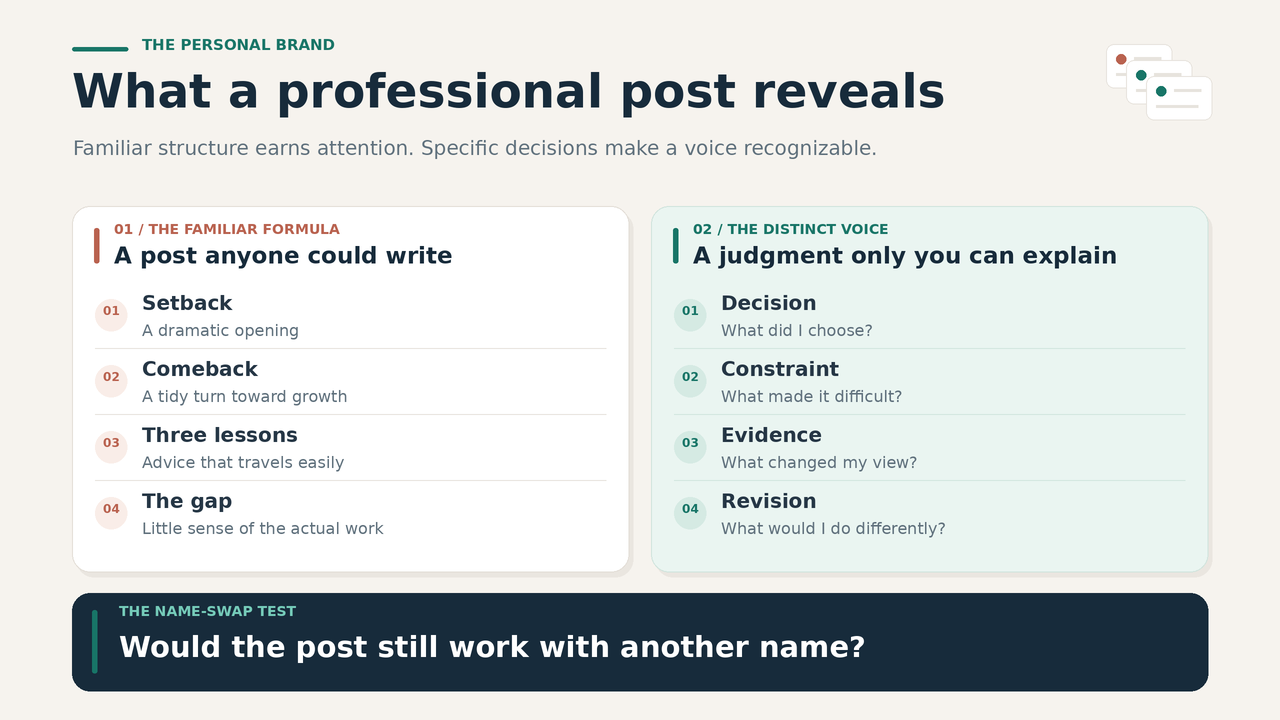
When I finish reading a LinkedIn post about a professional setback, I often know the lesson before I know the story. The writer has learned resilience and given me three tidy takeaways. What I still want to know is which decision they made when things went wrong. That choice, more than the polished ending, is what would make their personal brand sound like theirs.
I understand why people write this way. A busy reader can follow the story in seconds, and a prospective client or employer gets a reassuring picture of the person behind the profile. But if I can replace the writer’s name with someone else’s and leave every sentence intact, what have I learned about that person?
This is the odd promise of the personal brand. We are encouraged to make ourselves recognizable, yet some of the most recognizable formats leave the person out. I want a professional voice that helps readers see the work behind it, even when that work does not produce a tidy lesson.
Why a Personal Brand Matters
I cannot dismiss the need to be visible. A freelancer without an established network has to give strangers a reason to trust them. A job seeker may need a profile that makes their experience understandable before anyone offers an interview. For a founder, a clear public account of the company’s work can open a conversation that an advertisement cannot.
LinkedIn presents a profile as a way to manage professional identity and be found by recruiters and others. A study based on interviews with 39 freelancers and clients on Upwork found that workers tried to showcase skills, expand their presence, and distinguish themselves. The researchers also found that too much self-promotion could work against a freelancer. Upwork and LinkedIn are different settings, but the tension is familiar: people must show enough of themselves to be considered without knowing precisely how they will be judged.
That is why our guide to building a strong personal brand advises clarity and consistency. I would not tell someone looking for work to abandon those things. I would ask what they are being consistent about. A reliable account of your skills is useful. A requirement to sound like the same upbeat authority in every post can become a constraint on what you are willing to say.
When the Brand Starts Editing the Person
Think about writing a post after a difficult decision at work. Your colleagues could read it, along with future employers, clients, and people who do not know the circumstances. You cannot disclose everything. You want to appear thoughtful and capable. It is tempting to remove the awkward parts and offer a lesson that any audience can approve.
The edits may seem harmless. A disagreement becomes “I learned the importance of listening.” An unresolved problem becomes “Here are three things every leader should do.” The colleague who challenged your view disappears, as does the constraint that made the decision difficult. What remains may be readable, but it teaches me less about your judgment.
The problem can grow when several people speak for the same company. Our guide to planning LinkedIn posts across multiple spokespeople suggests giving the founder, product lead, and operations lead different decisions to explain. If all three publish the same polished claim, I learn little about what each person actually knows.
Researchers Leah Scolere, Urszula Pruchniewska, and Brooke Erin Duffy interviewed 52 creative workers about presenting themselves online. They found that workers shaped that presentation around their understanding of each platform, its audience, and their own identity. I recognize the urge to write for the audience I imagine is watching. No platform has to instruct me to remove a caveat; I may decide on my own that it makes a post look less certain.
In publishing, uncertainty often makes an explanation more useful. A claim may be true under one condition and misleading without it. If I take out the condition to make a sentence stronger, I may make the sentence worse. The same problem arises when professional advice loses the context that gave it meaning.
Strong openings and short paragraphs are ordinary writing tools. I use them. The trouble begins when the form is settled before the thought. LinkedIn said in March 2026 that it was working to reduce repetitive, low-substance posts and engagement bait in its feed. That announcement does not explain why writers use familiar formats, but it shows that repetition is a problem even the platform wants to address.
Even Vulnerability Has a Familiar Ending
The pressure extends beyond advice. Consider a post that begins with rejection, exhaustion, or a failed project. Someone reading it may feel less alone. Sharing that experience can be generous. But professional stories seem to have a narrow range of acceptable endings: the rejection led to growth, the exhaustion revealed a better way to lead, the failure became the foundation of success.
In a study first published online in 2024 in New Media & Society, Shani Orgad examined 40 LinkedIn posts about vulnerability. She identified several kinds of stories, including accounts of triumph after difficulty and posts that challenged the pressure to promote oneself. Her analysis gives me a reason to read such posts with care. A person may be telling the truth and shaping that truth for an audience at the same time.
I do not need anyone to post an unfinished account of grief or burnout to prove they are sincere. People are entitled to privacy and to a hopeful ending. What troubles me is the expectation that a difficult experience must be converted into a useful professional trait before it can be shared. Some experiences change our work slowly. Some remain painful. A personal brand that demands a lesson from each one has too much control over the story.
Show Me the Decision Behind the Advice
“Good leaders listen” is easy to agree with. It gives me little reason to remember who said it. I would learn more if a manager explained what they heard, which part of a plan changed as a result, and what they still could not resolve. A reader might disagree with the choice. At least there would be a choice to examine.
I think about the same distinction in editorial work. “Accuracy matters more than speed” makes a safe post. Imagine an editor explaining why a claim needed another source, how the headline overstated the evidence, and what the published version finally said. Another editor could challenge that reasoning or use it in a similar situation. The detail gives the principle somewhere to stand.
Specificity makes a writer more accountable. Someone can ask why they did not take another path. They may have to say, “This worked in our circumstances, but it might fail in yours.” To me, that is a stronger sign of expertise than advice that claims to work everywhere. Readers can hear the difference between a principle someone has tested and a sentence designed to collect agreement.
There is a cost to the writer, too. A carefully maintained public persona can make a change of mind feel like a branding error. If I am always the decisive editor with an instant answer, admitting that I was persuaded by new evidence may seem off-message. Yet that admission would tell readers something worth knowing about how I work. A professional reputation should be able to hold a revision.
That is the kind of thought leadership grounded in actual work I find useful. It allows readers to see a method and its limits. A polished statement about excellence gives them far less.
A Template Can Help Someone Be Heard
There is a fair objection here. Structure helps busy readers. A first-time job seeker may have no idea how to introduce their skills in public. A freelancer working in a second language may find a familiar format helpful. Someone employed in a sensitive role may have good reasons to keep details out of a post. I do not want to turn candor into another demand that falls hardest on people with the least room to take a risk.
Visibility also has practical value. In a 2025 survey by Edelman and LinkedIn of 1,934 U.S. executives on LinkedIn, 55% of the respondents described as “hidden decision-makers” agreed that reviewing an organization’s thought leadership was one important way to vet potential vendors. The study concerns B2B material broadly, rather than the results of an individual’s posts. It helps explain why people invest time in communicating their expertise.
A template can provide a doorway. The question is what comes through it. A concise post that names a real constraint or explains a useful decision serves a reader well. A dramatic opening followed by an interchangeable lesson serves the format. I would not judge a person’s ability by one short post, but I would like the post to give me something I could not get from anyone else.
Let the Work Shape the Personal Brand
When I think about what I want my own personal brand to mean, I come back to questions I can answer: What did I do? What evidence changed my view? Which trade-off did I accept? What would I handle differently next time? I do not have to answer all of them in public, and I do not need to turn every working day into content. Our analysis of content velocity and quality makes a similar case for giving thought leadership more time and original judgment. I would rather start with the work than ask which version of myself will attract the broadest approval.
I want room for different kinds of writing, too. A correction can be direct. An uncertain idea can sound uncertain. A celebration can simply be a celebration without pretending to contain a universal lesson. Consistency in care and honesty does not require an identical tone every time.
Nor would I let reach settle every question about value. A post can travel widely because its message is easy to agree with. A narrower account might prompt one thoughtful question from someone who knows the field. I cannot measure the worth of those exchanges by the same number. What matters to me is whether the reader has learned something about the work and the person responsible for it.
What I Want My Name to Mean
A personal brand is supposed to help someone be recognized. If my name is the only part of a post that makes it mine, I have left out too much.
I want the people who read my work to recognize a decision I can explain, a claim I have checked, or a view I was willing to revise. Those things may not fit a reliable posting formula. They give my voice a reason to be remembered.