
The Anthropic IPO is asking investors to value a company whose product could change the economics of knowledge work. But the investment question is narrower—and harder—than whether artificial intelligence will become more capable. It is whether Anthropic can turn that capability into durable earnings while paying for its infrastructure, defending its position, and preserving a mission that does not put shareholders first in every decision.
Anthropic’s November 10 announcement outlined a proposed offering of 825 million shares at an indicative price of $70 to $78, with an application to list on Nasdaq under “ANT.” Those are proposed terms, not evidence of a completed stock-market debut.
As checked on November 16, 2026, the company’s IPO FAQ gives November 18 (EST) as the expected pricing date and November 19 (EST) as the expected start of trading, subject to regulatory clearance. Neither is a completed event. A planned ticker is not a live quotation, and an indicative price range is not a guaranteed purchase price.
The distinction matters. Before a trading price becomes a headline, the underlying business deserves scrutiny.
For someone who uses Claude every working day, the temptation is understandable: “This product is useful to me, so surely the shares will be valuable.” The first judgment concerns a tool. The second concerns the price paid for a claim on future earnings. They can point in different directions.
The Anthropic IPO at a Glance
| Reader question | What the reviewed materials establish |
|---|---|
| Has this article confirmed a completed listing? | No. It describes proposed terms and a conditional timetable. |
| What is being sold? | Class A shares; most of the proposed base offering is newly issued stock. |
| Is the offering size the company’s valuation? | No. Valuation also requires the relevant post-offering share count. |
| Does adjusted profitability settle the business case? | No. Accounting profit, cash flow and adjusted measures answer different questions. |
| What is the central editorial test? | Whether useful AI can generate durable returns after delivery costs, competition and governance constraints. |
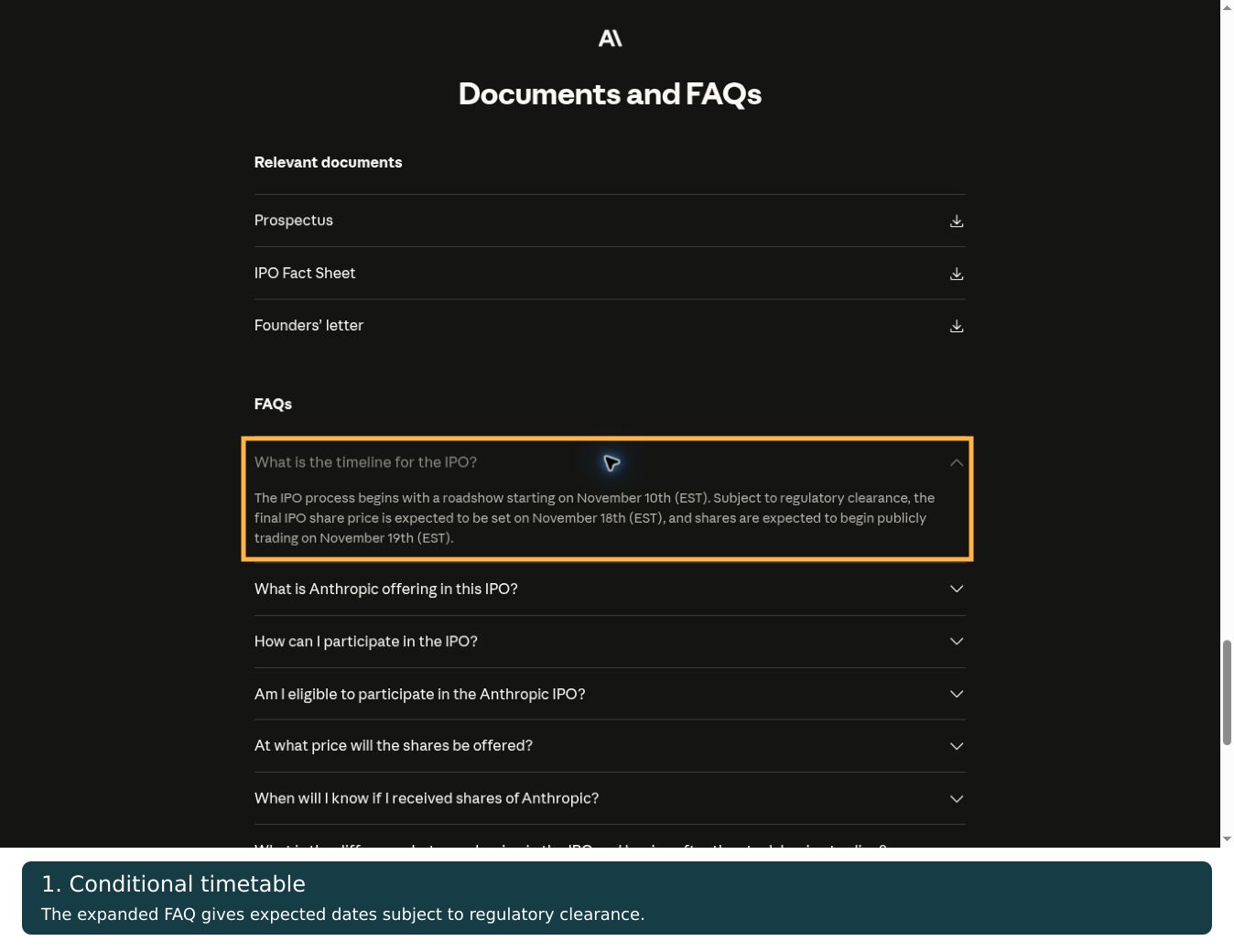
Captured after navigating or expanding the official IPO website on November 16, 2026. Amber outlines identify the source passage; the annotation below is editorial. Original captures are preserved in the evidence package. This demonstrates source inspection, not an audit or a product-performance test.
Evidence 1: The expanded FAQ gives expected dates subject to regulatory clearance. Source: Anthropic IPO website, captured November 16, 2026. Editorial annotation; original capture retained.
Wall Street can put a price on shares in Anthropic. Whether that price captures the value of intelligence is a different question. Investors would own a financial interest in one organization’s ability to commercialize AI, rather than a claim on everything the technology might contribute to society.
What the Anthropic IPO Would Actually Sell
The proposed offering contains two different transactions: newly issued shares that raise money for Anthropic and shares sold by existing holders.
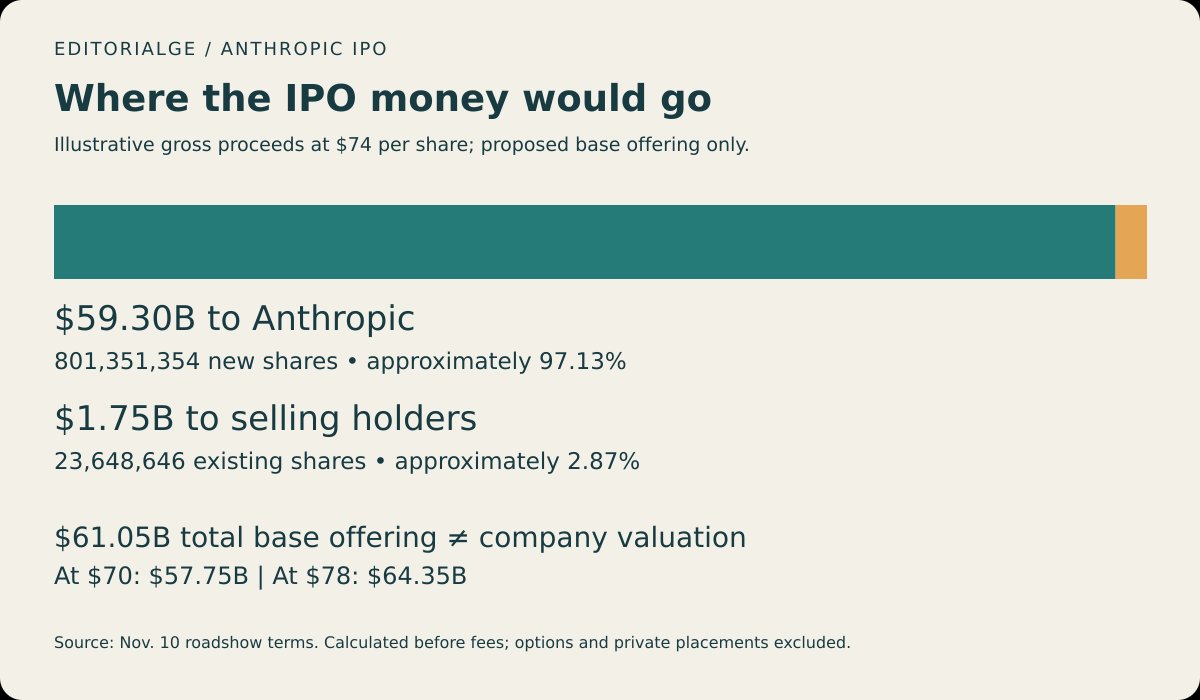
At the midpoint of the announced range, $74 a share, the distinction looks like this:
| Proposed base offering | Shares | Gross amount at $74 |
|---|---|---|
| New shares issued by Anthropic | 801,351,354 | Approximately $59.30 billion |
| Shares sold by existing holders | 23,648,646 | Approximately $1.75 billion |
| Total | 825,000,000 | $61.05 billion |
These are calculations from the announced terms, before underwriting discounts and expenses. They exclude the underwriters’ additional-share option and any separate private placement. The selling shareholders’ proceeds would not go to Anthropic.
Crucially, $61.05 billion would be the gross size of this base offering at its midpoint—not the company’s total valuation. Establishing that valuation requires the relevant post-offering share count and a clear treatment of dilution.
This may sound like financial housekeeping. It is actually the first test of whether the debate will remain grounded.
An IPO can simultaneously fund expansion, provide liquidity to existing holders, and establish a public market price. Each function answers a different question. Combining them into one spectacular number makes the transaction easier to promote and harder to understand.
A Price Range Is Not a Valuation Model
Recalculating the base offering at both ends of the proposed range produces $57.75 billion at $70 and $64.35 billion at $78. The midpoint is $61.05 billion. All three amounts concern the shares in this offering, before fees—not every share in the company.
Newly issued shares account for approximately 97.13% of the base offering; existing-holder sales account for approximately 2.87%. That helps describe where the gross proceeds go. It does not reveal how much of the company public investors will own after the transaction.
The practical discipline is to keep three denominators separate: shares offered, total shares outstanding after the IPO, and a diluted share count that includes relevant potential equity. Without that distinction, two commentators can use the same share price and produce very different “valuations.”
The Business Case Is Stronger Than a Demonstration
Anthropic’s disclosed financial highlights show substantial commercial activity. For the quarter ended September 30, 2026, the company reported revenue of $17 billion. It also reported more than 11,900 customers generating at least $100,000 in trailing-12-month revenue.
That evidence deserves weight. A compelling demonstration attracts attention; repeated spending suggests that customers have found something worth buying.
However, commercial scale does not settle the profitability question. Anthropic’s quarterly highlights presented several measures that should be kept separate:
| Measure | Quarter ended September 30, 2026 |
|---|---|
| Revenue | $17.0 billion |
| GAAP operating margin | −3% |
| Adjusted operating margin | 15% |
| Net loss | $23.3 billion |
The reported net loss included a $21.9 billion noncash fair-value charge associated with financing instruments. Consequently, treating the entire net loss as cash consumed by operations would misrepresent the figures. Equally, presenting the adjusted operating margin as ordinary accounting profitability would omit important distinctions.
The responsible interpretation is that the business has demonstrated demand, while the quality and durability of its economics still require examination.
Investors should want to know how much revenue comes from recurring, economically sustainable use. They should also ask whether customers expand their spending because Anthropic delivers measurable value, because introductory economics are attractive, or because experimentation budgets remain unusually generous.
Those explanations can coexist. Their relative importance determines what happens when customers begin demanding tighter returns.
The Missing Bridge Between Growth and Cash
An operating margin of −3% on $17 billion of quarterly revenue implies an operating loss of roughly $510 million. A 15% adjusted margin on the same revenue implies approximately $2.55 billion of adjusted operating income. These are illustrations calculated from rounded disclosed inputs, not replacements for the underlying financial statements or reconciliation.
Likewise, subtracting the $21.9 billion noncash charge from the $23.3 billion net loss leaves $1.4 billion arithmetically. That remainder must not be relabelled “cash burn.” Other noncash items, working-capital movements and investing activity can still separate accounting loss from cash flow.
My reading of these figures is that the reconciliation deserves as much attention as the headline growth. The useful follow-up is to trace each adjustment, decide whether it is recurring, and compare operating cash flow with the infrastructure and financing needs that sit elsewhere in the accounts. That is a method for scrutiny, not a claim that the accounts have been independently audited here.
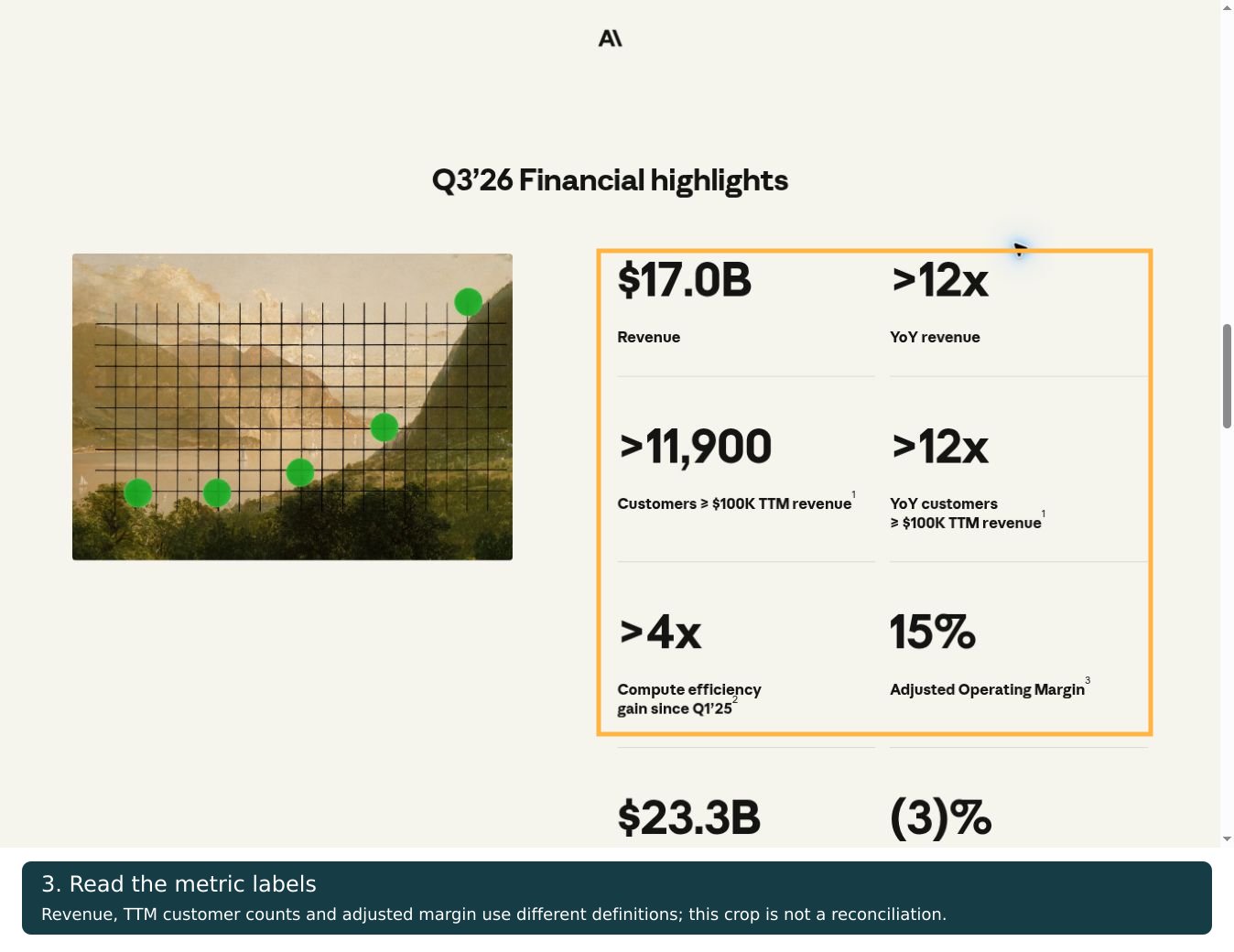
Captured after navigating or expanding the official IPO website on November 16, 2026. Amber outlines identify the source passage; the annotation below is editorial. Original captures are preserved in the evidence package. This demonstrates source inspection, not an audit or a product-performance test.
Evidence 3: Revenue, TTM customer counts and adjusted margin use different definitions; this crop is not a reconciliation. Source: Anthropic IPO website, captured November 16, 2026. Editorial annotation; original capture retained.
A Better Model Does Not Automatically Produce a Better Business
The strongest investment case for Anthropic is that AI becomes embedded in valuable workflows.
Consider a hypothetical company using an AI system to help maintain software. Initially, the tool might assist with individual coding tasks. Over time, it could become integrated into documentation, testing, review, and internal development processes.
If that integration consistently saves time without creating unacceptable errors, the customer has a reason to renew. If replacing it requires retraining employees and rebuilding processes, the supplier may gain a more durable commercial relationship.
This is where technical capability can become economic value.
But several steps separate a strong model from a strong investment. The system must perform useful work. Customers must trust it enough to keep using it. Delivery costs must leave room for profit. And competitive pressure must not transfer most of the savings to buyers through lower prices.
A model can improve at every benchmark while its provider’s pricing power weakens.
That possibility is especially important when competing systems become sufficiently capable for ordinary business needs. Customers do not always require the most advanced intelligence available. They may prefer an adequate system that is cheaper, easier to integrate, or already included in an existing service.
Anthropic’s challenge is therefore broader than staying near the technological frontier. It must demonstrate why customers should keep paying it attractive prices as access to capable AI expands.
The Infrastructure Bill Changes the Story
Anthropic’s amended IPO filing disclosed $900.9 billion in commitments as of and subsequent to September 30, 2026, substantially related to computing and infrastructure. Of that amount, $451.6 billion was due before the end of 2030. These commitments span different arrangements and years; they should not be described as current debt, annual expenses, or immediate cash burn.
Their significance lies in the relationship between future demand and capacity purchased to serve it.
Large infrastructure commitments can support growth. They can also reduce flexibility if demand, pricing, or technology develops differently from expectations.
There is a reasonable argument for committing early: a company cannot serve customers reliably if it lacks computing capacity when they arrive. Waiting for perfect certainty could mean surrendering business to better-prepared competitors.
The opposing argument is equally serious. Long commitments can outlast the assumptions that justified them.
A cheaper approach to delivering intelligence might expand the market while changing which infrastructure earns attractive returns. More efficient models might reduce costs per task while encouraging customers to demand lower prices. Higher usage might absorb available capacity without producing equally strong profits.
The important question is how much financial room Anthropic retains when those forces interact.
Look at the Payment Calendar, Not Just the Total
The filing also places approximately $70.7 billion of commitments in the 12 months following September 30, 2026. That shorter horizon is a more immediate planning question than the full multiyear total. The $70.7 billion is included within, rather than added to, the $451.6 billion expected before December 31, 2030.
The subtraction leaves approximately $449.3 billion after that 2030 threshold, with substantially all of the remainder expected between 2031 and 2045. This is a timing breakdown of disclosed commitments, not a debt maturity schedule or forecast of losses.
A buyer of shares should therefore ask what finances the nearer-term obligations: cash already held, customer receipts, offering proceeds or additional funding. The article does not assume an answer. It identifies the bridge the financial statements and future disclosures must make visible.
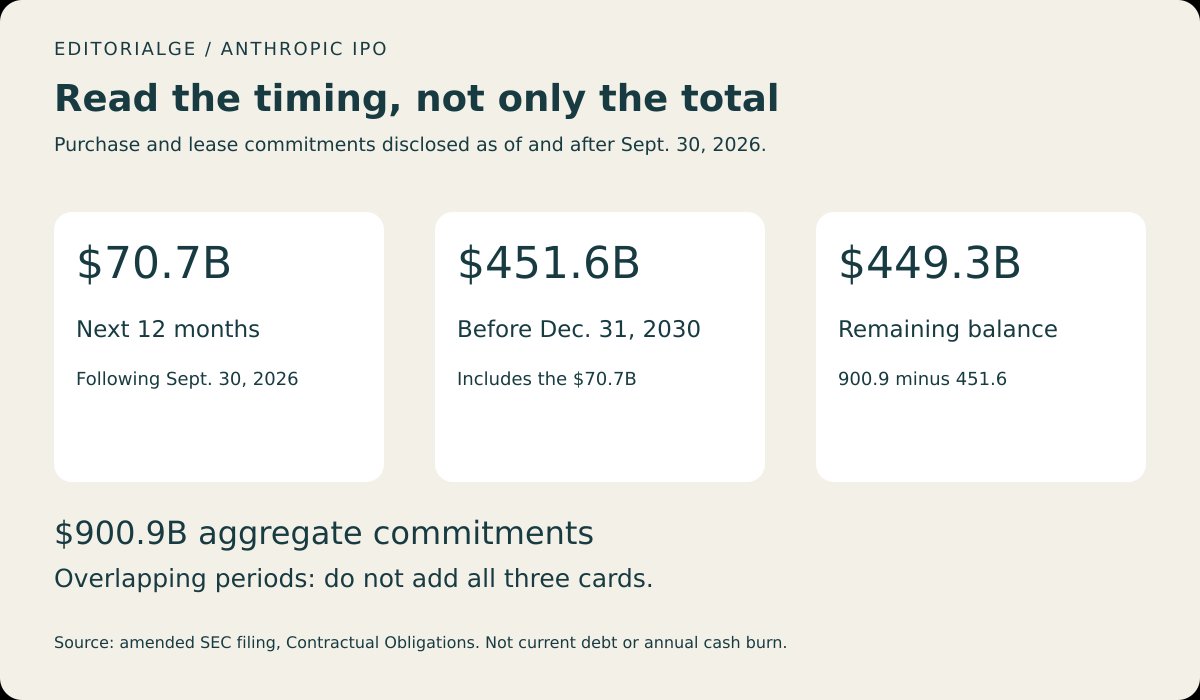
Infographic: commitments — click to enlarge.
Efficiency Needs a Clear Definition
Anthropic’s IPO materials describe a greater-than-fourfold improvement in “compute efficiency.” The measure compares revenue relative to computing and infrastructure expense in the third quarter of 2026 with the same ratio in the first quarter of 2025. It is a company-defined financial relationship, not a claim that every chip became four times faster or every task became four times cheaper.
That distinction illustrates a wider problem in AI finance: technically persuasive language can conceal economically different measurements.
A company can improve revenue per dollar of infrastructure expense through several routes. Better utilization may help. Product mix may change. Pricing may improve. Engineering advances may reduce the resources required for particular workloads.
Each route has different implications for durability.
For customers, the most useful measure might be the cost of completing a task correctly. For shareholders, it might be the profit remaining after delivering that task and supporting the business around it.
A credible investment narrative should explain how those measures connect. Otherwise, “efficiency” risks becoming an optimistic word standing in for several unanswered questions.
Anthropic’s governance introduces another distinction investors should understand before treating it as a conventional technology listing.
The proposed structure gives Founder LLC’s Class F shares 50.1% of voting power on matters submitted to shareholders generally, with exceptions concerning Class T directors. The Long-Term Benefit Trust’s Class T rights generally allow it to elect and remove a majority of the authorized board. The trust does not manage daily operations. Anthropic is also organized as a public benefit corporation.
These arrangements matter because financial participation and institutional control are different things.
A public investor may support Anthropic precisely because it has committed to a broader purpose. Customers may also value governance designed to consider consequences beyond immediate revenue.
That could become a commercial advantage if it produces credible decisions, reliable products, and durable trust.
Yet the arrangement also creates a question that cannot be answered by a mission statement: what happens when an attractive business opportunity conflicts with the organization’s assessment of acceptable risk?
A decision to delay a release, restrict a use case, or forgo revenue might protect long-term value. It could also disappoint investors seeking faster growth.
Neither outcome is automatically evidence of failure. The issue is whether shareholders understand the institution they are financing and whether its decision-making remains intelligible when genuine conflicts arise.
The IPO would test whether public markets can accommodate this bargain without pretending it is an ordinary arrangement.
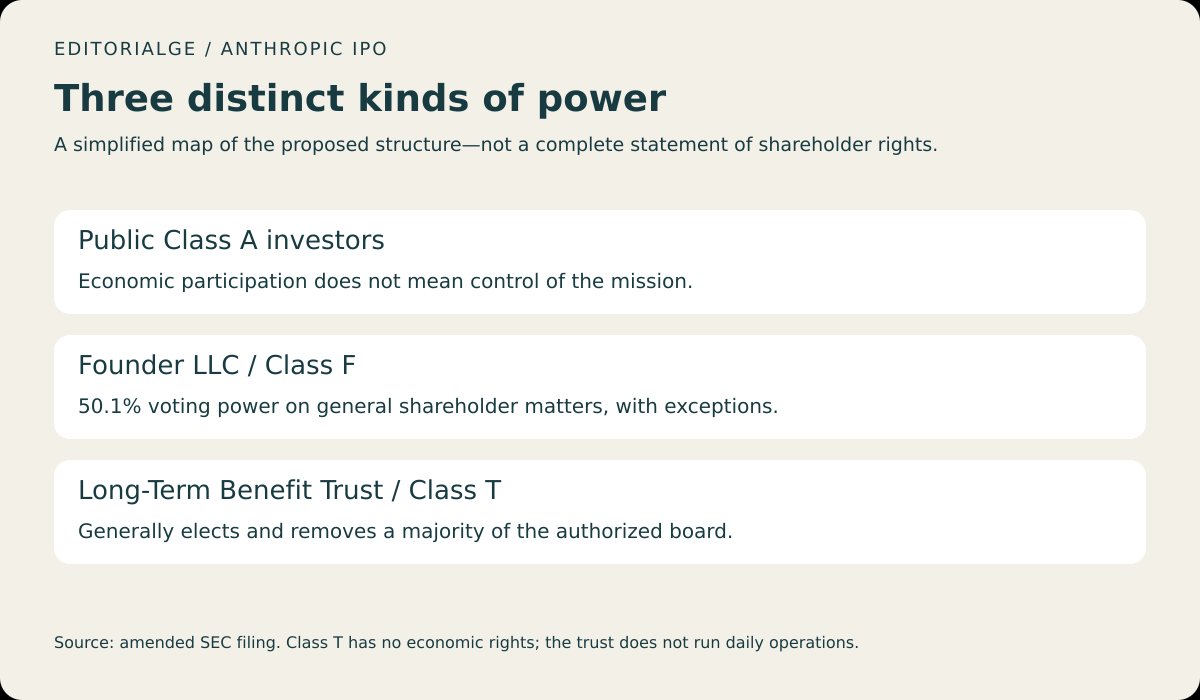
The Governance Bargain Should Be Priced Honestly
It is possible to admire a mission and still ask whether the shares offer enough protection for outside owners. Those positions are compatible. The relevant question is not whether safety matters; it is who decides when safety and a commercial opportunity conflict, and how that decision is explained.
For example, a hypothetical delay in releasing a lucrative capability could preserve customer trust or avoid a serious harm. It could also reduce near-term revenue. An outside shareholder would need to assess the rationale, available evidence and consistency with the company’s stated purpose, while recognizing the limits of their voting influence.
A mission-led structure does not remove the need for accountability. It changes the parties to whom the institution owes an explanation. Clear reporting becomes more valuable when ordinary shareholder control is constrained.
The Value of Knowledge Work Is Not Anthropic’s Revenue Opportunity
Anthropic’s investor factsheet estimates the global economic value of knowledge work at more than $40 trillion in 2025. That is the company’s framing of the opportunity, rather than a measure of revenue available to Anthropic.
The distinction is fundamental.
If an AI system helps an employee complete a task faster, the resulting value may flow to several places. The employer might retain savings. Customers might receive lower prices. Workers might complete more valuable work. A software distributor or infrastructure supplier might capture part of the spending.
The model provider receives whatever its position in that arrangement allows it to charge.
This is why technological importance does not translate directly into an equity valuation. A technology can produce enormous benefits while the companies supplying it face intense competition.
The reverse is also possible. A supplier may earn substantial profits because it controls scarce access or a powerful distribution channel, even when broader social benefits are uneven.
An editorial assessment should keep both questions visible: how much value AI creates, and who captures it.
The stock market primarily prices the second.
A Successful Debut Would Be an Opening Judgment
Editorialge’s earlier coverage of interest in major AI-company listings reflected the anticipation surrounding access to these businesses. A public offering would give that anticipation a visible price.
But a strong opening session would answer a limited question: how buyers and sellers value the available shares under the conditions of that trading day.
It would not establish that the company’s long-term economics had been proven.
The SEC’s investor bulletin on IPOs explains that offering prices and subsequent market prices can differ, and that regulatory review should not be mistaken for approval of an investment’s merits.
The more revealing period would follow, when recurring disclosures allow investors to compare promises with results.
Does customer spending remain strong after initial adoption? Do margins improve while the company continues investing? Can it explain changes in infrastructure obligations clearly? Do governance commitments survive commercial pressure?
Those questions are less theatrical than an opening bell. They are more useful.
What Would Strengthen—or Weaken—the Investment Thesis?
The optimistic interpretation would become more persuasive if Anthropic showed sustained customer renewals, expanding use tied to measurable business outcomes, improving economics after clearly explained adjustments, and infrastructure spending that remained proportionate to demand.
It would also benefit from evidence that trust and product quality create relationships competitors cannot easily displace.
The skeptical interpretation would gain strength if revenue growth increasingly depended on concessions, if customers shifted spending easily between providers, or if infrastructure obligations narrowed the company’s choices faster than cash generation improved.
Governance would deserve similar scrutiny. A disagreement between mission and revenue would not, by itself, invalidate the structure. Opaque explanations or inconsistent decision-making would be more concerning.
These are conditional tests, not predictions. They make the argument open to revision as evidence develops.
That is a better foundation for analysis than assuming that either AI enthusiasm or skepticism must eventually be vindicated.
A Scorecard for the First Reporting Cycles
| Area | Evidence that would strengthen the case | Evidence that would weaken it |
|---|---|---|
| Customer value | Renewals and expansion supported by repeatable outcomes | Spending that fades when trials or concessions end |
| Delivery economics | Better margins with transparent, stable adjustments | Growth that requires worsening economics per useful task |
| Infrastructure | A clear funding plan matched to obligations and demand | Capacity commitments outpacing financial flexibility |
| Competitive position | Customers choose the platform despite credible alternatives | Easy switching and persistent price pressure |
| Governance | Consistent explanations of difficult mission–revenue decisions | Unclear responsibility or shifting decision standards |
This scorecard deliberately avoids a buy-or-sell verdict. The information needed to judge an investment includes its eventual price, full capital structure and the investor’s own circumstances. An editorial can make the questions sharper without pretending that uncertainty has disappeared.
Wall Street Can Price the Claim. Intelligence Remains Larger.
The Anthropic IPO brings a consequential question into public view: how much of the value created by increasingly capable AI can one company retain?
The answer depends on customers, competition, infrastructure, execution, and governance. Technical progress matters throughout, but it cannot substitute for those business fundamentals.
Anthropic may build systems that help people produce more, discover more, and solve harder problems. The financial return to shareholders would still depend on what the company earns after paying to deliver those capabilities—and on the terms under which investors participate.
Wall Street can put a price on that claim. It will revise the price repeatedly.
Intelligence itself, including the benefits and costs that extend beyond a company’s accounts, will remain larger than the number on the screen.