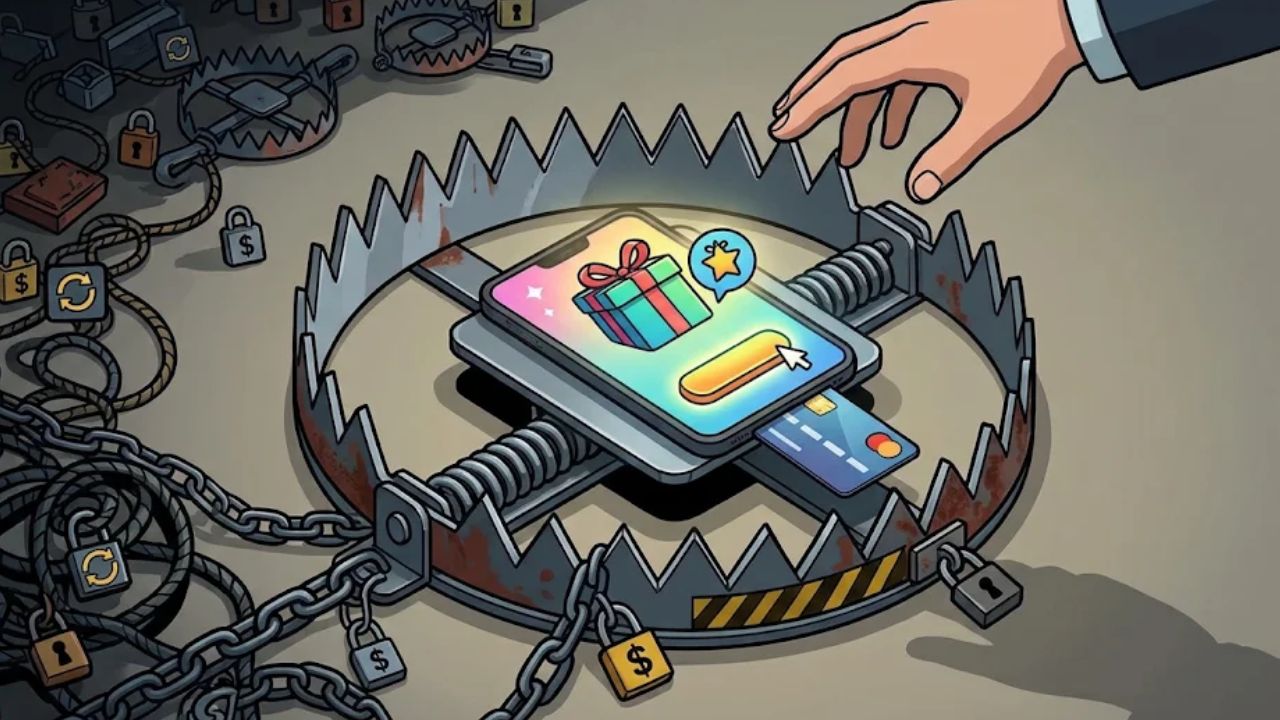
Maybe you lost a seed phrase once, or you quit crypto because one wrong click felt like it could cost you everything. Account abstraction tries to fix that. It turns your crypto wallet into a “smart account,” a wallet that follows rules you set instead of trusting one secret key.
With a smart account, trusted friends or devices can help you get back in if you lose access. You can approve many steps with one tap, and you can pay fees in digital dollars or let the app pay them for you.
But it doesn’t remove risk. It moves risk to new places. Below you’ll learn how it works, who uses it, and what to check before you switch.
What Is Account Abstraction?
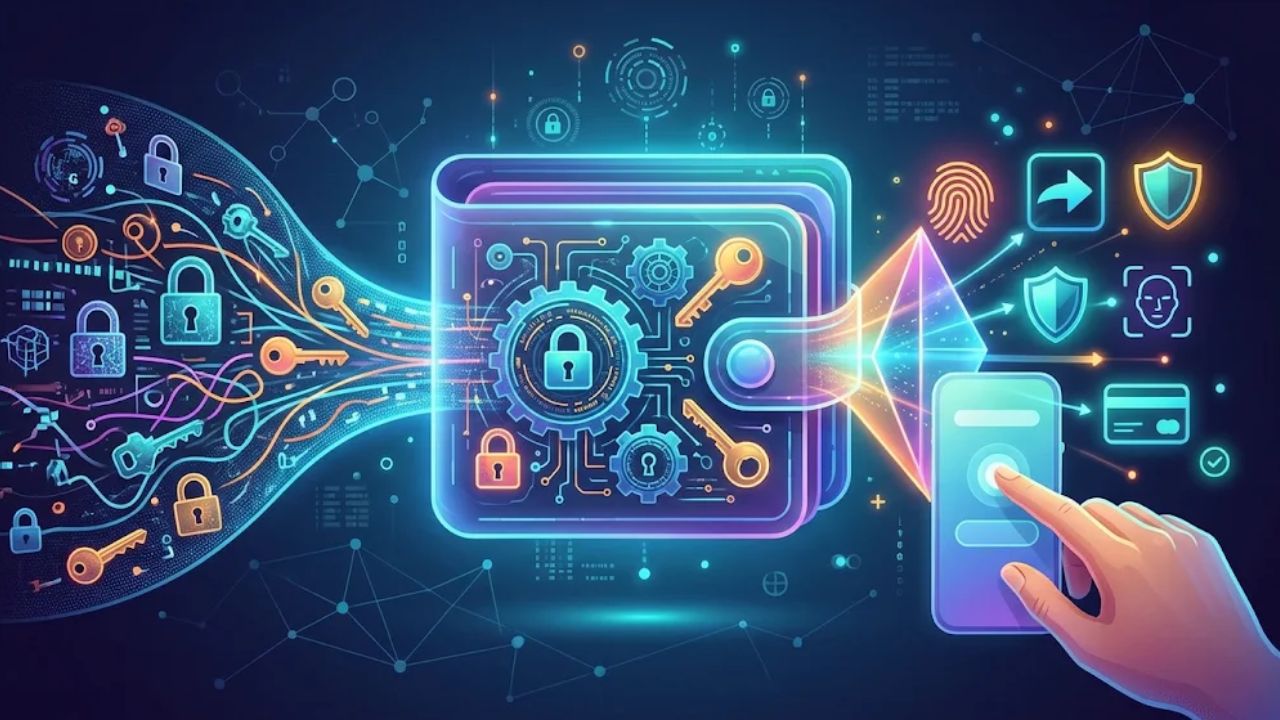
Account abstraction lets each account set its own rules for approving actions. Those rules run as smart contract code, and the network adds only a few basic limits. In simple terms, it lets your personal wallet work like a smart contract.
Ledger puts it this way: it turns every wallet into a Smart Account. Your wallet stops being just a lock and key. It becomes a small program that follows your rules.
The Problem With One Key
Most wallets today rely on a single private key for access and signing. If that key is lost or stolen, your funds are at risk. That key is usually backed up as a seed phrase, a list of words you must never lose or share.
This old type of account is called an Externally Owned Account, or EOA. Think of it as one key that opens one door. Whoever holds the key owns the door.
What Changes With a Smart Account
Account abstraction makes wallets programmable, flexible, and easier to use, so they don’t depend only on raw keys and signatures. The goal is to let you build more safety and a better experience into your own account.
So instead of “one key does everything,” you can choose rules like these: two devices must agree, a friend can help you recover, or a game can only spend a small amount.
A Short History in Plain Words
This isn’t a brand-new idea. The Ethereum Foundation first proposed the concept. Here’s how it grew over time:
- 2017: EIP-86 proposed letting contracts check and approve transactions.
- 2021: EIP-4337 laid out a framework for smart accounts.
- March 1, 2023: The EIP-4337 EntryPoint contract went live on Ethereum Mainnet.
- 2024: EIP-7702 proposed letting regular EOAs act like smart accounts.
- May 7, 2025: EIP-7702 went live in Ethereum’s Pectra upgrade.
How Does Account Abstraction Change Crypto Wallets?
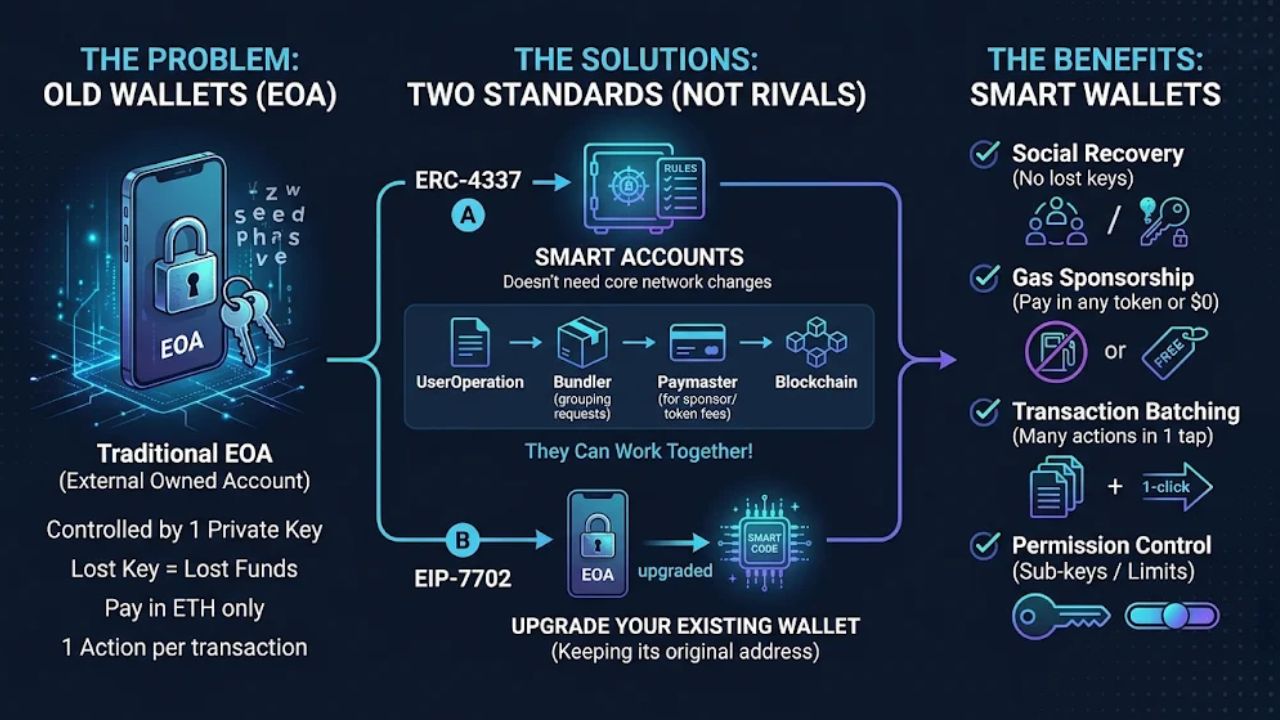
You’ll hear about two standards: ERC-4337 and EIP-7702. They aren’t rivals. ERC-4337 is the system that carries and processes smart account requests, while EIP-7702 lets the wallet you already have hand its work to smart contract code.
A wallet can use one, the other, or both together. For example, an upgraded EOA can still send its requests through ERC-4337 helpers.
ERC-4337: Smart Accounts Without Changing Ethereum’s Core
ERC-4337 works without any changes to Ethereum’s base layer, the part where the network agrees on what’s true. It keeps wallet actions separate from that layer. That’s why it could launch without a big network upgrade.
Instead of a normal transaction, your wallet creates a “UserOperation.” It’s a request that says what you want to do. These requests wait in their own line, called a dedicated mempool, before they get processed.
Wallets such as Argent, Ambire, Safe, and Braavos use account abstraction this way.
EIP-7702: Upgrading the Wallet You Already Have
EIP-7702 adds a new transaction type that lets an EOA set code in its own account. It went live on May 7, 2025, during the Pectra upgrade, and lets existing EOAs run smart contract code.
That matters because you keep your same address. You don’t have to move funds to a brand-new wallet. Your account points to a smart contract, called a “delegate,” and borrows its features.
That link doesn’t switch off by itself after one transaction. It stays in place until you change it or clear it.
EIP-7702 brings three big upgrades: batching many actions into one transaction, letting another account pay your fees, and handing out weaker “sub-keys” with limited permissions.
Regular Wallet vs Smart Wallet at a Glance
| Feature | Regular wallet (EOA) | Separate smart-contract account using ERC-4337 | Upgraded EOA (EIP-7702) |
| Who controls it | One private key | Rules written in code | Your key, plus a delegate contract |
| Lost key | Funds are at risk | Can be set up for recovery | Depends on the delegate you pick |
| Paying fees | ETH only | Tokens or a sponsor | A sponsor can pay |
| Many steps at once | One action per transaction | Yes, batching | Yes, batching |
| Keep your address | Yes | A separate account has its own new address | Yes |
| Network change needed | None | None | Yes, live since Pectra |
Keep in mind that these are what each setup can do. A given wallet may not turn on every feature.
What Happens When You Tap “Send”: An ERC-4337 Example
Here’s the journey of one tap in a wallet that uses ERC-4337. Other smart wallets may work a bit differently. Bundlers and paymasters sound technical, but they’re just helpers.
- Your wallet writes a request: It builds a UserOperation that lists what you want, such as “swap these tokens.”
- The request gets in line: It goes to a special waiting area for these requests, not the normal transaction line.
- A bundler picks it up: A bundler is a helper that collects many requests, packs them together, and sends them to the blockchain as one transaction. Think of a mail carrier who gathers letters into one bag.
- The EntryPoint checks the rules: The bundler’s transaction calls a special contract, the EntryPoint, using a function called handleOps. Your account’s own code then checks whether the request follows your rules.
- Someone settles the fee: The bundler pays the network fee in ETH up front. It then gets paid back, either from your account or by a paymaster.
- A paymaster may step in: A paymaster is a smart contract that can pay your gas fees for you. It can also let you pay in stablecoins or other tokens instead of ETH.
- It lands on the blockchain: The bundled transaction gets added to a block. Your swap is done.
You don’t see most of this. You see one button and one confirmation.
What Are the Key Benefits of Account Abstraction?
Smart wallets let you set your own safety rules, recover your account if you lose your keys, and share security across trusted devices or people. These are options a wallet can build, not features every smart wallet includes. Here’s what they look like in real life.
- Recovery without seed phrase panic: Account abstraction could remove the need for seed phrases. It does this by giving you more than one way to control your account, plus a recovery system. For example, say you lose your phone. Two of your three chosen “guardians,” such as a friend and a second device, could help you get back in.
- Multisig and custom approval rules: Smart accounts can use different signature types, multisig setups, and custom recovery. Multisig means more than one signer must approve. For example, a big transfer might need both your phone and your laptop.
- One tap for many steps: A smart wallet can batch many actions and sign them all at once. In DeFi, a swap often needs an “approve” step and then a “swap” step. Batching joins them into one.
- All or nothing. Batches can be atomic, meaning every step in one transaction succeeds or none does. You won’t end up stuck halfway through a trade.
- Pay fees in USDC, or not at all: You can pay network fees in a currency you choose instead of only ETH. Apps can also pay for you, which makes it easier for new users to get started.
- Session keys for apps and games: Session keys let you use an app under preset rules for a limited time. You approve several actions without signing each step. For example, a game might get a key that only works for one hour and only for game moves.
- Limits and safe lists: You can give out sub-keys with much weaker powers than full control of your account. Some wallets add spending limits or only allow sends to addresses you trust. That can box in an app’s key, but it won’t stop someone who holds your main key.
- Passkeys and hardware keys: Some smart wallets let you sign with a passkey, such as your fingerprint or face, instead of typing a long password. Passkeys are about how you log in, while session keys limit what an app can do. You can also pair a hardware wallet like Ledger so your Smart Account keys stay offline.
Does Account Abstraction Really Make Crypto Wallets Simpler?
To answer that, look at where new users give up today. Then look at whether smart accounts are actually catching on.
Why Wallets Lose New Users
Turnkey, a wallet company, shares some rough numbers. It reports that 38% of users dropped off while connecting a wallet, and 60% dropped off before funding it.
Turnkey also reports that 70% of users make just one transaction and leave. By its count, only 13% of new wallet users stay after one week. These are Turnkey’s figures, not a measure of every crypto user.
Each of those drop-off points lines up with a problem smart accounts target. A scary seed phrase at setup can be replaced by recovery options.
Needing ETH before you can do anything can be fixed by a paymaster. A pile of confusing pop-ups can become one batched tap.
How Widely Are Smart Accounts Used?
One snapshot comes from ethereum.org. It says the EntryPoint contract has helped create over 26 million smart wallets and 170 million UserOperations since March 2023.
A separate report from BlockEden.xyz, dated February 10, 2026, counts 40 million smart accounts across Ethereum and Layer 2 networks. Nearly 20 million of them were created in 2024 alone. Layer 2 networks handle transactions off Ethereum’s main layer, then report the results back to it.
The same report counts over 100 million UserOperations under ERC-4337. That’s a 12x jump from 8.3 million in 2023.
The two sources give different totals, so check each one’s date and what it covers before you compare them. Also, accounts aren’t people. One person can own many accounts.
Who Pays the Fees?
The BlockEden.xyz report says paymasters handled gas for 87% of the UserOperations it counted. That doesn’t mean 87% of users transacted for free.
Some paymasters sponsor fees, while others charge users in tokens such as USDC. Before you rely on it, check what token you’ll be charged, any limits on free sponsorship, and what happens when sponsorship ends.
The Honest Answer
Yes, it can be simpler for the person tapping the buttons. But the hard parts haven’t disappeared. They moved into code, helpers, and settings you choose once and then forget about.
That’s fine if the code is good and your settings are smart. It’s a problem if they’re not. Which brings us to risk.
What Are the Risks of Account Abstraction, and How Do You Stay Safe?
Smart accounts fix old problems, but they open new doors too. The 2025 Pectra upgrade made that very clear.
What Went Wrong After Pectra
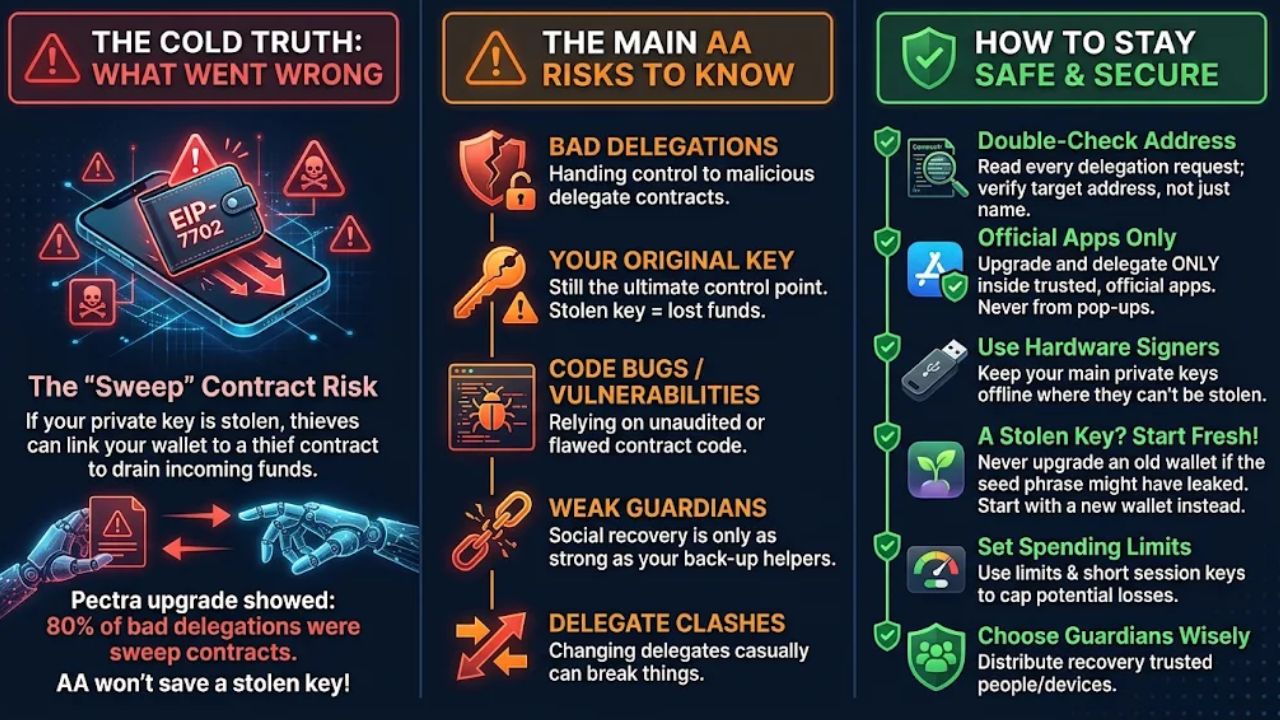
A June 1, 2025 report from The Block found that over 80% of EIP-7702 delegations pointed to harmful “sweep” contracts. These were built to drain wallets whose keys were already stolen. A single copy-pasted piece of code made up most of all EIP-7702 delegations.
Here’s how it works. A thief who already has your key points your wallet to a sweeper contract. From then on, anything that lands in your wallet can get pulled out right away.
Security researcher Taylor Monahan put it plainly: “It’s not actually a 7702 issue; it’s the same issue crypto has had since day one: end users struggle to secure their private keys.”
The Main Risks to Know
- Bad delegations: The EIP-7702 rules warn that a poorly built delegate can let an attacker take near-complete control of your account. Signing a delegation is like handing someone the keys to your house’s rulebook.
- Switching delegates: Changing your delegation is a security-critical step. One delegate’s stored data can clash with another’s. Don’t switch delegates casually or because a random site asks you to.
- Your key still matters: With EIP-7702, your original private key still controls your account. If it’s stolen, smart features won’t save you.
- Code bugs. A smart account is only as safe as its code. Pick wallets whose smart contract code has been audited by security reviewers.
- Weak guardians: Social recovery depends on who your guardians are. If you pick people who are easy to trick, or devices that are easy to lose, your backup plan gets weaker.
- Leaning on helpers: Bundlers and paymasters make things smooth. But if an app stops paying your fees, you may need to pay gas yourself again.
How to Stay Safe
- Read every delegation request: Security firm SlowMist advised: “Wallet service providers should quickly support EIP-7702 transactions and, when users sign delegations, should prominently display the target contract.” If your wallet doesn’t show you which contract you’re delegating to, don’t sign.
- Check the address, not the name: Compare the target address with your wallet provider’s official docs for that network. A friendly name or “verified” code on screen is not proof that it’s safe.
- Only delegate through your own wallet app: Upgrade inside the official app you already trust. Never do it from a link in a message, ad, or pop-up.
- Use a hardware signer: A hardware wallet keeps your Smart Account’s private keys offline. That guards against stolen keys, the root of the sweeper problem. It won’t make bad code safe, though, so you still need to check what you approve.
- Set limits: Use spending limits and short-lived session keys. Limits can restrict an app’s session key, but they may not protect you if your main key is stolen or you approve a malicious delegate.
- Pick guardians with care: Choose people and devices you trust, and make sure they’re not all in one place.
- If a key was ever exposed, start fresh: Don’t try to rescue an old wallet by upgrading it if its seed phrase may have leaked. Move your funds to a new, clean account instead.
Should You Switch to a Smart Wallet?
Account abstraction lets you program more safety and a better experience into your own account. You can set your own rules, recover access if you lose your keys, and share security across trusted devices or people.
But neither ERC-4337 nor EIP-7702 alone promises those features or makes a wallet safer. What matters is how a given wallet builds them.
A Quick Checklist Before You Switch
- Try a separate smart account if recovery and batching matter most to you and you’re fine moving your assets.
- Try an EIP-7702 upgrade if keeping your address matters, your own wallet app offers it, and you trust the delegate.
- Stay where you are for now if the wallet doesn’t yet support your networks, tokens, apps, or hardware signer.
Before you move money, confirm five things. Check how recovery is set up, which fee tokens are accepted and what they cost, and whether the delegate or add-on code was audited.
Then check that your hardware signer works with it. Finally, know how you’d get back in if the app or its helpers stopped working.
Our Take
If seed phrases and gas fees scared you off, a smart wallet is worth a look. Recovery, one-tap batches, and flexible fees target the exact places where new users give up.
If you already use a wallet like MetaMask or a Ledger, EIP-7702 means you may be able to upgrade without moving your funds. Just treat every delegation request as a big deal, because it is.
Keep one thing in mind. As Taylor Monahan said, the core problem is still that users struggle to secure their private keys. A smart wallet gives you better tools for that job, but you still have to use them.
Our advice: start small. Try a well-known smart wallet with a small amount, set up recovery and spending limits first, and keep your main keys on a hardware signer. Once it feels natural, you can decide how much to move over.
Frequently Asked Questions About Account Abstraction
1. What is account abstraction, in simple terms?
Account abstraction turns your crypto wallet into a programmable smart account that follows rules you define. Unlike a standard wallet that depends on a single private key, a smart account lets you add backup options, spending limits, and recovery tools.
2. How can account abstraction make crypto wallets easier to use?
It lets you pay gas fees with stablecoins like Tether instead of ETH, bundle multiple steps into one click, and recover a lost wallet through trusted contacts.
3. Can account abstraction help stop fraud?
Yes, smart accounts let you set daily spending limits and whitelist trusted addresses. If something suspicious happens, you can lock your wallet immediately to protect your DeFi (decentralized finance) funds.
4. Which blockchains support account abstraction today?
Ethereum supports it now, and the upcoming Glamsterdam upgrade is expected to deepen that native integration. Polkadot also offers smart account tools like proxies and multi-sig wallets on its Asset Hub. Its sister network Kusama typically tests these features first, making it a useful preview of what’s coming.
5. Can account abstraction make everyday payments easier?
Yes, Visa has already piloted automatic payment flows using smart contract wallets, meaning paying an online store with stablecoins could one day feel as easy as a Visa contactless tap.