
Chinese AI vs American AI is becoming a debate about the wrong finish line. A week ago, I asked which country would lead the next era. Today, the more urgent question is who will control the process by which better AI is built, distributed, and put to work. A model can lead a benchmark on Monday and face a stronger rival before the week ends. That does not make the progress meaningless. It makes permanent victory claims increasingly difficult to defend.
Google’s Argon, Carbon, and Hydrogen names can sound like successive chapters in a single march toward supremacy. Anthropic’s Fable 5.2 adds another headline. OpenAI’s GPT-6 Astra remains part of the conversation, alongside Chinese developers such as Alibaba, Moonshot AI, and DeepSeek. But these are not interchangeable products competing on one identical task.
My view is that American laboratories currently have the stronger frontier position in the selected measurements examined here. Within that group, Anthropic has the highest score in this comparison; Google has a compelling strategy for combining powerful models with faster execution; OpenAI remains a serious contender in turning models into working tools. None of that establishes permanent dominance, and none of it makes Chinese AI irrelevant.
My Working Hypothesis: Better Scores Do Not Automatically Mean Better Editorial Work
I wanted to test a practical hypothesis: the more useful writing assistant is not necessarily the one with the higher benchmark score. For my publishing work, evidence discipline, clear reasoning, and the amount of editing an answer needs matter too.
I submitted an editorial test file in the Claude and Gemini mobile apps and saved screenshots of the responses. The assignment asked for a 300–350-word opinion column using only a hypothetical evidence packet, followed by exactly four evidence-check bullets. The packet described anonymous Models A and B. Its 65 and 60 scores were fictional inputs for this exercise, not fresh measurements of Claude or Gemini. They must not be confused with the separately sourced benchmark table later in this article.
What These Screenshots Actually Establish
The model identities used for this comparison are Claude Fable 5.2 (High) and Gemini 4 Carbon (High), as confirmed by me, the author. These identities are author-reported; the supplied screenshots do not independently verify both selections. The observations concern the captured responses, not a controlled model benchmark.
There is another limitation. Claude’s response says the entire file—including the scoring rubric and review sheet—was attached. It also says memory and tools were enabled, although it claims not to have used them. That statement is part of the response, not an independently verified settings audit. The Gemini screenshot likewise shows the test file’s introductory material. These were exploratory app sessions, not a blinded or tightly controlled experiment. Matching “High” labels would not, by itself, establish equal compute or equivalent settings.
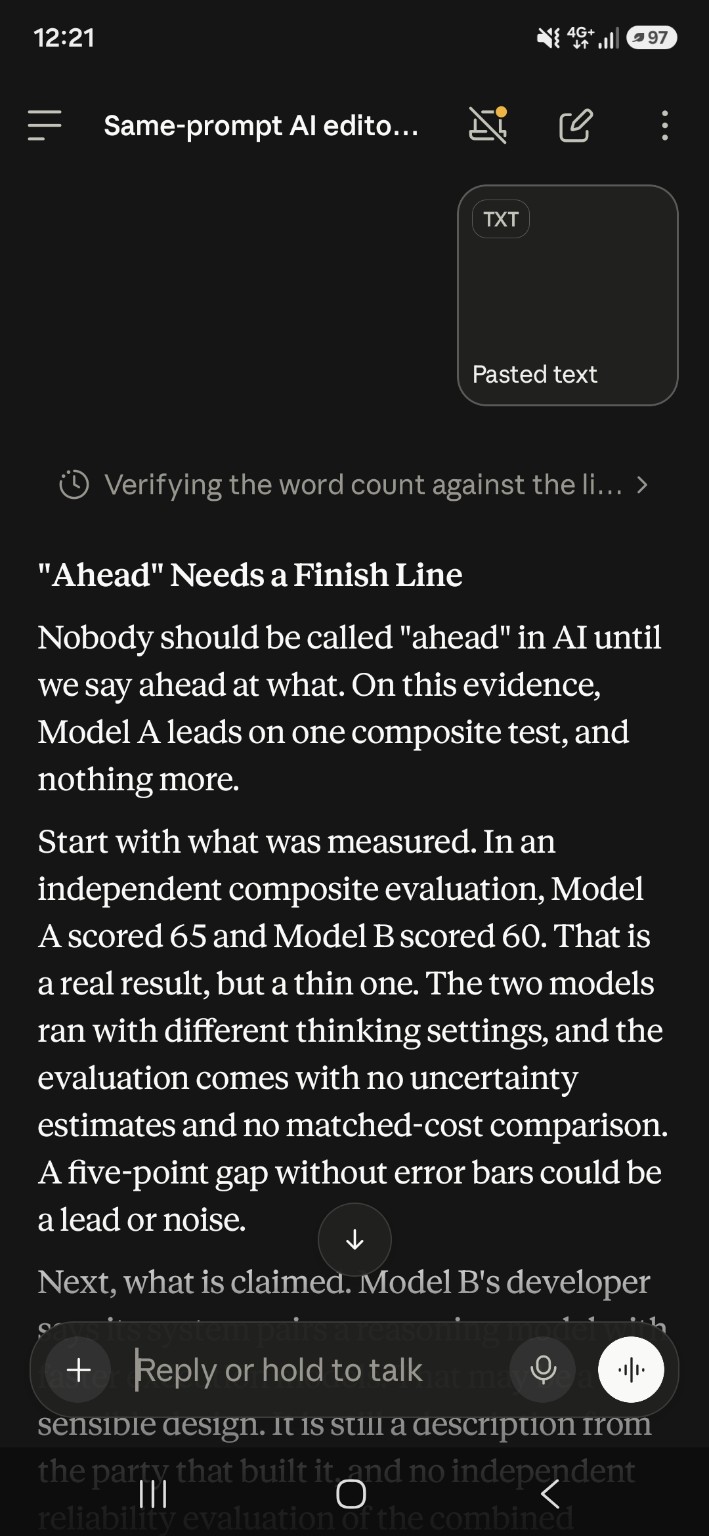
 Gemini 4 Carbon (High), identified by the author. Original mobile screenshot; model selection is not independently verified. Tap to enlarge.
The Differences I Would Notice at the Editing Desk
| What I examined | Claude Fable 5.2 (High) — author-reported | Gemini 4 Carbon (High) — author-reported |
|---|---|---|
| Opening and voice | A shorter headline, “”Ahead” Needs a Finish Line,” and a direct challenge to the meaning of leadership. | A longer, explanatory headline and an opening focused on task-specific, comparable conditions. |
| Organization | Explicit transitions separate what was measured, what was claimed, and the writer’s interpretation. | A more procedural explanation moves from evaluation limits to research controls and purchasing criteria. |
| Advice for a publisher | Count factual corrections and measure the total cost and editor time needed to reach publishable quality. | Log outputs and errors on standardized tasks, then assess turnaround and reliability at matched cost. |
| Self-improvement claims | Emphasizes that people define goals and control deployment. | Also distinguishes a bounded, human-directed tool from autonomous repeated self-improvement. |
| Evidence-check format | The screenshots show four bullets mapping claims to A, B, C, and D. | The screenshots show four bullets, with D and E combined in the final bullet. |
| Disclosure of test limitations | Adds an explicit warning about seeing the rubric and the session settings. | No comparable test-condition warning appears in the supplied response. |
For this particular assignment, I prefer the Claude sample’s more conversational editorial voice. Gemini’s sample offers useful procedural detail, although I would tighten it for an opinion page. That is my editorial judgment about these outputs, not evidence that one underlying model is generally more capable.
Neither answer is ready to publish unchanged. Claude calls the packet’s score “a real result”; Gemini introduces it as “results available today.” Both phrases risk turning a hypothetical scenario into apparent reporting when the text is separated from its prompt. I would explicitly label the scenario fictional. Claude also suggests the gap could be noise; without uncertainty estimates, that remains a possibility, not a statistical finding.
I have not assigned a numerical winner. Claude reports a 341-word body, but that is its own count; parts of the screenshots are covered by app controls. The record does not establish comparable response times, costs, repeated-run reliability, or independently checked compliance with every instruction.
View Claude’s disclosure about the test setup
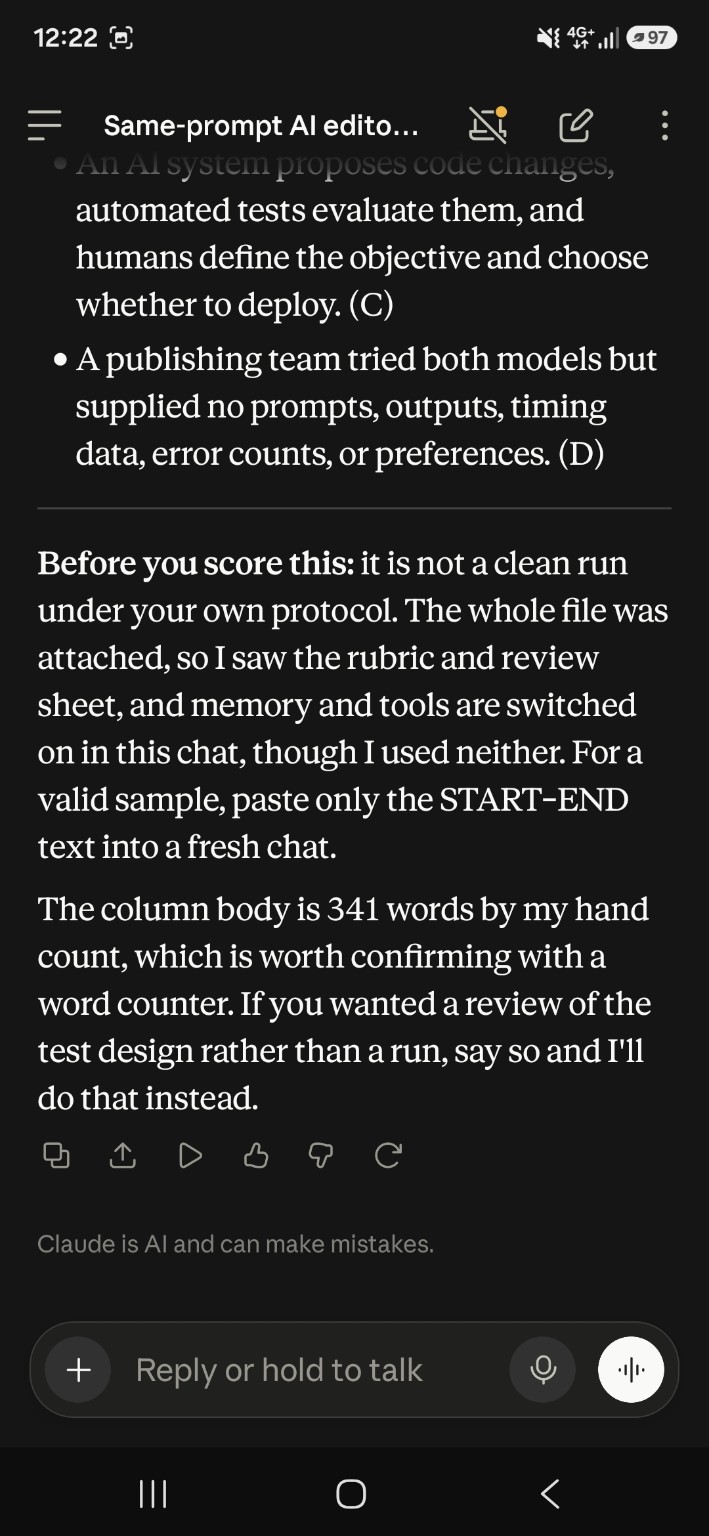
My hypothesis remains a useful question, not a proven result. This exercise shows why I want to inspect the answer and the conditions that produced it. A stronger follow-up would verify the selected models, submit only the prompt in fresh chats, record settings, retain complete outputs, and repeat the task before scoring the responses without model names.
Author-supplied conversation links: Claude thread and Gemini thread. The review above uses the nine supplied mobile screenshots; the shared pages could not be independently retrieved during preparation.
What Has Changed Since My First Chinese AI vs American AI Article?
In my first article in this series, I argued that leadership could be shared across research, deployment, and applications. The new releases strengthen that argument. They also force me to update the evidence rather than defend an old table because it appeared under my name.
The earlier article documented a six-assistant writing exercise conducted on November 6. Its narrow lesson was about editorial work: a fluent opening still needed judgment and verification. That exercise was not a test of the newly released Hydrogen or Fable 5.2, and I am not presenting it as one now.
As a publisher and the founder of ImagineLab.art, I care about the distance between an impressive answer and something useful enough to put in front of a customer or reader. That perspective shapes this editorial. The benchmark comparisons below come from published evaluations and provider disclosures. My exploratory app exercise above is a separate source of editorial observations, with its limitations disclosed.
Who Is Ahead Right Now? Give the Answer a Date
The following selected snapshot uses the Artificial Analysis Intelligence Index v5.0.1, checked on November 13, 2026. Scores are index points, not percentages. Thinking settings differ, and this is not a matched-cost comparison or the complete leaderboard.
| Developer | Exact model and setting | Index score |
|---|---|---|
| Anthropic | Claude Fable 5.2 — max | 65 |
| Gemini 4 Carbon — high | 60 | |
| OpenAI | GPT-6 Astra — max | 57 |
| Gemini 4 Hydrogen — xhigh | 54 | |
| Moonshot AI | Kimi K3.1 Pro | 46 |
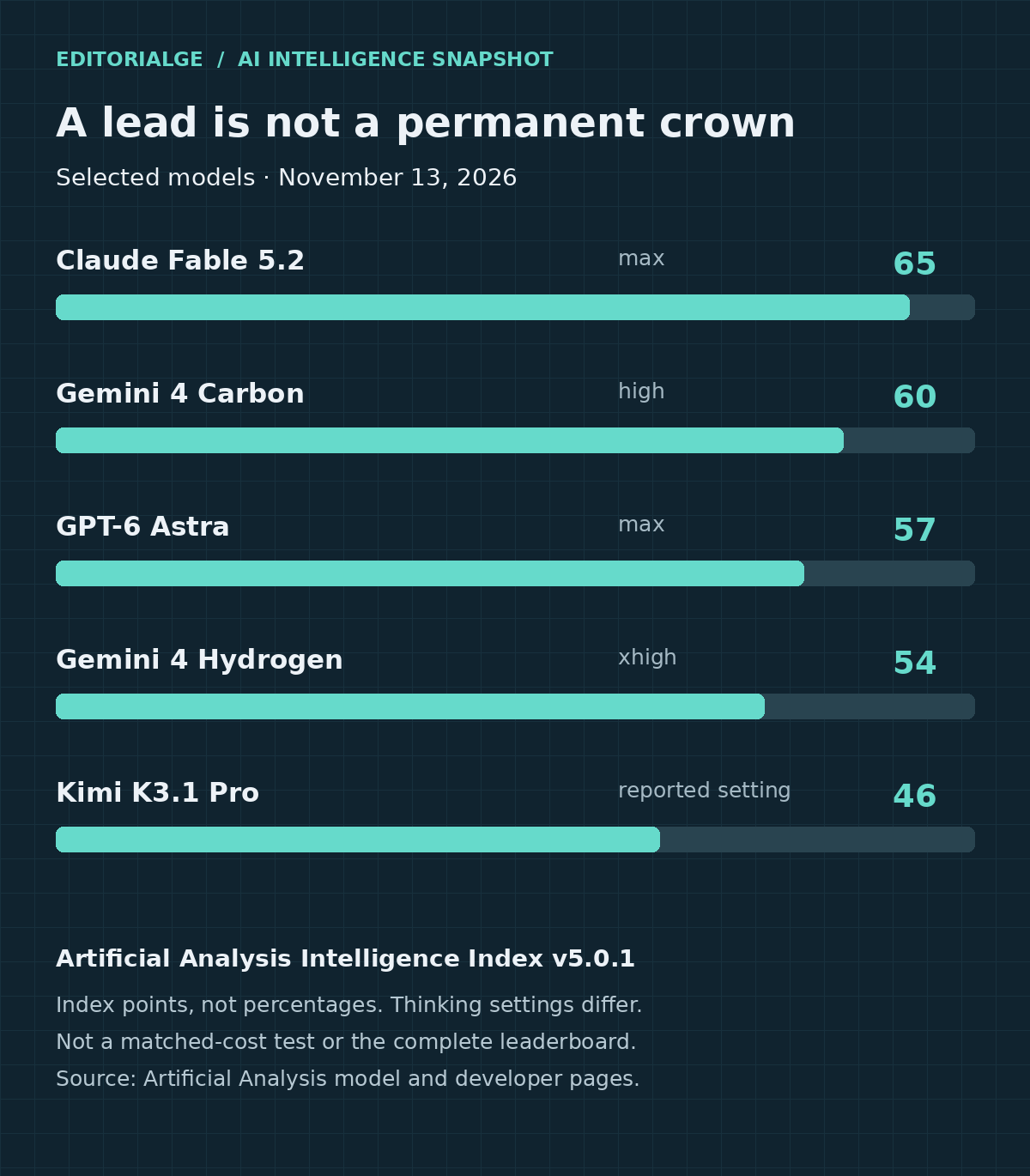
Source: Artificial Analysis’s model and developer pages. This table answers a specific evaluation question. It does not measure national capability, consumer market share, newsroom writing quality, or the best model for every business.
On this evidence, I would not call Google the unqualified winner. Fable 5.2 leads the selected comparison. Nor would I declare OpenAI finished because Astra sits below two competing entries. A composite score is useful evidence, but a business does not buy a composite score. It buys results under constraints.
Those constraints include latency, usage allowances, tool access, reliability, cost, data handling, and the time a human spends repairing mistakes. A model that wins a difficult reasoning test can be the wrong choice for thousands of routine requests. Conversely, saving money per token is not a saving if every answer creates expensive rework.
Google’s Interesting Move Is the Division of Labor
Google announced broader Carbon availability on November 10 and Hydrogen on November 12. Its product descriptions position Carbon for demanding reasoning and Hydrogen for faster execution. Google also describes an Orchestrator that switches models within a session, with Carbon coordinating and lighter models handling work where appropriate.
I find that more significant than the chemistry-inspired names. It treats intelligence as something to allocate. A difficult planning decision may deserve a more capable model; a bounded execution task may not. The question becomes whether the system knows when to escalate, when to check, and when to stop.
For a publishing operation, the analogy is familiar. Reporting, editing, fact-checking, design, and production are related jobs, but they are not the same job. Giving every stage to the most expensive resource is not automatically good management. Giving every stage to the cheapest one can be worse.
The danger is that adding agents can create an appearance of verification without genuine independence. If the planner and reviewer share the same mistaken assumption, a longer chain of approvals may simply repeat the error. More agents should mean clearer responsibilities and better checks, not merely more activity.
Is AI Now Creating the Next AI?
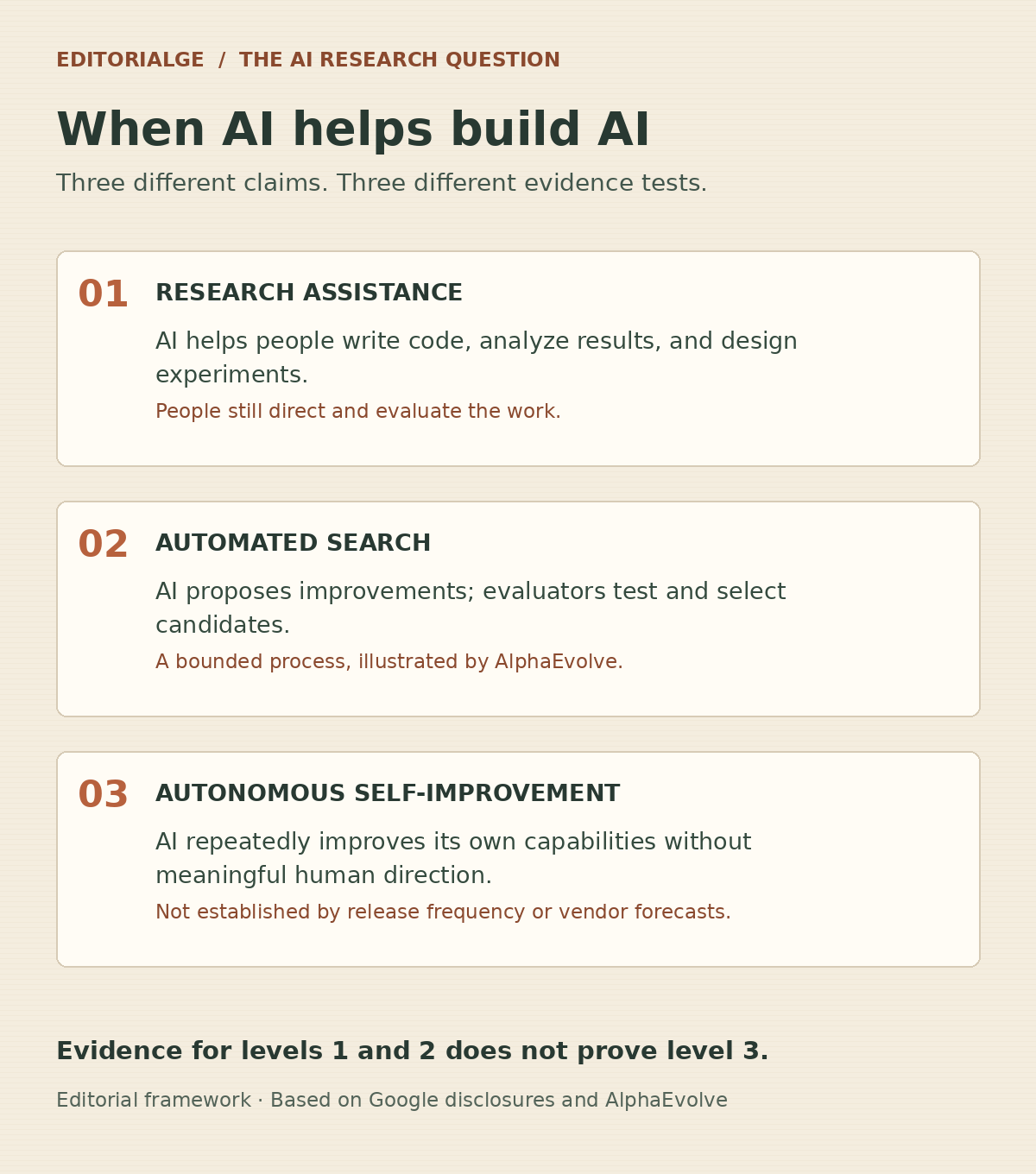
There is a real development behind the dramatic question. In Google’s third-quarter earnings remarks, Sundar Pichai said AI was helping increase training and launch velocity and anticipated further acceleration from recursive self-improvement. That is a consequential company claim. It is not public proof of an autonomous, unlimited intelligence explosion.
Google’s earlier AlphaEvolve work provides a more concrete example. DeepMind described a Gemini-powered system that proposes programs and uses automated evaluation to select improvements, including work relevant to computing infrastructure and model training. That is AI contributing to the machinery used to develop AI.
I distinguish three levels. First, AI assists people with research and engineering. Second, a system proposes and tests improvements within a defined evaluation process. Third, a system autonomously redesigns and improves its own capabilities across repeated cycles without meaningful human direction. Evidence for the first two does not automatically establish the third.
The phrase “AI giving birth to AI” hides this distinction. It suggests a single magical event where the actual process may involve code generation, experiment design, optimization, evaluation, human selection, and large amounts of infrastructure.
It would also be wrong to treat November’s releases as the beginning of all AI-assisted AI research. AlphaEvolve was announced in May 2025. The current question is how much more of the research process can now be accelerated, under what controls, and with what independently demonstrated results.
Why Faster Releases Do Not Prove an Intelligence Explosion
A company can release several models close together because they were developed in parallel, because access is being expanded in stages, or because different versions serve different price and performance needs. Announcement frequency alone cannot tell us how quickly underlying scientific capability is improving.
The stronger test would examine research productivity over time: successful experiments, validated discoveries, efficiency gains, and the extent to which AI contributions caused those improvements. It would also ask whether progress generalizes beyond the tests used to select it.
A system can become excellent at satisfying an evaluator while missing the real objective. That is why the quality of the test matters as much as the number of attempts. If AI makes experimentation cheaper, the demand for trustworthy evaluation increases rather than disappears.
Anthropic’s Lead Deserves Recognition, Not Mythology
Anthropic introduced Fable 5.2 and Mythos 5.2 on November 9. It says they share an underlying model but differ in safeguards and access arrangements. Its announcement describes improvements in technical tasks and efficiency. Those are provider claims that should be considered alongside independent evaluations.
The selected index gives Fable a strong result. I take that seriously. I do not turn it into proof that Claude will produce the best article, handle every spreadsheet correctly, or outperform every competitor at every budget.
Leadership can be meaningful and temporary at the same time. A serious comparison should give a company credit for what it has demonstrated while leaving room for the next result to change the conclusion.
OpenAI Is Competing on More Than One Model Name
GPT-6 Astra is a model; ChatGPT is a product environment. Confusing the two makes comparisons less useful. OpenAI’s Astra announcement emphasizes computer use, software engineering, and professional work, while its broader family includes other models for different operating needs.
For me, the product question is whether an assistant can move reliably from a request to a finished piece of work. Can it use the right files? Can it preserve formatting? Can it make a bounded change and show what happened? Can it distinguish completion from a task that is still blocked?
Those capabilities matter in publishing and business. They also make failures more consequential. A wrong sentence can be edited; an incorrect action in a connected application can affect records or other people. An assistant’s willingness to admit uncertainty is therefore part of its practical value.
China’s Opportunity Is Bigger Than Winning This Table
Kimi’s entry in this selected snapshot is below the leading American entries. That is a fair statement about this model and index. It is not a comprehensive evaluation of Chinese research, and it says nothing definitive about every Qwen or DeepSeek release.
Alibaba’s Qwen organization publishes downloadable model weights, including Qwen3.8 variants. That creates a different set of possibilities from a product available only through a hosted interface. Deployment rights and requirements still depend on the particular model and license; open weights are not the same as a fully open training process.
For organizations outside the United States and China, that flexibility can matter. A team may want to customize a model, choose its infrastructure, or reduce dependence on a single provider. None of those choices automatically produces lower costs or better privacy. They create options that must be evaluated.
I would therefore resist two easy stories: that China has already won because some models are accessible, or that China has lost because one selected frontier comparison favors US laboratories. Both confuse one part of the industry with the whole industry.
What This Means for a Founder in Bangladesh
I do not want my businesses to become spectators cheering for one laboratory. I want us to become better at choosing, checking, and changing tools.
That means keeping important work portable, recording which model produced a result, and checking performance on assignments that resemble our own. It means considering the cost of review alongside the subscription or API bill. It also means resisting the temptation to migrate an entire workflow every time a new name trends.
Our earlier writing exercise offered a modest reminder: one prompt could show how assistants approached an assignment, but it could not establish a universal champion. A useful next evaluation would repeat real tasks, record failures, and assess the final reviewed output. The exploratory app exercise reported above is a starting point, not evidence that a new launch has passed a comprehensive newsroom evaluation.
Readers deserve the same discipline. If an AI-generated claim cannot be traced to evidence, fluency does not rescue it. That principle should survive every model upgrade.
My Verdict: The Lead Is Real; the Crown Is Not Permanent
My current judgment is that the American frontier remains strong, Anthropic leads this selected intelligence comparison, and Google’s combination of reasoning, execution, and distribution deserves particular attention. OpenAI remains a substantial competitor in models and working environments. Chinese developers remain important challengers whose influence cannot be reduced to one score.
The next phase of Chinese AI vs American AI will be shaped by how efficiently research becomes useful systems—and how much of that research AI itself can help perform. Google’s disclosures make accelerated AI development a serious subject. They do not justify declaring that autonomous self-improvement has already settled the future.
As a founder and CEO, I want progress that leaves people with more capability and more choice. If the models become stronger while our judgment becomes weaker, we have misunderstood the opportunity. The winner I care about is the reader, creator, or small business that can do better work without surrendering the ability to question the machine.
Reporting note: This is the second op-ed in the series, based on public disclosures and evaluations checked November 13, 2026. It references the previously published November 6 writing exercise and now includes a separate exploratory app exercise based on nine author-supplied mobile screenshots. The author identifies the models as Claude Fable 5.2 (High) and Gemini 4 Carbon (High); these identities are author-reported rather than independently verified from the screenshots. This is an exploratory writing exercise, not a controlled benchmark. The exercise uses fictional packet scores, separate from the sourced index table.