
Start with the letters your child is learning at school, then give those letters something to do: hide them around the room, match them to groceries or spot them on a familiar shop sign. Arabic letter games for bilingual families in UAE work best as small, manageable activities that fit the language a child already understands. There is no need to buy a new app or turn the evening into another lesson.
A child who speaks Arabic with grandparents may need practice recognizing printed words. A child who mainly speaks English at home may first need to learn what those words mean. Giving both children the same alphabet worksheet misses that difference.
The ten games below cover those different starting points. Some need only a few handwritten cards. Others use a school reader, grocery packaging or a pretend shop. Each has a particular purpose, so families can choose one useful activity instead of working through a list from top to bottom.
What Makes These Games Relevant to UAE Families?
The UAE Ministry of Education’s Kindergarten Parent Guide recommends pointing out Arabic in books, signs and packaging, using the language during ordinary routines, and playing memory or letter-hunt games. That gives parents a practical starting point: use the Arabic already present in the child’s surroundings.
It does not mean every school uses the same teaching sequence. Before making cards, ask for the current letters, a few familiar words and a pronunciation model from the class. A family in Dubai, Abu Dhabi or Sharjah can use the same game while changing the vocabulary to match its own school materials.
This is a research-led selection of home activities, not a review of ten commercial products. Selection favored distinct letter skills, simple materials, room for adult support and examples that can carry over into daily life in the UAE. The games have not been tested by Editorialge, and the sources do not establish a measured learning benefit for each activity.
No specialist purchase is necessary if the household already has paper, crayons and suitable books. Choose by readiness rather than a rigid age label: a child who is new to Arabic needs a different starting point from a confident speaker meeting the written script.
Arabic Letter Games for Bilingual Families in UAE: Which One Fits?
| Game | Choose it for | What to use |
|---|---|---|
| Letter Treasure Hunt | Matching a letter to the same shape | Duplicate paper cards |
| Dot Detective | Telling similar letters apart | Clear models of ب, ت and ث |
| Arabic Letter Bingo | Recognizing a letter when named | A small homemade grid |
| Picture-and-Letter Match | Connecting a known word to its first sound | Familiar pictures |
| Mystery Letter Bag | Practicing object names before matching letters | A bag and safe objects |
| Build-a-Letter Workshop | Examining the shape without demanding neat handwriting | Dough or thick crayons |
| Letter-Form Families | Finding a familiar letter inside a word | Accurately printed word cards |
| Mini Souq Letter Shop | Using known words during pretend shopping | Pictures or play groceries |
| Arabic Sign Explorer | Recognizing letters outside learning materials | Packaging, books or clear signs |
| Family Letter Story | Returning to words through a child’s own story | Paper and drawings |
1. Letter Treasure Hunt: Give Beginners a Clear Match
For a child who is meeting Arabic letters for the first time, finding an identical shape is a manageable task. Asking for its name, sound and an example word all at once may make the same activity unnecessarily difficult.
Make two copies of three familiar letters. Leave one set on a table and hide the other set in easy-to-reach places. Show a card, then ask the child to bring back its partner. A card beside the school bag or on a low bookshelf is enough; elaborate clues add preparation without adding much letter practice.
When the cards are together, name the letter and look at it briefly. Where are the dots? Which way does the shape open? Keep the reference visible for as long as it helps. Once matching is comfortable, let the child hide the cards and send an adult searching.
Use the same writing style in both sets initially. A child should not have to solve a font difference before understanding the matching game. Save different printed styles for a later round.
2. Dot Detective: Slow Down at the Details That Matter
A missing dot is not a decorative mistake in Arabic. It can change the letter. With ب, ت and ث, the shared basic shape makes the dots particularly useful to examine: one below, two above or three above.
Place clear models beside one another and let the child describe the difference in whichever language is easiest. Then offer a second set to sort into matching groups. After that, draw the shared shape and invite the child to add the dots needed to match a chosen card.
There is a reason to give these details their own game. A 2020 study by Rana Yassin, David L. Share and Yasmin Shalhoub-Awwad examined spelling by 96 Arabic-speaking pupils in grades one, two and four. It identified letter formation and joining among the difficulties involved in learning the script. The study concerns spelling, not this home game, but it helps explain why recognizing the broad outline is only part of the task.
If three letters are too much, compare two. Keep the cards upright rather than introducing mirrored or rotated versions. The point is to notice the correct distinctions, not to catch the child out.
3. Arabic Letter Bingo: Keep Siblings in the Same Game
Bingo is a useful choice when siblings want to play together but know different amounts of Arabic. One board can contain four letters, another six. Both children can take part without the younger one being expected to keep up with a larger alphabet.
Draw a small grid and write a familiar letter in each square. Call a letter name and let the players mark it with a crayon. For a beginner, hold up the matching card too. Let a more confident child become the caller, using the same school pronunciation model.
Decide what the round is practicing before it starts. Calling a letter name asks for one kind of recognition; saying a word and asking for its first sound asks for another. Both versions are possible, but switching between them without explanation can make a correct response seem wrong.
There is no need for a timer. If one child searches slowly, give that child time to examine the whole board instead of turning recognition into a race.
4. Picture-and-Letter Match: Check the Word Before the Letter
A picture of a door looks straightforward until a child names it in English and looks for D. In Arabic, باب begins with ب. The picture has stayed the same; the spoken word has changed.
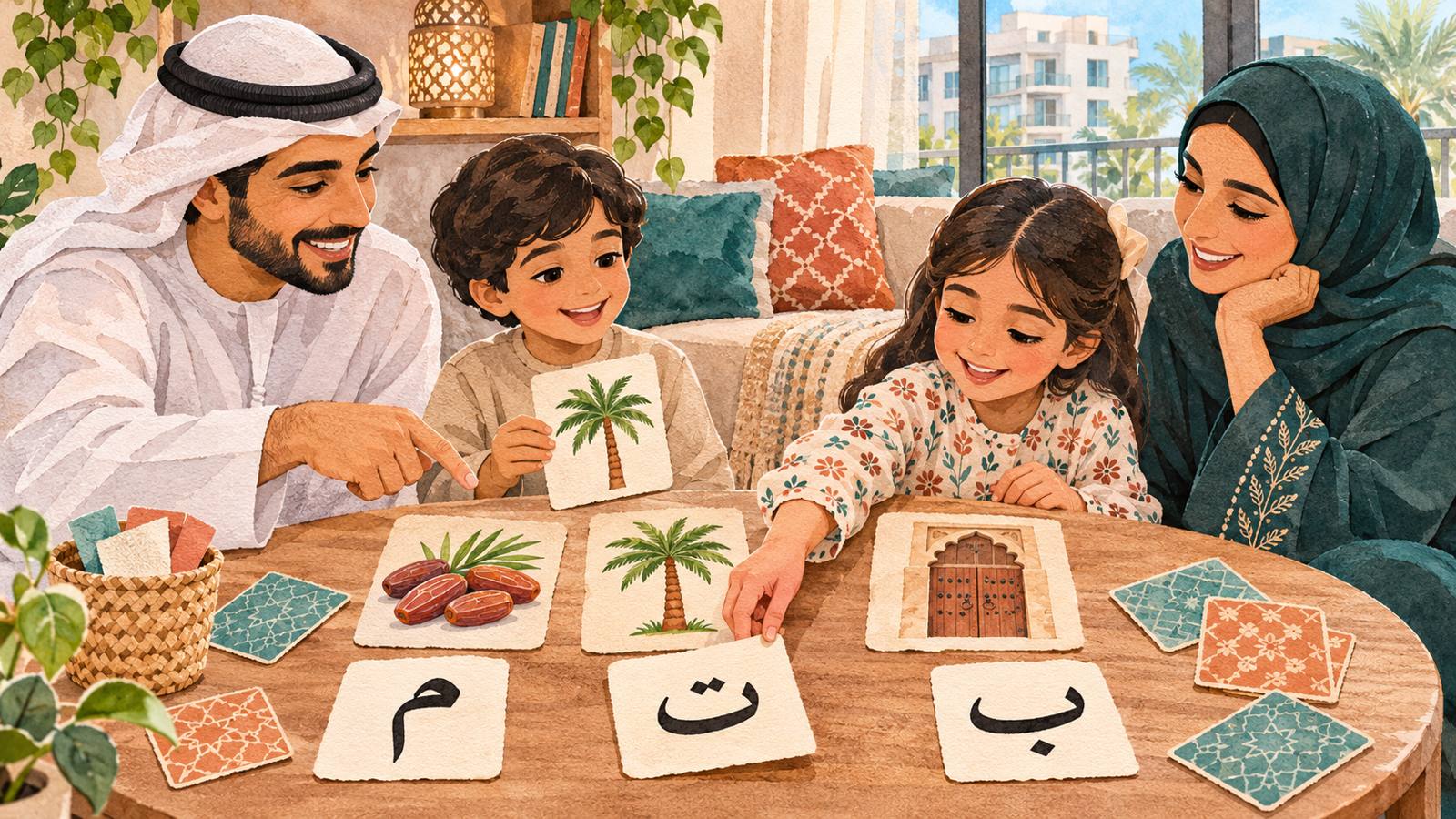
Begin with three pictures whose Arabic names are already familiar. For example, باب means door, تمر means dates and موز means bananas. Say each word before asking the child to match its initial letter: ب, ت or م.
If the vocabulary is new, spend the first round naming and discussing the pictures. Add the letter cards afterward. Otherwise, a missed match tells very little: the child might recognize the letter perfectly well but not know the Arabic name of the object.
This is an easy activity to connect with the kitchen table. A picture of dates can sit beside the family’s dates container; bananas can supply the next example. Use the Arabic word throughout the matching step, even when the explanation of the rules is in English.
5. Mystery Letter Bag: Let Objects Start the Conversation
The mystery bag suits children who would rather handle something than work through a page. Put a few familiar, safe objects inside a cloth bag, or use large picture cards when suitable objects are unavailable. Leave out small, sharp or breakable items.
The child takes out one item, names it with an adult and chooses its initial letter from two or three cards. If the Arabic name is unfamiliar, supply it and keep talking. A bag that produces a new word can still be enjoyable without becoming a test of that word immediately.
For a child who dislikes reaching into a bag, cover the objects with a cloth and uncover them one at a time. A sibling can choose the next item or hold the letter cards.
Notice whether the difficulty lies in remembering the word or recognizing the letter. That observation is more useful for planning tomorrow’s activity than counting how many answers were right.
6. Build-a-Letter Workshop: Look Closely Without a Handwriting Test
Rolling dough into a letter gives a child time to examine its shape without also having to control a pencil. Thick crayons or paper strips offer alternatives for children who dislike dough.
Keep a clear model beside the work area. Choose one familiar letter, make its main shape and add the dots. Compare the finished version with the card: does it face the same way, and are the dots in the right place? A recognizable attempt is enough to discuss.
Then find that letter somewhere else, perhaps on a bingo card or in the child’s book. This links the construction activity back to print.
Dough is useful for studying appearance; it does not teach the pen movements needed for handwriting by itself. When the child is ready to write, use the formation example provided by the teacher rather than assuming that the order used to assemble the dough is the correct writing sequence.
7. Letter-Form Families: Move Beyond Alphabet Cards
A child may know ب on a flashcard and still hesitate when it appears inside a word. Arabic letters change appearance according to their position and connections, so success with isolated cards does not settle the whole reading task.
Use a few intact words from a checked school resource. Place the isolated target letter beside the words, then search together for its different appearances. Point to the relevant part without cutting the word into separate alphabet shapes.
Start with one word the child understands. Compare another example once the first is familiar. Ask what stayed recognizable and what changed. There is no need to present a complete positional chart in the first session.
This is the activity where preparation matters most. Typing isolated letters with spaces between them and pushing the cards together will not reliably show how a word is written. Printed connected examples spare parents that problem, particularly when they are learning Arabic alongside their child.
8. Mini Souq Letter Shop: Put Familiar Vocabulary to Work
A pretend shop gives children a reason to use words they have already practiced. Set out pictures or play groceries in a few baskets, then use a letter card as the shopping clue.
A ت card can lead to تمر; a م card can lead to موز. The shopper chooses the item, names it and hands it to the shopkeeper. Then swap roles. An adult can deliberately pause and ask for help, allowing the child to explain rather than only answer.
Keep a picture-and-word reference beside the baskets. Add a greeting or request already used in class, but do not make a full Arabic sentence the price of taking a turn. The letter game should remain accessible while spoken vocabulary grows.
Base the shop on the family’s actual groceries, whether they come from a neighborhood store, supermarket or souq. Familiar purchases make the local connection useful. There is little value in choosing unfamiliar objects simply because they look more traditionally Emirati.
9. Arabic Sign Explorer: Find the Same Letter Somewhere New
This activity takes the letter off the homemade card. Choose one familiar character and look for it in clear print on a book cover, grocery package or sign the family passes regularly.
Packaging at home is often the easiest place to start because the child can take as long as needed. Keep a reference card beside it. If the letter looks different in the word, compare the two rather than insisting that the child should already recognize it.
For an outing, choose a moment when everyone is safely stationary. Parents can handle any photographs for a later look at home. Avoid turning the game into a search near traffic or asking children to approach unfamiliar people.
A shop logo with elaborate lettering may be interesting, but it is a poor first example. Clear ordinary print is easier to compare. Recognizing one letter is the achievement here; it does not mean the child can read the whole sign.
10. Family Letter Story: Make Something Worth Reading Again
For a child who likes drawing, a homemade story offers a quieter finish. Choose a familiar letter and two known Arabic words that contain it. Draw a few pictures and let the child decide what happens.
The story itself can be told in the family’s strongest language. Use the Arabic words where they belong, then write them accurately beside the drawings. A beginner can point to the target letter; a more confident child can help label a picture.
Avoid forcing every sentence to contain the chosen sound. A small story that makes sense is easier to revisit than a collection of unrelated words assembled to satisfy the letter exercise.
Keep the pages together. On another day, ask the child to retell the story, find a word or choose a new ending. The drawing supplies a familiar reason to return to the print, without needing another set of purchased materials.
When Arabic at School Is Different From the Language at Home
Use the school’s Modern Standard Arabic examples for the written cards. If a family uses a different spoken Arabic word at home, explain that difference plainly. A child should not come away believing that the language used by a parent or grandparent is simply wrong.
The same applies to families whose home language is not Arabic. WIDA’s guidance on multilingual children and their families encourages the continued use of home languages. Its guidance is not UAE-specific, but the principle is relevant here: parents can support Arabic practice without abandoning the language in which family conversation is richest.
A parent who is not confident in Arabic can still organize the cards, take turns and help a child compare shapes. Ask the teacher for a short audio example for the chosen words. Transliteration may help an adult remember a prompt, but it should not replace the Arabic print or become the only pronunciation model.
If a child gives the English name of an object, acknowledge it and offer the Arabic word. For that turn, decide whether the aim is learning the word or matching the letter. Requiring both at once can obscure what the child already understands.
A Short Routine That Does Not Take Over the Evening
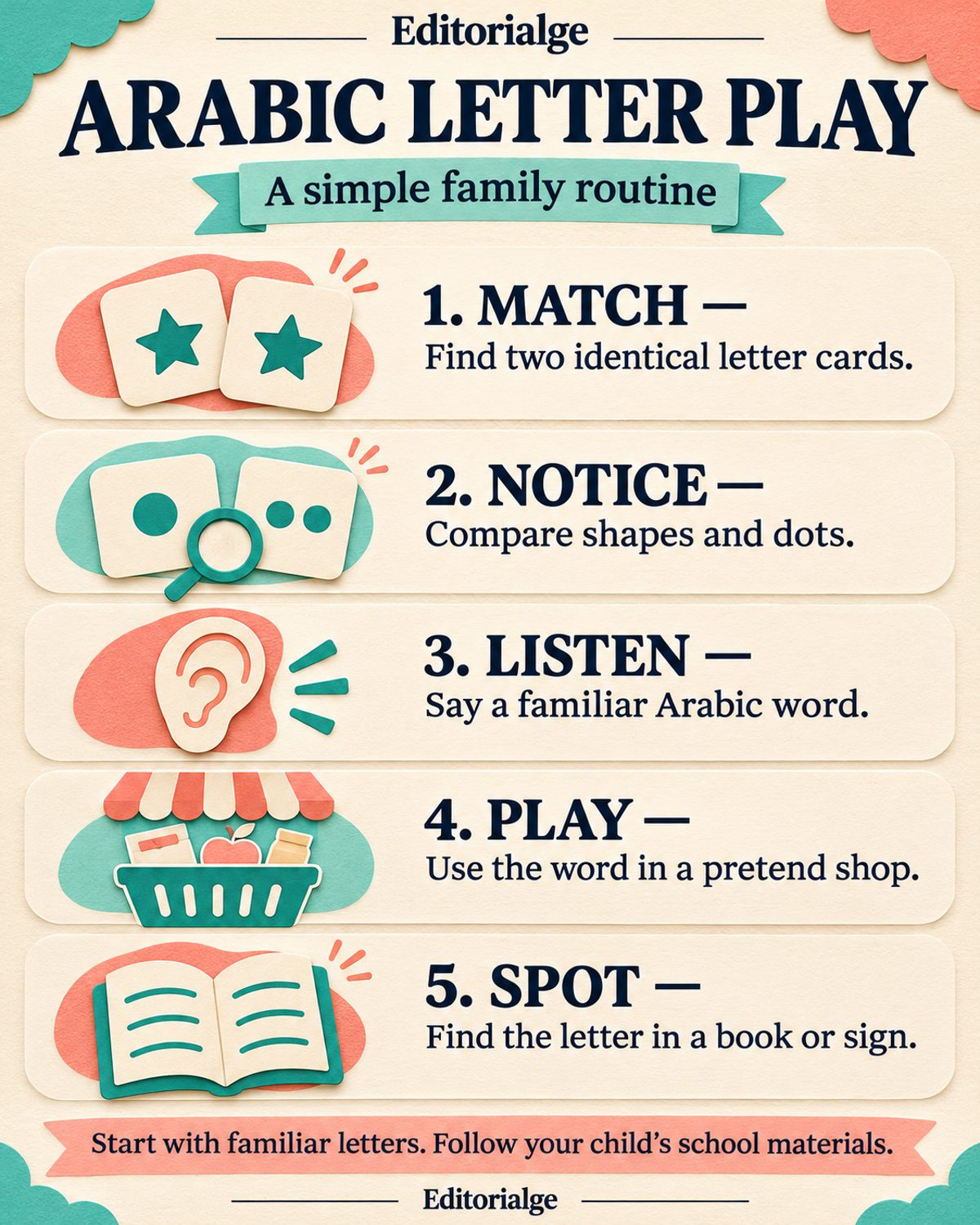
Choose a small set of letters from the current school work and reuse it. On one day, hide the cards. Another day, bring out the matching pictures. Later, look for one of those letters on packaging. These are suggested ways to vary practice, not a prescribed sequence or a promise of progress within a week.
Keep a note only when it helps: “recognized the shape without the model,” “needed the Arabic word first” or “found the letter in a new word.” Those observations give a teacher something more specific to respond to than a general report that Arabic is difficult.
An app can supply an audio example or a short matching activity, but check what the child is actually being asked to do. Editorialge’s guide to making screen time educational explains how to connect an on-screen task with practice afterward. Families comparing ways to support another language can also read our Mandarin vocabulary games guide; the resources differ, so its product choices should not be treated as Arabic recommendations.
Start With the Difficulty You Can Actually See
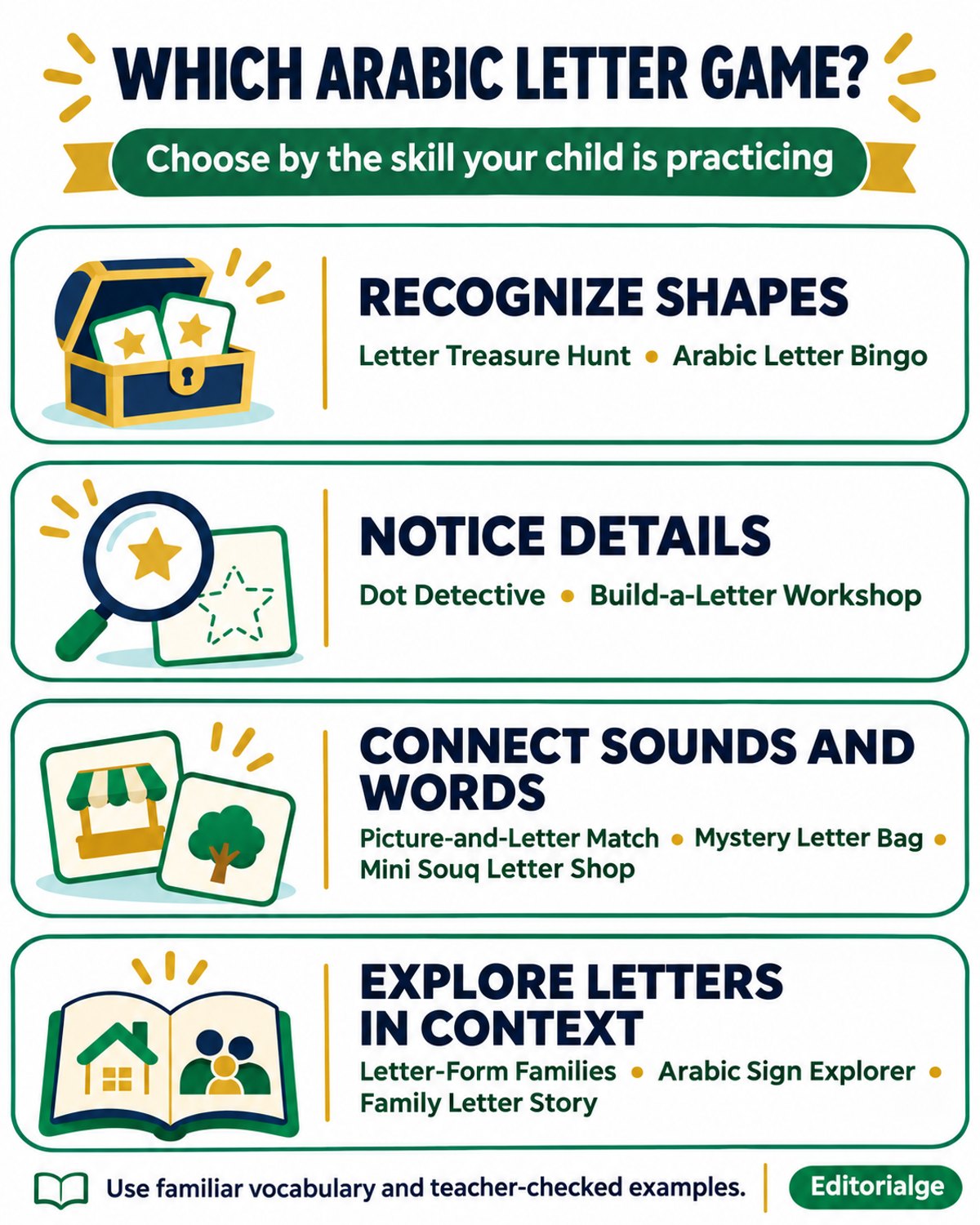
When choosing Arabic letter games for bilingual families in UAE, begin with a specific observation. If the shapes are unfamiliar, try the treasure hunt. If dots cause confusion, bring out Dot Detective. If cards are easy but words are not, use Letter-Form Families.
One useful game, a reliable example and an adult willing to listen are enough for a first session. Stop while the activity is still welcome, keep the cards and return to them another day.