
Singapore startup communities can offer founders something a directory of contacts cannot: a place to test an idea, ask a difficult question and meet people who understand the next decision. The right community depends on what you are building. A researcher looking for a commercialization partner, a maritime founder seeking a pilot and a first-time entrepreneur still shaping a business model will need different kinds of support.
These 12 Singapore startup communities and founder programmes include incubation networks, university communities, specialist ecosystems and peer events. Some accept applications from a broad range of founders. Others have specific affiliation, sector or stage requirements. Start with the problem you need to solve, then check the latest intake and terms before committing time or money.
How we selected the communities
We reviewed organizer and institution pages on November 11, 2026, looking for a Singapore connection and an identifiable opportunity for founders to learn, find peers, receive mentorship or work with partners. The list includes communities with recurring programming and selective venture-building programmes that connect accepted founders to a network. It is organized by fit, not a ranking.
This is desk research, not a review based on membership or participation. Fees, equity requirements, funding decisions, dates and eligibility can change. A programme’s past cohort is evidence of the kind of work it has offered, not proof that applications are open now. The Enterprise Singapore overview of Startup SG is a useful starting point for public support and mentor-partner pathways (Enterprise Singapore, n.d.).
| Community or programme | Useful starting point | Check before applying |
|---|---|---|
| B71 Singapore | Incubation and founder network | Current track and access |
| ACE.SG | Mentorship and startup association | Membership and cohort terms |
| SGInnovate | Deep-tech people and events | Match to technical needs |
| Antler Singapore | Venture-building residency | Selection, equity and costs |
| SMU BIG | University incubation | Affiliation eligibility |
| National GRIP | Research commercialization | Founder and IP requirements |
| PIER71 | Maritime customer discovery | Challenge timing and fit |
| Tangent | Early idea-building cohort | Age, attendance and dates |
| Founder Institute | Structured early-stage development | Current fees and programme terms |
| Startup Grind Singapore | Founder talks and peer events | Event format and registration |
| raiSE | Social-enterprise support | Registration and impact criteria |
| Quest Ventures | Startup Singapore Quest mentoring | Mentor availability and application |
12 Singapore startup communities to explore
1. B71 Singapore
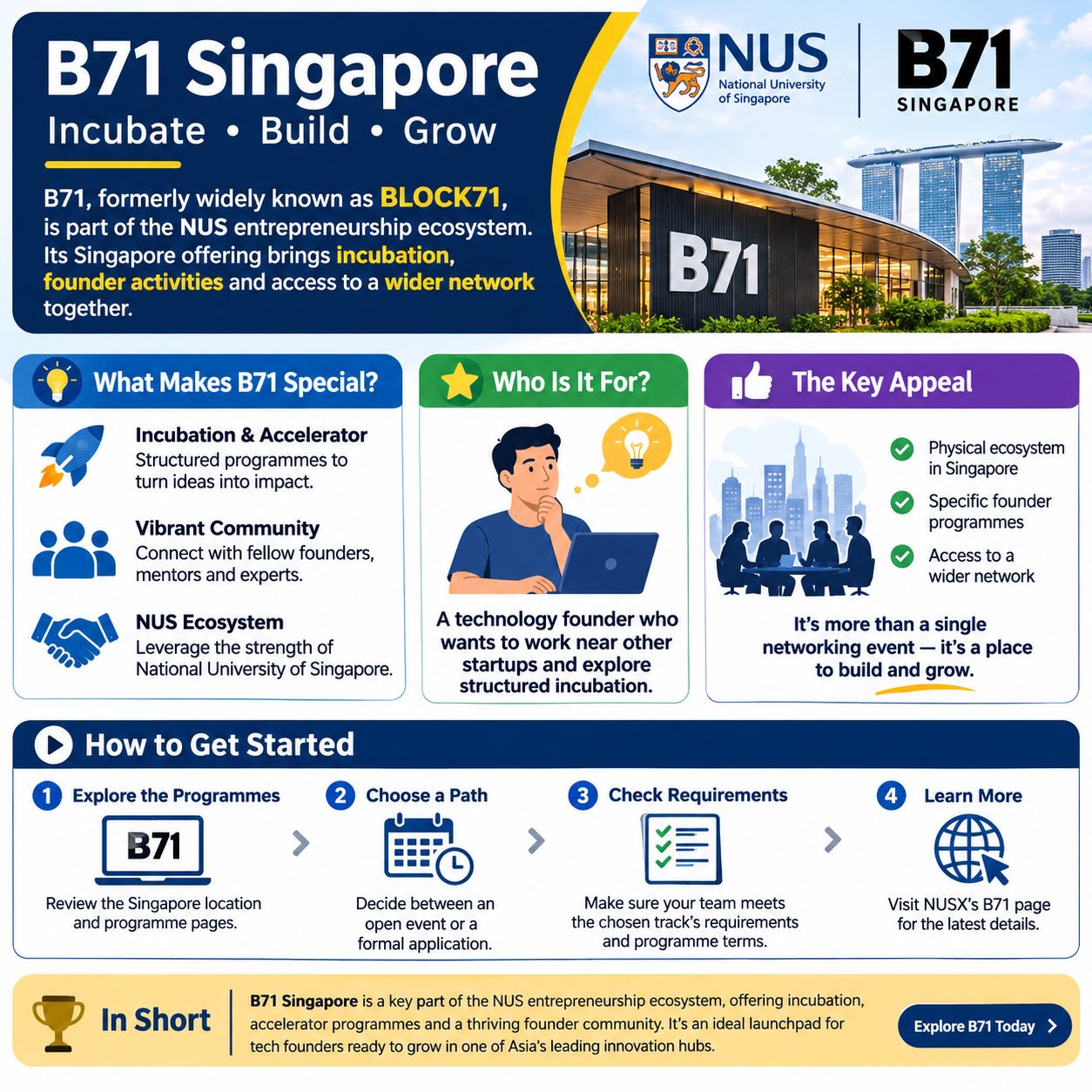
B71, formerly widely known as BLOCK71, is part of the NUS entrepreneurship ecosystem. Its Singapore offering brings incubation, founder activities and access to a wider network together. The B71 Singapore page distinguishes incubation and accelerator routes from other community activity (NUSX, n.d.).
Best for a technology founder who wants to work near other startups and explore structured incubation. The appeal is the combination of a physical ecosystem and specific founder programmes, rather than a single networking event.
How to start is to review the Singapore location and programme pages, then choose between an open event and a formal application. NUSX’s B71 page describes current pathways. Check whether your team meets the chosen track’s requirements and what workspace or programme terms apply.
2. Action Community for Entrepreneurship (ACE.SG)
ACE.SG connects Singapore’s startup ecosystem through membership, events and founder-development activities. Its academy describes an incubation programme for early-stage founders that addresses idea validation, business models and investor readiness. Its Meet The Mentor events connect startups with experienced founders and experts (ACE.SG, n.d., 2026).
Why founders might choose it is access to a broad local ecosystem while working on a specific business challenge. A founder preparing for customer discovery could begin with an academy session, then look for a mentor with relevant operating experience.
Review the current membership criteria and event registration process. Mentoring availability and admission to a cohort are separate decisions. Before applying, write down the question you need help answering and check whether the programme supports your stage and sector.
3. SGInnovate and Deep Tech Central
SGInnovate works across Singapore’s deep-tech ecosystem. Its Deep Tech Central platform is designed to connect companies, talent and technical communities, while its event programme brings founders, researchers and practitioners together (SGInnovate, n.d.).
Best for founders whose commercial problem depends on a substantial technical or scientific advance. A team developing a research-backed product may find value in conversations about specialist hiring, partnerships and the move from research to operations.
Start by identifying an event or resource relevant to your field, then ask about the specific support your company needs. Talent programmes have their own participant and employer conditions. Joining an event does not automatically provide investment, a laboratory or an employee placement.
4. Antler Singapore
Antler’s Singapore residency brings selected founders into a venture-building environment, with a network of founders and operators and the possibility of investment after its evaluation process. Its Singapore page describes an in-person residency and asks founders to cover their own travel and living costs (Antler, n.d.).
Why founders might choose it is the concentrated period for shaping a venture and meeting potential collaborators. It is most relevant to founders prepared for a selective, venture-backed model rather than casual networking.
Check current cohort dates, application requirements and the full investment documentation. Distinguish admission to the residency from an investment decision. Ask about equity, deal terms, in-person expectations and living costs before accepting an offer. Do not assume figures advertised for a previous cohort apply to your agreement.
5. SMU Business Innovations Generator
Singapore Management University’s Institute of Innovation & Entrepreneurship runs the Business Innovations Generator, known as BIG. SMU describes it as a coaching-oriented incubation pathway to help aspiring entrepreneurs move ideas toward market, with mentors and community members involved (SMU IIE, n.d.).
Best for eligible founders seeking a structured university environment and regular feedback while developing a business. It may be useful when the team needs to improve a value proposition and plan early customer conversations.
Start with the institute’s BIG information and ask which affiliation or team requirements apply to the intake. Confirm the duration, time commitment and any changes to programme design. Access to university community events and acceptance into incubation are separate. Ask about intellectual-property arrangements if university resources or research are involved.
6. National GRIP through NTU and NUS
The National Graduate Research Innovation Programme combines elements of NUS and NTU venture-building initiatives to help teams move research toward commercial application. NTU describes support around market validation, business-model design and access to the university’s innovation ecosystem (NTU, n.d.).
Why founders might choose it is the fit between a research-based technology and a structured commercialization process. A technical team can evaluate whether its intellectual property addresses a real customer problem and what complementary skills it needs.
Read the eligibility rules for the relevant pathway. NTU identifies academic participants and certain industry professionals interested in working with NTU intellectual property among potential applicants. Check current intake dates, any funding conditions and licensing terms. Do not interpret headline grant ceilings as funding already awarded to an applicant.
7. PIER71
PIER71 is a maritime innovation ecosystem in Singapore. Its Smart Port Challenge connects startup proposals with industry-defined problems, and selected teams take part in an accelerator focused on market validation and customer discovery (PIER71, 2026).
Best for founders building for ports, shipping, maritime sustainability or related logistics operations. The practical advantage is the chance to understand a specific industry problem and meet potential maritime partners.
The 2026 challenge page lists applications closing in June and an accelerator running from September to November. Those dates describe that cohort, not a standing invitation to apply. Review the current challenge statements and next intake, including in-person requirements and any conditions attached to prizes or pilots.
8. Tangent
Tangent describes a four-week, in-person incubator in Singapore for people building unconventional businesses. Its published programme explains that participants retain their equity and are not charged a participation fee for that programme (Tangent, n.d.).
Why founders might choose it is the opportunity to make progress on an early idea alongside a small cohort. It can suit someone who wants dedicated building time and guidance without assuming that a venture-capital fundraising path is the right destination.
The organizer describes its target age range and also invites interested people outside it to make contact. As of the research date, its listed 2026 cohorts are full and 2027 dates are displayed. Check the current application page, attendance expectations, travel costs and any updated conditions.
9. Founder Institute Singapore
Founder Institute operates a Singapore chapter within its international company-building network. Its Singapore pages describe a structured founder programme, mentor involvement and continued alumni resources (Founder Institute, n.d.).
Best for an early-stage founder who wants a defined sequence of work and feedback against milestones. A structured programme can help a team move from an idea to clearer customer and business-model assumptions.
Review the exact Singapore cohort schedule and whether sessions are in person or online. Request current fees, any shared-equity or participation documents, withdrawal terms and time commitments in writing. Free public events and admission to the paid or selective programme may have different conditions.
10. Startup Grind Singapore
Startup Grind Singapore is a local chapter of an international founder community. Its chapter page lists talks, networking and virtual events bringing together founders, investors and operators. At the time of research it also lists upcoming online programming (Startup Grind, n.d.).
Why founders might choose it is a low-commitment way to learn from other builders before applying for a formal incubator. An event can be especially helpful when a founder wants to hear how others approached hiring, fundraising or growth.
Check the chapter calendar and register for the individual session. Some events are virtual, some are in person, and prices or attendee conditions can differ. Arrive with a clear question and follow up with people whose experience fits the problem. A public event does not imply admission to a separate accelerator.
11. raiSE
The Singapore Centre for Social Enterprise, raiSE, supports businesses seeking sustained social impact alongside commercial activity. Its membership framework includes an early Impact Community and categories for social enterprises at later stages, with different resources and eligibility conditions (raiSE, n.d.).
Best for a founder whose business model intentionally addresses an identified social need. The appeal is access to a community discussing both the economics of the venture and how to measure its effects.
Check the current membership criteria, including Singapore business registration and impact documentation. The organizer lists different application and fee conditions by category. Funding and accelerator opportunities have their own eligibility requirements, so confirm the particular programme instead of assuming membership guarantees a grant.
12. Quest Ventures — Startup Singapore Quest
Quest Ventures describes Startup Singapore Quest as a mentorship-led initiative within the Startup SG ecosystem. Its programme information frames experienced mentors and ecosystem connections as support for startup founders (Quest Ventures, n.d.).
Why founders might choose it is a specific need for guidance from people familiar with company building and fundraising. It may be worth investigating when a founder has a clear business problem and is looking for an appropriate mentor relationship.
Ask which application route and mentors are available now, what stage of company the programme accepts and whether a particular grant pathway is involved. Where investment or grant support is discussed, obtain the separate eligibility and contractual details. A mentor introduction is an opportunity for advice, not a promise of investment or customers.
Pick a community around the next milestone
Before joining, write down one decision you need to make in the next three months. It might be choosing a customer segment, finding a technical co-founder, preparing a pilot or understanding how to commercialize research. A programme is easier to evaluate when you can match its format and people to that milestone.
- Check whether the organiser serves your industry, stage and location.
- Separate open events from selective programmes and investment offers.
- Ask what founders actually do during the programme and how feedback is delivered.
- Confirm fees, equity, intellectual-property and attendance terms in writing.
- Speak with current or recent participants where possible and compare their needs with yours.
For a first-time founder, a public talk followed by a targeted mentoring session may be a practical first step. A maritime team with a working prototype might instead seek a challenge with relevant corporate problem statements. A researcher using university-owned technology should clarify licensing before selecting a commercialization pathway.
Community membership also takes time. Consider the hours required for sessions, preparation, travel and follow-up. If a programme includes an investor pitch, our guide to pitch deck best practices can help you prepare. Founders building foundational skills can also explore these courses for aspiring founders.
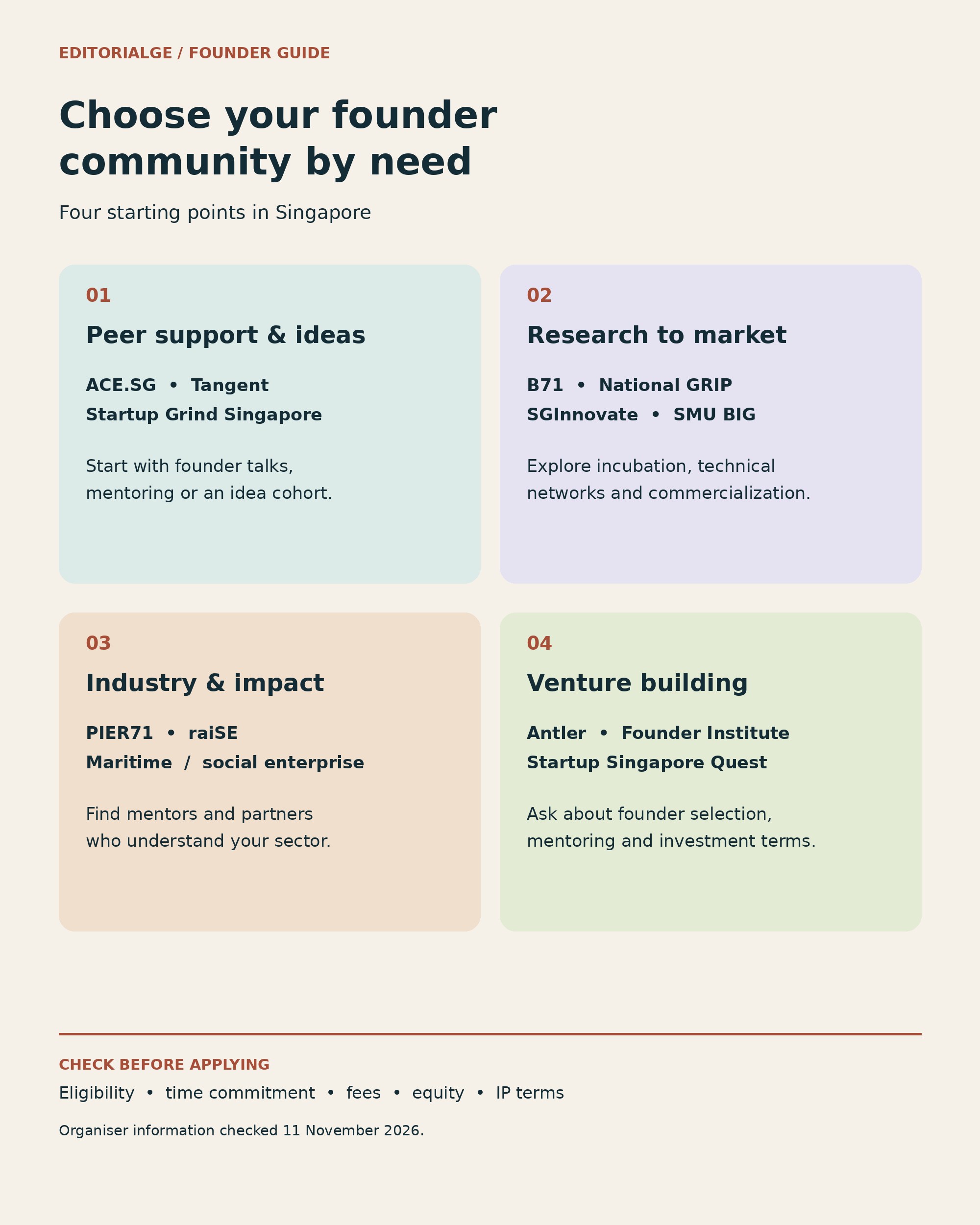
The graphic groups possible starting points into peer support, research commercialization, industry-specific networks and venture building. Check each organizer’s current admission criteria.
Questions founders should ask
Can an international founder participate?
It depends on the organiser, programme and immigration or business requirements. Some welcome international teams, while grants and university pathways can have additional conditions. Check the relevant programme directly and obtain appropriate professional advice for your circumstances.
Does every incubator take equity?
Terms vary. Some organisers describe an equity-free programme, while venture builders may offer investment under separate terms. Read the documents for the specific cohort, including fees, optional investment and intellectual-property provisions.
Are events enough to build a useful network?
Events provide introductions. The value comes from following up on a shared problem, being clear about what help you need and offering useful context in return. If you need intensive product feedback or specialist infrastructure, a structured programme may be a better fit.
Make the first conversation count
The most useful Singapore startup communities are the ones that help you take a concrete next step. Choose a room where the people understand your customer or technology, ask how the programme actually works, and compare the commitment with your immediate milestone. An informed application will be more valuable than a long list of memberships you cannot use.