When I set a marketing budget for a small business, I do not begin with the percentage that another company spends. I begin with what marketing needs to accomplish and what the business can afford to learn without putting pressure on cash flow. I use the same approach when we set the marketing budget for our own software: define the commercial outcome, count the full cost, test a focused idea, and increase spending only when the evidence supports it.
A percentage of revenue can be a useful sense check, but it cannot make the decision for you. Two businesses with the same revenue may have different margins, sales cycles, customer values, growth targets, and cash reserves. Giving both companies the same budget percentage would create a neat answer, not necessarily the right one.
My approach is to build the budget from the business goal upward and the cash limit downward. The final number has to work from both directions.
Disclosure: I work with marketing planning and take part in setting the marketing budget for our software. The figures in this article are illustrative and do not represent confidential company performance.
Start With the Business Outcome, Not the Channel
Budget discussions often begin with channels: How much should go to Google Ads, SEO, email, Facebook, or LinkedIn? I think that question comes too early. A channel is a route to an outcome, not the outcome itself.
I first write down one primary result for the budgeting period. It could be:
- 20 qualified sales enquiries each month
- 12 new paying customers each month
- 100 product trials from the right customer segment
- More renewals or repeat purchases
- Additional bookings during a predictable quiet season
“Increase awareness” is not yet specific enough to fund. I still need to know who should become aware, what I want that audience to do next, and how the team will recognize useful progress.
This is why I prefer to map the marketing funnel before assigning money. A business may already attract plenty of visitors but convert very few of them into leads. In that situation, buying more traffic can make the problem more expensive. The budget may be better used on the offer, landing page, checkout, or sales follow-up.
The same principle matters in our software work. A trial registration is encouraging, but it is not the same as an activated user, a paying customer, or a renewal. A practical SaaS growth system connects acquisition with activation and retention. If users leave before receiving value, increasing promotional spend will not repair the underlying problem.
The US Small Business Administration’s marketing-plan guidance recommends defining the target market, competitive advantage, goals, action plan, budget, and measurement method. The document does not need to be complicated. It needs to make the purpose of each expense clear.
How I Calculate a Marketing Budget for a Small Business
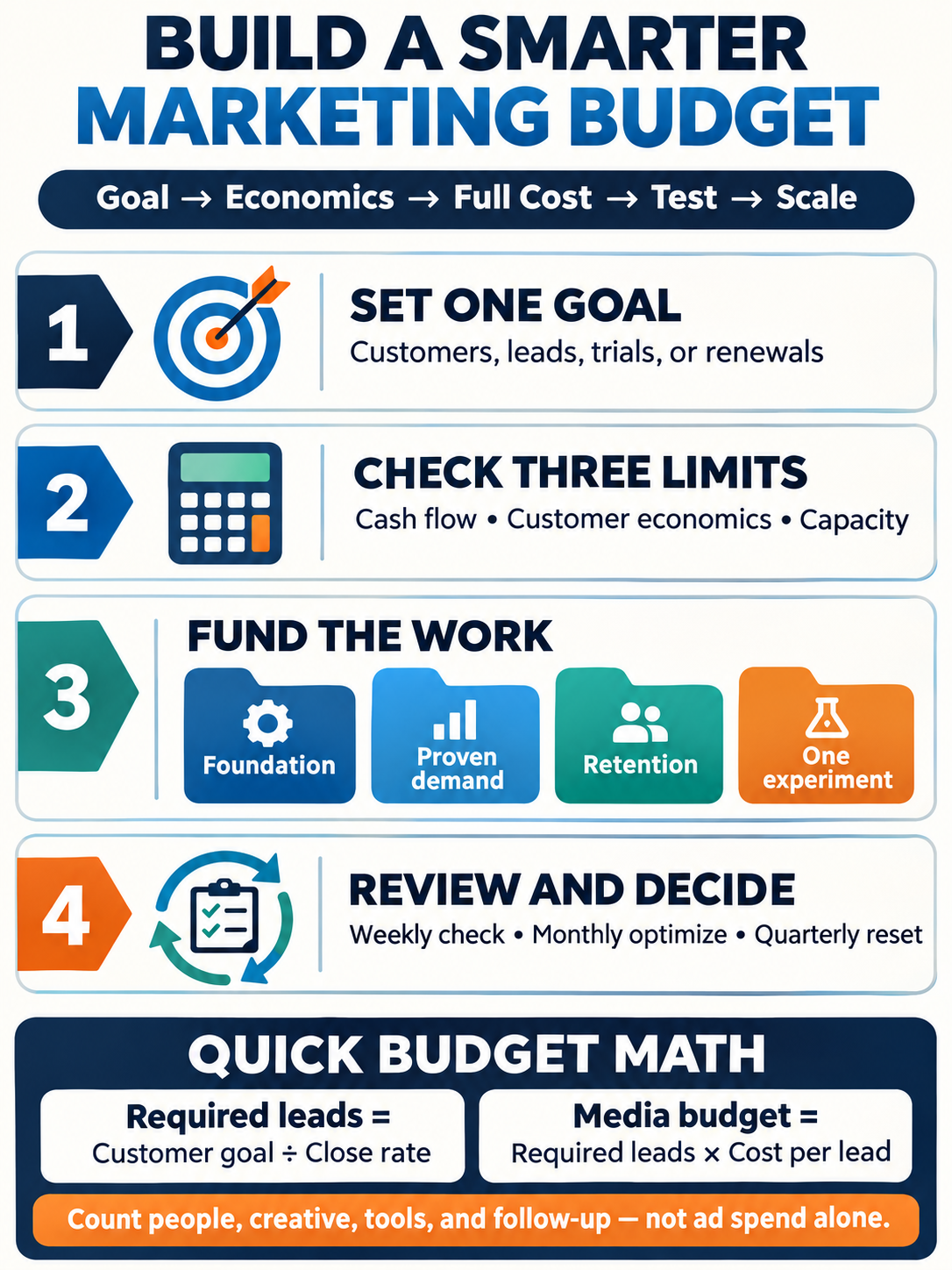
Once the outcome is clear, I work backward from customer economics. Four numbers usually provide a useful starting point:
- The number of new customers the business wants
- The contribution profit from an average customer
- The percentage of qualified leads that become customers
- The expected cost of generating a qualified lead
Contribution profit matters more than revenue alone. A sale may carry product, delivery, payment-processing, support, return, or service-delivery costs. The money left after those direct costs helps the business recover its acquisition spending and cover overhead.
For a one-time purchase, I look at the contribution from the first sale and only include repeat purchases that the business can support with real records. For subscription software, I also consider how long gross profit takes to recover the acquisition cost. The CAC payback period is useful because an acquisition cost can look acceptable while still creating cash-flow pressure if recovery takes too long.
A Connected Budget Example
Suppose a small service business wants 12 new customers in one month. Its current records suggest that 25% of qualified leads become customers, and a qualified lead costs about $40.
- Required qualified leads: 12 ÷ 0.25 = 48
- Estimated media spend: 48 × $40 = $1,920
Now assume the business has checked its margins and decided that it can spend no more than $250 in total to acquire one customer.
- Total acquisition ceiling: 12 × $250 = $3,000
- Amount remaining after media spend: $3,000 − $1,920 = $1,080
That remaining $1,080 must cover the work that makes the campaign possible. An illustrative allocation could look like this:
| Cost | Illustrative Amount |
|---|---|
| Paid media | $1,920 |
| Creative and landing-page work | $400 |
| Tracking and allocated software costs | $180 |
| Lead qualification and follow-up | $300 |
| Contingency | $200 |
| Total | $3,000 |
This is not a recommended benchmark. It is a way to expose the assumptions. If the full cost exceeds $3,000, the business needs to improve conversion, reduce the cost per lead, increase customer value, change the offer, or reconsider the channel. Simply hiding some expenses outside the marketing budget does not improve the economics.
Set Three Limits Before Approving the Total
Published spending benchmarks vary because businesses vary. I would not choose a marketing budget from a percentage alone. Before approving the total, I check three limits.
The cash-flow limit: How much can the business pay during the test period without weakening payroll, inventory, taxes, product delivery, or other essential operations? Marketing expenses are paid before many returns arrive.
The customer-economics limit: What is the maximum affordable cost for a qualified lead or paying customer? This should come from contribution margin and credible retention data, not an optimistic lifetime-value forecast.
The operational limit: How much new demand can the business serve properly? A company that can accept ten additional clients does not need a campaign built for one hundred. A software team that cannot onboard or support new accounts may damage retention by scaling acquisition too early.
If a percentage is still needed, I use it as a guardrail and convert it into a fixed amount the business can sustain through a meaningful test. A smaller focused campaign that runs long enough to generate useful information is better than an ambitious budget that has to be abandoned halfway through.
Count the Costs Hidden Behind Ad Spend
Ad spend is the most visible part of many budgets, but it is rarely the full cost. A realistic marketing budget for a small business should include the resources required to plan, create, distribute, measure, and follow up on a campaign.
Depending on the business, that may include:
- Paid media, listings, and sponsorships
- Photography, design, video, and copywriting
- Employee time spent on marketing
- Freelancers, consultants, and agency retainers
- Website, landing-page, and checkout improvements
- Email, CRM, analytics, scheduling, and research tools
- Discounts, samples, referral rewards, and other incentives
- Events, printing, shipping, and physical materials
- Lead qualification and sales follow-up
The accounting boundary can differ between companies. Some businesses keep sales salaries outside the marketing budget. That can work if the rule stays consistent. However, when I calculate a blended customer acquisition cost, I still want the relevant sales and marketing expenses visible. Otherwise, an apparently cheap campaign may be relying on uncounted labor.
This also matters when comparing internal staff with outside support. A proper in-house team versus agency comparison includes management time, briefing, reviews, software, and specialist help. Comparing one salary with one retainer rarely shows the complete cost.
Allocate the Budget by Job, Not by Platform
I do not divide money evenly among channels to make the plan look balanced. I divide it according to the work marketing needs to perform.
Foundation and measurement cover the website, essential customer-management tools, analytics, conversion tracking, and core assets. These costs should remain lean, but every campaign becomes harder to evaluate when the foundation is unreliable.
Demand capture reaches people already searching for a solution. Search advertising, local search, referral partners, marketplaces, and strong service pages can fit here.
Demand creation helps the right people recognize a problem, understand a category, or remember a brand. Content, video, partnerships, events, organic social media, and targeted paid social may fit this role. The split between organic and paid social should follow the audience, creative capacity, conversion path, and business goal rather than a permanent ratio.
Retention and expansion support existing prospects and customers. Email, onboarding, customer education, renewal communication, and useful follow-up belong here. Email marketing has real operating costs, but it can support repeated communication without purchasing a fresh ad impression for every message.
Controlled experiments give the team room to test one audience, offer, message, or channel without risking the whole budget. Each experiment still needs a hypothesis, spending cap, meaningful conversion, and decision date.
For a small business with limited resources, I would normally fund one primary acquisition route, one retention route, and one controlled experiment before adding more channels. Spreading a modest budget across every popular platform may generate activity without producing a clear lesson.
Content also needs a defined job. Many costly content marketing mistakes begin before production, when a team approves topics without connecting them to audience needs, distribution, or a meaningful next step.
Write the Stop and Scale Rules Before Launch
An experiment should buy information as well as leads or sales. Before a campaign begins, I write down:
- The business goal and target audience
- The offer, message, and channel
- The maximum approved spend
- The action that counts as a conversion
- The test period, based on the normal buying cycle
- The conditions for continuing, changing, or stopping the campaign
I avoid applying the same test period to every business. A low-cost ecommerce purchase and a high-value B2B contract have very different decision cycles. The campaign needs enough time and observations to support a decision, but it should not continue indefinitely because the team is reluctant to challenge the original idea.
Before paid promotion starts, I also check whether the main action can be measured. Google explains that conversion tracking can connect ad interactions with actions such as purchases, calls, sign-ups, or downloads. The setup must also follow the privacy and consent requirements that apply to the business and its customers.
The metrics I review depend on the goal, but the chain usually includes:
- Total cost, including production and labor
- Qualified leads or relevant product trials
- Lead-to-customer or trial-to-paid conversion
- Customer acquisition cost
- Contribution profit from acquired customers
- Payback time
- Repeat purchases, usage, or renewals
Clicks, impressions, reach, and engagement can explain what is happening inside a campaign. They do not replace qualified demand, revenue, or retention.
I also decide in advance what would make me pause a channel. Poor lead quality, acquisition costs that cannot be recovered, broken tracking, repeated operational friction, and declining marginal returns are all reasons to investigate. The practical signs that a marketing channel should be reconsidered are more useful when they are agreed upon before sunk costs influence the decision.
Review the Budget on Three Different Clocks
I do not rebuild the whole plan every time a daily metric changes. Instead, I separate monitoring from strategic review.
- Weekly: Check tracking, spending pace, lead quality, and obvious delivery problems. This prevents waste without turning every fluctuation into a new strategy.
- Monthly: Compare planned and actual costs, customer quality, conversion, acquisition cost, and the performance of each funded channel.
- Quarterly: Revisit the goal, total budget, channel mix, customer economics, product or service capacity, and upcoming seasonal needs.
These are management rhythms, not universal rules. A fast ecommerce campaign may need more frequent decisions, while a long B2B sales cycle may need a wider measurement window.
A Practical Marketing Budget Template
A useful budget does not need a complicated spreadsheet. I keep the structure tied to cost, ownership, outcome, and the next decision.
| Budget Line | Planned Cost | Actual Cost | Intended Outcome | Owner | Decision |
|---|---|---|---|---|---|
| Website, CRM, email, and analytics | Reliable conversion and measurement | Keep / change / remove | |||
| Content and creative production | Campaign or funnel asset completed | Keep / change / remove | |||
| Primary acquisition channel | Qualified leads or new customers | Scale / hold / stop | |||
| Retention and customer communication | Repeat sales, activation, or renewals | Scale / hold / stop | |||
| Staff, freelance, or agency support | Required execution capacity | Keep / change / remove | |||
| Controlled experiment | One hypothesis tested | Scale / revise / stop | |||
| Contingency | Approved exceptions only | Use / carry forward |
Below the table, I add four figures: total marketing cost, new customers acquired, blended customer acquisition cost, and contribution generated. That turns the budget from an expense record into a decision tool.
The Number Must Be Defensible
The right marketing budget for a small business is not the largest amount an owner feels brave enough to spend or the smallest amount that keeps expenses comfortable. It is a sustainable investment that can produce a trustworthy lesson and a plausible route to profitable growth.
I arrive at that number by defining one business outcome, working backward from customer economics, respecting the cash limit, counting the full cost, concentrating on a few channels, and writing the stop-or-scale rules before launch. That process is less exciting than copying a benchmark. It is much more useful when the money is real.