I use AI almost every day, so my view of AI productivity is not theoretical. It helps me sort messy notes, explore an angle, build an early structure, adapt copy, and clear away repetitive work. It gives me a starting point and more room to think about the parts of the work that still need me.
But I keep returning to an uncomfortable question: where does the saved time go? Too often, it does not return to the person doing the work. It becomes space for another article, another report, another visual, another meeting, or another deadline. A task becomes faster, and that faster pace quietly becomes the new normal.
If AI lets us produce more but never lets anyone work with greater care, finish earlier, or step away on time, then we have improved the production system without improving the working day. AI should give people time back, not simply make every hour denser.
AI Productivity Is Real, and That Is Why This Matters
I am not interested in pretending that AI does not save time. It does.
In a 2023 experiment published in Science, 453 college-educated professionals completed defined writing tasks with or without ChatGPT. Those using the tool finished 40% faster on average, while the quality of their work rose by 18%. A later study published in The Quarterly Journal of Economics found that an AI assistant increased customer-support productivity by about 15%, with the largest gains among less-experienced workers.
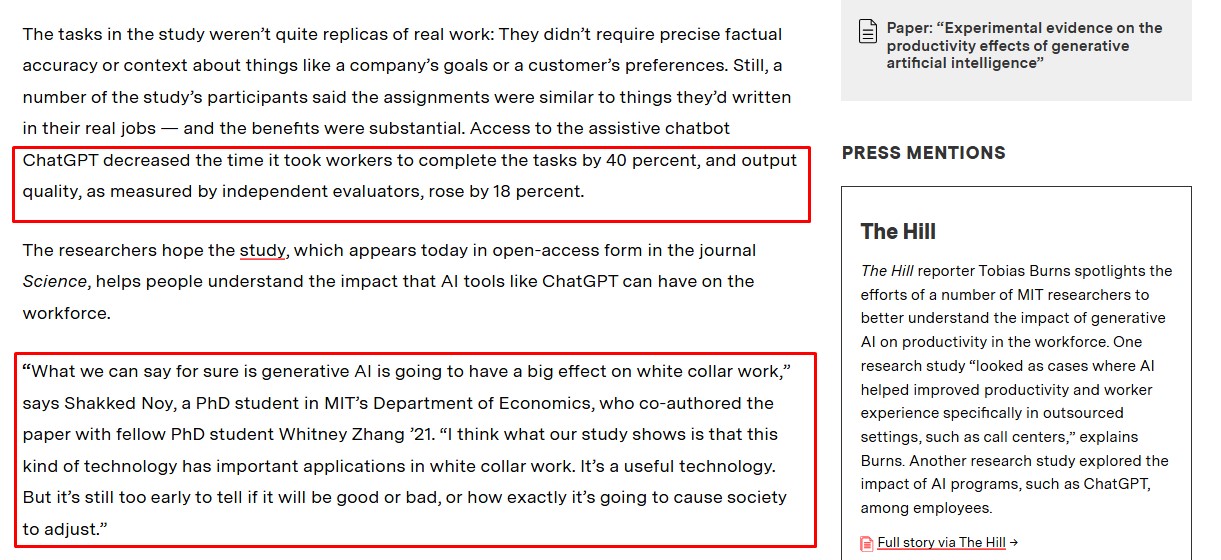
Those figures do not apply to every job. Both studies examined particular tasks in particular settings. Still, they confirm something many of us already experience: AI can remove friction from work.
I see that benefit in editorial work. AI can group research notes, compare structures, identify a gap in an outline, or adapt an idea for another format. It can handle preparation that would otherwise consume attention before the real decisions begin.
That last part matters. A quick outline is not a finished article. A fluent paragraph is not a verified claim. A generated image is not automatically the right image. AI often speeds up the beginning of a task, while a person remains responsible for deciding whether the result is accurate, useful, original, and worth publishing.
This is why an AI productivity agent should be judged by the full task, not its first response. If generation becomes faster but checking, correction, and recovery take longer, the work has merely moved somewhere less visible.
Generation time is not completion time.
The Time Saved by AI Can Disappear Into More Work
The pressure does not always arrive as an explicit demand. Often, the workflow simply expands around the tool.
If an outline takes less time, it becomes tempting to add another article. If adaptation becomes easier, one article can become a newsletter, a LinkedIn post, a script, and several visuals. Each item may seem reasonable. Together, they can consume every minute the technology saved.
Possibility slowly turns into expectation. That is the productivity ratchet I worry about. What feels like an impressive efficiency this month becomes the minimum acceptable pace next month. The benefit is real, but the person doing the work may never feel it.
Research suggests this tension reaches well beyond publishing. In an OECD survey covering more than 5,000 workers in finance and manufacturing, about three-quarters of AI users said the technology had increased the pace at which they performed their tasks. A faster pace can be useful, and many respondents also reported better performance. But the OECD warned that it could also indicate greater work intensity.
This is where the wider discussion about workplace productivity trends needs to become more honest. Productivity is not only a question of how many tasks move through a system. It is also a question of what happens to concentration, judgment, autonomy, and energy while those tasks are moving.
The figures behind modern productivity and burnout show what happens when work expands while uninterrupted focus becomes harder to protect. AI can ease that problem or accelerate it, depending on whether saved time is protected or treated as vacant capacity.
Fast Output Still Creates Slow Human Work
The hidden review burden is especially familiar to editors.
AI can produce a polished draft in seconds. Then someone has to check the sources, find the missing context, remove repetition, correct confident errors, restore the intended voice, and decide whether the argument says anything original. The output looks finished long before it is dependable.
Some AI features create more review work than they save because their speed is visible while checking remains scattered. A summary may require reopening the source. A translation may be technically correct but wrong for the audience. A meeting recap may turn a suggestion into a decision.
This does not make the feature useless. It means the honest measure is net time saved after setup, review, correction, approval, and failure recovery.
The same principle applies to creativity. AI can offer variations quickly, but speed does not solve the problem of AI-generated content and originality. When many people use similar models with similar prompts, the results can settle into the same safe structure and familiar language. Human experience, brand memory, audience knowledge, and editorial judgment still have to give the work a reason to exist.
That is also how I think about ImagineLab.art, which brings writing, images, video, voice, music, infographics, and chat into one workspace. Its deeper value is reducing the friction of moving among separate tools, subscriptions, files, and interfaces. That should give creators more control over their attention, not an obligation to produce in every available format.
A tool has done something meaningful when it removes unnecessary work. It has done much less when it merely makes unnecessary work easier to assign.
Disclosure: ImagineLab Art is our in-house AI creative platform developed and operated by Editorialge Media LLC, the publisher of Editorialge. I mentioned it because I use it most of the time to get my work done faster.
I understand why employers invest in AI. They want faster service, lower costs, more output, and better results. There is nothing unreasonable about expecting a productivity tool to improve production.
But more output should be one benefit of AI, not the only benefit. Every saved hour should not disappear into a larger target.
Some of that time can support deeper research, better editing, learning, experimentation, or collaboration. Some can reduce work carried into evenings or make a demanding day more manageable. Better judgment, fewer mistakes, stronger ideas, and sustainable performance all carry business value.
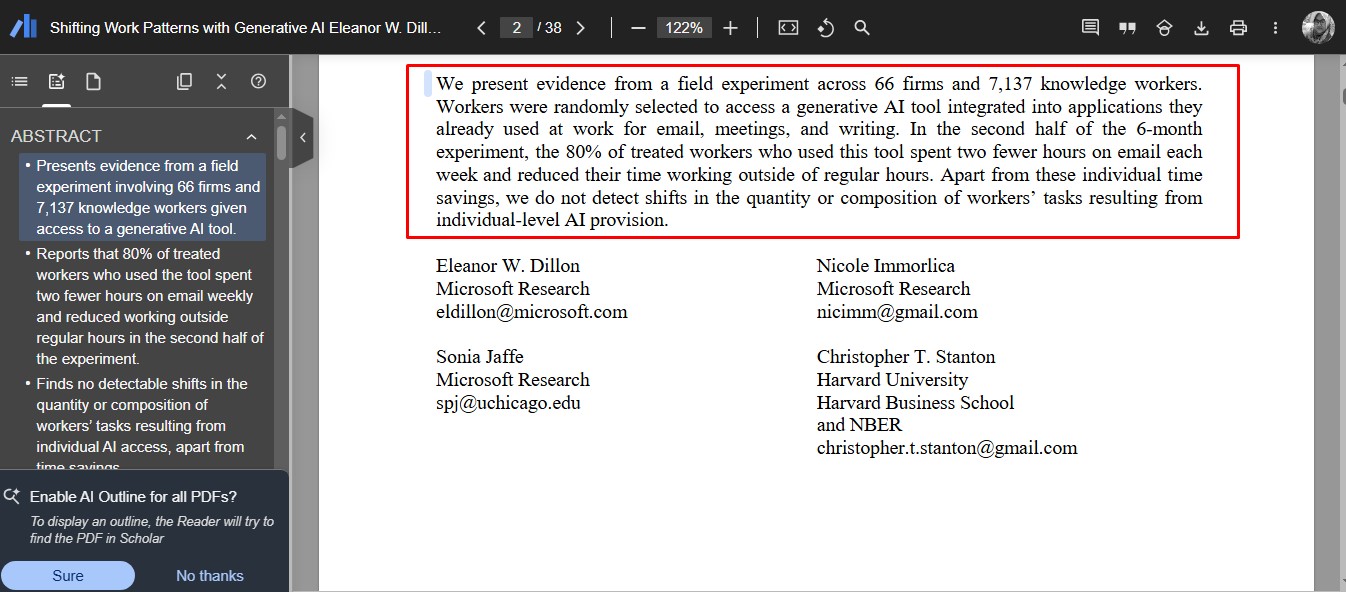
A 2025 randomized field experiment involving 7,137 knowledge workers across 66 companies offers a useful example. Workers with access to an integrated generative AI tool spent less time on email and reduced work outside regular hours. The tool did not transform every part of their jobs, and it did not significantly reduce meetings. Still, the result matters because some of the efficiency remained visible as time, rather than immediately becoming another assignment. That is the outcome I want us to pursue more deliberately.
Before calling an AI rollout successful, I would ask five questions:
- Did it reduce total completion time after review and correction?
- Did it remove repetitive or low-value work?
- Did it reduce work outside normal hours?
- Did quality, learning, or autonomy improve?
- Who was allowed to keep the time that was saved?
The fifth question is the one most productivity dashboards miss. An organization may decide to reinvest some saved time in additional output. That can be reasonable. But if workers create more value while receiving none of the time, flexibility, learning, or breathing room created by the technology, the gains are being measured from only one side.
Human-centered AI productivity requires a fairer bargain. The company can benefit. Customers can benefit. Workers should benefit too.
A Faster Day Should Also Become a Lighter One
I do not use AI because I want to squeeze an unlimited number of tasks into a day. I use it to remove friction from work that does not need all of my attention, so I can give more attention to the work that does.
Sometimes that should mean better research or sharper editing. Sometimes it should mean having enough time to question a weak idea instead of polishing it. Sometimes it should mean finishing on time and stepping away without feeling that an empty hour is a failure of ambition.
The future of AI productivity should not be a workplace where every person behaves like a machine simply because the machines became faster. It should be a workplace where technology handles more of the mechanical burden, and people have more room for judgment, creativity, care, learning, and life outside work.
If AI makes every hour more crowded but no day more manageable, we will have built a faster workplace, not a better one. The most meaningful productivity gain AI can give us may be the time we are finally allowed to keep.