

Backlinks rarely arrive in tidy, predictable numbers. A website may gain only a few links for several weeks and then receive dozens in two days. That sudden rise can look suspicious on a chart, but it may have a perfectly reasonable cause. A news story was widely cited. New research attracted attention. A useful tool spread through an industry. Several publications syndicated the same report.
This is where link velocity becomes useful. It measures how quickly a website or page gains and loses backlinks over time. However, it is often misunderstood as a Google-imposed speed limit.
Google can see when it discovers links and assess whether they appear manipulative. What it has not published is a safe number of backlinks that every website should stay below. A steep graph alone does not prove spam. The sources, anchor text, linked pages, and reason behind the increase tell the more important story.
What Does Link Velocity Measure?
Link velocity is the rate at which a website or individual page gains or loses backlinks during a particular period.
A basic calculation looks like this:
Link velocity = New backlinks ÷ Time period
If a site gains 300 backlinks in 30 days, its average gross link velocity is 10 backlinks per day. That number sounds useful, but it leaves out a critical detail. Those 300 links could come from 200 independent publications or from one website placing the same link across hundreds of pages.
For a more reliable assessment, look beyond the headline backlink count.
| Measurement | What It Reveals |
| New backlinks | Total links discovered during the period |
| New referring domains | Number of independent websites providing links |
| Lost backlinks | Links that disappeared or became inaccessible |
| Lost referring domains | Websites that stopped linking to the site |
| Net link growth | New links minus lost links |
| Page-level velocity | How quickly one page gains or loses links |
| Domain-level velocity | Link changes across the entire website |
New referring domains usually provide more context than raw backlinks. One sitewide footer, author archive, or syndicated feed can create hundreds of links without representing hundreds of independent endorsements.
The time frame also matters. Daily numbers are often noisy. Weekly or monthly comparisons provide a clearer view, especially for an established publisher.
Discovery Date Is Not Always Publication Date
Backlink platforms record a link when their crawler finds it. That may not be the day the link first appeared.
Suppose a publication added a link on June 1, but a backlink tool did not recrawl the page until June 8. The platform may report June 8 as the discovery date. If it finds several older links during the same crawl cycle, the graph can show a spike that did not happen all at once.
Different platforms operate separate crawlers and databases. Their totals will not match each other, and none of them provides a complete copy of Google’s link index.
Google Search Console has limitations as well. Its Links report shows a sample rather than every backlink Google knows about. It combines certain duplicates and groups linking sites by root domain. Its “Latest links” export is useful for investigation, but it should not be treated as a complete historical record.
Does Google Watch Link Velocity?
The clearest answer is this:
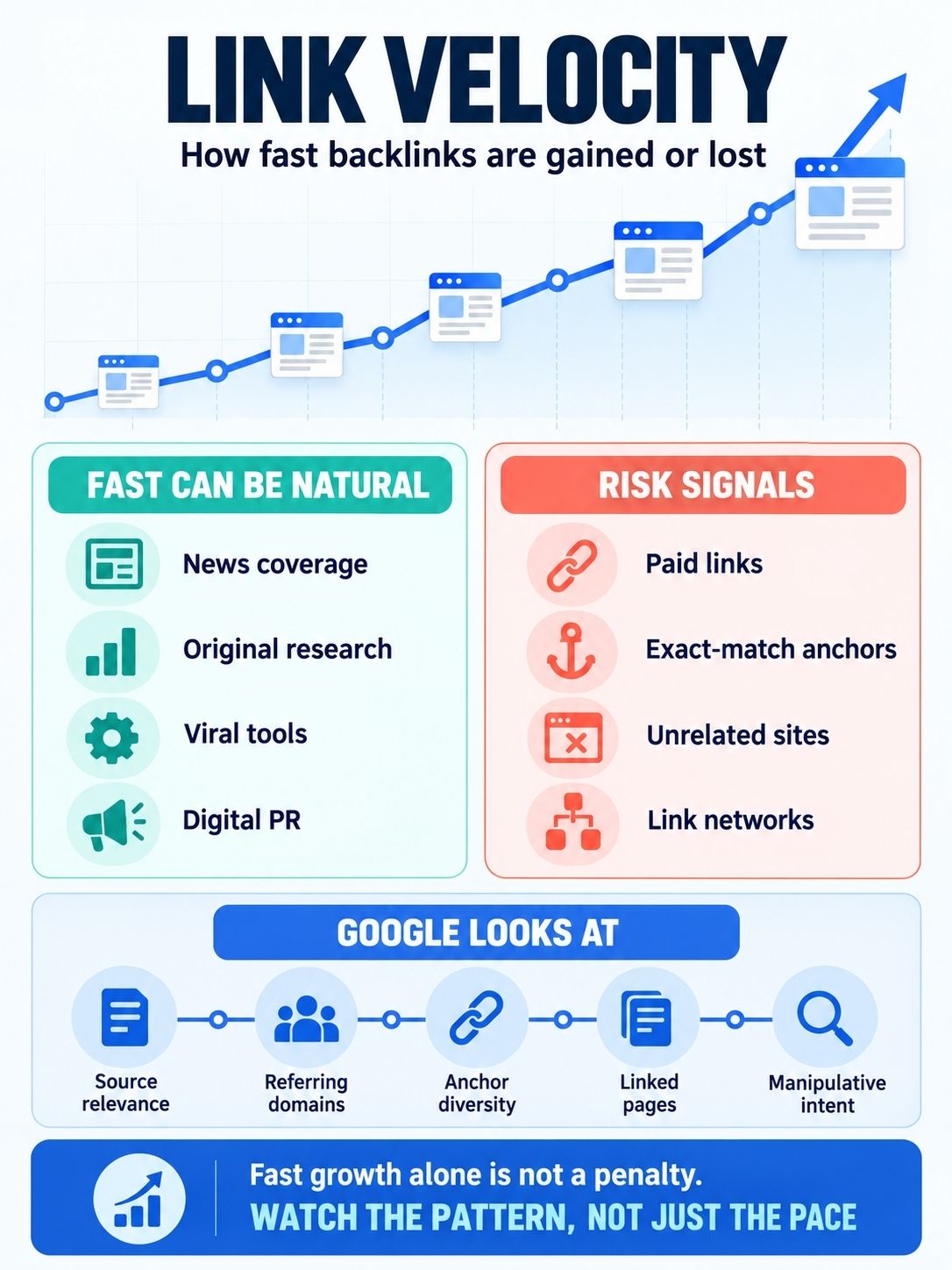
Google can observe link growth over time, but it has not confirmed link velocity as a standalone ranking factor or published a penalty threshold.
Google uses links to discover pages and understand their relevance. It also operates spam-detection systems that identify manipulative linking practices.
There is historical evidence that Google has examined link timing. A Google-held patent describes analyzing when links appear or disappear and whether the rate of acquisition rises or falls. The system described in the patent could use those changes to judge whether a document appeared fresh or stale.
That patent is useful background, but it is not proof of how Google Search works today. Technology companies patent ideas they may test, change, combine with other systems, or never use in the form described.
Google’s current public guidance focuses on link spam, not a metric called link velocity. Its policies address links created mainly to manipulate rankings, including bought links, excessive exchanges, automated placements, low-quality directories, optimized widget links, and widely distributed footer links.
Google’s SpamBrain system can also identify unnatural links and websites created to sell or pass ranking credit. In many cases, Google may neutralize those links so they no longer provide the expected benefit. A website involved in serious policy violations may also receive a manual action.
Therefore, it is more accurate to say that Google watches link patterns and manipulation, not that it enforces a fixed backlink speed limit.
When Fast Link Growth Makes Sense
Genuine attention is rarely evenly distributed. It often arrives in bursts. A breaking story may be cited by several publications within hours. Original research may attract links after being mentioned by one influential journalist. A free calculator, template, or industry report can spread rapidly through professional communities. Product announcements and successful digital PR campaigns can also create short periods of high link velocity.
Consider two hypothetical situations:
In the first, an original report earns links from 40 relevant publications. The anchor text varies, and most links point directly to the research page. The timing matches the report’s release and subsequent media coverage.
In the second, a service page receives 40 links from unrelated blogs. Most use the same commercial anchor, and the surrounding articles provide little connection to the service.
Both sites gained the same number of links. The patterns do not carry the same meaning.
A legitimate increase commonly includes:
- Relevant publications or specialist websites
- Contextual mentions within useful content
- Varied brand, title, URL, and descriptive anchors
- Several independent referring domains
- Links pointing to the asset that attracted attention
- Timing that matches a publication, campaign, or public event
The better question is not, “Did the links arrive too quickly?” It is, “Why did these links appear?”
When Link Velocity Deserves a Closer Look
Speed becomes more concerning when it appears alongside signs of manipulation.
Watch for large groups of links from irrelevant websites, repeated exact-match anchors, or backlinks concentrated on a single commercial page. Other warning signs include automated profile links, low-quality directories, paid posts without the proper attributes, and links placed across templates or footers.
A cluster of websites with similar designs, authors, article structures, or ownership patterns can also indicate a controlled network. Links that appear and disappear together may deserve the same scrutiny.
However, slow acquisition is not proof of quality.
Some link sellers deliberately spread placements over several months so the graph appears gradual. Ten paid guest posts do not become editorial endorsements because they were scheduled carefully. A private network remains a private network even if it adds only two links per week.
Trying to imitate a “natural” velocity misses the point. The method and purpose behind the links matter more than the schedule.
How I Review Link Velocity on a Publisher Website
In my work with publisher SEO at Editorialge, I deal with content that can attract links in very different ways. Timely reports may receive several citations close together, while evergreen guides tend to build recognition more gradually. That experience has taught me not to judge backlink health from the shape of a graph alone.
When I see an unusual change, this is how I review it.
1. I Identify What Actually Changed
My first question is not simply, “How many links appeared?” I check how many independent websites created them.
A jump of 1,000 backlinks may come from one domain adding a sitewide link. A smaller increase of 20 links may represent 20 new publications. The second change could be far more meaningful.
I compare:
- New backlinks
- New referring domains
- Links per domain
- New and lost domains
- Pages receiving the links
This separates broad recognition from repeated links generated by a small number of sources.
2. I Match the Timing With the Editorial Calendar
I look at what the site published or promoted before the increase.
Was there an exclusive story, original report, interview, partnership, product announcement, or digital PR campaign? Was an older article updated or republished? Did another publication syndicate the content?
This step often explains a spike before deeper investigation is necessary.
Keeping dated notes about important campaigns and publications helps. A chart viewed six months later is much easier to interpret when there is a record of what happened at the time.
3. I Inspect the Linking Pages
A domain-level authority score is a useful filter, but it cannot tell me why the link exists.
I open a sample of the linking pages and check whether the content is relevant, accessible, and written for a real audience. I look at the sentence surrounding the link and whether the destination genuinely helps the reader.
A link from a recognized domain can still appear on a weak or compromised page. A smaller specialist publication may provide a highly relevant editorial citation. The page itself deserves inspection.
4. I Review the Anchor Text and Destination
Earned links rarely use identical wording every time. They may use the brand name, article title, author name, URL, or a descriptive phrase.
A sudden concentration of the same commercial anchor deserves attention, particularly when those links point to a pricing, product, or service page.
The destination should also make sense. Original research attracting citations is expected. An ordinary sales page receiving many keyword-rich links from unrelated blogs presents a different pattern.
5. I Check Whether the Links Last
A campaign that gains 100 links and loses 90 shortly afterward is different from one that retains most of its citations.
Rapid loss may come from expired campaign pages, deleted guest posts, discontinued websites, changed templates, or short-lived link schemes. It may also have an innocent explanation. News pages move, websites restructure, and publishers update old content.
I review retention alongside the source quality and original reason for the links. No single metric gives the full answer.
Do Not Assume Every Link Spike Caused a Ranking Drop
Timing can be misleading.
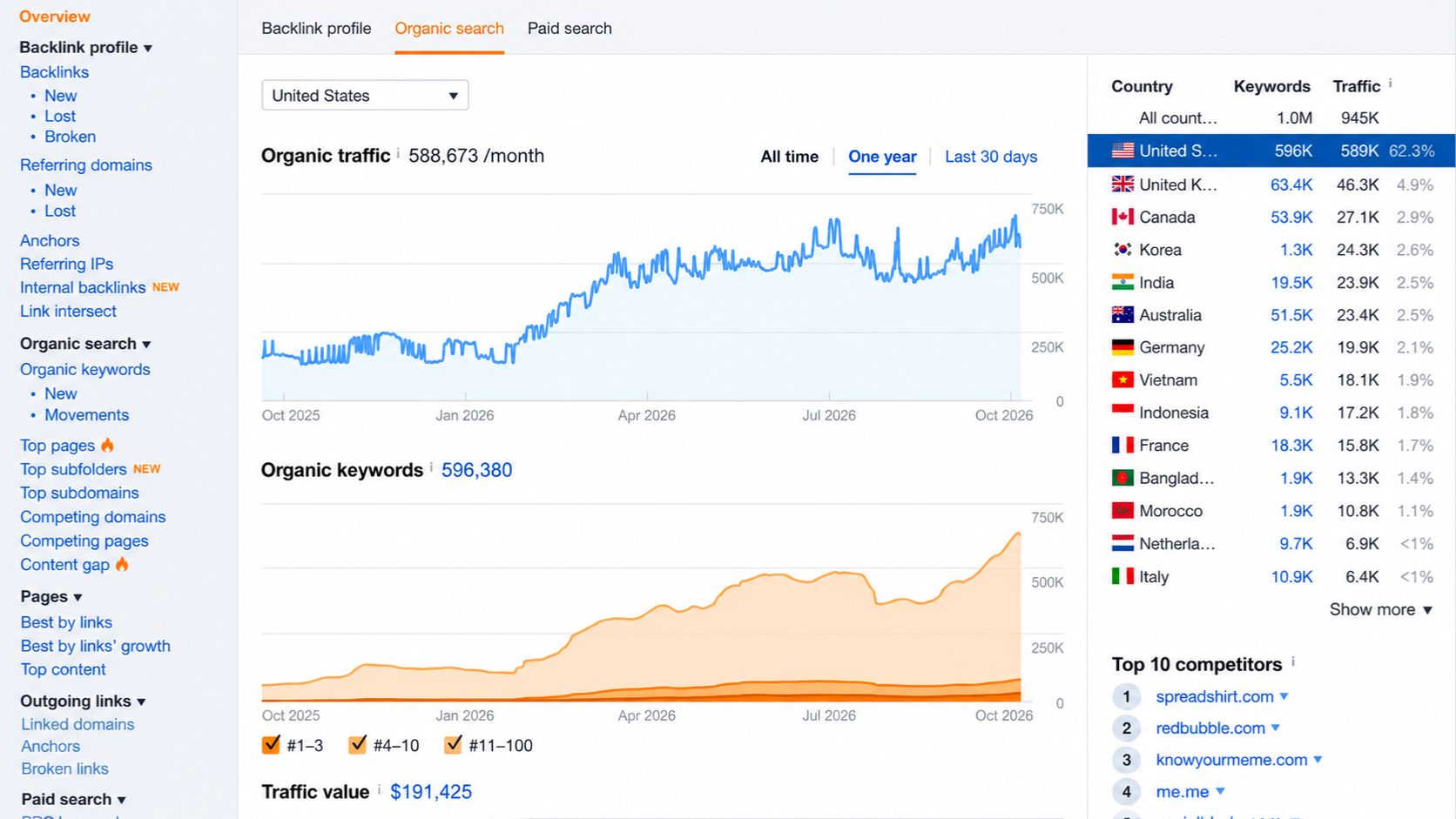
A site may experience a backlink spike around the same time as a traffic decline, but that does not prove the links caused the loss. A Google update, indexing problem, technical change, seasonal demand, stronger competition, or declining content quality may be responsible.
Check Google Search Console for indexing problems, changes in impressions, affected queries, and any manual action. Compare which pages lost visibility with the pages receiving the new links.
If the two groups do not overlap, the backlink spike may be unrelated.
This is one area where editorial judgment matters. SEO tools make it easy to place two charts beside each other. They do not prove causation.
What Should You Do After a Suspicious Spike?
Start by investigating rather than immediately removing or disavowing links.
Confirm whether the increase comes from many referring domains or one website. Open a representative sample of the linking pages. Look for a shared template, syndication feed, scraper network, automated profile system, or repeated anchor pattern.
If the links are unsolicited spam that you did not create, monitoring may be enough. Google says its systems can usually determine which links to trust without additional guidance from the website owner.
If you or an SEO provider created manipulative links, take a different approach. Stop the campaign, request removal where practical, and make sure legitimate paid placements use rel=”sponsored” or rel=”nofollow”.
Keep a record of what you find. Note the discovery date, source, destination, anchor type, suspected cause, and action taken. That record becomes useful if the pattern continues or a manual action appears later.
Should You Use the Disavow Tool?
High link velocity alone is not a reason to disavow backlinks.
Google describes its Disavow Links tool as an advanced feature that can harm search performance when used incorrectly. Most websites do not need it.
Google recommends considering disavowal only when a site has a considerable number of spammy, artificial, or low-quality backlinks and those links have caused, or are likely to cause, a manual action.
Where possible, try to remove links associated with paid placements or link schemes first. Do not upload a list simply because unfamiliar domains appeared in a backlink report.
Build Citations, Not a Perfect Graph
I would not set a target such as “five links per week” merely to keep link velocity looking safe. That approach shifts attention from value to scheduling.
A better strategy is to create material that gives people a reason to cite the website:
- Original surveys and proprietary data
- Expert interviews with specific insights
- Calculators, templates, and useful free tools
- Detailed explanations of difficult subjects
- Timely reporting and exclusive information
- Transparent comparisons
- Well-documented case studies
- Reusable visual resources with clear attribution
Promote those assets to relevant journalists, publishers, communities, and industry professionals. The results will not arrive at a perfectly even rate. Some campaigns may gain little attention, while others create a sudden burst.
That unevenness is part of genuine publishing.
Measure success through relevant referring domains, referral traffic, link retention, cited pages, and the editorial context of the mentions. Raw backlink volume belongs in the report, but it should not control the decision.
Commonly Asked Questions about Link Velocity
Is Link Velocity a Google Ranking Factor?
Google has not confirmed a standalone ranking factor called link velocity. It uses links as relevance signals and operates systems that detect link spam. The rate of link growth may provide context, but Google has not published a formula or safe threshold.
What Is a Good Link Velocity?
There is no universal number. An appropriate rate depends on the website’s age, industry, audience, publishing frequency, existing visibility, and publicity. Ten new referring domains may be significant for a local business but routine for a large publisher.
Can Gaining Backlinks Too Quickly Hurt a Website?
A rapid increase in legitimate editorial links is not inherently harmful. Risk rises when the links come from paid schemes, automated placements, irrelevant websites, controlled networks, or repeated keyword-rich anchors.
Should a New Website Build Links Slowly?
A new site should earn links honestly rather than limit genuine attention. If an original resource receives substantial coverage soon after launch, there is no sensible reason to reject those links. Quality and relevance matter more than an arbitrary monthly quota.
How Should Link Velocity Be Monitored?
Track new and lost backlinks, new and lost referring domains, anchor-text distribution, linked pages, and link retention. Review the data weekly or monthly, and record major publications or campaigns so unusual changes can be connected with real events.
Watch the Pattern, Not Just the Pace
Link velocity shows when a backlink profile is changing. It does not explain why.
My approach is simple: I do not try to manufacture a perfectly smooth link graph. I look at the independent websites involved, the relevance of the mentions, the anchor text, the destination pages, and the event that caused the growth.
Google can observe link changes and act against manipulation, but it has not published a backlink speed limit. Build resources worth citing, investigate unexplained spikes, and judge links by their origin and purpose rather than the steepness of a chart.