

Learning apps regularly ask children and adults to answer questions, complete activities, and earn scores. However, not every quiz or progress bar shows whether real learning is taking place.
My experience with children’s learning apps, including the work around our in-house Edutorial platform, has made me careful about separating engagement from evidence of learning. An app may keep a learner tapping for 20 minutes with points, animations, and rewards. That does not necessarily mean the learner understood the lesson or corrected a mistake.
This is where formative assessment in learning apps matters. It checks understanding while learning is still happening. More importantly, it uses the result to decide what should happen next. The learner may receive a targeted hint, repeat a skill, move to a harder task, or get support from a teacher or parent.
The quiz is only the starting point. The real value comes from the feedback and the next action.
What Is Formative Assessment in Learning Apps?
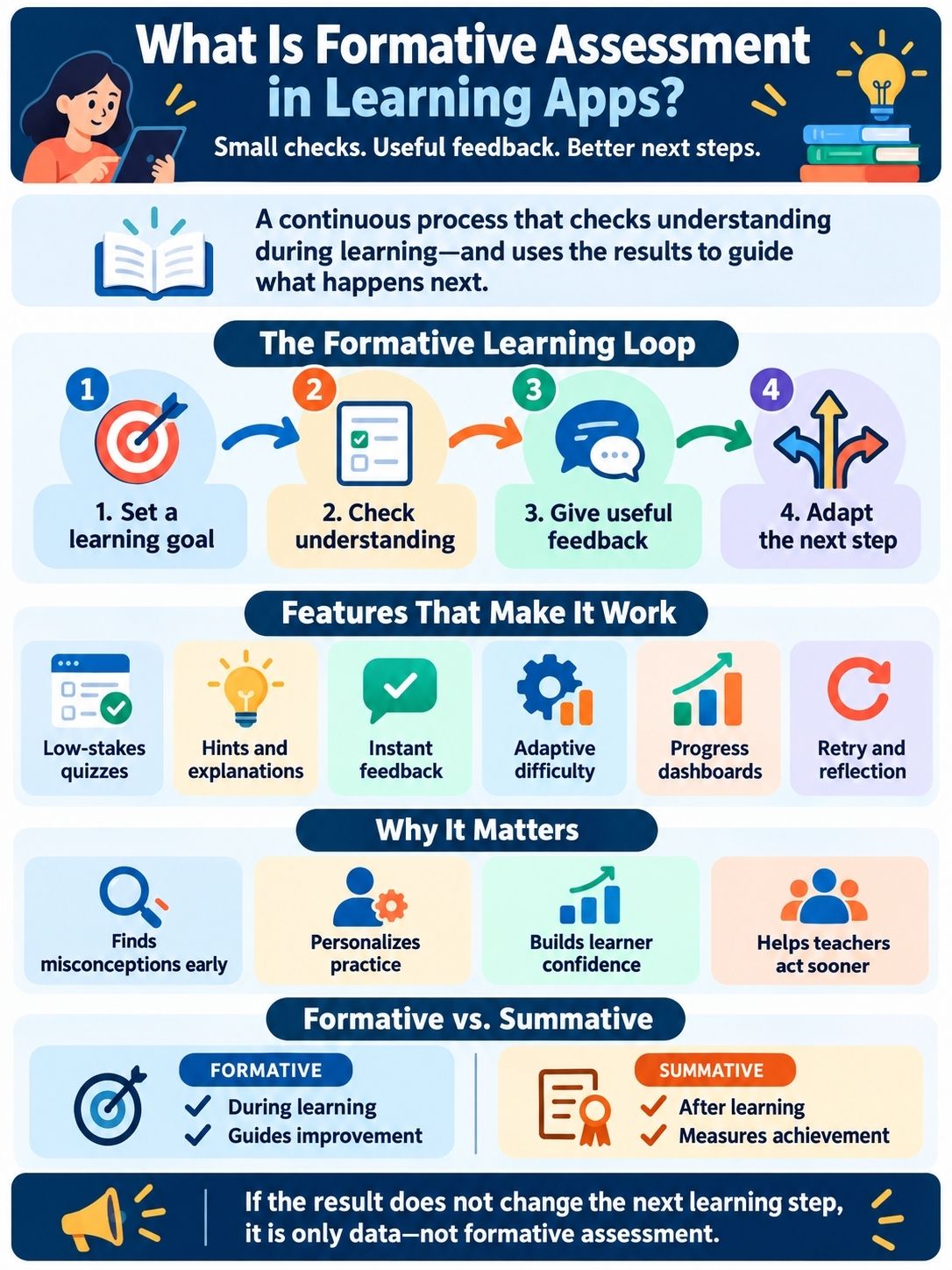
Formative assessment in learning apps is an ongoing process that gathers evidence about what a learner currently understands and uses that evidence to improve the next stage of learning.
It usually happens during a lesson, practice session, game, or activity. The app may analyze an answer, identify a misconception, provide feedback, adjust the difficulty, recommend another activity, or show a teacher where the learner needs help.
Formative assessment is often called assessment for learning because its primary purpose is improvement. Summative assessment, by comparison, generally judges what someone has learned at the end of a unit, course, or defined period.
Formative assessment is usually low-stakes, but it is not defined by whether it carries marks. A scored quiz can be used formatively if its results guide feedback, practice, or teaching. An ungraded quiz is not automatically formative if it only produces a score that nobody uses.
The clearest test is simple: Did the assessment result change what the learner, app, or teacher did next?
If the answer is no, the feature may be tracking or scoring rather than meaningful formative assessment.
How Does Formative Assessment Work Inside a Learning App?
A well-designed formative assessment process works as a cycle. It does not end when the learner submits an answer.
1. Set a Clear Learning Goal
The learner should know what skill or concept they are working on. A clear goal also keeps the assessment focused. If an app is testing fraction knowledge, for example, difficult reading instructions should not distort the result.
2. Collect Evidence of Understanding
The learner completes a task that may involve a question, spoken response, drawing, calculation, simulation, or short explanation. It should produce useful evidence connected to the learning goal, not merely keep the learner active.
3. Interpret the Response
The app or teacher considers what the response suggests. A wrong answer may reveal a misconception, while several attempts may indicate guessing. A correct answer completed with heavy hint use may not demonstrate independent mastery.
4. Provide Useful Feedback
The learner receives a hint, explanation, worked example, review task, or other support. Good feedback does not merely say, “Wrong. Try again.” It explains what to reconsider.
5. Adjust and Check Again
The result should influence the next step. The learner may receive targeted practice, return to a prerequisite skill, move to a harder task, or get teacher support. A new question can then show whether the learner can apply the idea in another context.
| Stage | Purpose | Possible App Feature |
| Set the goal | Clarify what the learner should understand | Lesson objective, skill target, rubric |
| Collect evidence | Make current understanding visible | Quiz, explanation, recording, simulation |
| Interpret | Identify strengths, gaps, or misconceptions | Error analysis, attempt history, confidence check |
| Respond | Help the learner improve | Hint, explanation, worked example, teacher alert |
| Adjust | Choose a better next step | Targeted practice, changed difficulty, reteaching |
| Recheck | Find out whether learning improved | New problem, later review, transfer task |
Which App Features Count as Formative Assessment?
Learning apps use many features that look educational. Some support formative assessment, while others mainly track participation or encourage continued use.
| App Feature | Is It Formative? | Why? |
| Quiz that only produces a score | Not necessarily | The result does not guide improvement by itself |
| Correct or incorrect symbol | Very basic | It identifies an error but gives little direction |
| Explanation followed by another attempt | Yes | The learner can act on feedback and try again |
| Hint based on a specific mistake | Yes | It addresses the learner’s current gap |
| Easier or harder next question | Potentially | The change must be based on valid learning evidence |
| Teacher progress dashboard | Potentially | It becomes formative when the teacher acts on the data |
| Badge, streak, or leaderboard | No | It reflects activity or motivation, not necessarily understanding |
| Completion bar | No, by itself | Completing content is different from mastering it |
| Mistake-review lesson | Yes | Previous errors influence future practice |
| Peer feedback using clear criteria | Yes | Learners can use the feedback to improve their work |
| AI-generated comments | Potentially | They must be accurate, useful, and open to review |
When I look at a learning app, I do not start with its rewards or colorful dashboard. I ask what happens after the learner makes a mistake.
If the app only removes a life, displays a red mark, or repeats the same question, the assessment loop is weak. If it helps the learner understand the error and gives them another meaningful chance, the feature has greater educational value.
Read about: Does a learning app help a child learn or just keep them busy?
What Are Examples of Formative Assessment in Learning Apps?
Formative assessment does not have to look like a traditional test. It can appear throughout the learning experience.
Embedded Knowledge Checks
An app may pause a video, story, or lesson and ask a short question. The best checks focus on an important concept rather than a sentence the learner saw moments earlier.
Targeted Hints and Error-Specific Feedback
A hint can guide the learner without immediately supplying the answer. Different wrong answers may also reveal different misunderstandings.
In a place-value activity, choosing 35 instead of 305 could show confusion about the role of zero. Error-specific feedback can address it directly.
Adaptive Practice
An adaptive app changes the sequence or difficulty based on performance. However, adaptive learning is not automatically formative.
Making questions easier because a learner answered slowly could be inappropriate if the learner was distracted, checking the work, or using assistive technology.
Mistake Review and Spaced Practice
Some apps return to earlier mistakes after a delay. This requires learners to retrieve the corrected information and helps show whether the learning lasted.
Self-Assessment and Reflection
Learners may rate their confidence, compare their work with an example, or reflect on their strategy. Being confidently wrong may reveal an established misconception that needs more than another routine question.
Teacher Dashboards and Open Responses
A teacher dashboard may show mastery, common errors, attempts, or hint use. It becomes formative when the teacher uses the information to adjust instruction.
Open responses, such as explanations, diagrams, code, or projects, can reveal reasoning that closed questions miss, although they often require human judgment.
Formative vs Diagnostic vs Summative Assessment
The difference between assessment types comes from how the information is used, not simply from the question format.
| Assessment Type | Main Purpose | Usual Timing | Learning App Example |
| Diagnostic | Identify starting strengths and needs | Before a course or unit | Placement activity or initial skill check |
| Formative | Improve learning while it is happening | During lessons and practice | Hint, feedback, retry, targeted practice |
| Interim or benchmark | Monitor progress across a longer period | At planned intervals | Monthly mastery check or mid-course benchmark |
| Summative | Judge achievement after instruction | At the end | Final test, certificate assessment, graded project |
A diagnostic activity can also support formative learning. If it identifies a missing prerequisite and the app changes the learning path, its evidence is being used formatively.
Similarly, a final test can have later formative value if a teacher analyzes the errors and uses them to plan future instruction. The purpose of the evidence matters more than the label attached to the task.
Why Is Formative Assessment Important in Learning Apps?
Formative assessment in learning apps connects evidence with action. Instead of waiting for a final test, learners get support while there is still time to improve.
It Finds Misconceptions Earlier
Frequent checks can reveal a misunderstanding before it becomes harder to correct. The app or teacher can then offer a different explanation or simpler example.
It Turns Practice Into Useful Evidence
Practice can strengthen memory and reveal gaps, but activity volume should not be confused with learning. Ten carefully selected questions with error review may be more useful than 100 repetitive ones.
It Makes Support More Specific
One learner may need a prerequisite lesson, another may need more practice, and a third may be ready for a harder challenge. Formative evidence helps the app or teacher choose accordingly.
It Helps Learners Understand Their Progress
Good formative assessment shows learners what they know, where they are struggling, and what to do next. A mistake becomes useful information rather than a final judgment about ability.
It Gives Teachers Faster Insight
Digital tools can collect responses from an entire class quickly and reveal patterns that inform the next lesson. They save time only when the information is clear enough to use.
What Does Useful In-App Feedback Look Like?
Feedback is central to formative assessment, but not every message helps learning.
Compare these two responses:
Weak feedback: “Incorrect. Try again.”
More useful feedback: “You added both the numerator and denominator. When fractions have the same denominator, keep the denominator and add only the numerators. Try the next step again.”
The second response identifies the likely error and gives the learner a clear action without immediately supplying the final answer.
Useful feedback should be:
- Connected to the learning goal
- Specific enough to guide improvement
- Written in language the learner understands
- Focused on the task, reasoning, or strategy
- Timely enough to influence the next attempt
- Short enough to avoid overwhelming the learner
- Followed by an opportunity to use it
Immediate feedback can help with facts, procedures, and misconceptions that need quick correction. It may be less useful when it interrupts a complex writing, design, or problem-solving task. In those situations, learners may need time to think and make a larger revision.
More feedback is not automatically better. A long explanation can overwhelm a young learner. The app should provide the right amount of support at the right time.
What Does Research Say About Digital Formative Assessment?
Formative assessment has a strong general evidence base. A review by the Australian Education Research Organisation examined 138 studies and found benefits across subjects, age groups, and learners with and without additional learning needs.
Research on feedback also reports positive overall effects, but outcomes vary. The focus, quality, timing, and usability of the feedback matter more than the fact that a message appears on the screen.
Evidence for technology-supported formative assessment is more cautious. Successful use depends on three conditions: a clear understanding of formative assessment, alignment between the tool and teaching practice, and the ability to interpret and act on the data.
Digital tools are efficient at scoring closed questions. They are less reliable when evaluating original reasoning, creativity, nuanced writing, or several valid solutions. Human judgment remains important for complex learning.
How Do Learning Platforms Use Formative Features?
Several familiar platforms illustrate parts of the formative process.
- Khan Academy provides mastery goals, and teacher reports that show progress and skill comprehension. Teachers can use the information to identify gaps or plan support.
- IXL uses diagnostic information to recommend skills a learner may be ready to study next.
- Nearpod lets teachers collect responses through quizzes, polls, drawings, open-ended questions, and interactive activities during a lesson.
- Duolingo uses mistakes and previous performance to shape review and personalized practice.
These examples illustrate possible mechanisms, not automatic proof that every activity is formative. The information still needs to support a useful learning decision.
What Are the Limitations and Risks?
Digital assessment can reveal useful patterns, but it can also oversimplify learning. Understanding its limits helps teachers, parents, and app teams use the data more responsibly.
Closed Questions Can Miss Deeper Thinking
Multiple-choice questions are easy to score, but they may not show how a learner reached an answer. A learner can guess correctly or use a flawed method. Explanations, drawings, projects, and conversations may provide richer evidence.
Data Can Create False Confidence
A dashboard may display precise percentages and mastery levels, but a score based on a few questions should not define ability. Language, attention, device problems, accessibility features, and task design can all affect performance.
Gamification Can Distract From Learning
Points, streaks, and badges can encourage participation but may shift attention toward rewards or comparison. They should support the learning goal rather than replace it.
Automated Feedback Can Be Wrong
Rule-based systems may reject an unexpected but valid answer. AI systems may misunderstand reasoning, generate an inaccurate explanation, or sound more confident than they should.
Learners should be able to question feedback. Teachers should be able to review important recommendations, particularly when the result may affect placement or support.
Assessment Data Raise Privacy Questions
Learning apps may collect answers, mistakes, response times, hint use, voice recordings, writing samples, and behavior patterns. Parents and schools should know why the information is needed, who can access it, how long it is stored, and whether it is used for advertising, product development, or AI training.
Young learners cannot meaningfully evaluate a long privacy policy. Data minimization, secure storage, child-appropriate defaults, and clear deletion controls should be built into the product.
Can AI Improve Formative Assessment?
AI may help analyze short written responses, generate personalized hints, identify error patterns, support language practice, or suggest activities. It can make feedback faster and move apps beyond simple right-or-wrong scoring.
However, AI feedback should be treated as support, not unquestionable authority. Responsible systems need:
- Clear limits on what the AI can evaluate
- Teacher review for important decisions
- Testing for inaccurate or biased results
- Strong learner data protection
- A way to report incorrect feedback
- Age-appropriate language and design
- No fully automated high-stakes decisions
AI can assist the formative feedback loop. It should not remove human responsibility from it.
Commonly Asked Questions About Formative Assessment in Learning Apps
What Is Formative Assessment in Simple Words?
Formative assessment checks what a learner understands while learning is still happening. The result is used to provide feedback, adjust practice, or change instruction so the learner can improve.
What Is an Example of Formative Assessment in a Learning App?
A learner answers a fraction question incorrectly. The app identifies the likely misconception, provides a short visual explanation, offers a related practice problem, and checks the concept again later. The process is formative because the response changes the next learning step.
Is an Online Quiz a Formative Assessment?
An online quiz can be formative, diagnostic, or summative. It is formative when the learner, app, or teacher uses the results to improve ongoing learning. A quiz that only records a final score is not necessarily formative.
What Is the Difference Between Formative and Summative Assessment?
Formative assessment supports improvement during learning. Summative assessment evaluates achievement after a period of instruction. Formative results guide the next step, while summative results usually record what has been achieved.
Are Scores and Progress Bars Formative Feedback?
Not by themselves. A score or progress bar shows performance or completion. Formative feedback should help the learner understand what needs improvement and what action to take next.
What Are the Benefits of Digital Formative Assessment?
Digital formative assessment can provide faster feedback, identify common mistakes, support targeted practice, show progress over time, and give teachers information from an entire class. Its value depends on task quality and how the information is used.
What Are the Disadvantages of Formative Assessment Apps?
Possible disadvantages include shallow question formats, inaccurate automated feedback, excessive data collection, inaccessible design, misleading mastery scores, and too much information for teachers or parents to interpret.
Can AI Provide Reliable Formative Feedback?
AI can provide useful hints and analyze some learner responses, but it can also make errors or misunderstand reasoning. AI feedback should be reviewable, used mainly for low-stakes support, and combined with human judgment.
The Best Assessment Changes What Happens Next
Formative assessment in learning apps is not defined by a quiz, score, animation, or dashboard. It is defined by what happens after the app gathers evidence.
The strongest systems reveal current understanding, provide useful feedback, guide an appropriate next step, and check again. For parents and teachers, the most important question is not, “How many activities were completed?” It is, “What did this information help the learner do next?”
That is the point where digital assessment begins to support real learning.