
“Free AI course” doesn’t always mean the same thing. One provider includes a certificate. Another gives you a badge. A third lets you watch every video for free but asks you to pay if you want graded assignments and a certificate.
That is the detail to check before choosing a course. These 10 free AI courses for beginners cover the basics, practical use, responsible AI, and a first step into machine learning. You can start learning from each without paying, but the table below shows exactly what remains free at the end. The first nine require no programming; the tenth assumes basic Python.
Course details and credential rules were checked against provider information on October 20, 2026. Times are estimates for self-paced learning.
Free AI courses for beginners compared
| Course | Estimated time | Coding needed? | Certificate, badge, or other proof |
| Elements of AI: Introduction to AI | 4–8 hours for each of six parts | No | Free course certificate after meeting exercise requirements |
| IBM SkillsBuild: AI Literacy | 4 hours | No | Free digital credential |
| Google Skills: Introduction to Generative AI | 45 minutes | No | Badge options; the broader free skill badge requires more learning |
| OpenAI Academy: AI Foundations | About an hour | No | Free course badge; a pathway certificate requires additional free courses |
| Microsoft Learn: AI Fluency | 4 hours 38 minutes | No | Free badges and trophy; no automatic certification certificate |
| Claude Academy: AI Fluency | 4 hours | No | Free completion badge after assessment |
| Cisco Networking Academy: Introduction to Modern AI | 6 hours | No | Free digital badge listed for the course |
| OpenLearn: An Introduction to Artificial Intelligence | 6 hours | No | Free Statement of Participation |
| DeepLearning.AI: AI for Everyone | 6 hours 54 minutes | No | Videos are free; graded assignments and certificate require PRO |
| Kaggle Learn: Intro to Machine Learning | About 3 hours | Basic Python | Free course certificate |
A badge or participation statement may be useful to show that you completed a course. Neither should be described as a certificate if the provider doesn’t call it one.
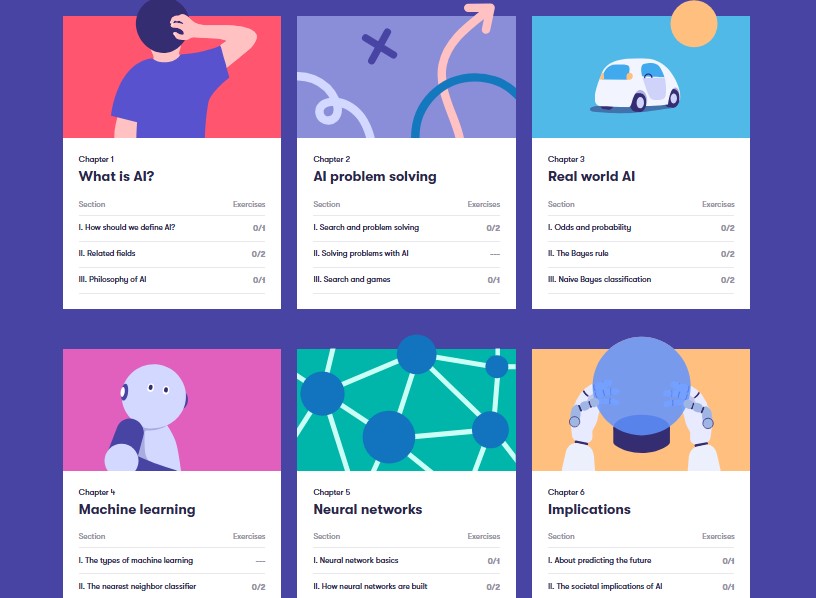
1. Elements of AI: Introduction to AI
If terms such as machine learning, neural network, and AI model still blur together, begin here. Introduction to AI, created by the University of Helsinki and MinnaLearn, builds from basic ideas to real-world applications, AI problem-solving, machine learning, neural networks, and the effects of AI on society.
You don’t need to code or bring advanced math skills. You do need to make time for the exercises. Elements of AI estimates four to eight hours for each of its six parts, making this a more substantial commitment than a one-hour overview.
Does the certificate cost extra? No. The Introduction to AI certificate is free once you meet the course requirements. You must complete at least 90% of the exercises, get at least half of them right, and complete the required peer reviews. Those reviews can mean waiting for your final result.
There’s an easy naming trap: Elements of AI also offers a course called Building AI. That course is free to study, but its electronic certificate costs €50. The two certificate policies should not be mixed up.
Choose this if: You want a solid, no-code foundation and a certificate that doesn’t require an upgrade. It is less suited to someone looking only for quick tips on a particular chatbot.
2. IBM SkillsBuild: AI Literacy
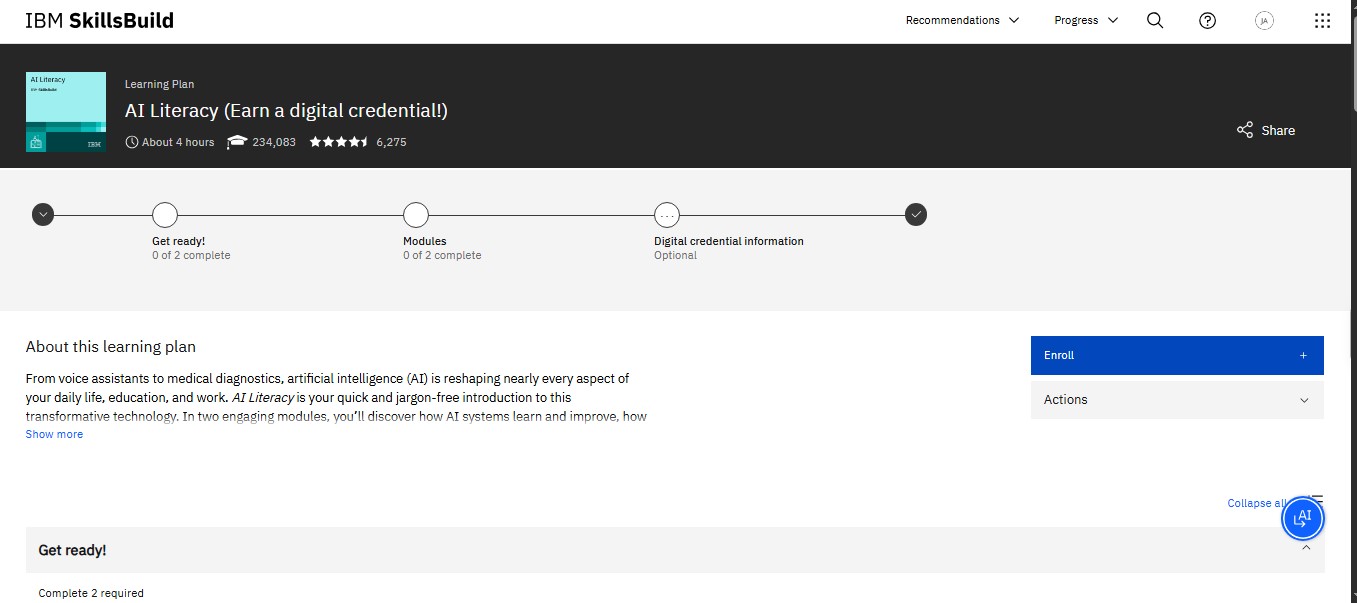
IBM’s AI Literacy is a shorter route into the subject. In about four hours, it covers how AI works, where people encounter it, what it can help with, and the risks and ethical questions that come with using it. The learning includes simple activities involving AI interfaces and practical problems.
This is a reasonable starting point if you want to understand the subject well enough to follow an AI discussion at work without committing several weekends to a course. It gives you breadth, though it cannot explore each technical idea in great depth in four hours.
Does the certificate cost extra? IBM lists a free digital credential for AI Literacy. Call it a digital credential, as IBM does, rather than a degree or a professional AI certification.
Check the title before enrolling: IBM SkillsBuild has other courses with similar names, including Artificial Intelligence Fundamentals. Those are separate learning options with different lengths.
3. Google Skills: Introduction to Generative AI
This 45-minute Google Skills course tackles a question many beginners have: What makes generative AI different from other machine-learning systems? It explains the basic idea, common uses, and some of Google’s tools.
The short length is its strength and its limit. It can help you understand what people mean by generative AI. It won’t, by itself, teach you to build and deploy an AI application.
Does the certificate cost extra? The introductory learning is available at no cost. Google’s course page uses badge language, but the broader Generative AI Fundamentals skill badge involves more than this single lesson. Google’s current beginner path lists four activities. Follow the live path’s requirements if the badge is your goal, and don’t mistake it for a Google professional certification.
Also watch the name: Google AI Essentials is a different course, offered through Coursera. Its trial and subscription terms should not be confused with this no-cost Google Skills introduction.
4. OpenAI Academy: AI Foundations
Knowing what a chatbot is and getting useful work from one are different skills. AI Foundations focuses on the second. It introduces AI and large language models, then asks you to work on a real task while practicing clear instructions, useful context, careful review, and responsible use.
You don’t need a technical background. You do need a ChatGPT account and a task you can work through. A previous Academy estimate put the course at roughly 70 minutes, although your time will depend on how much attention you give the practical activity.
Does the certificate cost extra? OpenAI Academy courses are free. For this individual course, the current reward is an AI Foundations badge: complete the course and score at least 80% on its assessment. The Foundations pathway completion certificate requires finishing the other courses in that pathway and passing their assessments. Completing AI Foundations alone earns the course badge, not the whole pathway certificate.
This is a particularly useful choice if you already use AI occasionally but tend to accept its first answer without checking it.
5. Microsoft Learn: AI Fluency
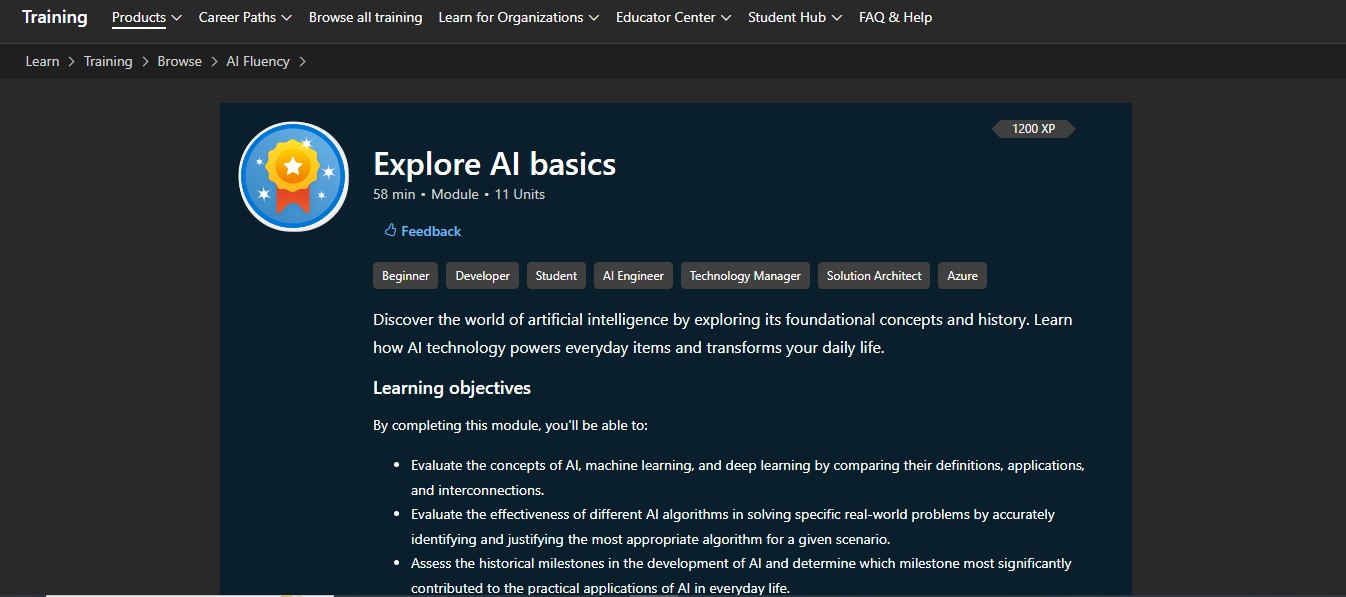
Microsoft’s AI Fluency is a seven-module learning path estimated at four hours and 38 minutes. It starts with basic AI concepts and moves through generative AI, searching and prompting, responsible use, Microsoft Copilot, workplace productivity, and accessibility.
You can read Microsoft Learn training without creating a profile. Sign in if you want to save your progress and record what you complete. The course makes the most sense for someone who wants a guided overview that includes Microsoft’s tools, although many of the basic lessons apply elsewhere too.
Does the certificate cost extra? There is no separate certificate promised for finishing this path. Microsoft Learn awards badges for completed modules and a trophy for a completed learning path. Those achievements are free. A Microsoft certification is a different credential with its own requirements; the learning-path trophy does not turn into one automatically.
6. Claude Academy: AI Fluency — Framework and Foundations
A good AI prompt is only part of doing good work with AI. You also have to decide which tasks to hand over, explain what you need, spot weak results, and take responsibility for what you use.
That is the idea behind Claude Academy’s AI Fluency course. Its four-part framework covers Delegation, Description, Discernment, and Diligence. Across 14 lessons and a quiz, you explore how generative AI works, where it struggles, how to communicate with it, and how to assess its output.
Despite the provider name, the lessons are meant to apply across AI tools. You can use another language model for the activities, and a paid chatbot subscription is not required.
Does the certificate cost extra? After finishing the four-hour course, you can take a final assessment for a completion badge. The course page describes a badge, not a separate formal certificate.
7. Cisco Networking Academy: Introduction to Modern AI
Cisco’s Introduction to Modern AI offers more opportunities to try tools as you learn. Its six-hour, self-paced course introduces AI concepts, then covers computer vision, machine translation, chatbots, and ways to write better prompts. It includes an open-ended project.
That mix makes it useful if you learn better by applying ideas than by watching a long series of explanations. The course is marked beginner level and does not require coding.
Does the certificate cost extra? Cisco lists the course as free and advertises a digital badge among its achievements. The course listing does not promise a separate professional certification. If you mention the reward on a résumé, call it a Cisco Networking Academy course badge.
8. OpenLearn: An Introduction to Artificial Intelligence
Most beginner courses focus on what AI can do for you. The Open University’s An Introduction to Artificial Intelligence spends more time on what AI might change around you.
Over about six hours, it examines AI’s history and its social, political, economic, and ethical questions. You’ll look at potential benefits, risks, fairness, and ways people might respond to the technology’s wider effects. There is no programming prerequisite.
Does the certificate cost extra? You can start reading without an account, but you need a free OpenLearn profile to track progress, access all activities, and earn the free Statement of Participation on completion. That statement is the course’s stated reward; it is not a professional AI certification.
Pick this if you want a broader perspective alongside the practical lessons offered by the other courses. Don’t pick it expecting a prompt-writing workshop.
9. DeepLearning.AI: AI for Everyone
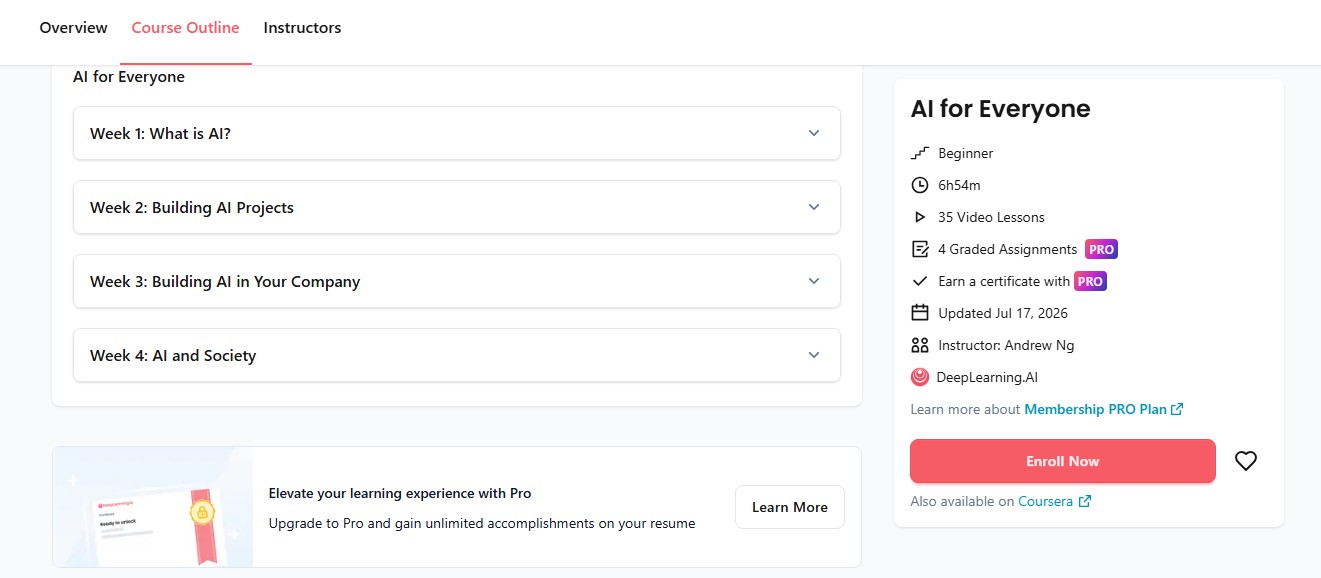
Andrew Ng’s AI for Everyone is a nontechnical course for people who need to make sense of AI decisions. It explains common terms, what AI can and cannot do, how to spot suitable projects, and what it takes for an organization to put AI to work.
That makes it especially relevant to managers, founders, and team members who may work with AI specialists without building models themselves. The course is about six hours and 54 minutes long.
Does the certificate cost extra? Yes. DeepLearning.AI lets you access the course videos for free, but its graded assignments and certificate require PRO. If you mainly want the lessons, the free access may be enough. If a certificate is your reason for enrolling, check the current PRO terms first.
This is the clearest exception in the list: the videos are free, but the full assessed experience is not.
10. Kaggle Learn: Intro to Machine Learning
Kaggle’s Intro to Machine Learning is for a different kind of beginner. You can be new to machine learning, but you should already know some Python.
In about three hours, you’ll explore data, train a first predictive model, check how well it performs, and learn about problems such as underfitting and overfitting. Later lessons introduce random forests. Instead of only hearing how models work, you begin working through the steps yourself.
Does the certificate cost extra? No. Kaggle lists the course at no cost and provides a completion certificate. Its certificate is a good match for someone who wants a first practical learning record, but it should not be mistaken for proof of advanced machine-learning ability.
If Python is unfamiliar, take Kaggle’s free Python course before this one. Otherwise, the exercises may feel like a programming problem before you reach the AI lessons.
Which course should you start with?
For a no-code introduction and a free course certificate, choose Elements of AI. Give it time; its exercises are part of what makes it useful. If you need a shorter overview first, IBM AI Literacy fits into about four hours.
If your goal is to use generative AI more effectively, decide what you most need. Google Skills explains the idea quickly. OpenAI AI Foundations gets you practicing on a real task. Claude Academy spends more time on deciding what to delegate and checking the result. Microsoft Learn is a natural fit if you also want to explore Copilot.
Choose OpenLearn for the wider social and ethical picture, or AI for Everyone for decisions about AI projects and strategy, provided you are comfortable with its paid assessment and certificate. When you are ready to build a first model and already know Python, move to Kaggle.
The credential matters, but the lesson matters more. A badge from a short introduction tells a different story from a certificate earned after exercises or a model you built. Describe what you actually completed and learned, and the recognition becomes more useful.
Frequently asked questions on free AI courses for beginners
Which free AI courses include a free certificate?
Elements of AI’s Introduction to AI and Kaggle’s Intro to Machine Learning include free course certificates. OpenAI Academy offers a completion certificate for its broader Foundations pathway after you finish the required courses and assessments; its individual AI Foundations course awards a badge.
Other courses here offer a digital credential, badge, trophy, or Statement of Participation. Those rewards are worth describing accurately rather than calling them all certificates.
Are all ten courses completely free?
You can begin the learning described in each course without paying. DeepLearning.AI’s AI for Everyone is the important exception to “completely free”: its videos are free, while graded assignments and the certificate require PRO. Some free badges or pathway certificates also require you to finish additional coursework.
Can I learn AI for free without coding?
Yes. The first nine courses do not require programming. Kaggle’s Intro to Machine Learning builds on basic Python, so leave it until you are comfortable with that language.
Is Google AI Essentials the same as Google’s free Introduction to Generative AI?
No. Introduction to Generative AI is the short course on Google Skills covered in this list. Google AI Essentials is a separate course available through Coursera, with trial and subscription terms that vary by location. Check the exact course name before enrolling.
Does Microsoft Learn give you a certificate for AI Fluency?
Completing the AI Fluency learning path earns Microsoft Learn achievements: module badges and a path trophy. It does not automatically issue a Microsoft certification certificate.
Are free AI course certificates worth putting on a resume?
They can show that you took the initiative to learn, especially when you can name a skill or exercise you completed. Use the provider’s exact credential name and be specific. “Completed Intro to Machine Learning and practiced model validation” tells a reader more than a broad claim that you are “AI certified.”