
A business deciding how to handle an agreement may be weighing two different needs: clear terms people can interpret, and a reliable way to automate routine actions. That is the practical question behind smart contracts vs traditional contracts. A traditional contract sets out an agreement in human language. A smart contract is code that can carry out specified actions when programmed conditions are met.
The two can work together. A written agreement might define a sale, delivery standards, and refund rights, while code releases a digital payment after a confirmed event. But code alone does not necessarily create a legally binding agreement. Some smart contracts are simply programs; others form part of an agreement intended to have legal effect.
| Point | Smart contract | Traditional contract |
| Basic form | Computer code, often deployed on a blockchain | Written or spoken agreement in human language |
| How it works | Runs programmed actions when specified conditions are met | Parties perform their obligations; people or institutions address disputes |
| More suitable for | Clear, repeatable tasks that can be verified digitally | Negotiation, judgment, exceptions, and detailed remedies |
| Legal effect | Depends on the agreement, facts, and applicable law | Depends on the agreement, facts, and applicable law |
| Changing the terms | May require an upgrade or a process agreed by the parties | Usually requires the parties’ agreement and may have formal requirements |
| Main risk | Code may not reflect the parties’ intent; some actions are difficult to reverse | Unclear wording or missed administrative steps can lead to disputes |
The choice between smart contracts vs traditional contracts is not a choice between technology and law. It is a question of which parts of a deal need human interpretation and which can be safely automated.
What Is a Traditional Contract?
A traditional contract is an agreement that creates obligations between parties. Depending on the law and circumstances, it may be written, spoken, or formed through conduct. A signed document is common, but a signature is only one part of the legal picture. The parties’ intentions, the terms they agreed to, and any rules for that type of transaction may also matter.
Take a company hiring a designer. The agreement might cover the work, deadlines, payment, ownership of the finished materials, confidentiality, and how either side can end the relationship. If a dispute arises, people can interpret the terms, negotiate, or use the dispute process set out in the agreement.
Traditional contracts can also be signed electronically; they do not need to be printed on paper. Requirements vary by jurisdiction and transaction. UNCITRAL’s Model Law on Electronic Signatures takes a technology-neutral approach: it considers whether an electronic method can perform the function of a signature rather than requiring one particular technology. The model law guides legislators; it does not automatically determine the rules in every country.
What Is a Smart Contract?
A smart contract is code that runs on a blockchain or another computing platform. It can carry out programmed actions when specified conditions are met. For example, code might transfer a digital asset after it receives a particular confirmation.
On Ethereum, users interact with smart contracts by sending transactions that execute functions defined in the deployed code. The program follows its instructions. It does not understand what the parties intended, decide whether a result is fair, or resolve a dispute.
The name can mislead. A program may automate a process without covering the legal terms needed for an enforceable agreement. A “smart legal contract” is a more specific arrangement: code performs or supports obligations under an agreement intended to have legal effect. That distinction is central to smart contracts vs traditional contracts.
Smart Contracts vs Traditional Contracts: The Main Differences
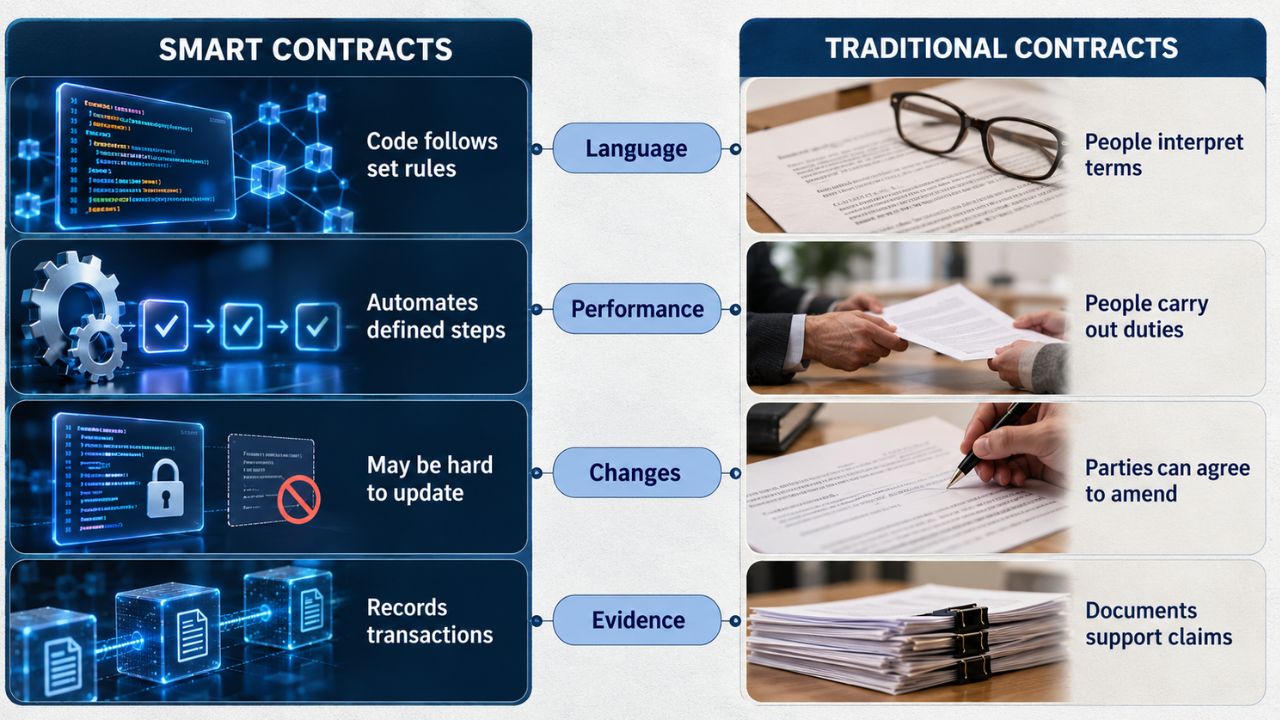
Language and interpretation
A traditional contract can define terms, assign responsibilities, describe exceptions, and explain what happens when something goes wrong. The parties can negotiate language to account for circumstances they may not have anticipated.
Code follows instructions. If a program transfers an asset when it receives a specified digital signal, it can make the transfer without checking whether the signal is accurate or the result is reasonable. It cannot independently interpret a vague promise or decide that an unusual delay deserves an exception.
That makes automation a poor fit for terms that depend on judgment. A supply agreement, for instance, may need to address damaged goods, disputed delivery records, customs delays, or other events that do not fit a simple rule.
Performance and automation
With a traditional agreement, people usually carry out the terms. A finance team sends an invoice, a customer reviews it, and payment follows. If someone does not perform, the other party may need to follow up, negotiate, or seek a remedy.
A smart contract can automate a defined step, such as releasing a digital payment after an agreed confirmation. This may reduce manual handling when the condition is precise and the information is reliable.
But automation does not remove operational work. Someone still has to write and review the code, provide accurate information, manage access, and decide what to do if the process fails. Any useful comparison of smart contracts vs traditional contracts has to include that work.
Amendments and reversibility
Parties can generally amend a traditional contract by agreement, subject to any formal requirements that apply. They can also set out how to end the agreement or respond to changed circumstances.
Changing deployed code may be harder. Some smart contracts are designed to be upgraded or paused; others are not. Even when a technical change is possible, the parties need to know who can authorize it and whether everyone affected must agree.
The written agreement should explain who can request or approve changes, who can pause a process, and what happens if the code and written terms conflict. Without those provisions, the parties may disagree over which version of the deal controls.
Evidence and transparency
Traditional agreements can be supported by signed copies, emails, invoices, delivery records, and other evidence. Their usefulness depends partly on how well the parties keep those records.
A blockchain may provide a time-stamped record of certain transactions. Depending on the system, code and transaction history may be visible to others. That record can show what the system did, but may not establish who controlled an account, why a party acted, or whether information supplied to the code was accurate.
A transaction history is evidence of recorded activity, not a complete account of the agreement.
Are Smart Contracts Legally Binding?
There is no single worldwide rule that makes every smart contract binding or invalid. The answer depends on the law governing the transaction, how the agreement was formed, what the parties intended, and whether applicable legal requirements were met.
In England and Wales, the Law Commission concluded that the existing legal framework can support smart legal contracts. It also identified possible new issues where automation raises questions about contract formation, interpretation, or remedies. This finding applies to England and Wales; it is not a global rule.
UNCITRAL’s Model Law on Automated Contracting, adopted in 2024, gives national legislators rules intended to address legal barriers to automated contracting. It is a model for countries considering legislation, not a law that automatically applies everywhere.
So, smart contracts vs traditional contracts is not a simple comparison of “legally valid” against “not legally valid.” Code may help perform an agreement, but it does not by itself guarantee that the parties formed an enforceable contract. Businesses should identify the parties, obligations, governing law, and dispute process in terms people can review.
Benefits and Limitations of Each Approach
Where smart contracts can help
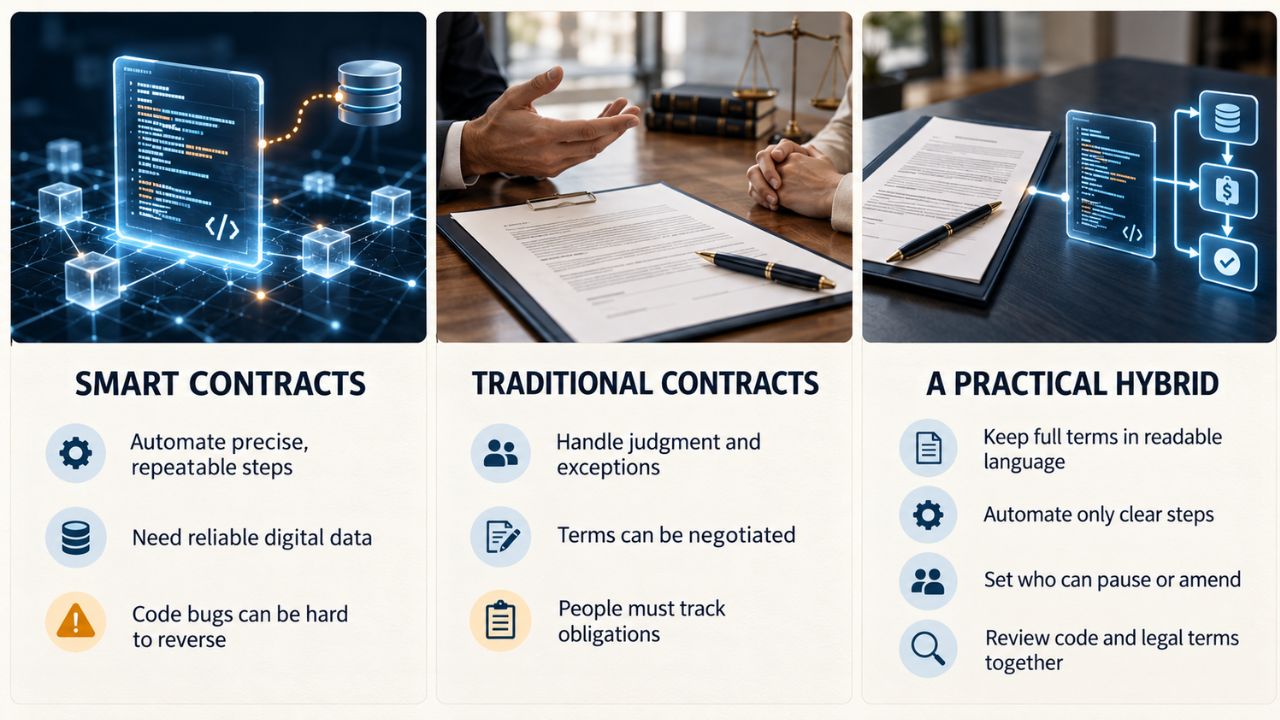
Smart contracts may suit repetitive tasks when the conditions are precise and the relevant information can be checked digitally. Once deployed, they can execute a defined instruction consistently.
The limits are practical. Code may contain a bug, depend on incorrect data, or act differently from what the parties expected. If a smart contract depends on real-world information, such as whether a shipment arrived, it needs a way to receive that data. Blockchain systems may use external data sources called oracles, which can introduce errors or security risks.
Where traditional contracts can help
Traditional contracts are usually better suited to complex arrangements involving negotiation, discretion, interpretation, or a broad set of remedies. People can assess context and respond when events do not fit a predefined rule.
They still need careful drafting and administration. Unclear wording can cause disputes, and manual processes can lead to missed deadlines. A signed agreement does not track its own obligations; someone has to manage them.
When Should a Business Use Each One?
A traditional contract is often the more practical choice when a deal covers a complex relationship, requires judgment, or depends on facts that cannot be reliably verified automatically. Employment, consulting, property, and long-term supply arrangements may need detailed terms and a clear way to handle exceptions.
A smart contract may fit one narrow task within a larger deal. Code could release a digital payment after an agreed confirmation, while a readable legal document sets the sale terms, delivery standards, refund rules, and dispute process.
For many businesses, a hybrid arrangement is the sensible starting point:
- Use readable legal terms to define responsibilities, governing law, and remedies.
- Automate only steps that are precise enough to code.
- Explain which terms control if the code and written agreement conflict.
- Decide who can pause the process or correct information.
- Have legal and technical reviewers check that the code carries out the intended task.
Before using a smart contract for a significant transaction, have the code reviewed and confirm that the legal documents cover what the code cannot. A lawyer familiar with the relevant jurisdiction and a qualified developer may both be needed.
Final Thoughts
The practical difference in smart contracts vs traditional contracts is straightforward: one explains the parties’ agreement, while the other can automate specific instructions. Neither is automatically safer or more enforceable.
For complex deals, clear legal terms matter more than automation. For narrow, repeatable tasks, code may save manual steps, provided the data and failure procedures are reliable. Before choosing, identify what must happen automatically, what still needs human judgment, and which law governs the agreement.
Frequently Asked Questions (FAQs) About Smart Contracts vs Traditional Contracts
Is a smart contract the same as a legal contract?
No. A smart contract is code that executes programmed actions. It may form part of a legally binding agreement, but the code alone does not establish that the parties formed one.
Can a traditional contract be signed electronically?
Often, yes, but the rules depend on the jurisdiction and type of transaction. Check the applicable requirements before relying on a particular signature method.
Can smart contracts be changed after deployment?
That depends on how the system was designed. Some contracts support upgrades or pauses; others may be difficult to change. The parties should also agree on who can authorize any changes.
Which type should a business choose?
Use a traditional contract when terms require interpretation or exceptions. Consider code for a clearly defined, repeatable task. Many arrangements need both.