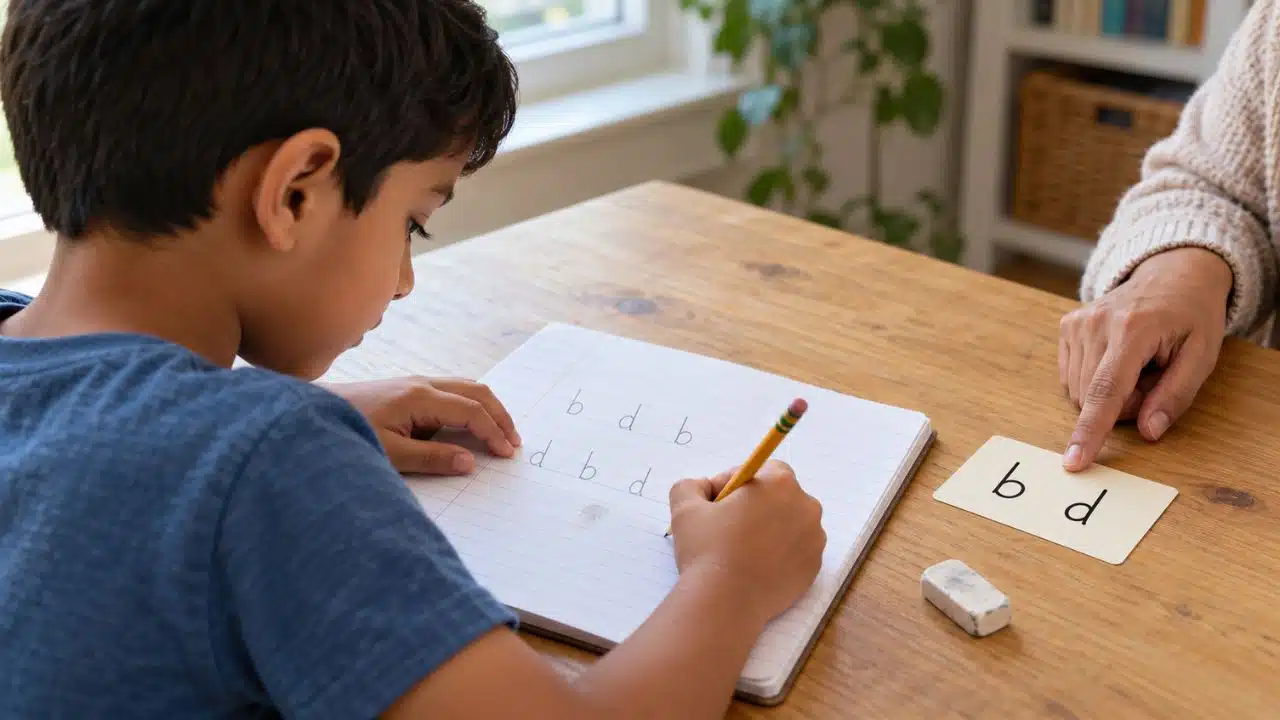
I first wondered why kids mix up b and d after noticing the mistake in my nephew Fariz’s writing when he was six. The letters share a similar shape, and children have to learn their direction as well as the movements used to write them. An occasional reversal on its own does not mean a child has dyslexia.
Fariz is seven now. He reads and spells comfortably, and I do not see the same confusion when he reads or traces letters. It happens when he writes something himself.
I have corrected him several times and reminded him to check his work afterward. These days, the mistakes happen less often, and he tries to fix them. I want to build on that progress by making the help more specific: showing how to form each letter and giving him a clear way to check it.
Why Kids Mix Up b and d
Look closely at lowercase b and d. Both have a tall line and a rounded part. In b, the rounded part sits to the right of the line. In d, it sits to the left. Direction is the crucial difference.
Children learning to read and write are still becoming familiar with these distinctions. Letter reversals occur among children with different reading abilities, so the mistake needs to be understood alongside the child’s other skills.
Handwriting adds another demand. A child must remember the letter’s form, choose where to start, and make the movements that produce it. Recognizing a printed letter and writing it independently are different tasks.
Tracing supplies the outline. Writing from memory requires the child to produce that outline. This helps explain why a child can trace a letter correctly but still reverse it in a sentence.
That is the useful distinction in Fariz’s experience. His writing gives me a specific skill to work on.

Does Confusing b and d Mean Dyslexia?
A b/d mix-up alone cannot tell you whether a child has dyslexia. Some children with dyslexia reverse letters, and others do not. Children without dyslexia can reverse them too. Dyslexia also does not mean that a person literally sees words backward.
What deserves attention is a broader pattern of difficulty with reading and spelling, particularly when it persists despite teaching and support.
Fariz’s comfortable reading and spelling, along with his improving writing, are encouraging observations. They help describe his situation, but they do not establish or rule out a diagnosis.
Age seven is not a cutoff that makes every reversal a cause for alarm. If mistakes remain frequent, interfere with schoolwork, or accompany other difficulties, speak with the child’s teacher.
How to Help a Child Who Mixes Up b and d
So far, my approach with Fariz has been to correct the mistake and ask him to check his writing. Based on the handwriting guidance I reviewed, the next step I recommend is a short sequence: demonstrate the movement, practice it, write from memory, then check it in words.
1. Demonstrate Where Each Letter Starts
Begin by asking the child’s teacher which handwriting style and prompts the school uses. Use the same approach at home so the child receives familiar instruction.
For a common print style, the two letters begin differently:
- For b: Start at the top of the tall stroke. Go down to the writing line, retrace upward to the middle, then curve to the right and around to make the rounded part.
- For d: Start with a small c-shaped curve. Continue around to close the rounded part, move up to form the tall stroke on its right, then come back down.
Write slowly and let the child watch the movement. You can add a starting dot or arrows to make the sequence easier to follow.
I would pay particular attention to that starting movement with Fariz. It gives him something concrete to practice beyond looking at the finished letter.
2. Practice One Letter at a Time When Needed
If switching between b and d leads to repeated guesses, simplify the task. Work on one letter with a few supported attempts, then practice the other separately as confidence grows. Bring both back into words once the movements are becoming more consistent.
A memory cue can help if the child understands it. For b, “bat before ball” connects the tall stroke with a bat and the rounded part with a ball. Show the letter while explaining the cue.
Choose a cue the child can use while writing. If remembering the trick becomes another source of confusion, return to the demonstration and a clear letter model.
3. Cover the Model and Write From Memory
This is the step I would prioritize for Fariz because tracing is already comfortable for him.
Try this sequence:
- Demonstrate the target letter.
- Let the child copy it.
- Cover the example and ask the child to write it again.
- Uncover the example and compare the two.
If the letter is reversed, show the movement again and offer another supported attempt. The Institute of Education Sciences includes this kind of practice from memory in its handwriting guidance.
Keep the exercise small enough that the child can concentrate on the movement. A few careful attempts give you a chance to notice where help is needed.
4. Put the Letter Into Familiar Words
Once the child can form the letter more consistently, use words they can already spell. That keeps the focus on handwriting.
For b, try bat, big, or bag. For d, try dog, dig, or dot. Briefly connect the letter to its sound, then ask the child to write the word.
Move into a short sentence when the child is ready. “The dog can dig” is one option. A child who finds that easy can write a sentence of their own.
This is where practice begins to resemble the writing that prompted the concern. A letter may look right on a practice line but still need attention when it appears among other letters in a word.
5. Make Checking a Clear, Separate Step
My reminder to Fariz has been to check properly after writing. To make that instruction more useful, I recommend giving the child a specific target.
After a sentence or short section, ask them to:
- Read back what they wrote.
- Find words containing b or d.
- Check the letters against a correct example.
- Fix any reversal they notice.
A small reference card beside the page can help. Use the same letter forms the child has been taught.
If they miss an error, point it out calmly. For example: “This word needs a b. Let’s look at where it starts.” Demonstrate again if necessary, then let the child make the correction.
I would keep this check focused on the target letters. Spacing, punctuation, and other corrections can have their own turn.
6. Keep Practice Brief and Acknowledge Progress
Short, repeated handwriting sessions give children opportunities to practice without filling an entire page with the same letter. Start with a few careful attempts and a familiar word or sentence.
When a child spots a reversal, acknowledge the correction. “You noticed it and fixed it” gives attention to a useful skill they can apply independently.
That matters to me because Fariz is already trying to put his mistakes right. I want that willingness to continue.
Keep an occasional dated writing sample as well. Comparing ordinary pieces of writing can show whether the problem is becoming less frequent and gives a teacher something concrete to look at.
Where Tracing App Can Help
Our team at Editorialge developed Alphabet Magic trace & phonics, which I have used with Fariz during his earlier alphabet learning. It includes uppercase and lowercase tracing, letter matching, and phonics activities.
For this particular difficulty, I see tracing as an optional reminder before writing on paper. After a guided activity, ask the child to produce the letter without an outline and use it in a familiar word.
The useful question is whether that practice carries into independent writing. Fariz’s recent improvement is something I have observed; I cannot attribute it to the app.


When to Ask a Teacher for Help
You can discuss recurring reversals with a teacher even while a child is improving. Bring a couple of writing samples and explain where the mistakes occur: during reading, copying, tracing, writing from memory, or several of these.
Ask whether the teacher sees the same pattern and which formation prompts to use at home.
Further advice is especially useful when reversals remain frequent despite clear teaching and practice, or when you notice:
- Reading that is unusually slow, hesitant or difficult.
- Persistent problems with spelling or connecting letters and sounds.
- Handwriting difficulties that interfere with schoolwork.
- Growing frustration or avoidance of reading and writing.
A teacher or learning support specialist can help identify appropriate support. If broader difficulties continue, an assessment by a qualified professional may clarify the child’s needs. A doctor can help investigate concerns such as hearing or vision when relevant.
You do not need to wait for a particular birthday to raise a concern.
Helping Him Keep Writing
Fariz is increasingly trying to correct his own mistakes. For me, that is a useful place to build from: give him a clear movement to practice and enough support to recognize when a letter needs another attempt.
I also want to pay attention to what he is writing about. A reversed letter needs help, but it should not become the only thing an adult notices on the page. My aim is for him to become more comfortable with handwriting while keeping the confidence to put his thoughts into words.
Frequently Asked Questions on Why Kids Mix Up b and d
1. Is It Normal for a Seven-Year-Old to Mix Up b and d?
Occasional reversals can still happen at seven. Consider how often they occur, whether they are decreasing, and how the child manages other reading and writing tasks. Discuss frequent or persistent errors with a teacher.
2. Why Does My Child Read b and d Correctly but Write Them Backward?
Reading presents the letter for the child to recognize. Independent writing requires recalling its shape and producing the right movements. Practice that includes writing without a visible model can help address that specific task.
3. Should I Teach b and d Together?
A brief comparison can show how the letters differ. If switching between them makes practice confusing, give each letter separate attention first, then return to mixed practice as the child becomes more secure.
4. Should I Correct Every Reversal Immediately?
During a focused letter exercise, give prompt feedback and demonstrate the movement again. During a longer piece of writing, I suggest letting the child finish a manageable section before checking the target letters together.
5. How Long Does It Take to Stop Reversing Letters?
There is no fixed timetable. Look for progress in everyday writing and increasing independence when checking. If the difficulty stays frequent or causes frustration despite support, speak with the child’s teacher.