History is rarely a quiet affair, and October 2 serves as a magnificent testament to the turbulent, inspiring, and profound nature of the human journey. Whether you are a dedicated history enthusiast, an academic archivist, or simply a curious reader wondering about the historical footprint of this specific date, exploring the events of October 2 offers a sweeping and dramatic journey through time.
Some dates on the calendar pass by with little more than a whisper, but October 2 has consistently echoed with the sounds of revolution, the birth of global icons, the fall of empires, and the dawn of groundbreaking cultural phenomena. It is the day the world welcomed the architect of non-violent resistance. It is the day nations fought for their sovereignty, and it is the day when some of the greatest minds in literature, art, and politics either took their first breath or their last.
In this comprehensive editorial feature, we will embark on an in-depth exploration of October 2. We will begin our journey by examining the monumental historical milestones of the Bangalee sphere and the Indian subcontinent, move through significant international observances, dissect major world-altering global events by region, and finally honor the lives of the most influential figures born or lost on this day.
The Bangalee Sphere & The Indian Subcontinent
The Indian subcontinent, encompassing modern-day India, Bangladesh, and Pakistan, shares a complex, deeply intertwined history. On October 2, this region has witnessed events of tremendous political and cultural magnitude that continue to shape the socio-political landscape of South Asia today.
Major Historical Events
-
1869 – The Birth of an Era (India): Mohandas Karamchand Gandhi was born in the coastal town of Porbandar, Gujarat. While this is a birth anniversary, it functions as a historical epoch. Gandhi’s philosophy of Satyagraha (insistence on truth) and Ahimsa (non-violence) did not just dismantle the British Raj; it permanently altered the psychological approach to civil resistance globally, directly influencing leaders like Martin Luther King Jr. and Nelson Mandela.
-
1977 – The Dhaka Military Coup Attempt (Bangladesh): Bangladesh’s early years as a sovereign nation were fraught with political instability. On October 2, 1977, while the government of President General Ziaur Rahman was distracted by the intense, internationally broadcast hijacking of Japan Airlines Flight 472 at Dhaka Airport, a faction of the Bangladesh Air Force and Army launched a violent mutiny. The coup failed, leading to a massive and swift military crackdown. Hundreds of military personnel were executed in the aftermath, leaving a controversial and traumatic scar on the nation’s political history.
-
1996 – Bangabandhu Murder Case Filed (Bangladesh): In a monumental legal milestone for the Bangalee nation, an official murder case was filed on October 2, 1996, regarding the brutal August 15, 1975 assassination of Sheikh Mujibur Rahman, the founding father of Bangladesh. For over two decades, the perpetrators had been shielded by the Indemnity Act. The filing of this case marked the beginning of a long quest for national justice and closure.
Famous Births and Deaths in the Region
-
Lal Bahadur Shastri (Born 1904, India): India’s second Prime Minister was born on the same day as Mahatma Gandhi. A man of immense integrity and humility, Shastri led India through the crucial Indo-Pakistani War of 1965. He is forever remembered for coining the unifying national slogan “Jai Jawan, Jai Kisan” (Hail the Soldier, Hail the Farmer), which galvanized the nation during a period of severe food shortages and military threat.
-
Faruq Mahfuz Anam / “James” (Born 1964, Bangladesh): Born in Naogaon, James is arguably the most iconic rock musician in Bangladesh’s history. As the frontman of Nagar Baul, his distinct baritone and psychedelic rock infused with Baul mysticism revolutionized Bengali band music and earned him massive acclaim across the border in Bollywood.
-
Swami Abhedananda (Died 1939, India): A direct disciple of the mystic Ramakrishna Paramahamsa, Abhedananda was a prominent spiritual leader and philosopher who spent a quarter of a century in the United States and Europe disseminating the teachings of Vedanta.
International Observances & Holidays
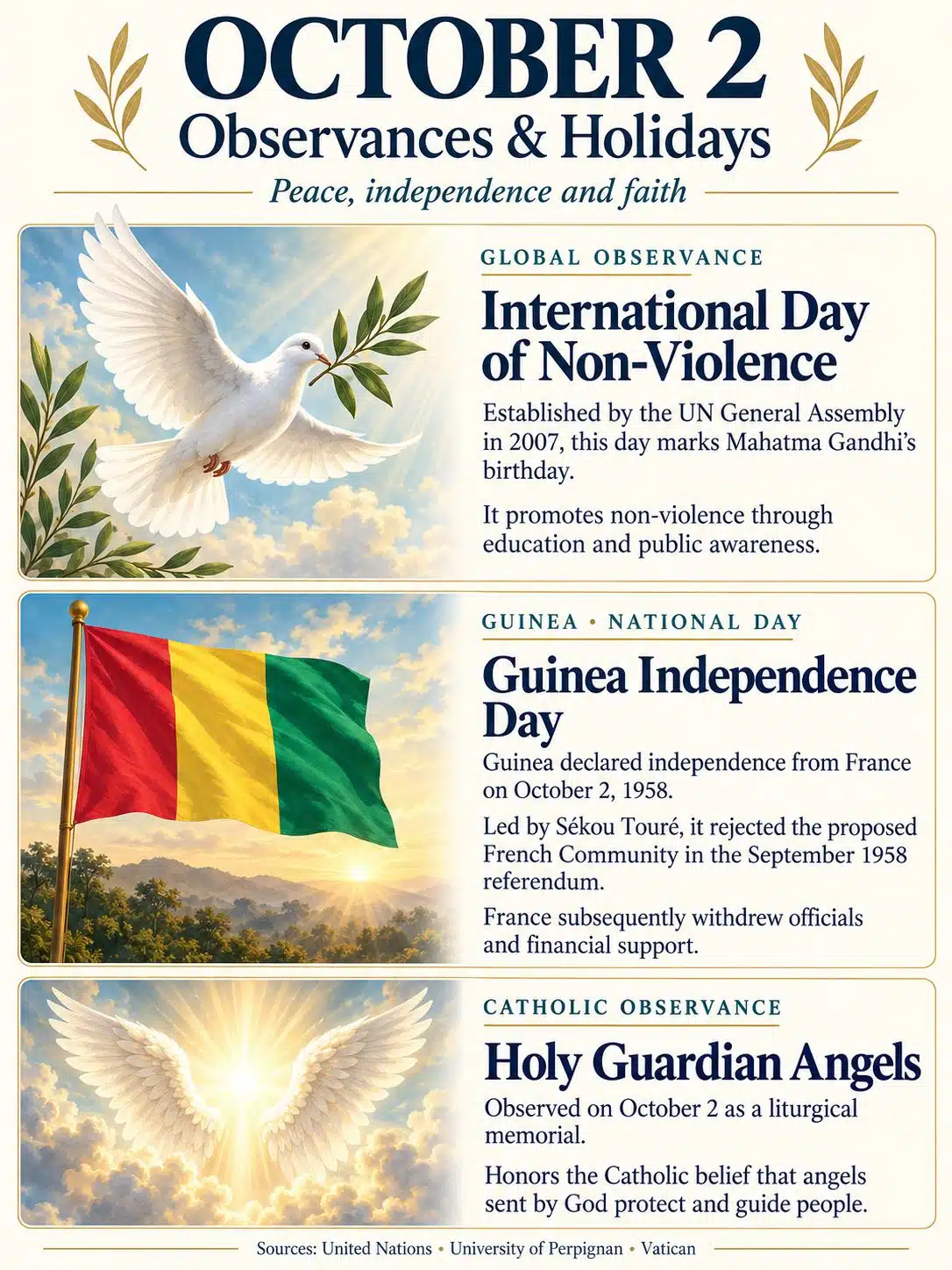
October 2 is recognized globally through various deeply meaningful observances, blending cultural reverence with calls for global peace.
-
International Day of Non-Violence (Global): Established by the United Nations General Assembly in 2007, this day is deliberately timed to coincide with Mahatma Gandhi’s birthday. It serves as an international platform to disseminate the message of non-violence, emphasizing that the most profound political and social changes can be achieved without shedding blood.
-
Guinea Independence Day (National Day): On October 2, 1958, Guinea declared its absolute independence from France. Under the fierce leadership of Sékou Touré, Guinea was the only French sub-Saharan African colony to vote “No” to joining the newly proposed French Community. This bold rejection sent shockwaves through the continent, accelerating the Pan-African movement. In retaliation, the departing French administration stripped the country of all its infrastructure—taking everything from telephone wires to lightbulbs.
-
Feast of the Guardian Angels (Catholic Church): A traditional Christian observance honoring the belief that spiritual beings are assigned by God to protect and guide human beings.
Global History
Beyond the borders of South Asia, October 2 has been a silent witness to some of the most dramatic shifts in human history, spanning across continents and centuries.
United States
-
1919 – Woodrow Wilson’s Secret Stroke: Following an exhausting national tour to promote the League of Nations, U.S. President Woodrow Wilson suffered a massive, debilitating stroke on October 2. He was left partially paralyzed. In what is often described as a “secret presidency,” his wife, Edith Wilson, effectively took over the executive branch’s daily operations, deciding which matters were important enough to bring to the bedridden President.
-
1967 – Thurgood Marshall Breaks the Barrier: Thurgood Marshall was officially sworn in as the first African American Associate Justice of the U.S. Supreme Court. Before this, as an NAACP lawyer, he famously won the Brown v. Board of Education case, striking down racial segregation in public schools. His appointment was a watershed moment in American civil rights history.
-
2002 – The Beltway Sniper Attacks Begin: A terrifying three-week ordeal began in the Washington, D.C. metropolitan area when John Allen Muhammad and Lee Boyd Malvo began a series of coordinated, random sniper shootings that left ten people dead and a region paralyzed by fear.
Russia & Eastern Europe
-
1552 – The Fall of Kazan: Russian Tsar Ivan the Terrible successfully led his troops into the city of Kazan, ending the Khanate of Kazan. This pivotal military victory allowed Russia to expand east of the Ural Mountains, fundamentally transforming Russia into a vast, multi-ethnic empire.
-
1941 – Operation Typhoon Begins: In the freezing, muddy trenches of World War II, Nazi Germany launched a massive, all-out offensive aimed at capturing Moscow. Despite the staggering might of the German war machine, fierce Soviet resistance and the brutal onset of the Russian winter halted the advance. The failure of Operation Typhoon proved to be a fatal turning point for Hitler’s ambitions.
Western Europe
-
1928 – The Foundation of Opus Dei (Spain): Catholic priest Josemaría Escrivá founded Opus Dei in Madrid. The institution, which preaches that everyday life and professional work are paths to spiritual sanctity, has since grown into one of the most influential, wealthy, and heavily debated organizations within the modern Catholic Church.
-
1944 – The Warsaw Uprising Ends: After 63 days of unimaginable urban warfare, the Polish Home Army was forced to surrender to Nazi forces on October 2. The resistance fighters had hoped for Soviet assistance, which never materialized. The Nazis subsequently razed Warsaw to the ground in retaliation.
United Kingdom
-
1925 – The Dawn of Television: Scottish engineer and inventor John Logie Baird successfully transmitted the first recognizable greyscale television image—a ventriloquist’s dummy named “Stooky Bill”—in his London laboratory. This breakthrough laid the foundation for the visual broadcast medium that dictates modern global culture.
China
-
1990 – Guangzhou Baiyun Airport Tragedy: A hijacked Xiamen Airlines flight attempting an emergency landing collided with two other passenger jets on the runway in Guangzhou, resulting in 128 fatalities. The horrific tragedy exposed severe flaws in China’s aviation security and led to sweeping, modernization-focused reforms in global anti-hijacking protocols.
Australia & Canada
-
1956 – Operation Buffalo (Australia): The British military detonated an atomic bomb in Maralinga, South Australia. The devastating radioactive fallout severely impacted the local Aboriginal populations, poisoning their ancestral lands and triggering a decades-long struggle for indigenous environmental justice.
-
1535 – Cartier Reaches Hochelaga (Canada): French explorer Jacques Cartier navigated the St. Lawrence River and arrived at the Iroquoian village of Hochelaga. His mapping of this territory laid the groundwork for what would eventually become the vibrant city of Montreal.
South America
-
1968 – Tlatelolco Massacre (Mexico): Just ten days before the Summer Olympics were set to open in Mexico City, military and police forces fired into a crowd of peaceful student protesters in the Plaza de las Tres Culturas. The massacre, which left hundreds dead, shattered the illusion of Mexican democratic stability and exposed the authoritarianism of the ruling PRI party.
-
1992 – Carandiru Massacre (Brazil): A riot inside the Carandiru Penitentiary in São Paulo was met with extreme and lethal force by the military police, resulting in the deaths of 111 inmates. It remains one of the darkest human rights violations in Brazilian history, sparking international outrage regarding prison conditions.
Notable Births & Deaths (Global)
History is an intricate mosaic constructed by the individuals who dare to push boundaries. From visionary storytellers to controversial politicians, the people born and lost on October 2 have left indelible marks on our global consciousness.
Famous Birthdays on October 2
-
Nat Turner (Born 1800, American): An enslaved African American preacher who orchestrated and led the deadliest slave rebellion in United States history in August 1831. Though the rebellion was brutally suppressed and Turner was executed, his actions shattered the Southern myth of the “contented slave” and became a potent, enduring symbol of Black resistance to oppression.
-
Groucho Marx (Born 1890, American): Born Julius Henry Marx, Groucho was a master of the quick-witted retort, a brilliant physical comedian, and the leader of the legendary Marx Brothers. With his greasepaint mustache, omnipresent cigar, and stooped walk, he revolutionized American cinematic comedy in films like Duck Soup.
-
Graham Greene (Born 1904, English): Widely regarded as one of the greatest English novelists of the 20th century. His literature, including masterpieces like The Power and the Glory and The Quiet American, deeply explored the ambivalent moral, religious, and political landscapes of the modern world.
-
Annie Leibovitz (Born 1949, American): One of the most celebrated portrait photographers in modern history. From her early days at Rolling Stone magazine to capturing iconic, intimate images of celebrities and world leaders (including the famous photo of John Lennon and Yoko Ono taken hours before Lennon’s death), her lens has defined pop-culture imagery for decades.
-
Sting (Born 1951, English): Born Gordon Matthew Thomas Sumner, Sting rose to global prominence as the frontman and bassist for the pioneering rock band The Police before launching a massively successful solo career.
Famous Deaths on October 2
-
Samuel Adams (Died 1803, American): A vital Founding Father of the United States and a chief architect of the American Revolution. Adams was instrumental in organizing colonial resistance to British taxation, famously helping to orchestrate the Boston Tea Party.
-
Marcel Duchamp (Died 1968, French): A radical artist whose work is associated with the Cubist, Dada, and conceptual art movements. By submitting a porcelain urinal titled Fountain to an art exhibition in 1917, Duchamp shattered the traditional definition of art, arguing that the idea behind the work is more important than the physical object itself.
-
Rock Hudson (Died 1985, American): A towering icon of Hollywood’s Golden Age, known for leading roles in Giant and a series of beloved romantic comedies. Hudson’s death from AIDS-related complications in 1985 sent shockwaves through the world. As the first major celebrity to publicly acknowledge his diagnosis, his death profoundly shifted public perception, drastically increasing awareness and funding for HIV/AIDS research.
-
Tom Petty (Died 2017, American): The heartland rock icon and lead singer of Tom Petty and the Heartbreakers. Known for anthems like “Free Fallin'” and “American Girl,” Petty sold over 80 million records worldwide, leaving a massive cultural imprint on American rock music.
-
Jamal Khashoggi (Died 2018, Saudi Arabian): A prominent journalist, author, and dissident who was brutally assassinated inside the Saudi consulate in Istanbul, Turkey. His premeditated murder triggered a massive international human rights crisis, severely straining diplomatic relations and exposing the violent lengths authoritarian regimes will go to suppress press freedom.
“Did You Know?” Trivia
If you are looking for fascinating, lesser-known facts to share at the dinner table, October 2 has provided some incredible cultural footnotes:
-
The Origin of “Canada”: When French explorer Jacques Cartier arrived in indigenous territories in early October 1535, he misunderstood the local St. Lawrence Iroquoian word kanata (which simply meant “village” or “settlement”) as the name of the entire region. This linguistic misinterpretation officially gave the nation of Canada its name.
-
The Birth of Snoopy and Charlie Brown: On October 2, 1950, Charles M. Schulz’s iconic comic strip Peanuts was published for the very first time in just seven U.S. newspapers. Interestingly, Schulz originally wanted to name the famous beagle “Sniffy,” but changed it because the name was already in use by another comic.
-
Entering the Twilight Zone: The groundbreaking science-fiction, psychological thriller anthology series The Twilight Zone, created by the brilliant Rod Serling, premiered on television on October 2, 1959. It forever changed the landscape of speculative and philosophical storytelling in media.
-
The Gatorade Experiment: On October 2, 1965, players for the University of Florida football team tested a brand new, scientifically formulated carbohydrate-electrolyte beverage during a game. Designed to replenish fluids lost through intense sweating, the drink was aptly named “Gatorade,” birthing the multi-billion dollar sports drink industry.
Quote of the Day
“Non-violence is the greatest force at the disposal of mankind. It is mightier than the mightiest weapon of destruction devised by the ingenuity of man.”
— Mahatma Gandhi (Born October 2, 1869)
Final Thoughts
The tapestry of October 2 is woven with threads of deep contrast. It is a day that celebrates the peaceful philosophies of Mahatma Gandhi, yet remembers the violent struggles for independence and the tragic consequences of political coups and massacres. It marks the humble beginnings of beloved cultural touchstones like Peanuts and television itself, while serving as the final curtain call for titans of art, politics, and cinema.
History is rarely stagnant; it is an active, breathing force that informs our modern reality. By looking back at the events of October 2, we gain a clearer understanding of how the world we navigate today was built—one brilliant invention, one bold declaration, and one tragic loss at a time.