Tracing books are sold for surprisingly young children. Their age labels can leave parents wondering whether a toddler who prefers scribbling should already be following dotted letters.
Usually, there is no reason to rush.
So, when should kids start tracing letters? Many children are ready to try simple letter tracing around age 3 or 4, but age alone is a poor test. A child who can make intentional marks, copy a few basic lines, and follow a broad path may enjoy tracing. Another child of the same age may still need larger, freer drawing activities.
Tracing is only one small part of learning to write. Before children form letters, they learn how a crayon moves, how much pressure to use, how to stop at a point, and how to make a hand follow what the eyes see. Scribbling, drawing, painting, and copying shapes all contribute to that process.
When Should Kids Start Tracing Letters?
The preschool years are a reasonable time to introduce tracing, provided the activity matches the child’s current abilities.
The CDC lists scribbling as a milestone by 18 months. Its guidance for children around 30 months suggests inviting them to copy a straight line and later showing them how to draw a circle. By age 3, drawing a circle after an adult demonstrates it is listed as a developmental milestone.
Those milestones provide context, not a handwriting schedule. They do not mean that a child who scribbles at 18 months should move directly to letters, or that every 3-year-old should complete tracing worksheets. CDC milestone checklists are monitoring tools, not diagnostic assessments.
In practical terms, the progression often looks less tidy:
- A toddler experiments with scribbles and broad marks.
- A slightly older child begins copying lines, curves, and circles.
- Familiar letters start appearing among drawings and letter-like shapes.
- Tracing becomes easier once the child understands the movement involved.
- Copying and independent letter formation develop gradually afterward.
Children may move between these stages. A preschooler might write the first letter of their name from memory yet still fill the rest of the page with scribbles. That mix is normal in early writing.
Readiness Matters More Than the Workbook Label
A workbook marked “ages 2–4” is not evidence that every 2-year-old should be able to use it. Publishers choose broad marketing ranges; children do not develop on a packaging schedule.
Look at what the child can do without heavy adult assistance. Possible signs of readiness include:
- Making deliberate marks with a crayon or pencil
- Copying a vertical line, horizontal line, curve, or circle
- Following a wide path on paper
- Recognizing a few familiar letters
- Understanding directions such as “start here” or “go down”
- Showing curiosity when someone writes
- Staying with a brief drawing activity without becoming distressed
A child does not need to demonstrate every item. Interest can compensate for limited control, especially when the activity remains easy and playful.
The reverse is also useful. If an adult has to hold and guide the child’s hand through every letter, the task is probably too difficult. Hand-over-hand assistance may help in some therapeutic or individually planned situations, but it should not be the default way to push a toddler through an alphabet page.
Return to broad lines, circles, paint, chalk, or finger tracing instead.
Start With the Movements Inside Letters
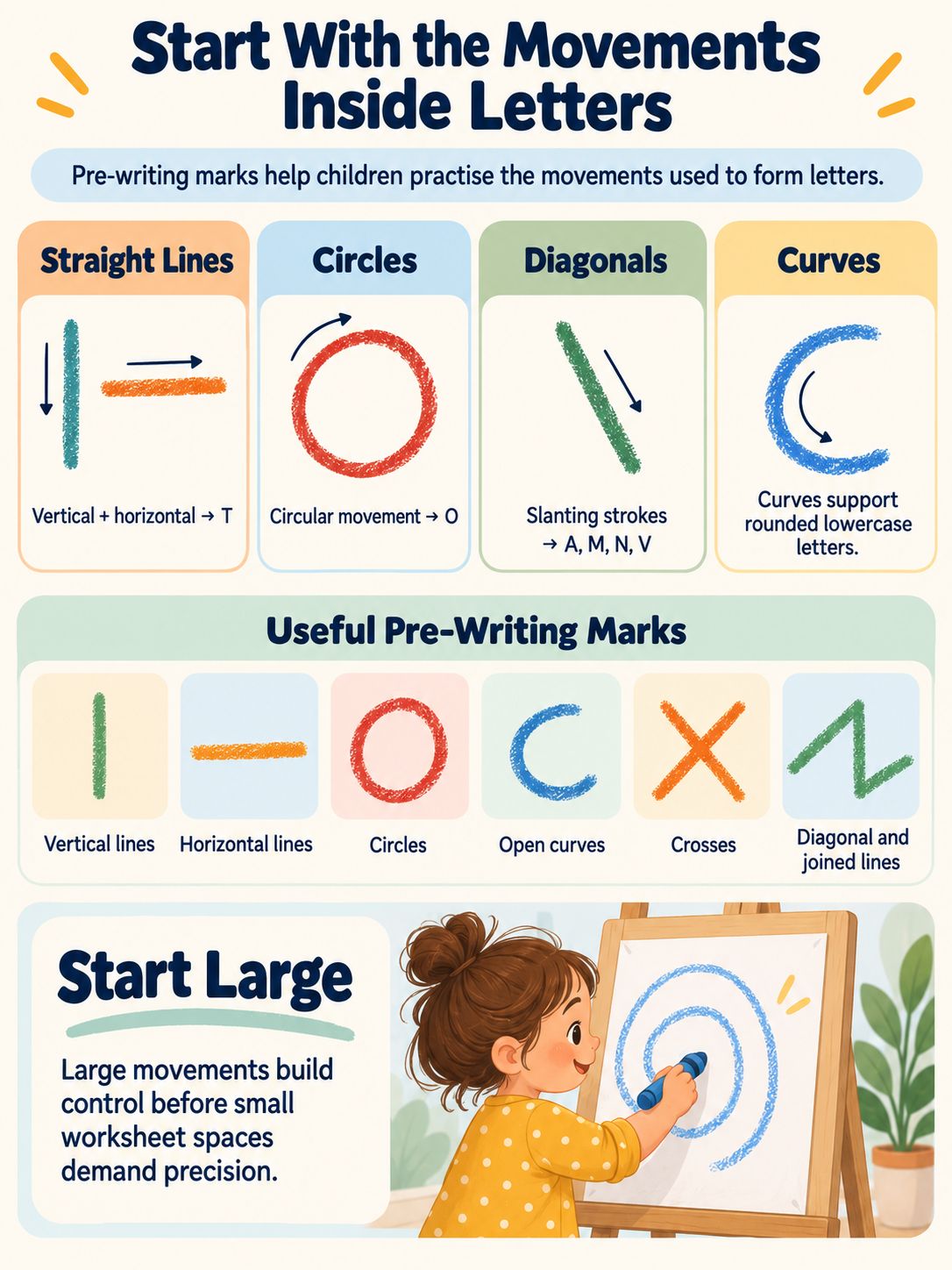
Letters are combinations of lines and curves. Children generally find them easier when the underlying movements are already familiar.
A capital T uses a vertical and a horizontal stroke. O requires a circular movement. A, M, N, and V contain diagonals, which can be harder to control. Rounded lowercase letters may present a different challenge because the child must manage curves, size, and direction at the same time.
Useful pre-writing marks include:
- Vertical and horizontal lines
- Circles and open curves
- Crosses
- Diagonal lines
- Joined lines
- Simple geometric shapes
There is no benefit in drilling these shapes until they look perfect. The child needs experience controlling the movement, not a test sheet full of identical crosses.
Large movements are often easier at first. A child might draw a vertical line on an easel before managing the same movement inside a small worksheet box. That is not a step backward; the larger surface reduces the precision required.
Scribbling Is Part of Learning to Write
Adults sometimes treat scribbling as something children should quickly outgrow. That view misses what the child is practising.
Through scribbling, children see that a hand movement produces a visible result. They experiment with direction, speed, pressure, and space. Over time, random-looking marks become more controlled. Some begin to stand for people, objects, or messages even when an adult cannot recognize them.
Head Start’s early-writing framework reflects this broad development from drawing and scribbling to letter-like forms and recognizable letters. Children may use several forms at once rather than leaving one stage behind before entering the next.
Give young children blank paper as well as guided activities. If every page contains dots, arrows, or narrow paths, they get little room to decide what marks they want to make.
Free drawing and letter instruction are not competitors. Children need both.
Tracing, Imitating, and Copying Are Not the Same
These terms are often used as if they describe one skill, but they place different demands on the child.
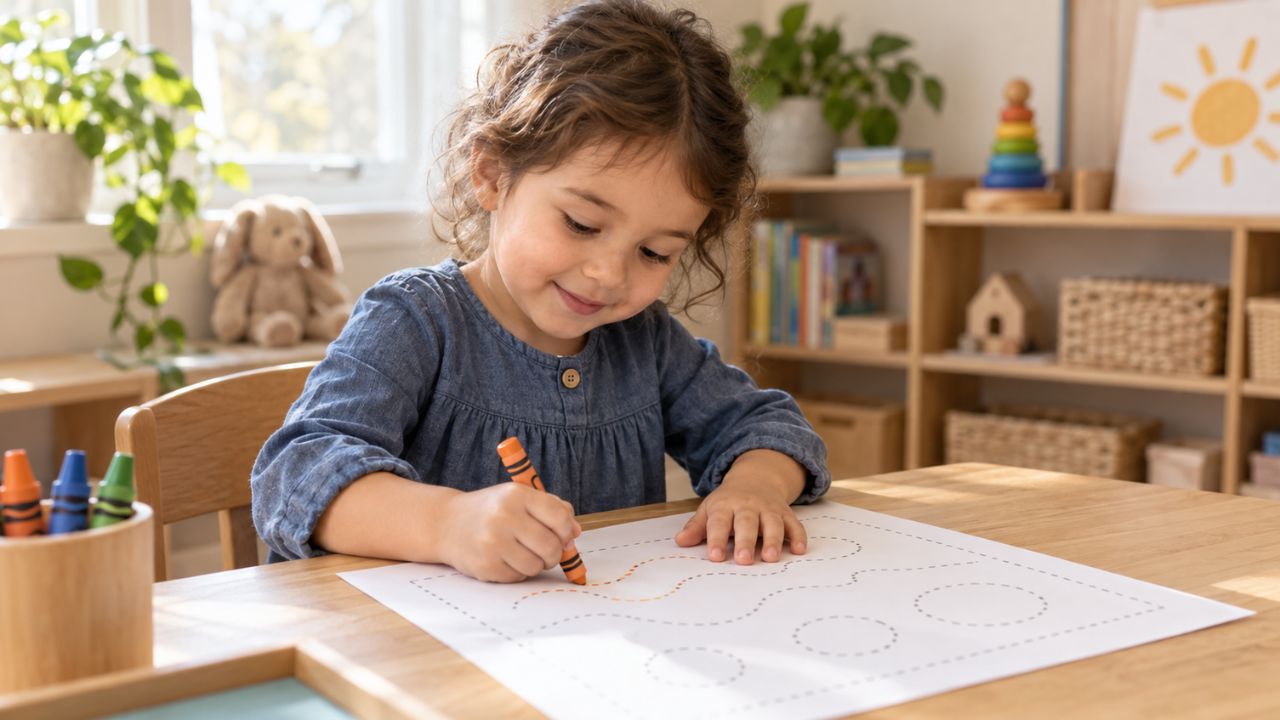
With tracing, the path appears beneath the crayon or pencil. The child has a continuous visual guide.
With imitation, the child watches an adult make the shape and then tries the same movement.
With copying, the completed shape sits nearby, and the child must work out how to reproduce it.
Consider a circle. A child might trace a printed circle neatly but draw an uneven loop when asked to copy one. Tracing supplied the route; copying required the child to remember and plan it.
This is why more tracing is not always the answer when a child cannot form a letter alone. The missing step may be learning where to begin, which direction to move, or how the strokes fit together.
Once tracing becomes comfortable, alternate it with imitation and copying. Otherwise, the child may become good at following dots without learning to produce the letter independently.
Introduce One or Two Useful Letters
Starting with the entire alphabet creates unnecessary work. A letter from the child’s name is more meaningful, although the first letter is not automatically the easiest one.
Make the letter large. Demonstrate it slowly, using a short movement cue such as “down and across” or “around and back.” Then let the child explore it in more than one way.
A sensible sequence is:
- Show the letter and say its name.
- Demonstrate how to form it.
- Let the child follow it with a finger.
- Make the same movement in sand, flour, foam, or water.
- Trace a broad version with chalk or crayon.
- Copy the letter beside a clear model when ready.
There is no reason to complete all six steps in one session. Two comfortable attempts may be enough for a young preschooler.
Correct the starting point or direction through calm modelling. Repeatedly forming a letter in an awkward way can establish an inefficient habit, but constant criticism is equally unhelpful. Preschool writing will be uneven. The immediate priorities are comfort, control, and understanding the movement.
Use Materials That Do Not Make the Task Harder
Many commercial worksheets use small letters and narrow dotted paths. Those pages can be frustrating for a child who is still drawing mainly from the shoulder and elbow.
Try:
- Chunky or short crayons
- Pavement chalk
- Paintbrushes and water
- Large paper attached to a wall or easel
- A shallow tray of sand or flour
- Letters formed from play dough or string
- Textured letters made from card
- A wipe-clean board with broad paths
Short crayons are often easier to control because there is less space for the child to wrap the whole hand around the tool. A special pencil grip is not automatically necessary, and it will not solve every control problem. Consider one only when a child has persistent difficulty holding the tool comfortably, ideally with guidance from an educator or therapist who understands the child’s needs.
Check the seating as well. A child who is stretching to reach a high table or balancing on a chair without foot support has to work harder to control the hand.
A vertical surface can encourage broad arm movement and a stable wrist, but it is not compulsory. Use the position in which the child can work comfortably.
Do Not Force an Adult Pencil Grip
Young children use several grasp patterns as their hands develop. Some hold a crayon in the fist before moving toward a finger-based grip. A mature tripod grasp may not become consistent until the early school years.
How the grip functions matters more than whether it looks textbook-perfect. Watch for:
- Pain or complaints of discomfort
- An unusually tight grasp
- Broken crayons or torn paper from heavy pressure
- Very limited control
- Rapid fatigue
- A wrist position that makes movement difficult
Repeatedly rearranging a child’s fingers can interrupt the activity and create tension around writing. Offer an appropriately sized tool, demonstrate a comfortable hold, and make a gentle correction when needed. Do not turn every drawing into a grip lesson.
For a left-handed child, place the paper slightly to the left of the body and try tilting it clockwise, with the upper-left corner higher. This can help the child see the line without curling the wrist over the page. Do not pressure a left-handed child to use the right hand.
When Tracing Creates Frustration
A child who refuses tracing is not necessarily refusing to learn. The page may be too crowded. The path may be too narrow. The pencil may feel uncomfortable, or the child may see no purpose in repeating an unfamiliar letter.
Change one part of the activity:
- Trace a road and drive a toy car along it.
- Draw a giant letter outdoors with water.
- Use a finger instead of a pencil.
- Let the child select the letter or color.
- Practise a letter from a favorite name or familiar word.
- Replace the worksheet with drawing and simple copying.
If the child enjoys drawing and experiments with letters but dislikes tracing sheets, forcing the sheets offers little value. Workbooks are convenient for adults, but they are not a required stage of literacy development.
Keep practice short enough that the child finishes successfully. Signs of fatigue include pressing harder, losing control, frequently switching grip, or trying to escape the activity. Stopping at that point is more productive than insisting on one final row.
When to Ask for Additional Guidance
Reluctance to complete a worksheet, untidy marks, or an immature grip does not by itself indicate a developmental disorder.
It is worth speaking with the child’s educator or health professional when difficulty is persistent and affects more than letter practice. Watch for pain, pronounced fatigue, loss of previously acquired skills, or trouble with several everyday hand tasks such as using utensils, turning pages, manipulating fasteners, or handling small toys.
A pediatrician, family doctor, child health professional, or early-years educator can help determine whether further assessment is appropriate. Occupational therapy may be useful when motor, sensory, or functional difficulties are limiting the child’s participation in daily activities. Referral routes and eligibility vary between health and education systems.
Final Thoughts
The practical answer to when should kids start tracing letters is to begin when the child is curious and the movement is manageable—often around age 3 or 4, but not always.
Choose one familiar letter, make it large, and let the child explore it with a finger, chalk, paint, or crayon. If that goes well, demonstrate how to form it and invite the child to copy it. If it leads to strain or frustration, return to drawing and simpler marks for a while.
There is no prize for finishing an alphabet workbook early. The more useful outcome is a child who sees writing as something meaningful, feels comfortable making marks, and is willing to keep trying.
Frequently Asked Questions
Should children trace uppercase or lowercase letters first?
There is no universal rule, and the approach may vary by school or writing program. Uppercase letters often use larger, simpler strokes, which can make some of them easier to introduce. Lowercase letters appear more frequently in books and everyday writing. Start with a meaningful letter the child can manage, then follow the formation style used by their school.
Is it a problem if a child writes letters backward?
Letter reversals are common during early writing. Young children are still learning direction, orientation, and the visual details that distinguish letters such as b, d, p, and q. Calmly show the correct formation, but do not treat an occasional reversal as a serious problem. Ask an educator or health professional for guidance if reversals continue alongside broader reading, writing, or developmental difficulties.
Does a child need to use a pencil for tracing practice?
No. Fingers, chalk, crayons, paintbrushes, and sticks used in sand can all introduce the movements found in letters. A pencil becomes more useful as the child gains control, but introducing it too early can make the activity harder than necessary. Thick or short crayons are often more manageable for beginners.
What if preschool or nursery expects tracing before my child is ready?
Ask what the activity is intended to teach and whether it can be adapted. Wider paths, larger letters, shorter sessions, or finger tracing may allow the child to practice the same movement with less frustration. A worksheet should be adjusted to the child’s development rather than treated as a fixed requirement.