As an expert historian and global news archivist, peering through the lens of September 22 reveals a profound tapestry of human triumph, tragedy, and transformation. From the sacred plains of the Punjab to the political corridors of Washington D.C., and from the launch of revolutionary television networks to the tragic finality of witch trials, this date serves as a microcosm of our shared global journey.
This comprehensive archival report delves deeply into the historical, cultural, and political milestones that define September 22, carefully balancing narratives from the Bangalee and wider Indian subcontinent with monumental shifts across the non-Bangalee world.
The Bangalee Sphere
The Indian subcontinent holds a remarkably dense history, marked by spiritual awakenings, colonial resistance, and the painful, triumphant births of modern nations. On September 22, several pivotal moments in diplomacy, liberation, and cultural evolution took place.
Historical Events
-
1965: The Indo-Pakistani War Ceasefire: On this day, a United Nations-mandated ceasefire officially took effect, bringing an end to the intense conventional warfare of the Indo-Pakistani War of 1965. Fought primarily over the disputed region of Kashmir, the war featured some of the largest tank battles since World War II. The ceasefire, brokered under immense diplomatic pressure from the United States and the Soviet Union, halted the immediate bloodshed but left the underlying geopolitical tensions unresolved, setting the stage for future conflicts. The significance of this day lies in the establishment of the Tashkent Declaration that followed, reshaping Cold War alliances in South Asia.
-
1971: Mukti Bahini Advancements (Bangladesh Liberation War): As September 1971 drew to a close, the Bangladesh Liberation War entered a critical phase. By September 22, the Mukti Bahini (the Bengali guerrilla resistance) had significantly intensified their operations against the occupying Pakistani military. During this period, figures like Major ATM Haider were taking crucial command roles in Sector 2, coordinating daring ambushes around Dhaka, Comilla, and Faridpur. The mounting success of these grassroots operations in late September severely demoralized the occupation forces and paved the way for the eventual Indo-Bengali joint victory in December.
Famous Births
| Name | Year | Profession & Legacy |
| Karmveer Bhaurao Patil | 1887 | Pioneering social activist and educator from Maharashtra. He founded the Rayat Shikshan Sanstha to provide education to marginalized rural communities, challenging the rigid caste-based educational monopolies of his era. |
| Ashokamitran | 1931 | A titan of post-independent Tamil literature. Born in Secunderabad, his realist fiction captured the nuances of urban, middle-class Chennai life with unparalleled empathy and sharp wit. |
| P. B. Sreenivas | 1930 | Legendary Indian playback singer known for his soulful voice, contributing heavily to Tamil, Kannada, and Telugu cinema. |
| Unni Mukundan | 1987 | Contemporary Indian actor and producer predominantly working in Malayalam cinema, celebrated for his versatile leading roles. |
Famous Deaths
-
Guru Nanak Dev Ji (1539): The most profound cultural and spiritual event of this date in the subcontinent is the passing of Guru Nanak, the visionary founder of Sikhism. His teachings shattered the contemporary social paradigms of the 16th century by preaching monotheism, universal equality, and a vehement rejection of the caste system. His legacy fundamentally altered the spiritual fabric of South Asia, emphasizing community service (Seva) and egalitarianism.
-
Ashalata Wabgaonkar (2020): A highly respected veteran of Marathi and Hindi theatre and cinema, her passing marked a significant loss for the Indian artistic community.
-
AKM Nowsheruzzaman (2020): A celebrated Bangladeshi sporting icon who uniquely represented his country on the national stage in both football and cricket, leaving behind a rich legacy in the domestic sports arena.
Cultural & Religious Festivals
While the Gregorian date shifts slightly against the lunar Nanakshahi calendar, the traditional observance of Guru Nanak Dev Ji’s passing is marked by Sikh communities worldwide with deep reverence. Gurdwaras host continuous readings of the Guru Granth Sahib, and the Langar (free community kitchen) is heavily attended, embodying his enduring message that all humans are equal in the eyes of the divine.
International Observances & Holidays
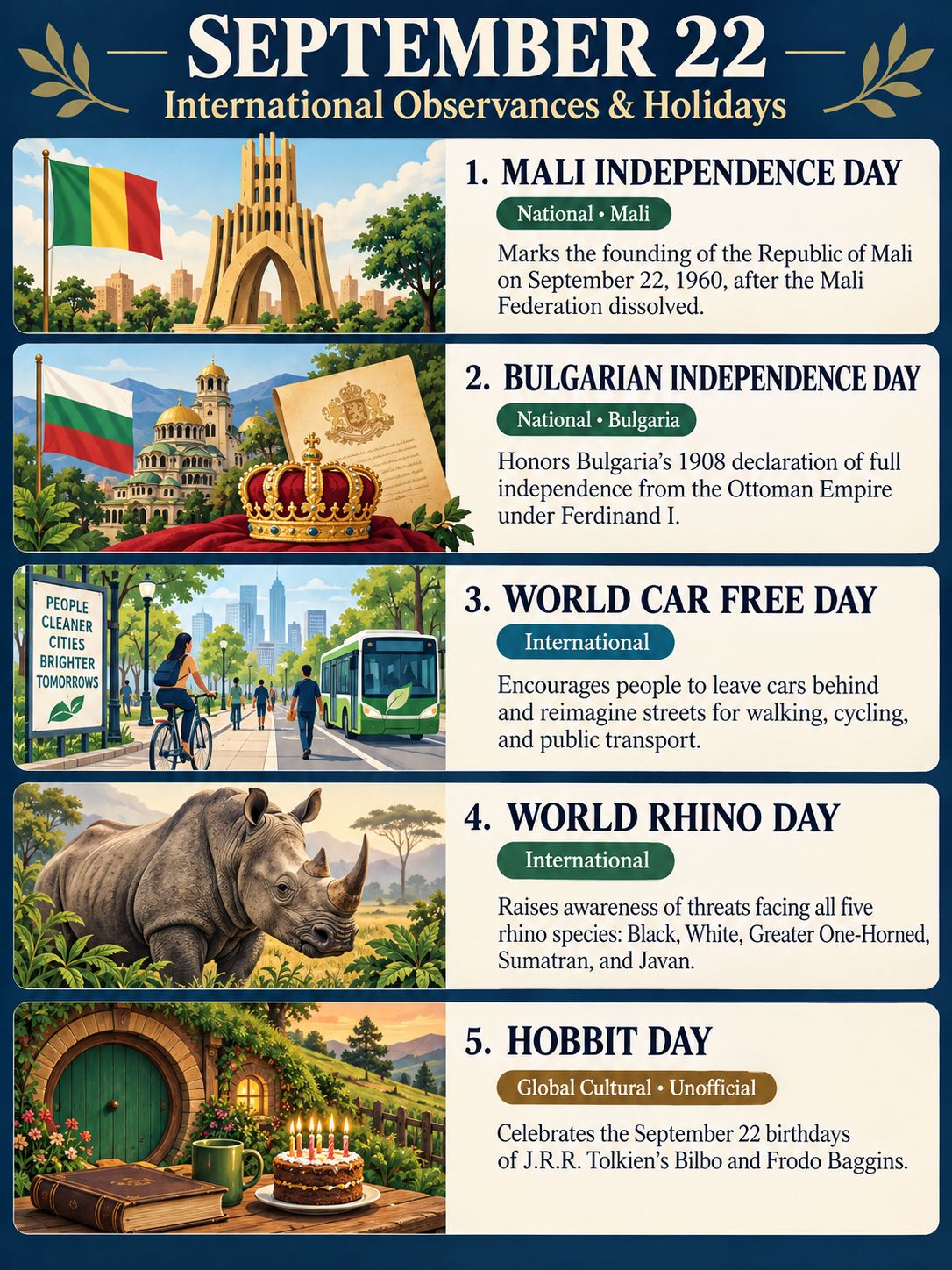
Global observances on September 22 range from solemn national milestones of independence to modern ecological movements aimed at preserving our planet.
| Observance / Holiday | Region / Scope | Historical Significance & Focus |
| Mali Independence Day | National (Mali) | Commemorates the Republic of Mali’s formal independence from French colonial rule in 1960, following the collapse of the short-lived Mali Federation. |
| Bulgarian Independence Day | National (Bulgaria) | Marks Prince Ferdinand’s 1908 declaration of full sovereignty from the Ottoman Empire, elevating Bulgaria from a principality to a kingdom. |
| World Car Free Day | International | An ecological and urbanist initiative encouraging citizens to forgo personal vehicles for a day. It highlights the urgent need to combat air pollution and reclaim city infrastructure for pedestrians and public transit. |
| World Rhino Day | International | Established to raise global awareness about the severe poaching crisis facing the five remaining species of rhinoceros (Black, White, Greater One-Horned, Sumatran, and Javan). |
| National Hobbit Day | Global Cultural | A lighthearted literary celebration honoring the fictional birthdays of J.R.R. Tolkien’s beloved characters, Bilbo and Frodo Baggins. |
Global History
History is rarely isolated. The events of September 22 have sent shockwaves across continents, shaping modern borders, civil rights, and cultural zeitgeists.
United States: The Dawn of Emancipation and Dark Hysteria
-
1862 (The Preliminary Emancipation Proclamation): Amidst the bloodiest chapters of the American Civil War, President Abraham Lincoln issued the preliminary Emancipation Proclamation. This monumental executive order declared that all enslaved individuals held in states rebelling against the Union would be legally freed on January 1, 1863. While it did not immediately free every enslaved person, it fundamentally shifted the moral cause of the war from merely preserving the Union to the outright abolition of slavery.
-
1692 (The Final Salem Hangings): The darkest chapter of colonial American hysteria essentially closed on September 22, 1692. The final group of eight individuals was hanged for witchcraft in Massachusetts. The subsequent public backlash against these tragic miscarriages of justice led to the end of the trials, forever embedding the dangers of mass paranoia and religious extremism into the American psyche.
-
1994 (A Television Revolution): On a lighter cultural note, the iconic sitcom Friends debuted on NBC. It evolved into a global cultural phenomenon that defined the 1990s and early 2000s, influencing everything from fashion to the way the English language was spoken globally. Ten years later, on this exact day in 2004, the groundbreaking drama Lost also premiered, forever changing serialized television storytelling.
China, Asia & the Middle East: The Ignition of Conflict
-
1980 (The Iran-Iraq War Begins): The geopolitical landscape of the Middle East was violently ruptured when Iraqi forces, under the command of Saddam Hussein, launched a massive invasion into Iranian territory. Exploiting the perceived chaos following the 1979 Iranian Revolution, Iraq aimed to seize control of the oil-rich Khuzestan province and the strategic Shatt al-Arab waterway. This marked the beginning of an eight-year conflict characterized by trench warfare, chemical weapons, and staggering casualties, ending in a devastating stalemate that crippled both nations’ economies.
Russia & Eastern Europe: Labor Strikes and Soviet Expansion
-
1980 (The Birth of Solidarity): On the very same day the Iran-Iraq war began, a different kind of revolution took root in Poland. The independent trade union Solidarność (Solidarity) was officially formed following mass strikes at the Lenin Shipyard in Gdańsk. Led by Lech Wałęsa, this was the first independent labor union in a Soviet-bloc country. It became a massive anti-communist social movement that ultimately played a central role in the peaceful collapse of the Soviet Union.
-
1944 (The Red Army takes Tallinn): During the brutal Eastern Front campaigns of World War II, Soviet troops captured Tallinn, the capital of Estonia, driving out the retreating Nazi German forces. This event marked the beginning of decades of Soviet occupation in the Baltic states.
United Kingdom: Coronations and Broadcasting
-
1761 (A Royal Coronation): King George III and Queen Charlotte of Mecklenburg-Strelitz were crowned in a lavish ceremony at Westminster Abbey. George III’s lengthy and turbulent reign would later oversee the massive global expansion of the East India Company, the industrial revolution in Britain, and the catastrophic loss of the American colonies.
-
1955 (The Birth of ITV): The Independent Television (ITV) network was officially launched in the United Kingdom, ending the BBC’s monopoly on television broadcasting and introducing commercial television to the British public for the first time.
Europe: Diplomatic Repercussions and Treaties
-
1992 (Yugoslavia Expelled): The United Nations General Assembly voted to essentially expel the Federal Republic of Yugoslavia (then comprising Serbia and Montenegro) due to its direct involvement in the horrific ethnic violence and war crimes during the Bosnian War.
-
1499 (Swiss Independence): The Treaty of Basel was signed, formally ending the Swabian War between the Old Swiss Confederacy and the House of Habsburg. This treaty essentially guaranteed the de facto independence of Switzerland from the Holy Roman Empire, laying the groundwork for the nation’s historic doctrine of armed neutrality.
Australia & Canada: Tragedies and Apologies
-
1966 (Australian Aviation Disaster): Ansett-ANA Flight 149, a Vickers Viscount aircraft, crashed near Winton, Queensland. All 24 people aboard perished in what remains one of the darkest days in Australia’s aviation history.
-
1988 (Canadian Civil Rights Milestone): Canadian Prime Minister Brian Mulroney delivered a formal, historic apology and announced a financial compensation package for Japanese-Canadians who were unjustly interned, stripped of their property, and disenfranchised by the Canadian government during World War II.
Rest of World: Media and Warfare
-
1888 (The World Explored): The very first issue of National Geographic Magazine was published in the United States. What began as a dry academic journal soon transformed into an iconic, globally recognized institution known for its stunning photojournalism and in-depth cultural anthropology.
-
1866 (The Battle of Curupayty): In South America, the grueling War of the Triple Alliance saw its most significant battle on this day. The outnumbered forces of Paraguay achieved a shocking and decisive tactical victory against the combined armies of Brazil, Argentina, and Uruguay, temporarily halting the allied advance in one of the continent’s bloodiest conflicts.
Notable Births & Deaths (Global)
History is ultimately driven by individuals. September 22 has welcomed scientific geniuses and pop-culture icons, while also bidding farewell to revolutionary martyrs and kings.
Famous Births
| Name | Year | Nationality | Legacy / Fame |
| Michael Faraday | 1791 | English | One of history’s greatest experimental scientists. His groundbreaking work in electromagnetism and electrochemistry led to the invention of the electric motor and the dynamo, laying the foundation for the modern electrified world. |
| Ruhollah Khomeini | 1902 | Iranian | The religious cleric and political architect who led the 1979 Iranian Revolution, overthrowing the Shah and serving as the nation’s first Supreme Leader, drastically altering Middle Eastern geopolitics. |
| Joan Jett | 1958 | American | Legendary rock singer, guitarist, and producer. As the frontwoman of Joan Jett & the Blackhearts, she became an enduring icon of female empowerment and punk rock rebellion. |
| Andrea Bocelli | 1958 | Italian | World-renowned operatic tenor. Blind since age 12, his transcendent voice bridged the gap between classical opera and mainstream pop, resulting in over 90 million record sales globally. |
| Tom Felton | 1987 | English | Actor best known globally for his defining portrayal of the complex antagonist Draco Malfoy in the phenomenally successful Harry Potter film franchise. |
| Tatiana Maslany | 1985 | Canadian | Emmy-winning actress celebrated for her unparalleled technical acting ability, famously portraying over a dozen distinct clone characters in the sci-fi series Orphan Black. |
Famous Deaths
| Name | Year | Nationality | Legacy / Cause of Death |
| Nathan Hale | 1776 | American | A 21-year-old soldier and spy for the Continental Army during the Revolutionary War. He was discovered and hanged by the British. His legendary purported last words—”I only regret that I have but one life to lose for my country”—cemented his status as a national martyr. |
| Shaka Zulu | 1828 | Zulu (South African) | One of the most influential monarchs of the Zulu Kingdom. He revolutionized Southern African military tactics with the iklwa (short spear) and the “buffalo horns” formation. He was assassinated by his half-brothers. |
| Marcel Marceau | 2007 | French | The world’s most famous mime artist. A survivor of the Holocaust who worked with the French Resistance to save Jewish children, he later brought the silent art of pantomime to global prominence. |
| Irving Thalberg | 1936 | American | Known as “The Boy Wonder,” he was a legendary film producer during the early years of Hollywood, co-creating MGM and shaping the modern studio system before dying tragically young of pneumonia at 37. |
| Alice Hamilton | 1970 | American | A pioneering physician and toxicologist who lived to be 101. She was the first woman appointed to the faculty of Harvard University and laid the bedrock for modern occupational health and safety laws. |
“Did You Know?” Trivia
To add some fascinating dinner-table conversation to your repertoire, here are three lesser-known historical anomalies that occurred on September 22:
-
The First All-Woman Jury (1656): Centuries before women gained the right to vote, the General Provincial Court in Patuxent, Maryland, impaneled the first all-woman jury in the American colonies. They were tasked with hearing a complex murder case against a woman named Judith Catchpole. Recognizing the nuances of the case, the female jury ultimately acquitted her.
-
The Unsolved “Vela Incident” (1979): On this day, an American surveillance satellite (Vela 6911) detected an intense, distinctive “double flash” of light over the southern Indian Ocean, near the Prince Edward Islands. The flash possessed all the optical signatures of an atmospheric nuclear bomb detonation. Because no nation claimed responsibility—and it violated the Partial Nuclear Test Ban Treaty—it sparked massive international intrigue. Today, it is widely theorized by intelligence experts to have been a highly classified, joint nuclear test conducted by Israel and apartheid-era South Africa.
-
The Launch of SMART-1 (2003): The European Space Agency (ESA) officially integrated its SMART-1 spacecraft with its launching rocket on this day. This mission was revolutionary because it was designed to test solar-electric propulsion (ion drives) in deep space—a technology that sounds like science fiction but is now crucial for modern long-distance space exploration.
Quote of the Day
“Nothing is too wonderful to be true, if it be consistent with the laws of nature, and in such things as these, experiment is the best test of such consistency.”
— Michael Faraday, pioneering English physicist and chemist, born on this day in 1791. His relentless curiosity transformed electricity from a parlor trick into the lifeblood of the modern world.
Final Thoughts
September 22 stands as a profound testament to human duality. It is a day marked by the severing of chains—from Lincoln’s emancipatory ink in 1862 to the defiant birth of the Polish Solidarity movement in 1980. Yet, it is equally a day scarred by conflict, witnessing the opening salvos of the devastating Iran-Iraq war and the lingering geopolitical tensions of the Indo-Pakistani ceasefire.
As we reflect on the births of scientific titans like Michael Faraday and the spiritual endurance of figures like Guru Nanak, we are reminded that history is not merely a collection of dates. It is a continuous, living narrative of innovation, resilience, and the relentless pursuit of freedom. Understanding the events of September 22 provides us with a sharper, more empathetic lens through which to view the complexities of our present global landscape.