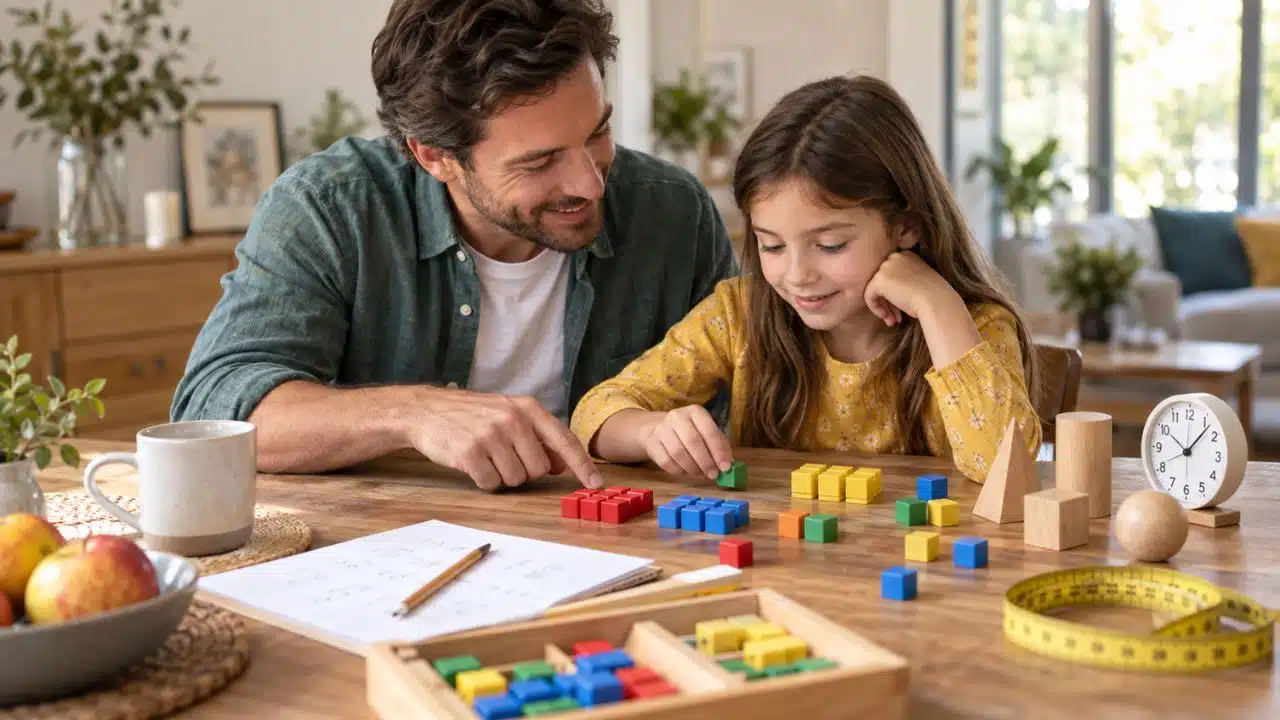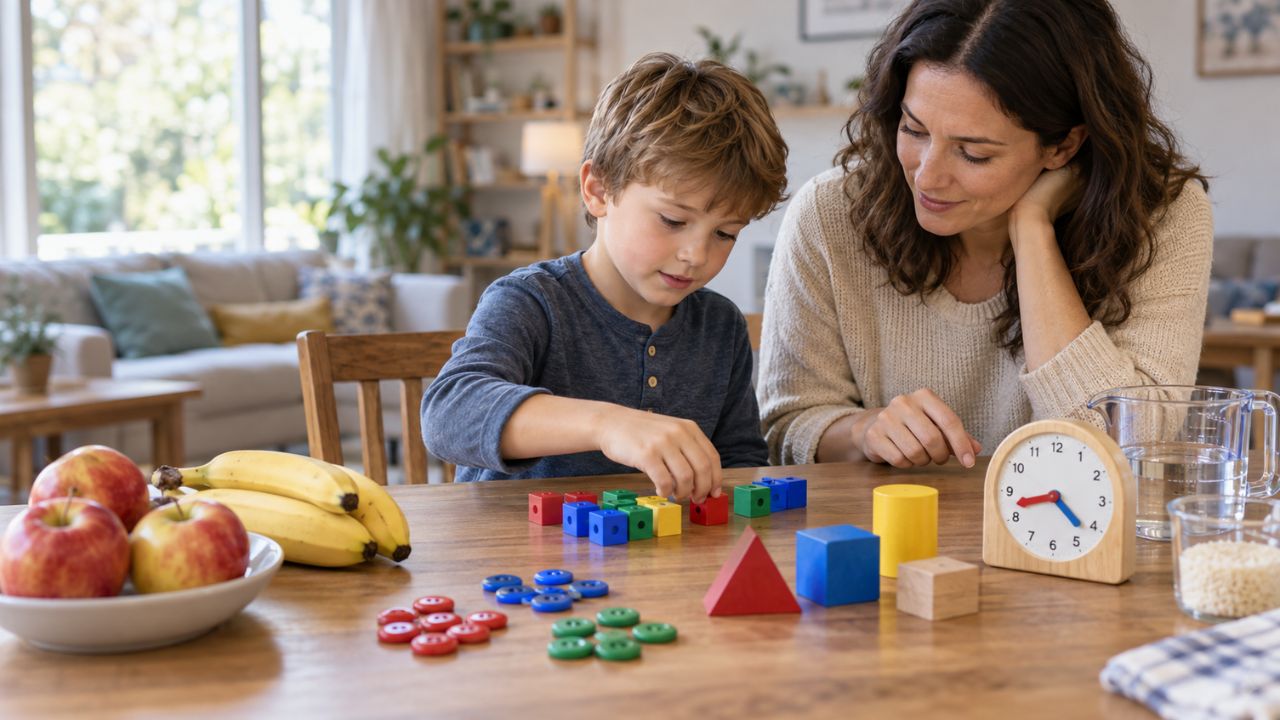
A child may count confidently to 20 but struggle to hand you five blocks. Another child may not count as far, yet immediately notices which plate has more crackers.
This is where many parents become confused. Saying number words and understanding quantities are not the same skill. Schoolwork can make early mathematics look like written sums, but its foundations develop through far more ordinary experiences: dividing snacks, sorting socks, building towers, following a sequence or deciding whether a toy will fit inside a box.
So, what is numeracy? It is the ability to understand and use numbers, quantities, patterns, shapes, measurements and mathematical relationships. For a young child, numeracy might mean recognising that two cups are needed at the table, predicting which tower will be taller or finding a fair way to share six strawberries.
Children build these abilities gradually. Parents can help without buying specialist toys, downloading numerous apps or turning playtime into a lesson.
What Is Numeracy in Early Childhood?
Numeracy extends well beyond counting. It includes several connected abilities:
- Recognising and comparing quantities
- Counting objects accurately
- Connecting a written numeral with an actual amount
- Combining and separating small groups
- Noticing and continuing patterns
- Sorting objects according to shared features
- Recognising shapes in different sizes and positions
- Understanding direction, position and distance
- Comparing length, weight and capacity
- Using mathematical ideas to solve practical problems
A child is using numeracy when placing one spoon beside each bowl, deciding which shoe belongs on which foot or noticing that cutting a sandwich changes its shape without changing the total amount of food.
Recognising the written symbol “4” matters, but only when the symbol means something. A child must eventually connect it with four buttons, four claps, four steps and other groups of four. Written numbers are representations of quantities, not the starting point for understanding them.
Counting From Memory Can Hide Gaps
Counting aloud helps children learn number names and their order. It does not necessarily show that they understand how counting works.
To count six toy cars correctly, a child has to say the number words in sequence, match one word to each car, count every car once and avoid counting any car twice. The final number—six—must then be understood as the total for the whole group.
You can explore this without making it a test. After a child counts the cars, ask, “So, how many are there altogether?” A child who answers six without starting over is showing an important understanding: the final number counted represents the size of the group.
A child who recounts has not failed. That connection may still be forming. Try asking the child to move each car into a new row while counting. The movement makes it easier to keep track of what has already been included.
Children also begin to recognise very small quantities without counting every object. Dice, dominoes and fingers are useful because they show small amounts in recurring arrangements. With enough exposure, a child can begin to recognise three dots as three rather than counting “one, two, three” each time.
The Main Parts of Early Numeracy
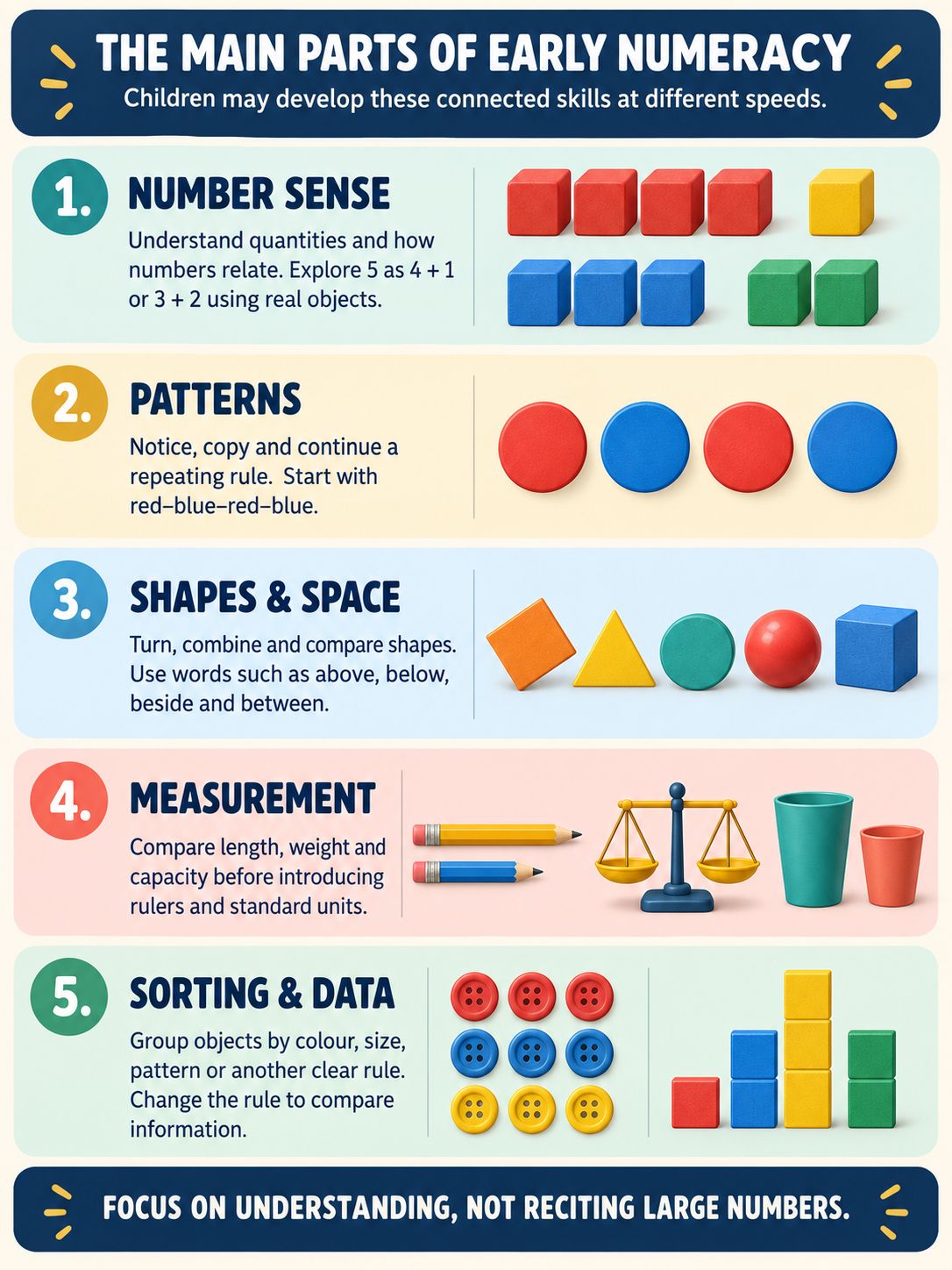
Mathematical development is uneven. A child can be fascinated by shapes but uncertain about counting, or understand “more” and “less” before recognising written numerals. The following areas are connected, but they do not have to develop at the same speed.
Number sense begins with relationships
Number sense is an understanding of what numbers represent and how quantities relate to one another.
A child with developing number sense begins to see that five is more than three, four can be separated into two and two, and removing an object makes a group smaller. Later addition and subtraction grow from these relationships.
Real objects are usually more useful than flashcards at this stage. Blocks, bottle caps, pebbles and pieces of fruit can be moved, grouped and separated. Once a child understands the amount, a number card can be introduced to connect that quantity with its written symbol.
Racing toward larger numbers is rarely helpful. A child who can explore five as four and one, three and two, or five individual objects is developing a stronger foundation than one who can recite to 100 without connecting the words to quantities.
Patterns teach children to predict
A pattern has a rule that repeats. It may appear as red-blue-red-blue, clap-stamp-clap-stamp or spoon-fork-spoon-fork.
Begin with a clear two-part pattern and pause before the next item. If the child can continue it, ask what keeps repeating. A child may be able to copy a pattern before having the language to explain its rule, so pointing or demonstrating is a valid response.
Once a simple pattern becomes familiar, make it slightly more demanding: red-red-yellow, red-red-yellow.
Patterns also appear in songs, stories and household routines. Recognising that one event reliably follows another helps children think about order, although a daily routine is not always a repeating mathematical pattern in the strict sense.
Shape learning should not stop at naming
Knowing the word “triangle” is useful, but spatial understanding develops through handling, turning, combining and comparing objects.
A child explores geometry when rotating a puzzle piece, arranging boxes on a shelf or building a wall around toy animals. Adults can support this thinking with words such as above, below, beside, between, inside, outside, straight, curved, corner and edge.
Show shapes in different positions. A square remains a square when tilted, and a triangle can be narrow, wide or upside down. If children see only one upright version of each shape, they may learn to recognise a familiar picture rather than the features that define it.
Include solid objects as well. A ball is not simply a circle, and a cereal box is not simply a rectangle. Rolling balls, stacking boxes and comparing cans help children notice how three-dimensional objects behave.
Measurement starts before rulers
Children do not need standard units to begin comparing length, weight or capacity. They can investigate which stick is longer, which shopping bag feels heavier or which cup holds more water.
Direct comparison is easier than judging from a distance. Place two pencils side by side. Set two towers on the same surface. Pour water between containers over a sink or outdoor area where spills are manageable.
Informal units come next. A table might be eight blocks long or ten hand spans wide. Use units that are roughly the same size, and place them without large gaps or overlaps. If one person measures with small blocks and another uses large blocks, they will get different answers. That apparent disagreement creates a useful reason to discuss standard units later.
Young children’s understanding of time usually begins with sequences—before lunch, after the bath, first we dress, then we leave—rather than reading a clock.
Sorting builds more than tidiness
Sorting requires children to decide which features matter. During laundry, socks might be grouped by owner, colour, size or pattern.
Ask the child to describe the sorting rule. There may be several sensible answers. Toy animals could be grouped by habitat, colour, size or number of legs. Changing the rule helps children understand that the same objects can be organised in different ways.
Older children can use sorted objects to represent information. Ask family members to choose a favourite fruit and place one block in a row for each vote. The rows make it possible to compare which choice received more, fewer or the same number of votes.
What Progress May Look Like
Age charts can reassure parents, but they can also create unnecessary worry. Early numeracy does not develop according to a rigid timetable.
Babies and young toddlers may notice changes in amount, explore whether objects fit inside containers and respond to repeated rhythms. Adults can count toes, stack cups and use words such as more, empty, full, big and small.
As toddlers grow, they may begin saying number words, matching simple shapes and sorting familiar objects. Giving one cup to each person or comparing two block towers makes these ideas practical.
During the preschool years, many children become more confident at counting small groups, copying patterns, comparing amounts and recognising some numerals. Dice games, building activities and informal measurement are often more revealing than worksheets.
Children in the early primary years usually begin combining and separating quantities more deliberately. They may explain a strategy, estimate before counting or use rulers, scales and measuring cups with guidance.
These descriptions are broad, not diagnostic. Language, disability, attention, previous opportunities and familiarity with the activity can all affect what a child demonstrates.
Watch what happens during ordinary play. Does the child notice when someone has no plate? Can they fetch two objects? Do they turn a puzzle piece when it does not fit? Can they show why one group has more? Such observations often reveal more than a rapid series of questions.
Practical Ways to Build Numeracy at Home
Useful home activities tend to share three qualities: they are brief, repeatable and connected to something the child already understands.
Give counting a purpose
Count objects because the total is needed. Set out plates for the family, place oranges in a bag or check how many stairs remain.
Instead of repeatedly asking, “Can you count these?” vary the problem:
- “Please bring three spoons.”
- “Do we have a cup for everyone?”
- “How many more plates do we need?”
- “What would happen if another person joined us?”
Touching or moving each object helps a young child match one number word to one item.
Ask for a prediction
Before measuring or counting, ask which container might hold more water, which route looks shorter or which tower contains more blocks. Then check.
An estimate does not need to be exact. Its value lies in making a reasonable judgment and comparing it with what actually happens. Avoid treating an inaccurate prediction as a wrong answer that needs immediate correction.
Cook together—with realistic expectations
Cooking brings counting, measurement, sequence and fractions into one activity. A young child can add three spoonfuls, count fruit pieces or compare a full cup with a half-full one. An older child may help double a simple recipe or divide food into equal portions.
The mathematics can disappear if the activity is too complicated. Choose one job the child can manage rather than trying to explain every measurement in the recipe.
Adults should retain control of hot surfaces, boiling liquids, sharp tools and ingredients that are unsafe to taste. Handwashing and allergy precautions still apply.
Choose games with manageable rules
Board games can develop dice recognition, counting and position. Card games can involve matching and comparing quantities. Hopscotch connects number order with movement.
A simple game that a child can follow is more valuable than an elaborate “educational” game that requires constant correction.
For preschool children, a number path can be especially useful. Each number appears inside a separate space, and the child moves one space for each count. This is easier for many beginners than a number line, where the numerals mark points and the distances between them carry mathematical meaning.
Let construction problems remain problems
Blocks and recycled boxes encourage children to investigate balance, height, symmetry and space.
Ask questions without taking over:
- “Which base would make the tower steadier?”
- “How could the bridge become wider?”
- “What might fit in this gap?”
- “Can you build another tower of the same height?”
Wait after asking. If an adult immediately supplies the answer or repairs the structure, the child loses the opportunity to test an idea.
Use storybooks without turning reading into a quiz
A picture book does not need a mathematics label. Stories often contain objects to count, characters of different sizes, repeated events or problems involving order, distance and sharing.
One thoughtful question can open a useful conversation. Asking something on every page is more likely to interrupt the story than deepen the mathematics.
The Words Adults Use Matter
Mathematical language helps children express relationships they already notice. Words such as more, fewer, equal, heavier, shorter, behind and next are useful well before formal lessons begin.
Questions that invite explanation reveal more than questions requiring a single answer:
- “How did you work that out?”
- “Can you show it another way?”
- “What do you think comes next?”
- “How could we check?”
- “What changed when you moved that block?”
Children can answer with gestures, drawings or objects when spoken explanations are difficult.
Families should also feel comfortable discussing mathematics in the language they use most confidently at home. A child does not need to encounter counting, comparison or spatial language in English first. If home and school use different languages, it may help to learn the common classroom terms while continuing richer mathematical conversation at home.
Common Approaches That Deserve Rethinking
Correcting every error immediately
If a child counts one object twice, giving the correct total does little to fix the underlying problem. Suggest moving each counted object aside. The child then gains a method for checking their own work.
Reaching for worksheets too early
Written numerals and equations are abstract. Young children generally need to move, group and compare objects before those symbols become meaningful.
Worksheets can provide practice for some school-aged children. They are far less useful when they replace conversation, construction and practical problem-solving. For toddlers and preschoolers, hands-on activity should carry most of the load.
Treating speed as understanding
A fast answer may come from recall rather than reasoning. A slower child who arranges objects, uses fingers and checks the result is doing valuable mathematical work.
Praise the strategy specifically: “You moved each button after counting it, so none were counted twice.”
Stopping children from using their fingers
Fingers offer a visible representation of small quantities and can support early addition and subtraction. Using them is not, by itself, evidence that a child is weak at mathematics.
Children should also work with objects, dot arrangements, drawings and spoken explanations. Over time, many develop faster mental strategies without being forced to abandon their fingers on a fixed schedule.
Expecting an app to do the teaching
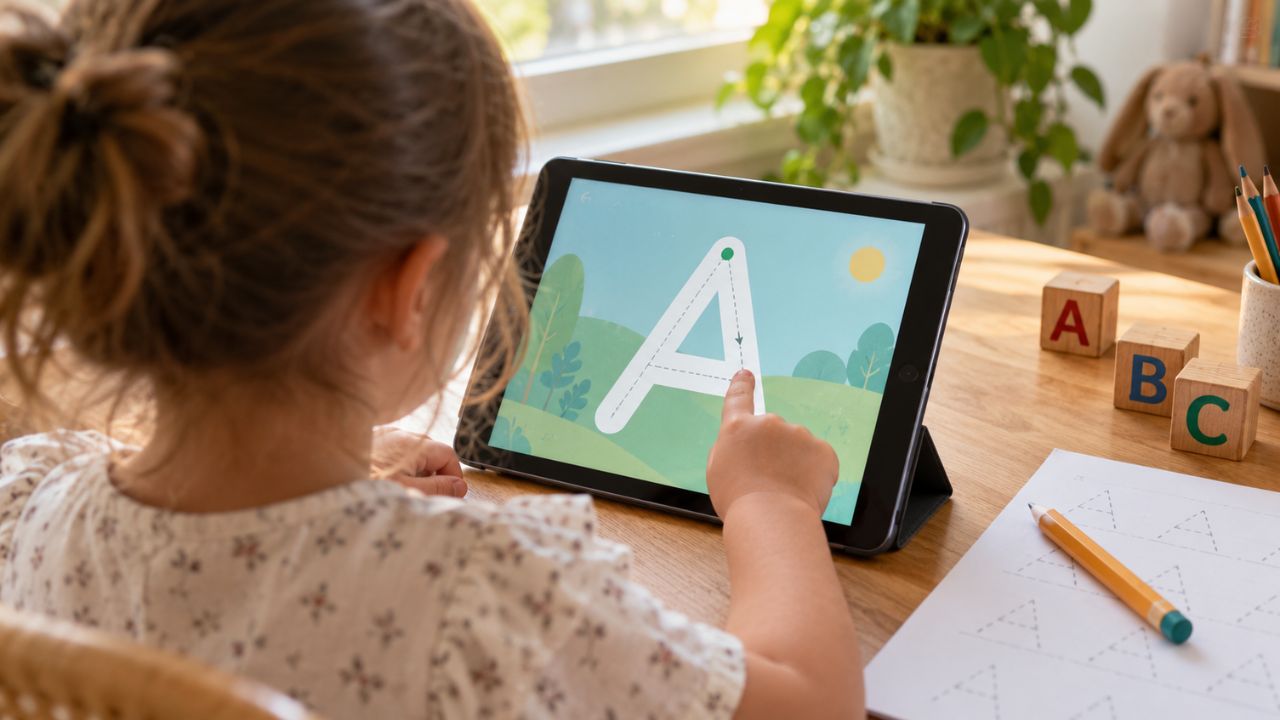
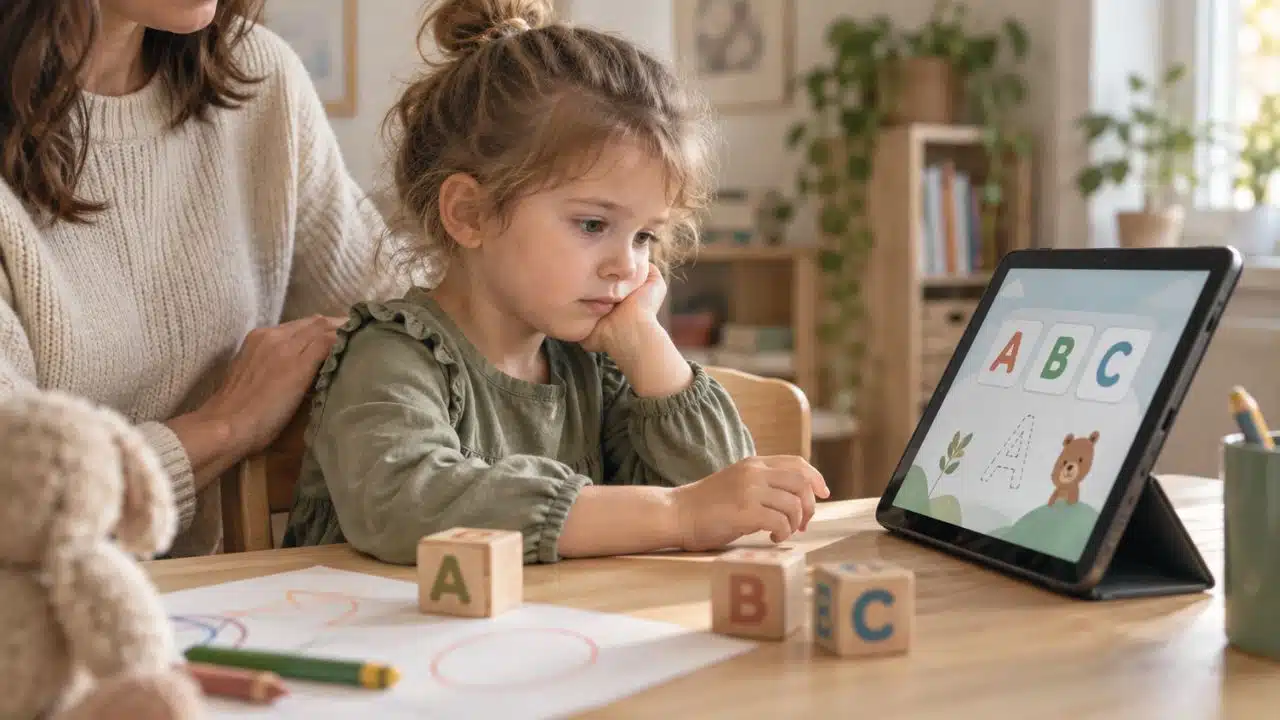
Educational apps are easy to overvalue. A child can learn to tap the expected answer without understanding the concept behind it.
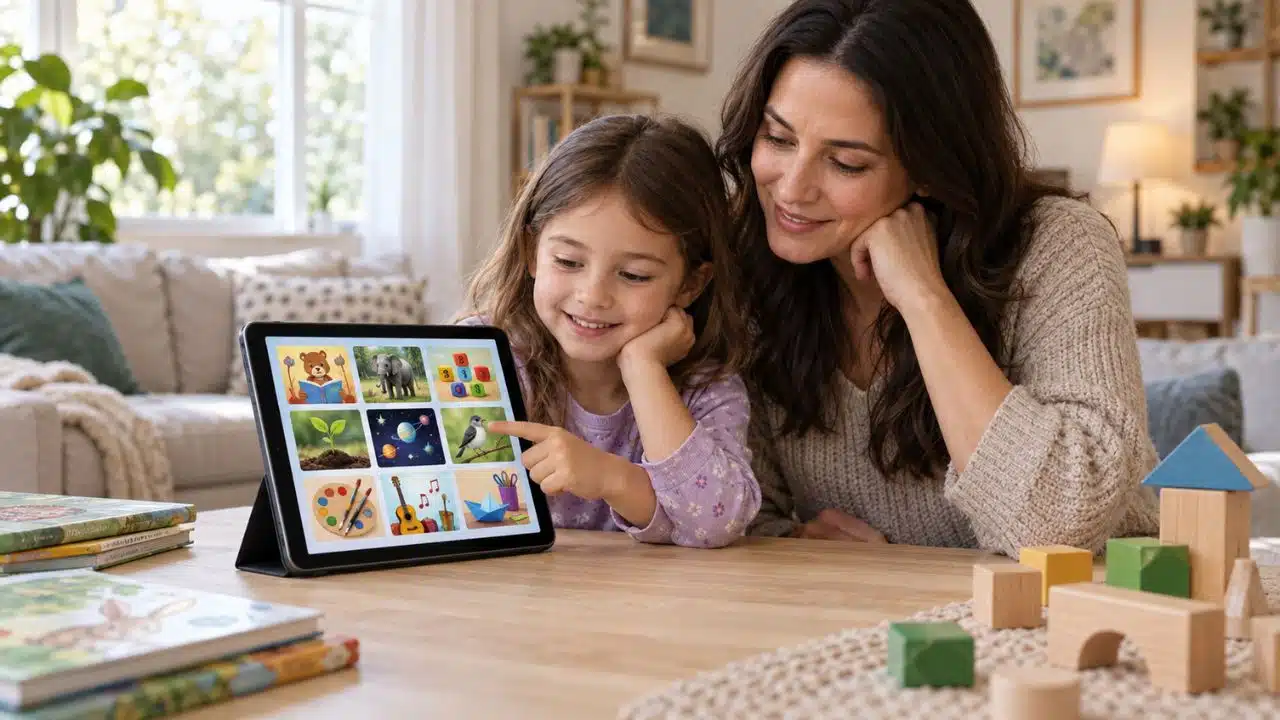
Digital activities may offer extra practice, particularly when an adult joins in and connects the screen activity to real objects. They should not displace building, measuring, talking or moving.
Before installing a children’s app, check its current age rating, privacy information, advertisements and in-app purchase settings. An “educational” label is a marketing category, not a guarantee of teaching quality.
Repeating “I was never good at math”
Children can absorb the idea that mathematical ability is fixed. Replace that message with something more useful: “This part takes practice,” or, “Let’s find a way to check.”
When a Child Continues to Struggle
A difficult afternoon does not indicate a learning disorder. Fatigue, distraction, anxiety, unfamiliar language or discomfort with being questioned can all affect performance.
Look for a pattern across time and settings. It is worth speaking with the child’s teacher if the child repeatedly struggles with foundational classroom tasks despite clear explanation and appropriate practice. Examples include persistent difficulty matching one number word to each object, comparing simple quantities or connecting familiar numerals with amounts.
Parents can raise broader developmental concerns with a pediatrician, family doctor or qualified child-development professional. Assessment and referral routes differ between countries. An online checklist cannot diagnose dyscalculia or another developmental condition.
While seeking advice, reduce the pressure. Return to smaller quantities and objects the child can move. Let the child demonstrate an answer rather than relying only on speech. Giving more difficult versions of a task rarely helps when the first idea has not yet made sense.
A Simple Starting Point for This Week
A home numeracy plan does not need to look like a curriculum. Choose three ordinary moments:
- Count something needed at mealtime.
- Compare or measure something during play.
- Play one short game involving quantities, patterns or position.
Stay with the numbers the child understands. If five objects remain difficult, work with two or three. If five is comfortable, add one, remove one or arrange the same total differently.
Repeated encounters with small quantities are more useful than racing toward large numbers.
Final Thoughts
Understanding what is numeracy changes the way parents see early mathematics. It appears when a child notices an unequal share, rotates a puzzle piece, predicts what comes next or finds that a wide container is not necessarily the one that holds the most water.
Start with one daily routine rather than a stack of activities. Count the plates, compare two portions or ask how many steps remain. Listen to the child’s reasoning and resist the urge to correct every mistake immediately.
Numeracy grows when mathematics has a real purpose. The household already contains most of the materials a child needs.
Frequently Asked Questions about Numeracy
Can a child have good numeracy skills without recognising written numbers?
Yes. A young child may compare groups, share objects fairly, continue a pattern or recognise small quantities before reliably naming written numerals. These are meaningful mathematical abilities. Written symbols can be connected to them gradually.
Should parents let children count on their fingers?
Yes. Fingers can help children represent quantities and solve early addition or subtraction problems. They are one strategy among several, alongside physical objects, dot patterns, drawings and mental calculation. There is no sound reason to ban finger use simply because a child has reached a particular age.
Does learning in two languages delay numeracy?
Using two or more languages does not prevent a child from developing mathematical understanding. A child may know a mathematical term in one language before knowing its equivalent in another. Parents and teachers should consider what the child understands across all the languages they use, rather than judging knowledge from vocabulary in only one language.